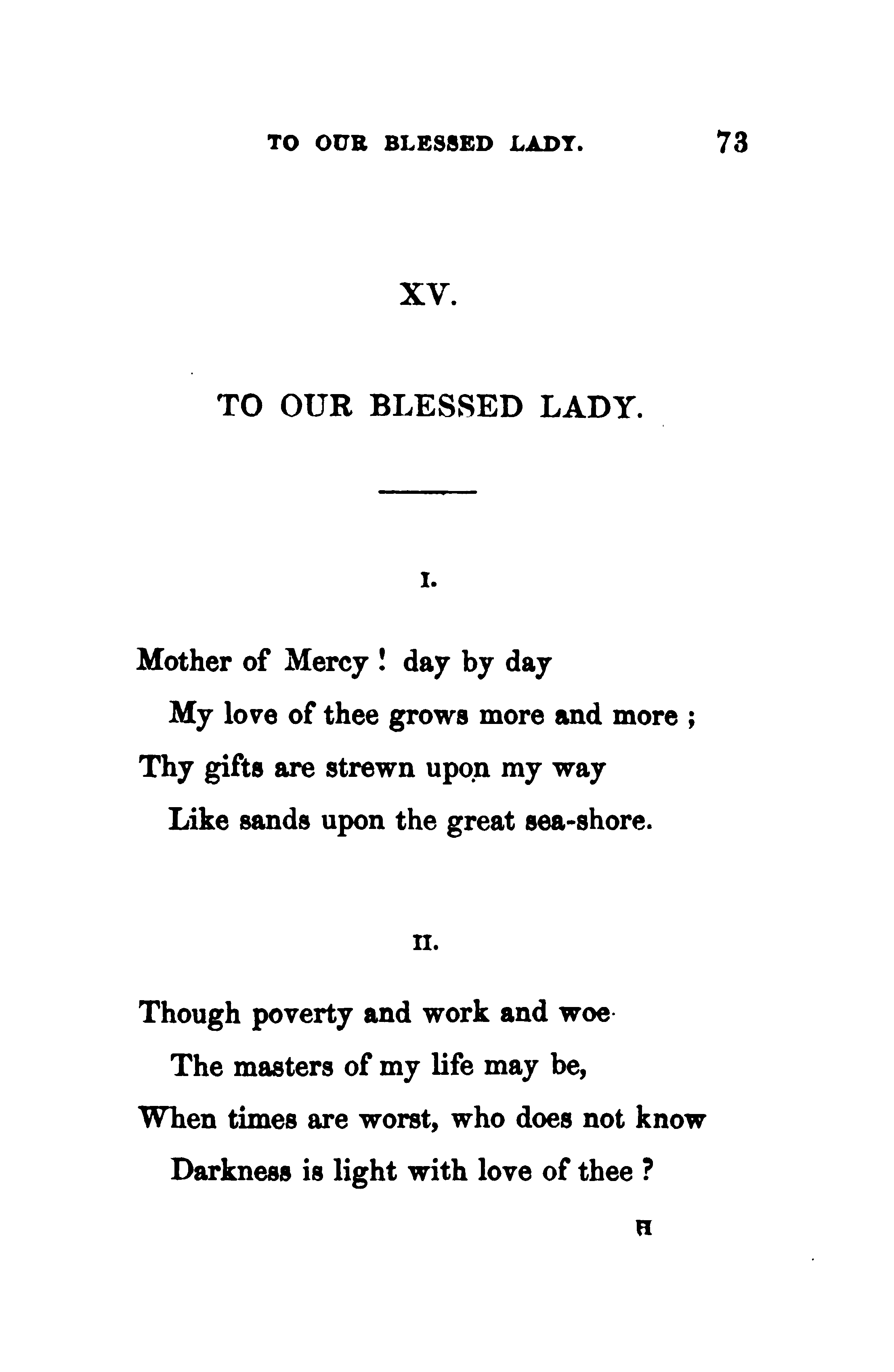
Mother of Mercy, Day by Day

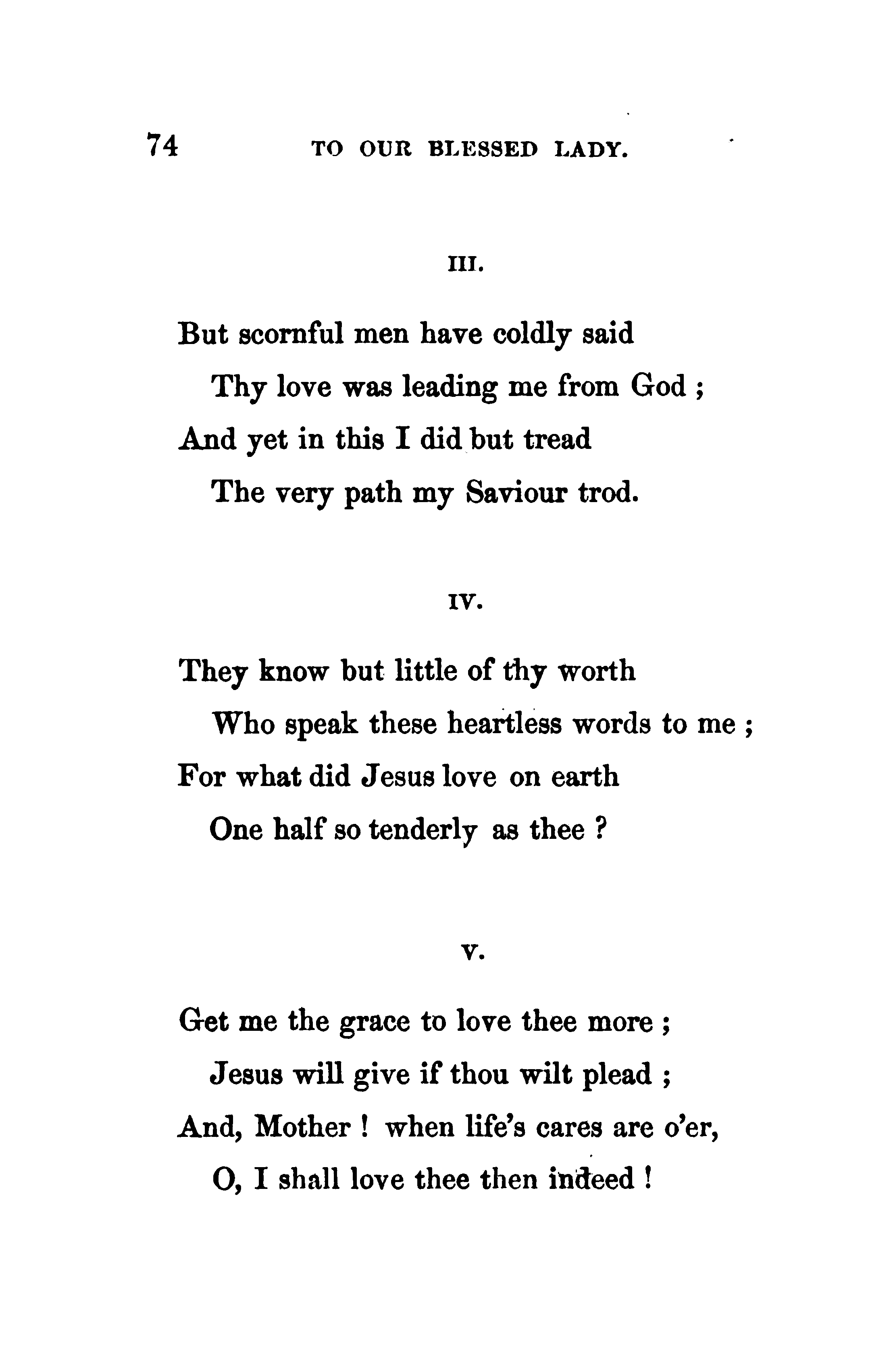
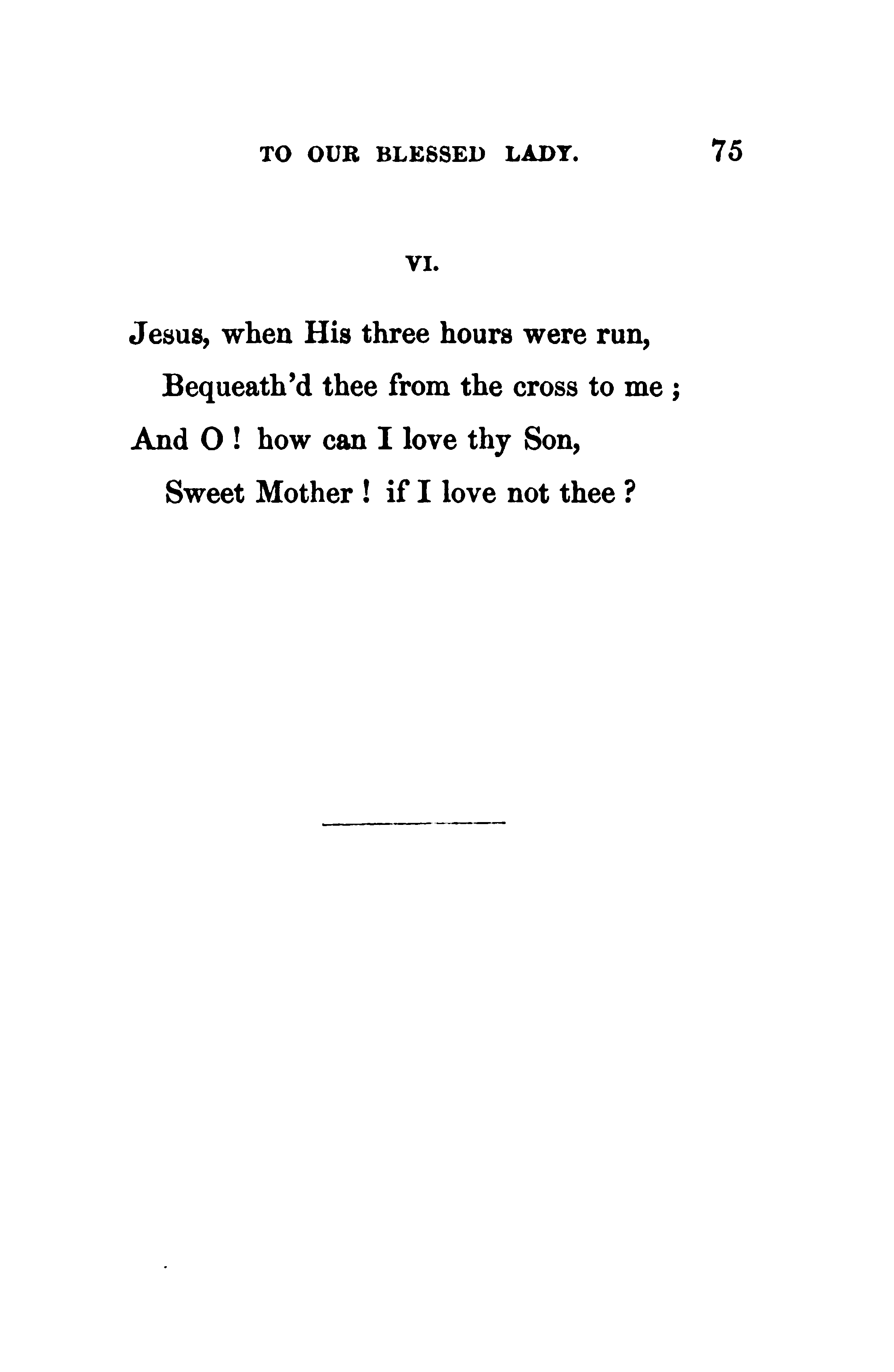
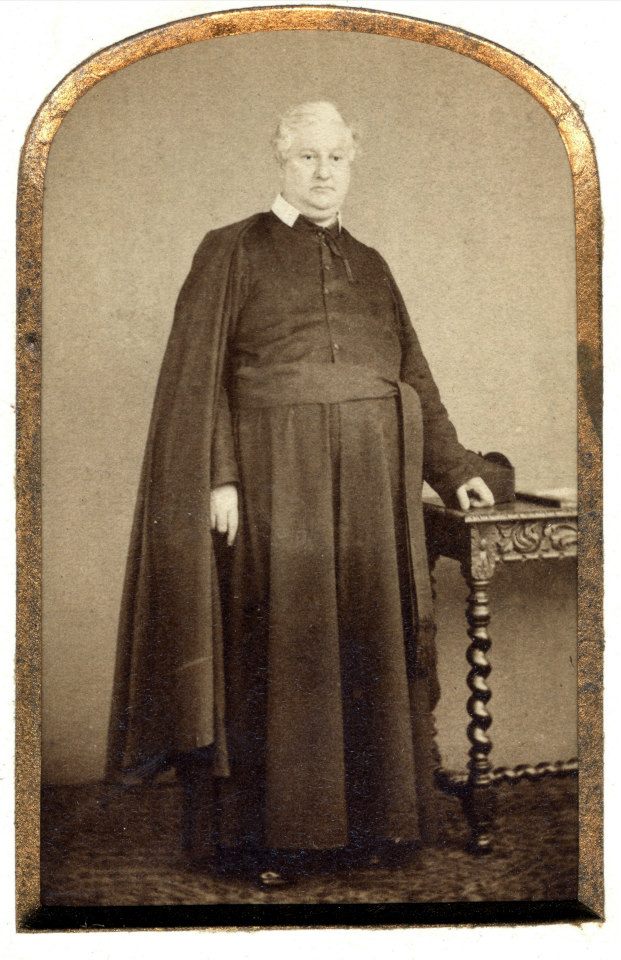
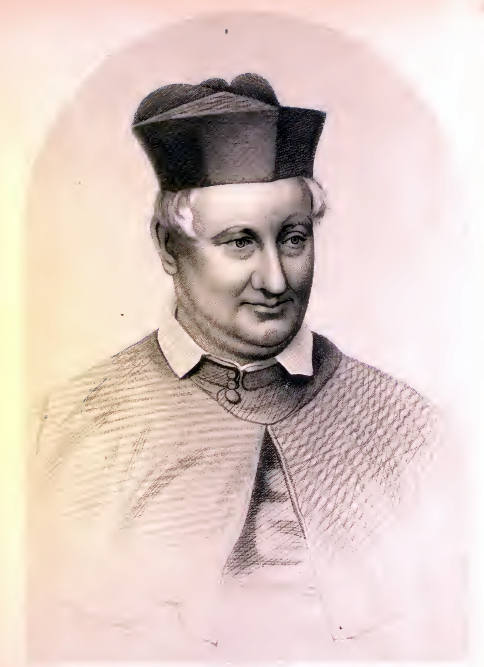
Father Frederick William Faber (1814-1863) wrote the text of this hymn. He was a convert to Catholicism and was received into the Catholic Church on November 18, 1845, by Bishop Wareing, the first Roman Catholic Bishop of the Diocese of Northampton. He made his first communion and in confirmation he took the name of his patron St. Wilfrid. He began writing hymns in 1848 and wrote his first two hymns while on a retreat in Yorkshire in the small sea-side town of Scarborough. These were Mother of Mercy, Day by Day and Jesus, My Lord, My God, My All.

Jesus and Mary, 1849

These first hymns and the few that followed where published in his JESUS AND MARY hymnal of which there were more than 1,000 copies sold by 1849. Father Faber wrote more than ninety hymns, some of them we still sing today including Faith of our fathers, living still; Jesus, My Lord, My God, My All; Dear Angel Ever at my Side; Dear Guardian of Mary; Like the Dawning; O Come and Mourn With Me Awhile, and There’s a wideness in God’s Mercy. He authored several books including All For Jesus; The Precious Blood; The Blessed Sacrament, and Growth In Holiness.

There is so much that I could write about Father Faber and his journey from Calvinism to Anglicanism and finally to Catholicism, but this would be a lengthy endeavor and is beyond the scope of this short write-up. However, it is worth mentioning a little something, call it a summary, of his journey to the Catholic Church.

As a young man Frederick Faber showed a natural prowess of poetry. This poetical element was developed during his boyhood and in the countryside of his youth (Westmoreland, Yorkshire, and Ambleside. Ambleside is a town that sits on the east side of the northern headwater of Windermere, England’s largest natural lake.) and where he spent much of his school days (the Grammar School of Bishop Auckland, Kirkby Stephen in Westmoreland until 1825, Shrewsbury School and then Harrow School) until he graduated to Oxford. He enrolled at Oxford University beginning in 1832 and was accepted to Balliol College one of the constituent colleges of Oxford and took up residence in the Lent Term of 1833 which was during the great Oxford Movement.

By his second year at the university his religious views began to undergo a change. Suffice is to say he rejected the teachings of Arminianism and all Calvinism (that God predestines people by choosing who will accept his salvation and that Christ suffered only for the elect of God, the chosen) and became a zealous advocate of Anglican principles. There are expressions found in his letters to his brother, friends and colleagues that indicate he had some misgivings concerning the Anglican beliefs. Certain doctrinal questions that were brought forward as a result of the Oxford Movement began to stir in him including the Catholic teaching on transubstantiation. He didn’t know it then, but these inner murmurings and doubts would in time lead him to the Catholic Church. It is also here that he became an enthusiastic admirer of Rev. John Henry Newman, vicar of St. Mary’s, although at this time he was not personally acquainted with him.

In 1835, Frederick Faber was chosen as a scholar of University College another of the constituent colleges of Oxford University. He desired earnestly to devote himself to the service of God and looked forward to a time when he could receive ordination as a minister in the Church of England. His election to fellowship at Oxford gave him a secure position and he set to work busying and preparing himself for orders. In August of 1837 he received deacon’s orders in the Church of England and was assigned to St. Wilfrid’s Cathedral of Ripon. In 1839 on the 26th of May he received priest’s orders and the Rectory of Elton, in Huntingdonshire, was offered to him by his college.

Courtesy of The London Oratory https://www.bromptonoratory.co.uk/
From the book Life and Letters of Frederick William Faber, D.D., Priest of the Oratory of St. Philip Neri

Shortly after accepting his duties as Rector of Elton he took a trip to the continent by way of France and then to Italy. He visited various cities in France and Italy when finally he arrived in Rome on May 9th, 1843. It is here that he acquired his devotion to St. Phillip Neri (1515-1595), the founder of the Oratorians. While in Rome he attended Ascension Thursday Mass in St. John Lateran’s church, the Pope’s cathedral. He was quite moved by the whole experience especially when Pope Gregory XVI descended from his throne and knelt before the foot of the altar. Mr. Faber left Rome on St. Alban’s Day (June 17) and traveled to Albano to spend a few quite days in the woods. Albano is about a twelve-hour ride from Rome in a horse drawn carriage.

Very ealry the next morning he received a letter that he was being summoned for an audience with the Pope at the Vatican Library at 5 P.M. that very day. He hurriedly set off to Rome in full dress and arrived at the Vatican Library and waited until the Pope arrived. Through an interpreter Frederick Faber and the Pope had a lengthy conversation which encompassed a few church matters but mostly his desires to join the Catholic Church.

The Pope said to him, You must not mislead yourself in wishing for unity, yet waiting for your Church to move. Think of the salvation of your own soul. He then laid his hands on Mr. Faber’s shoulders and blessed him with this prayer, May the grace of God correspond to your good wishes, and deliver you from the nets of Anglicanism, and bring you to the Holy Church. Frederick Faber left Rome greatly affected by the affectionate demeanor of this old Pope, his blessing, and his prayer. It was a day he would always remember.

He returned to his parish of Elton and the nearly one thousand parishioners, every day growing more and more Roman. For the next two years every expression of Catholic life answered a doubt or dispelled some fear and the words of the Holy Father to save his own soul weighed heavily upon him. By now many of his friends had already joined the Catholic Church and on November 16th, 1845, he officiated for the last time as Rector of Elton. Two days later he was received into the Catholic Church.

This brief account can hardly elucidate every happening, trial, and inward struggle of Father Faber’s conversion journey. You can learn more about this wonderful Catholic priest and his journey to Catholicism by reading his biography in The Life and Letters of William Frederick Faber, Priest of the Oratory of St. Philip Neri, published in 1869.

The Melodies:

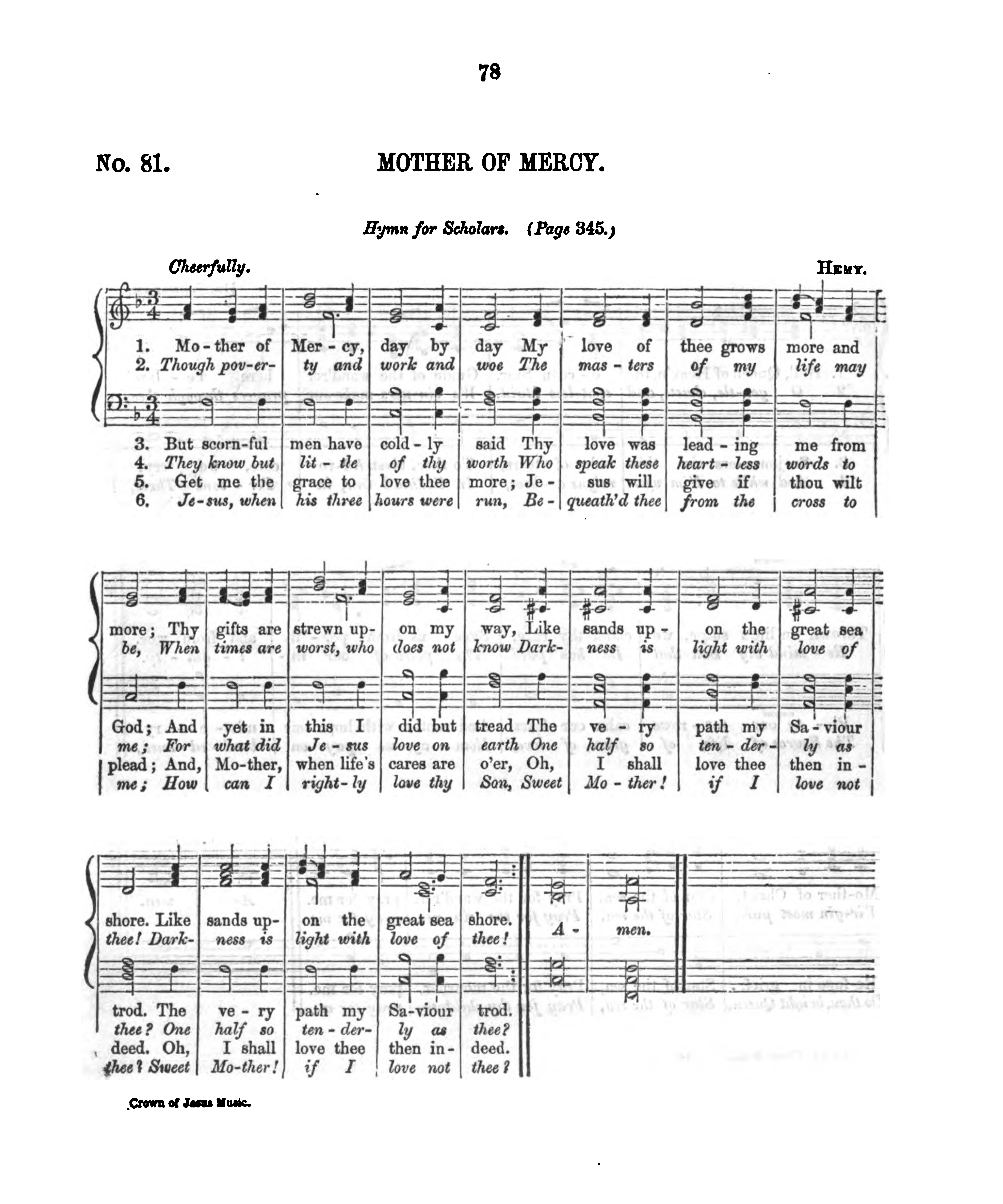
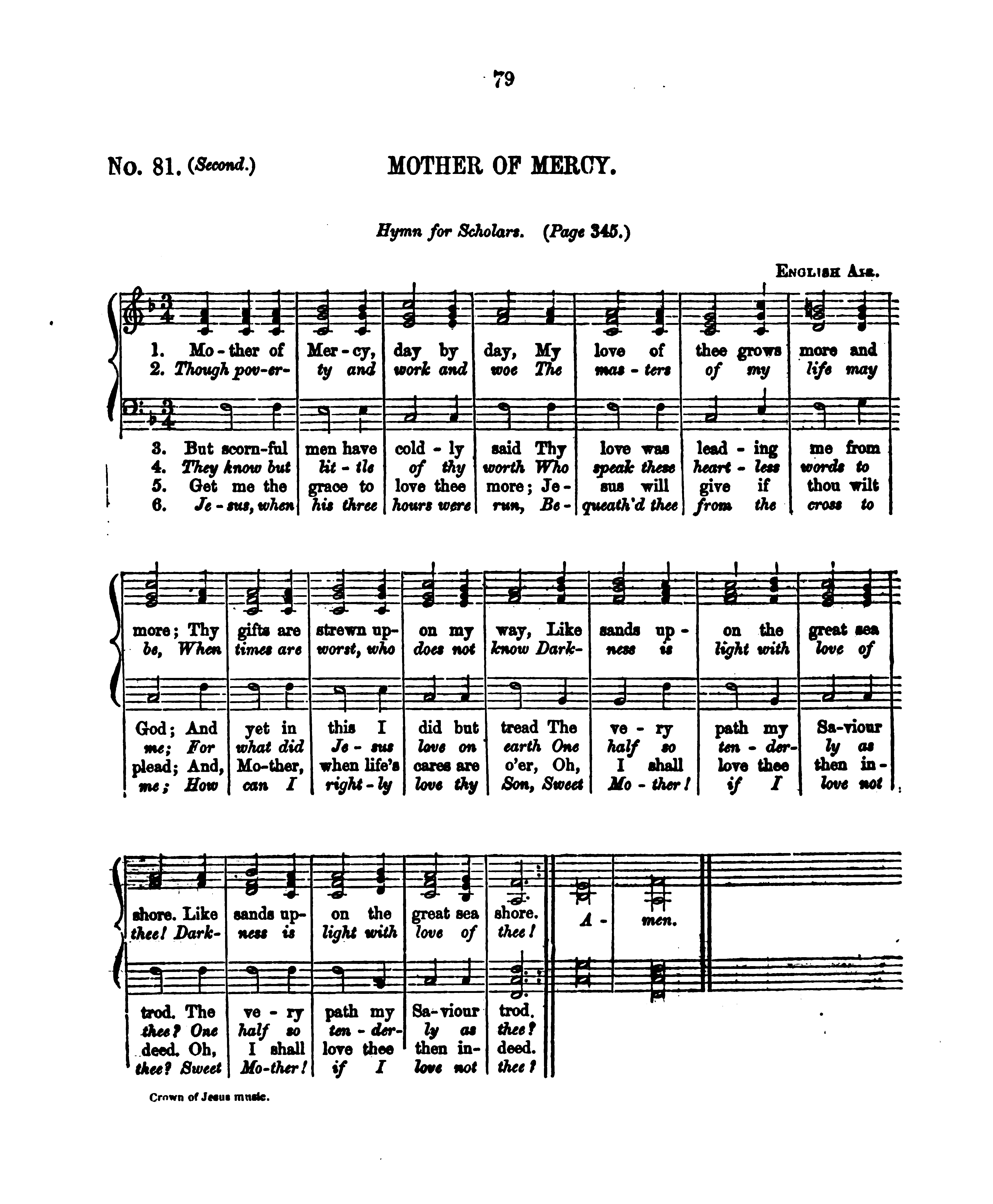
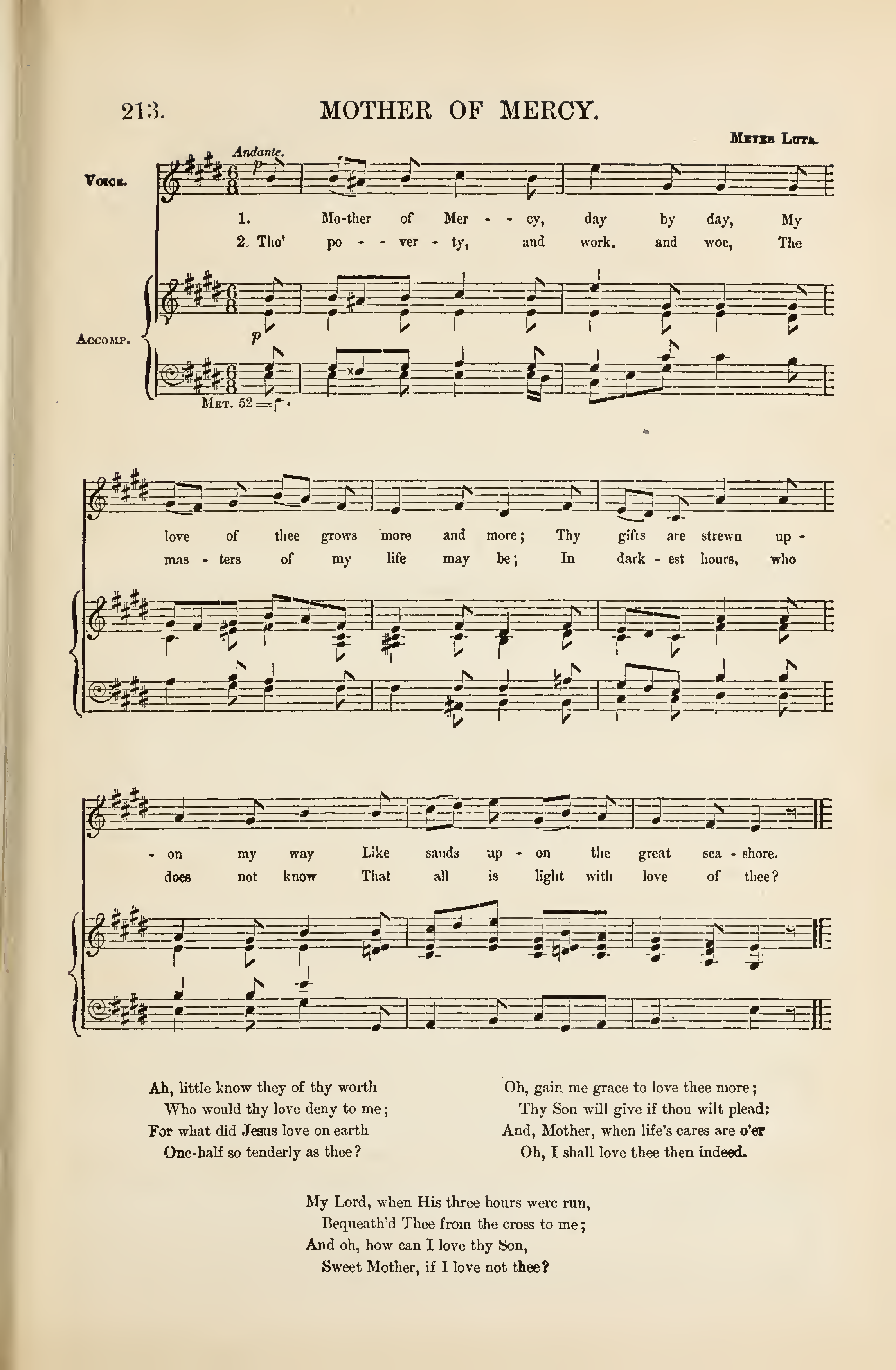
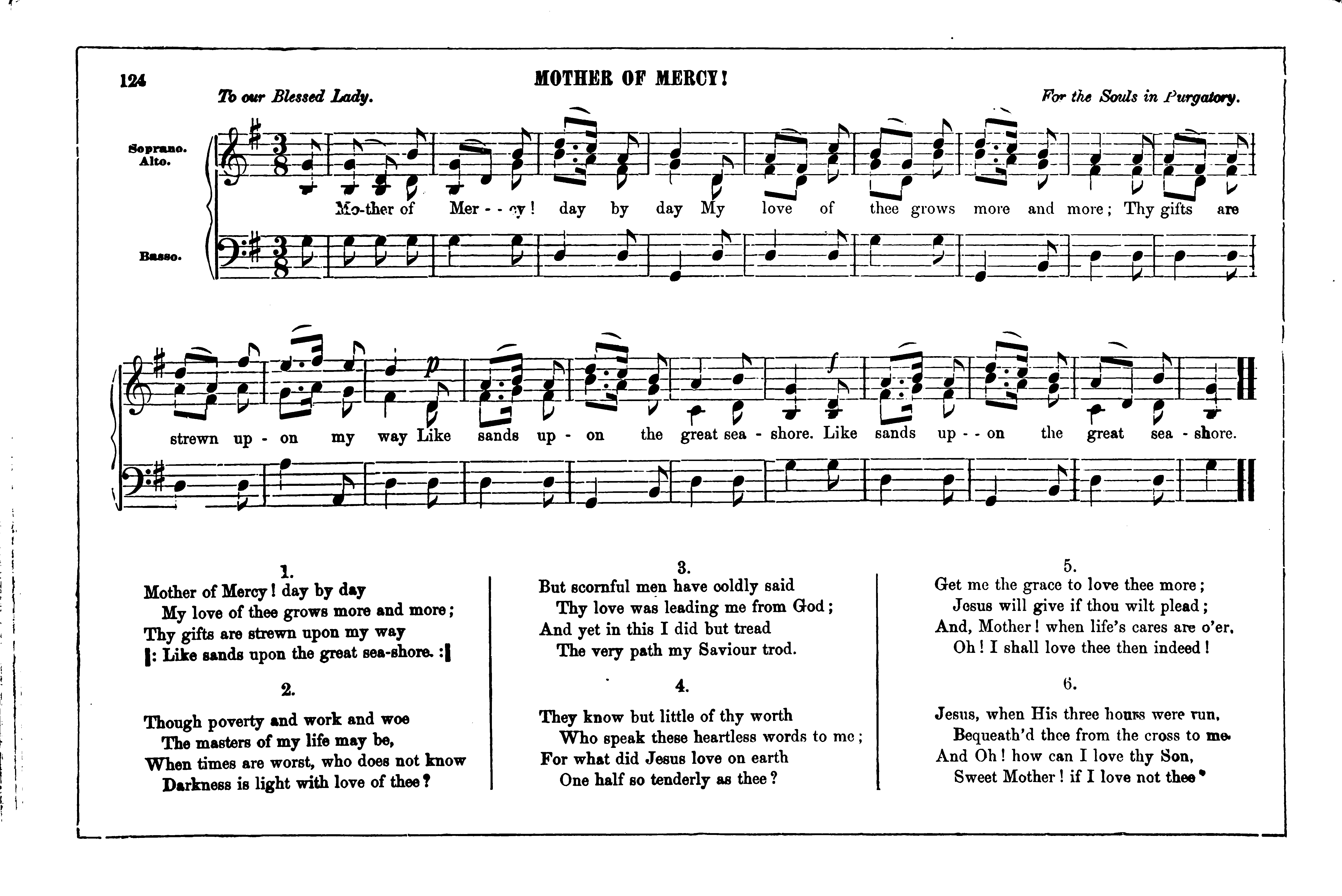
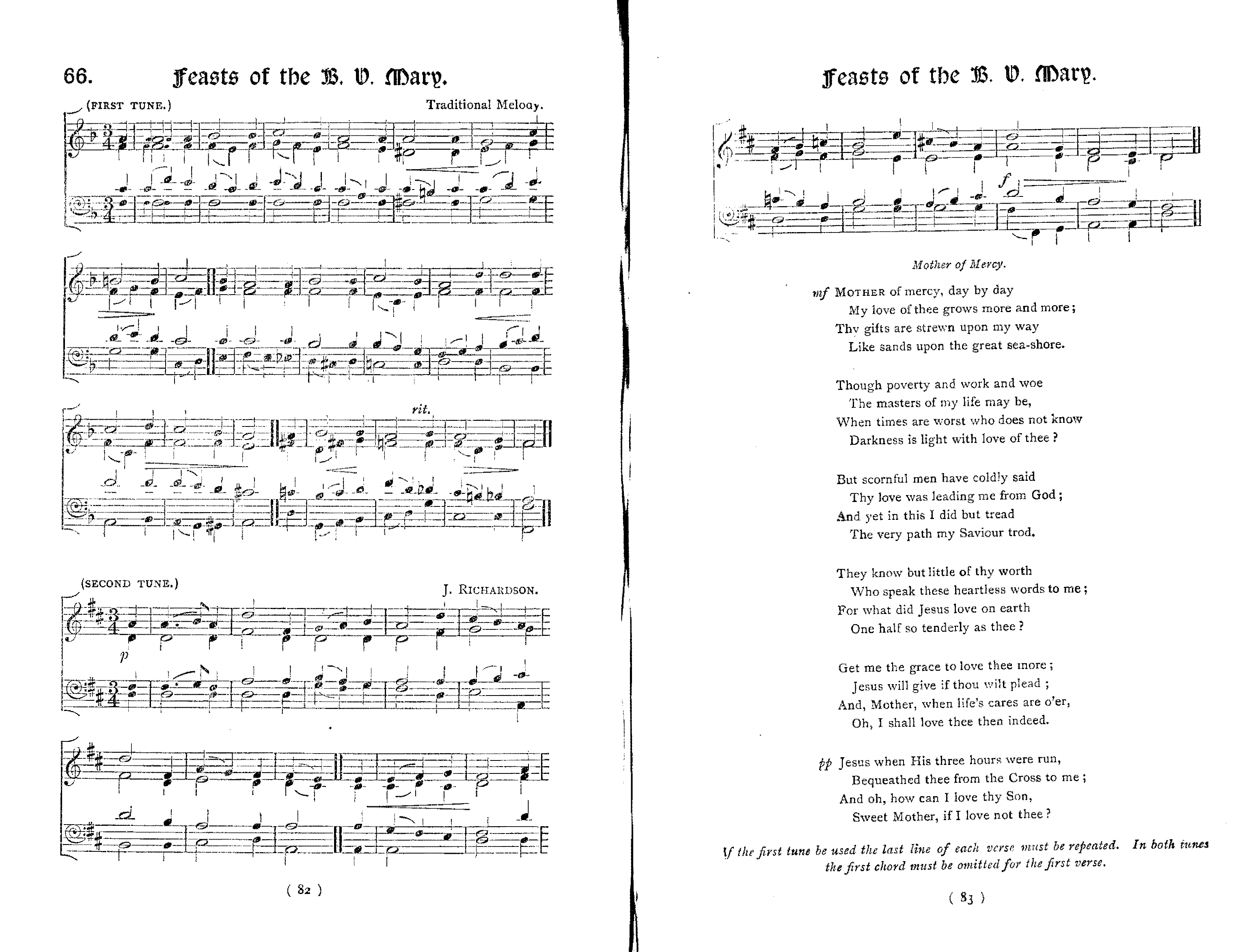
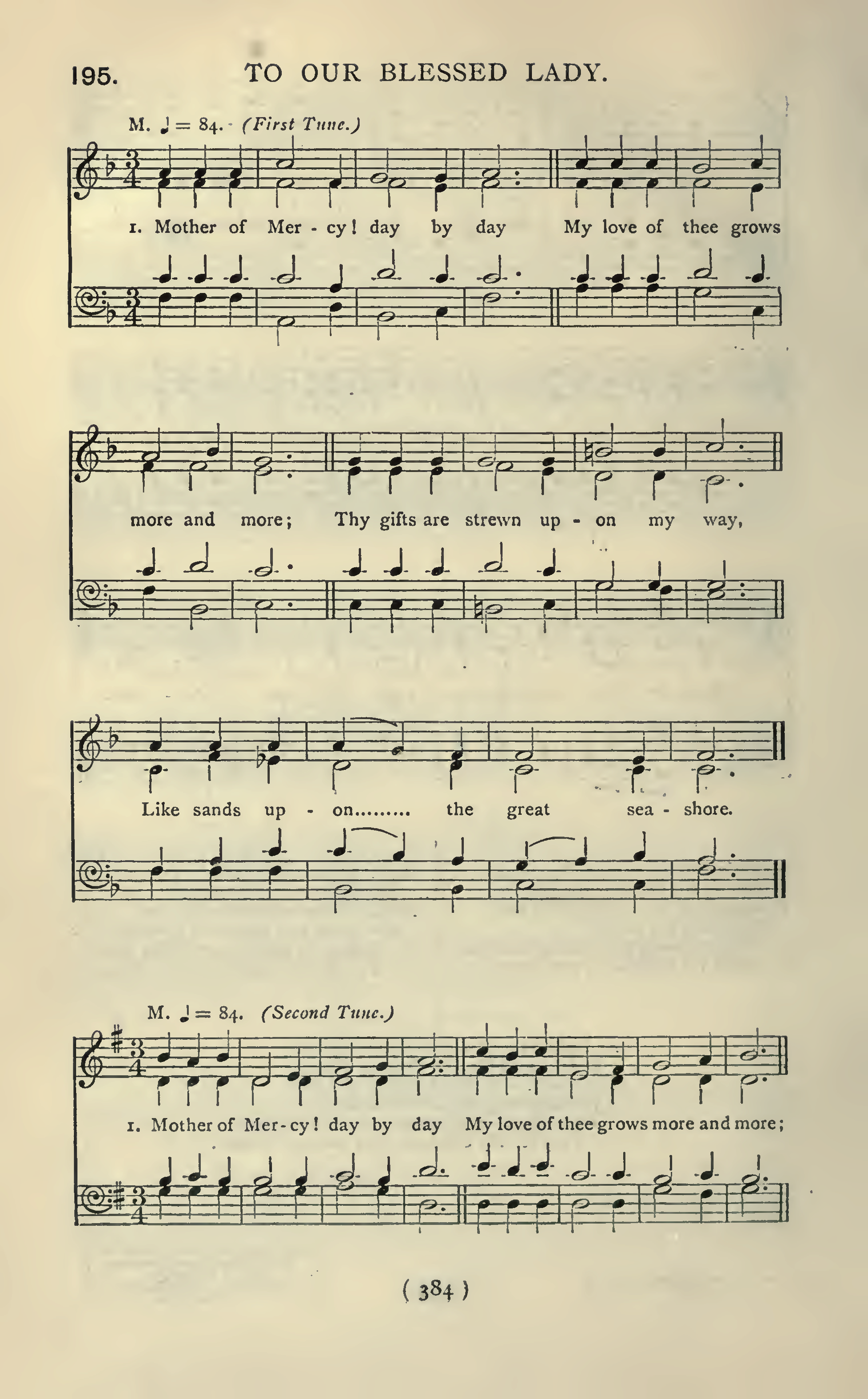
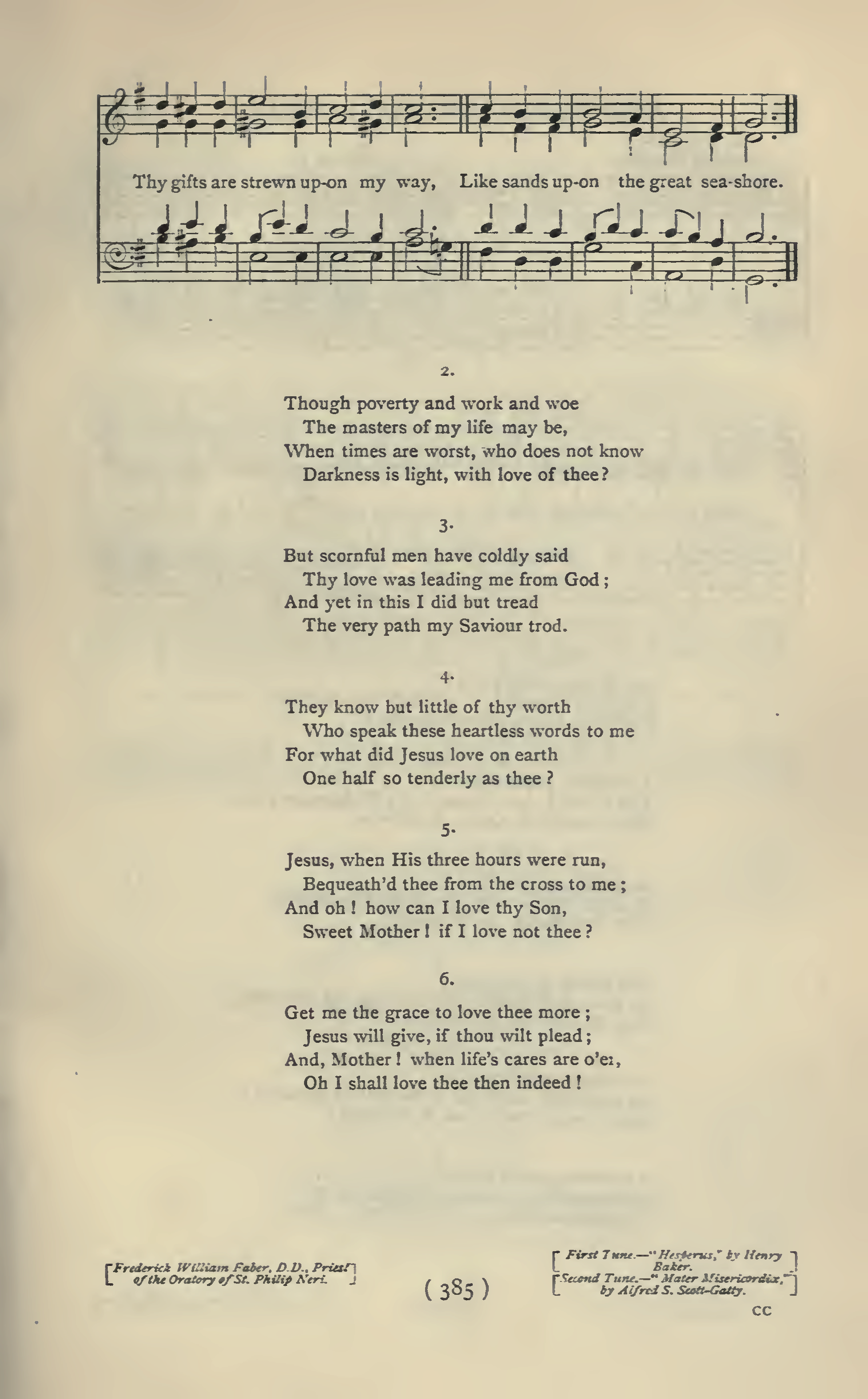
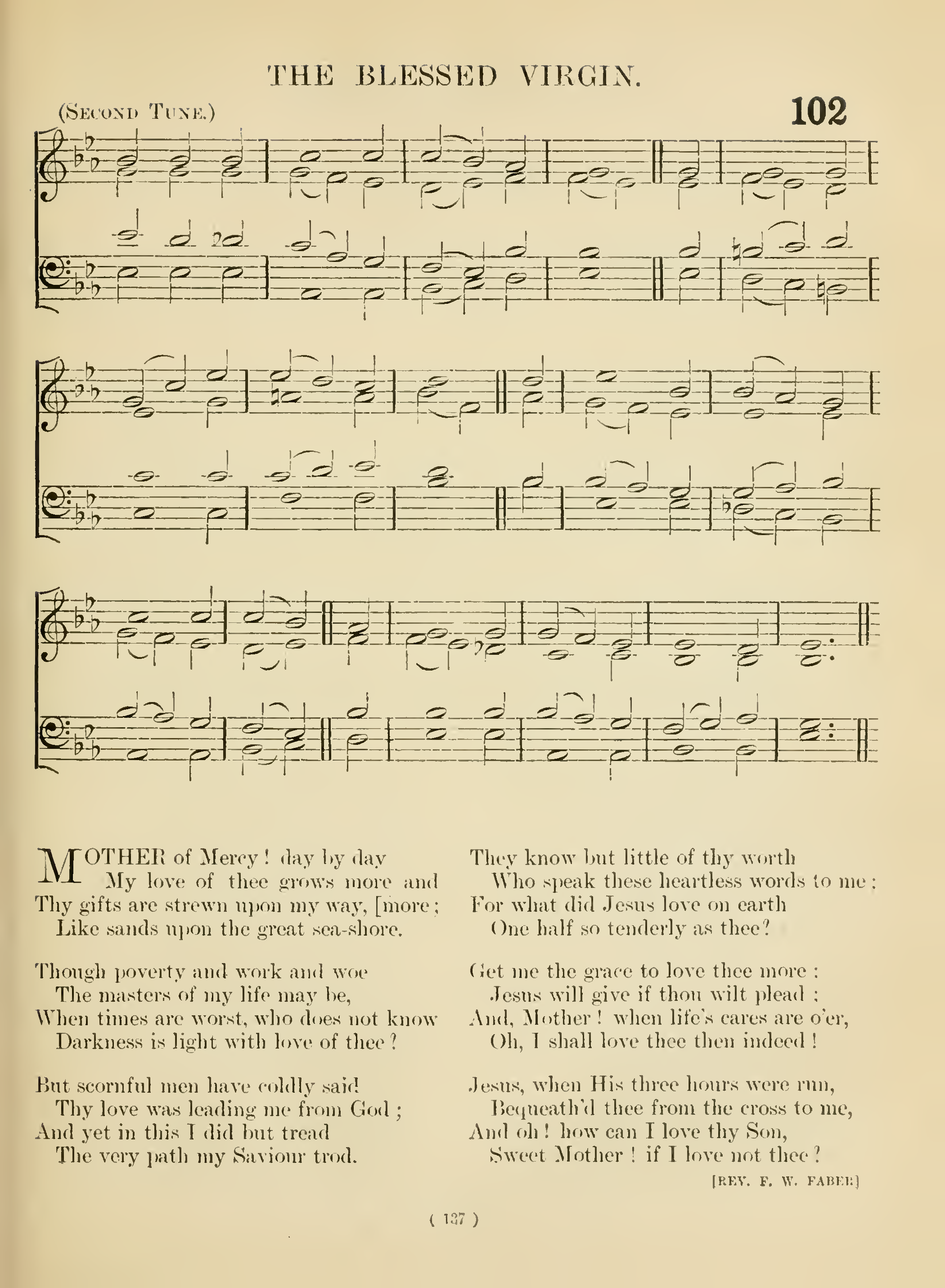
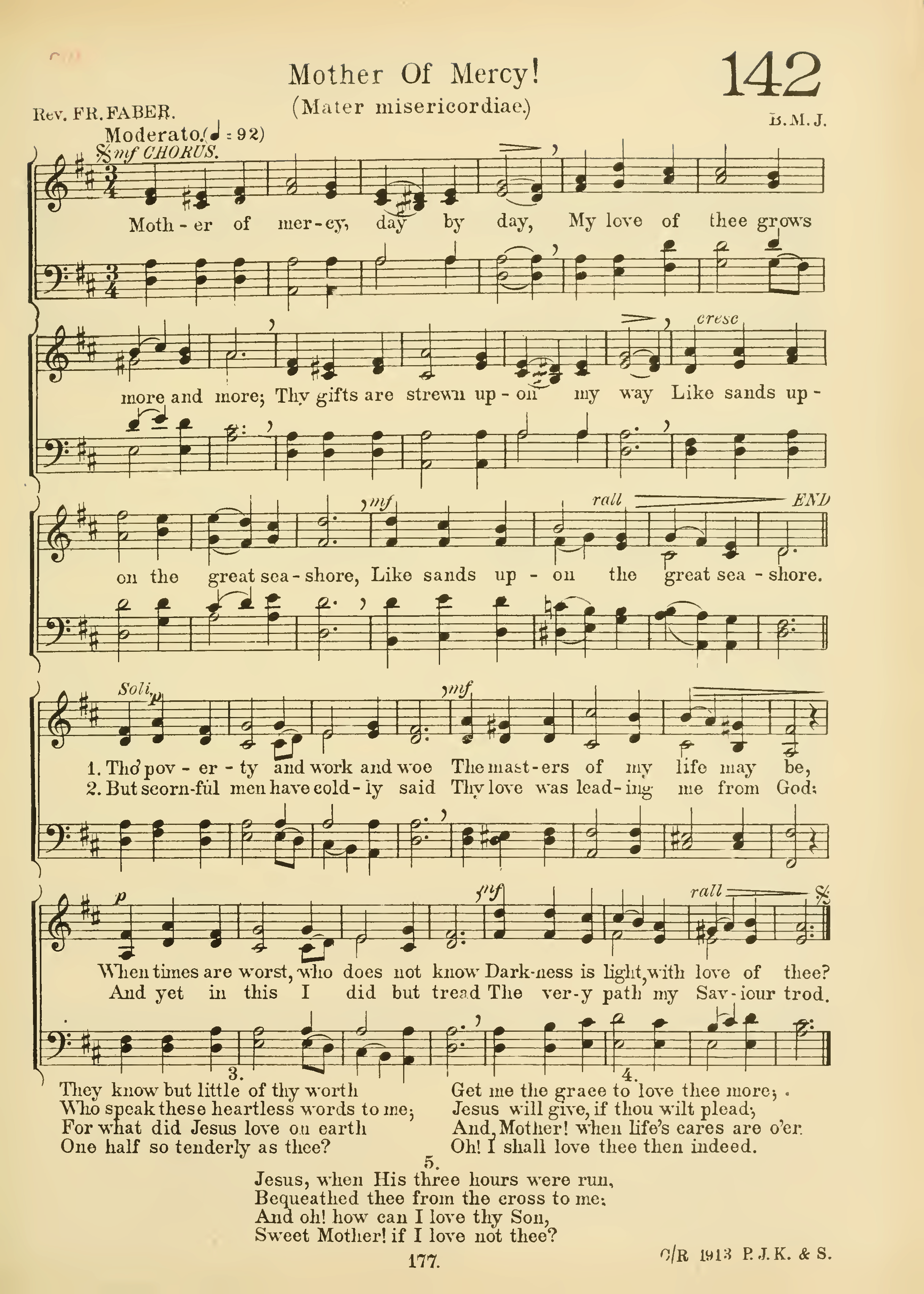
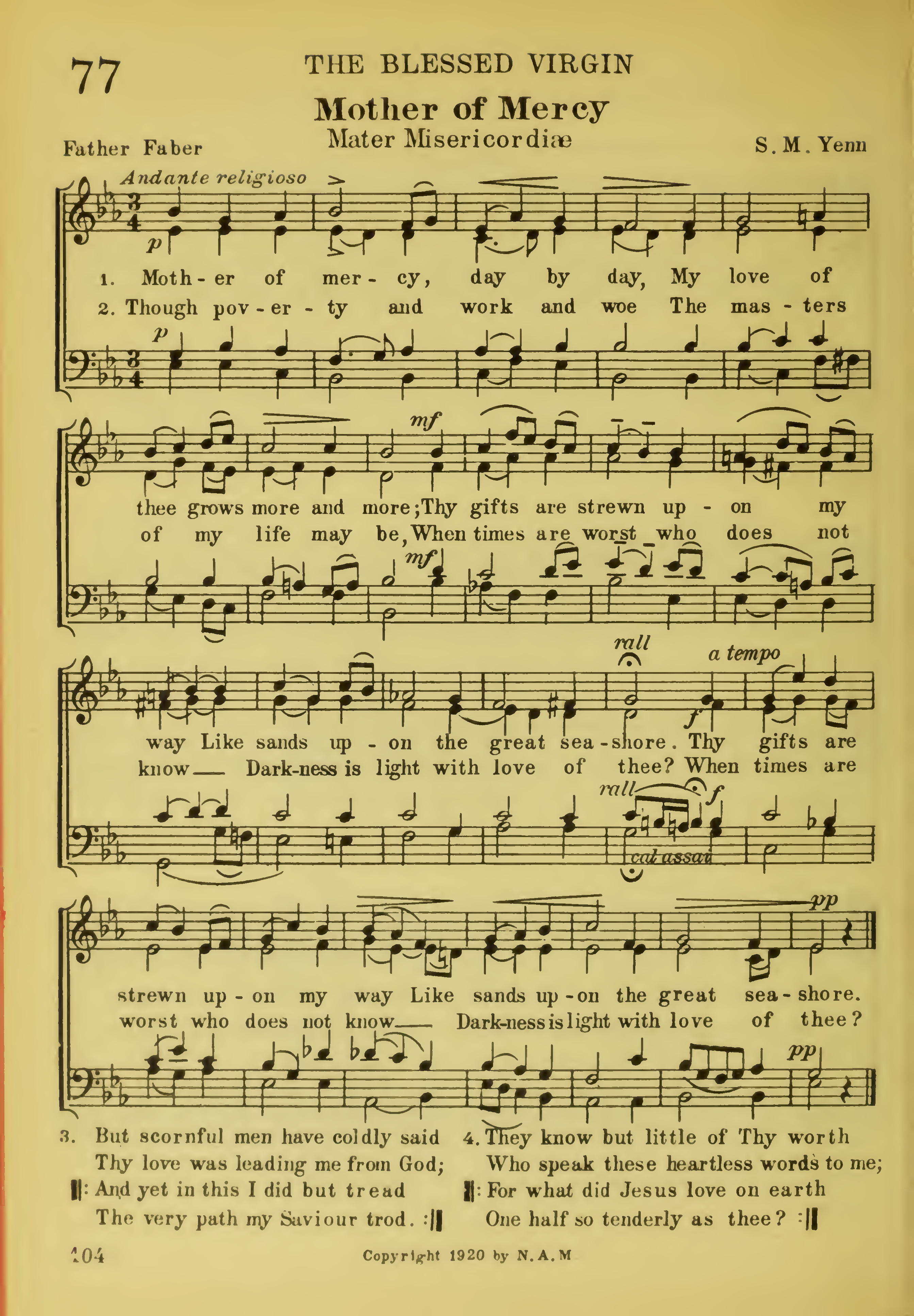
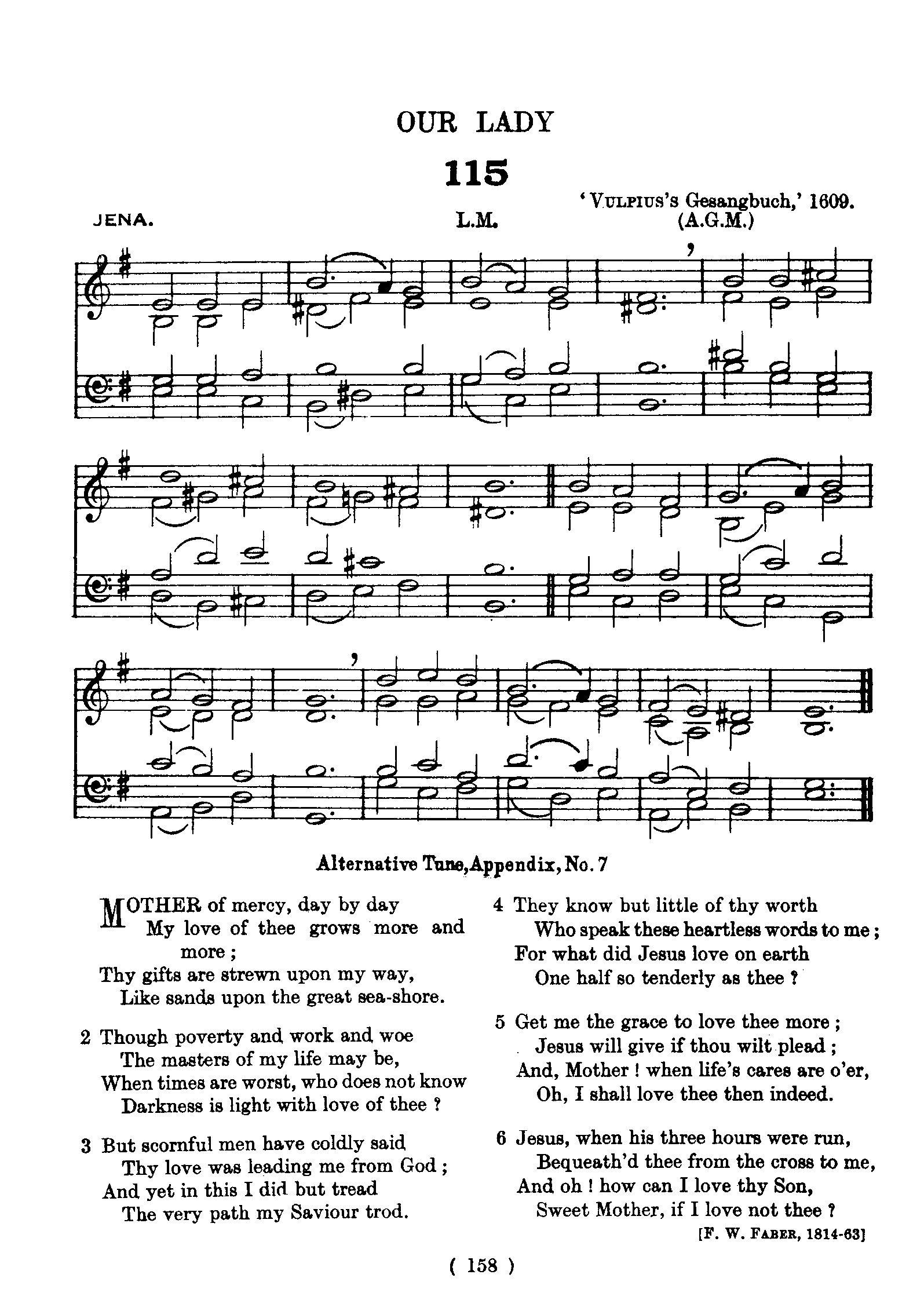
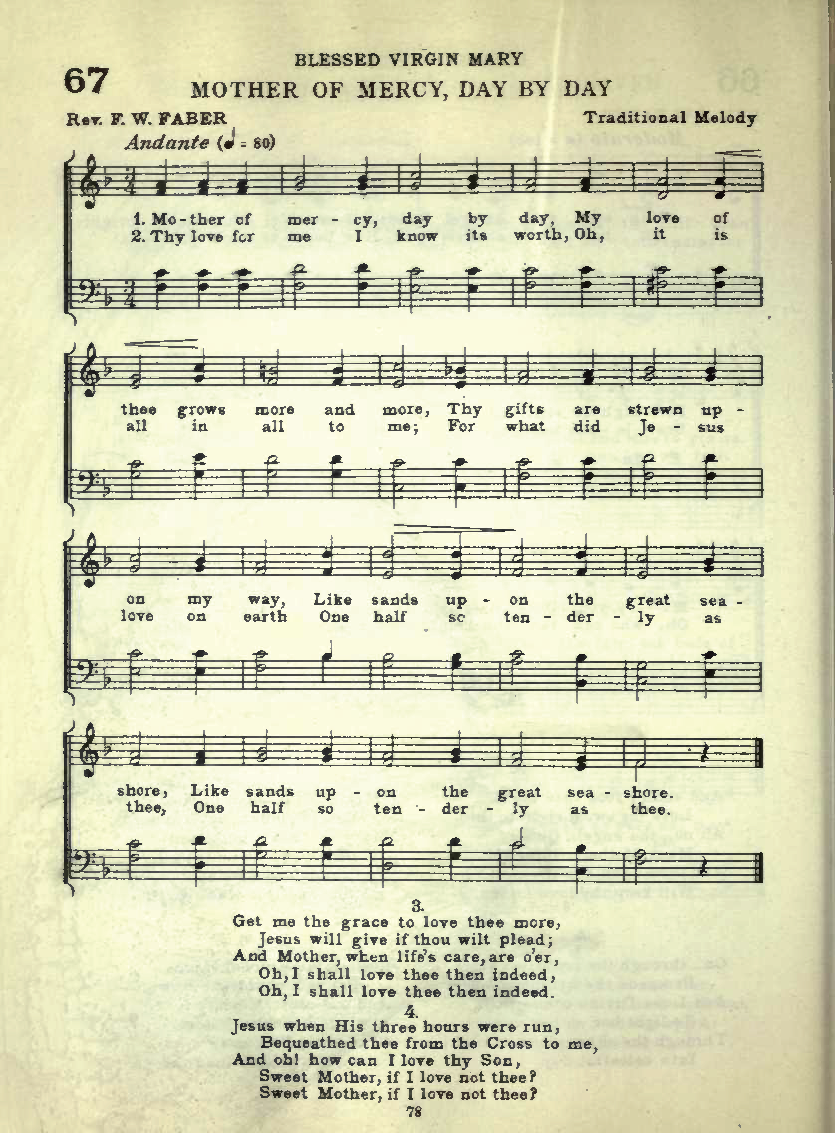
The melodies that have been composed are attributed to several musicians including two melodies by Henri F. Hemy (1818-1888) found in the CROWN OF JESUS MUSIC published in 1864, of these two melodies one would become traditional to the hymn; a melody by Meyer Lutz (1829-1903) found in THE POPULAR HYMN AND TUNE BOOK published in 1868; a melody by W. C. Peters (1805-1866) found in PETERS’ CATHOLIC HARP published in 1895; a melody by John Richardson (1816-1879) found in Tozer’s CATHOLIC HYMNS published in 1898; a melody by Henry Baker (1835-1910) and a melody by Sir Alfred Scott Gatty (1847-1918) found in the ARUNDEL HYMNAL published in 1905; a melody by Sir Richard R. Terry (1865-1938) found in the WESTMINSTER HYMNAL published in 1912; a melody by a Marist Brother known only as B. M. J., found in the AMERICAN CATHOLIC HYMNAL published in 1913; a melody by Father Simon M. Yenn (1863-1938) found in the ST. GREGORY HYMNAL published in 1920; and a melody from Melchior Vulpius’s Gesangbuch of 1609 found in the WESTMINSTER HYMNAL published in 1939.

Melodies by Henri Hemy - Crown of Jesus Music, 1864
Crown of Jesus Music, 1864 (traditional melody)

Henri (Henry) F. Hemy was born in 1818 Newcastle, England. He was the organist at St. Andrew’s Church in Newcastle and later professor of music at St. Cuthbert’s College now Ushaw College in Durham. He sang baritone and painted artwork. He composed more than seventy different works of music including waltzes, polkas, hymns and set most of Longfellow’s works to music. He compiled two hymn collections including EASY HYMNS AND SONGS, 1851 and CROWN OF JESUS MUSIC, 1864.

Melody by Meyer Lutz - Westlake's Popular Hymn and Tune Book, 1868

Meyer Lutz (Wilhelm Meyer Lutz) was a German born English organist. He was a composer and conductor known for his work touring with theater companies. He composed several operas and was the musical director of the Gaiety Theater in London’s West End. He was also the church organist in Birmingham, Leeds, and London. His father was Joseph Lutz (1801-1879), a music professor who introduced music to his son in the 1830s.

Melody by W. C. Peters - Peters’ Catholic Harp, 1895

William Cummings Peter was born in England and he came to Texas in 1820. During the years 1826-1828 he gave piano lessons in Pittsburgh, Pennsylvania. In 1829, he opened a music store in Louisville, Kentucky and another in Cincinnati, Ohio. Peters’ Catholic Harp was first published in 1863. Hymnals and other musical publications by the firm Peters’ in Cincinnati were extremely popular in the 1880s.

Melody by J. Richardson – Tozer’s Catholic Hymns, 1898

John Richardson grew up a choir boy at St. Mary’s Church, Liverpool, and later organist for St. Nicholas Church for twenty years. He taught music at St. Edward’s College and Upshaw and retired to Preston. He was admired by Cardinal Newman and honored by Pope Pius IX. He composed the melodies for the following hymns including By the Blood that flowed from Thee; Jesus, ever loving Savior; Come Holy Ghost, Creator Come; Sweet Mother, turn those gentle eyes; Look down, O Mother Mary; Hail, bright Star of Ocean, God’s own Mother; Mother of Mercy, Day by Day; and several others.

Melody by Henry Baker – Arundel Hymnal, 1905
Melody by Sir Alfred Scott-Gatty

Henry Baker composed the first tune found in the Arundel Hymnal of 1905. Henry Baker was a civil engineer building railroads in India. He was however musically inclined and completed a music degree at Exeter College, Oxford in 1867. He composed this tune known as Hesperus, Quebec, and Elim while a student at Exeter College.

Sir Alfred Scott-Gatty composed the second tune found in the Arundel Hymnal. He was a composer of children’s music and a few operettas. His collection of Little Songs for Little Voices was published in three volumes. He also was an officer of arms at the College of Arms in London and was knighted for his services in 1911.

Melody by Sir Richard R. Terry – Westminster Hymnal, 1912
Melody by B.M.J. – a Marist Brother – American Catholic Hymnal, 1913

Sir Richard R. Terry composed the melody found in the Westminster Hymnal of 1912. He was educated at King’s College, Cambridge and joined the Catholic Church in 1896. He was choirmaster and organist at the Westminster Catholic Cathedral from 1901-1924, and the editor of the Westminster Hymnal published in 1912. He was knighted in 1922.

Little was known about the Marist Brother B. M. J., except that he composed more than fifty of the hymns found in the AMERICAN CATHOLIC HYMNAL. Recently, the archivist for the Marist Brothers revealed to me that B. M. J. was a pseudonym for Brother Zephiriny. It was a customary practice in those days that an individual Brother’s name could not be used in a publication or in a musical composition without the expressed permission of the Brother Provincial. The Marist Brothers of the Schools of New York compiled the hymnal, and it consisted of Hymns, Latin Chants, and Sacred Songs for Church, School, and Home. There were two editions of the hymnal published by P. J. Kenedy & Sons of New York. The first was published in 1913 and the second edition was published 1921. Brother Zephiriny was one of the outstanding leaders of the U.S. province from 1892 until his death in 1928.

Melody by S. M. Yenn – St. Gregory’s Hymnal, 1920
Melody from Vulpius’s Gesangbuch – Westminster Hymnal, 1939

Father Simon Yenn served on the Music Committee for the Society of St. Gregory and was the Diocesan Director of Sacred Music for Ft. Wayne, Indiana. He composed the melodies for three hymns found in the ST. GREGORY HYMNAL published in 1920. Why art thou sorrowful? Mother of Mercy, and Hail Virgin, dearest Mary (Queen of May). He was a contributor to the Catholic Choirmaster magazine from 1915 till 1923 and wrote a series of articles on Church Music Reform.

Melchior Vulpius was a German composer and schoolmaster. He was a prolific composer and during his lifetime one of the most important contributors of Lutheran hymn tunes in Germany. He has two hundred motets and some four hundred hymns to his credit. He compiled several hymn collections and published several Sacred Vocal works both in Latin and German. The music was arranged by DOM Gregory Murray, O.S.B., a student of Sir Richard Terry.

Reflection

The arrangement I learned to sing in St. Mary’s Choir (1977-2010) which is the traditional melody comes from the ST. BASIL’S HYMNAL, 1918. The choir would sing this hymn before Mass on many occasions as a prelude and especially for the Feast of Our Lady of Mercy, September 24. At St. Mary’s we had a custom of singing a hymn the weekend before to remind parishioners that a feast day was fast approaching. Every so often the feast day would fall on Sunday which makes singing the hymn ever more appropriate.

The first verse of the hymn is quite moving and expresses the love many Catholics have toward Our Lady. The words, Thy gifts are strewn upon my way, Like sands upon the great seashore, are constant reminders to me of the many gifts we have received from Our Lady in our struggle against the wily snares of Satan. These include the Rosary, the Miraculous Medal, the Brown Scapular, the many invocations, prayers, and Church dogmas. What gifts of Our Lady have you found along your way that have helped you?

The last verse touches me deeply. Father Faber writes, Jesus, when His three hours were run, Bequeath’d thee from the cross to me, reflecting on John’s gospel (Jn. 19:26-27) where Jesus says to his mother from the cross, Woman, behold your son and to John, behold your mother. This hymn is by far one of my most favorite Catholic hymns and one that often times will spontaneously surface in my memories. I sing along with my friends of St. Mary’s Choir who precede ahead of me to that heavenly glory.

St. Basil's Hymnal, 1918 (traditional melody)

I want to thank Peter Meggison, producer of The Devotional Hymns Project for granting permission to link to a newly commissioned recording by the St. John Cantius Church, Chicago. Click on the link to hear this beautiful recording which includes all the verses from Father Faber’s 1849 hymn Mother of Mercy, Day by Day.

Below is a selection of the melodies listed above which have been composed for the hymn. These are computer generated sound files. The tempo is approximate but should provide the listener a good sense of what the hymn sounds like. All the hymns are in the public domain. Church musicians, if you use any of these selections in your Sunday or weekly music programs and you make a recording and you are willing to share, contact the author and I will feature it in the What’s New section of my website. 

album-art

00:00

O Jesus Christ, Remember

O Jesus Christ Redeemer

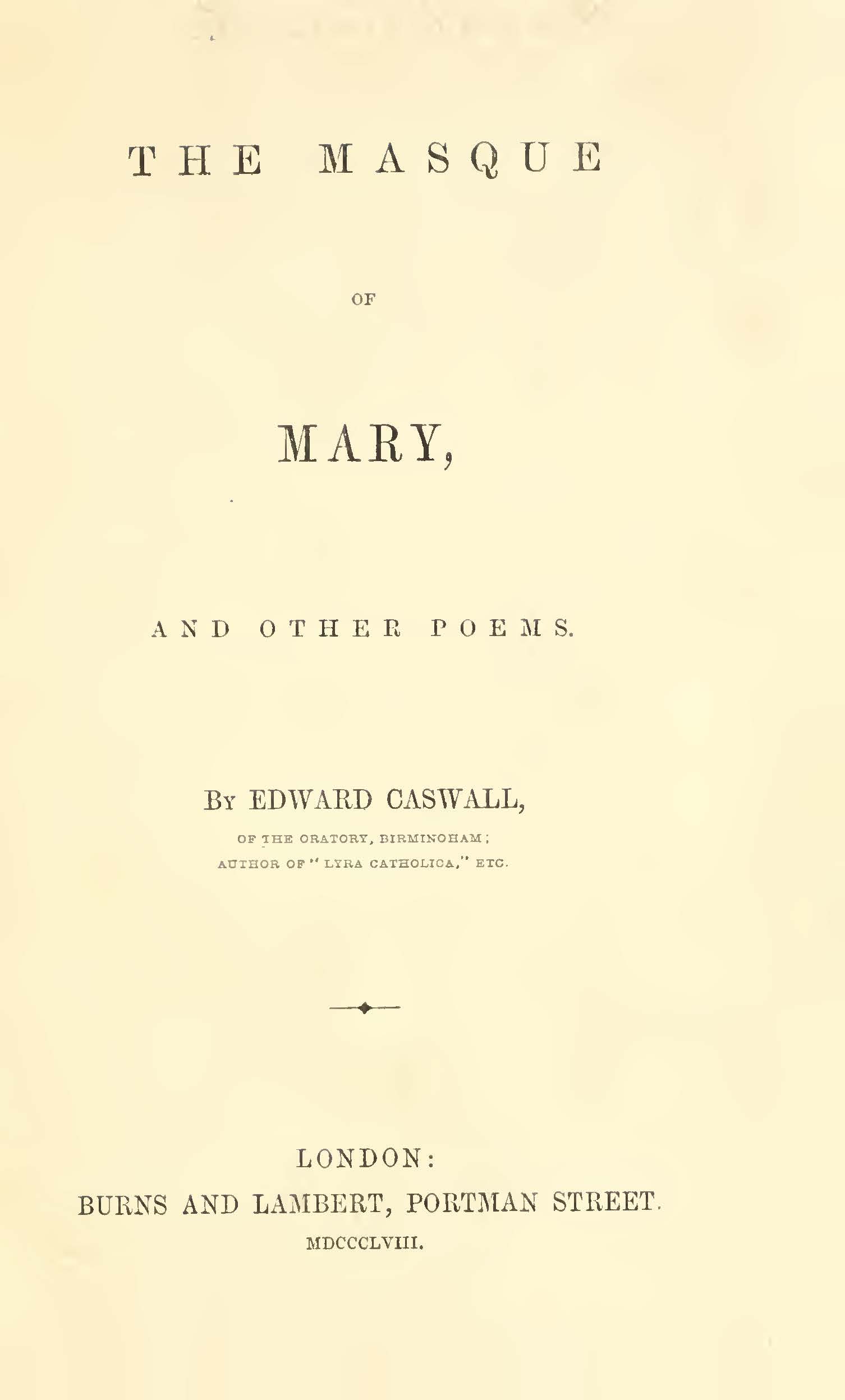
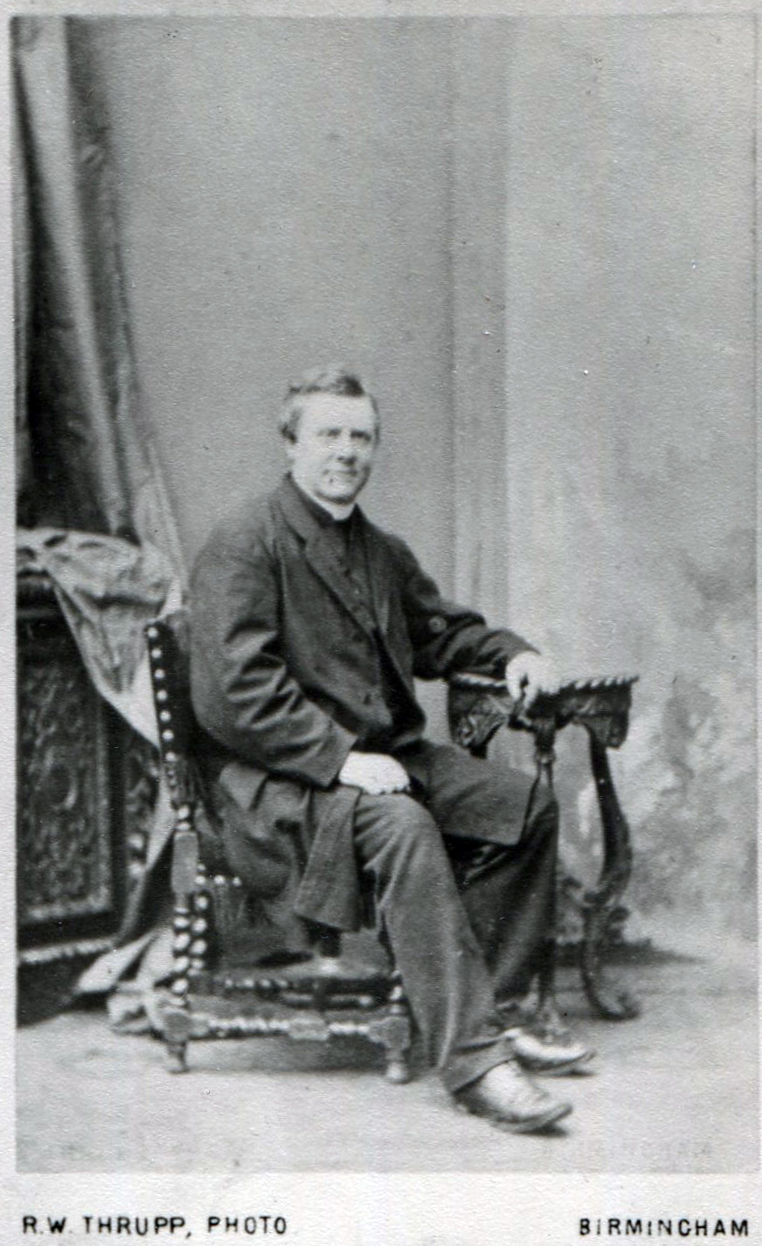
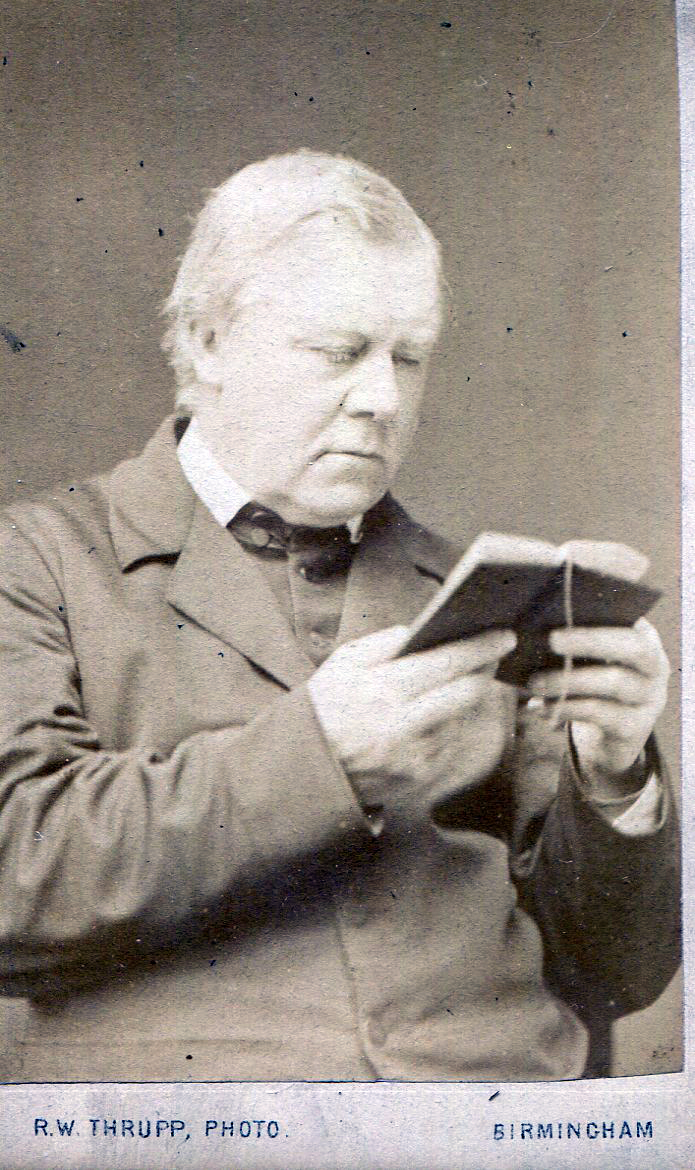
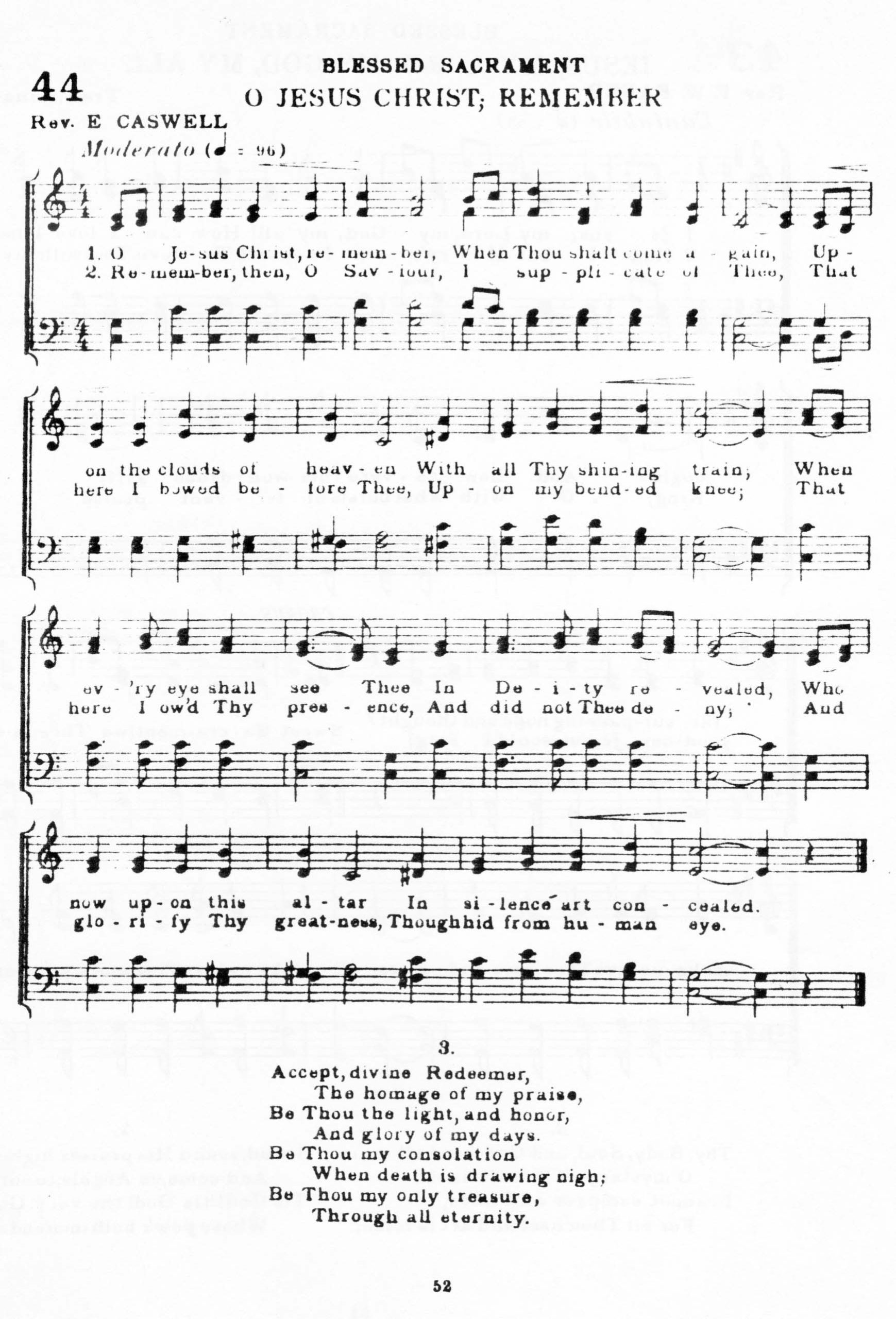
Father Edward Caswall a Roman Catholic priest wrote the text of this hymn. The earliest occurrence of the hymn that could be found is in his MASQUE OF MARY AND OTHER POEMS, published by Burns and Lambert of London in 1858. (Click on an image to enlarge)

Masque of Mary, 1858

Edward was a convert to Catholicism and was received into the Catholic Church on January 18, 1847, by Cardinal Charles Acton (1803-1847) at the Venerable English College in Rome. In attendance was Father John Henry Newman, Father Thomas Grant the Rector of the College, along with several others who had come with Edward that day. At this time Edward was married to Louisa Mary Stuart Walker who was also received into the Church of Rome a week later January 25, 1846.

During the summer of 1849, England was in the grips of a vicious cholera epidemic which persisted even into the autumn season. Edward and Louisa had gone to stay at Torquay, a sea side resort. On September 14, early in the morning, Edward left for Mass and on his return from church he found Louisa and the landlady of the lodge where they were staying deathly ill with the cholera and by 11 o’clock that night Louisa Caswall was dead.

Edward was devastated and grief stricken as one could only imagine. He at once sent word to Father Newman, and they arranged that Louisa’s Requiem Mass and burial would take place at St. Wilfrid’s in Cotton, Staffordshire. The pastor of St. Wilfrid’s was Father Frederick William Faber, a fellow convert and student at Oxford University. It is unclear if Edward or Father Faber knew each other before this time but certainly, they became acquainted at this Mass. Father Newman celebrated the Mass and Father Henry Formby a longtime friend whom Edward knew from their days at Brasenose College, Oxford, a fellow convert, and priest at the Oratory, sang the Dies Irae.

In the following year around February 1850, the Birmingham Oratory was set up at its present address on Hagley Road in Edgbaston. It is also at this time that Edward was admitted as a novice to the Oratory and three days later he received the tonsure and was admitted to Minor Orders. Then on December 21, 1850, the anniversary of his wedding to Louisa, he was ordained as a subdeacon and a year later almost to the day on December 20, 1851, he was ordained a deacon. By April 1852, the building in Edgbaston had been completed and all the Oratorians moved into the new location. On September 18, 1852, Deacon Edward along with Deacon Henry Bittleston were ordained as priest.

Fr. Edward Caswall  courtesy of the Birmingham Oratory, London
Fr. Edward Caswall
courtesy of the Birmingham Oratory, London
Fr. Edward Caswall  courtesy of the Birmingham Oratory, London
Fr. Edward Caswall
courtesy of the Birmingham Oratory, London

Throughout his life, Father Caswall was a prolific writer. During his time at Brasenose College, a constituent college of Oxford University he published several literary works including The Oxonian – a series of papers on University life written with a humorist point of view. This was followed by his Pluck Examination Papers which he later published in a book The Art of Pluck – the caricature of these works was to enlighten the undergraduate on how to fail his examinations and in the lingo of the University to get plucked. The ability to write in satire and at the same time convey a moral point was a gift that Father Caswall had. These and several other publications were enormously successful and provided him with a steady income which he would receive help from during his college days and in the future.

During his conversion journey to Rome, Father Caswall kept a journal that was still unpublished, and its existence known only to a handful of people. He was a man of meticulous detail and observation and his eyewitness accounts of Roman Catholicism during his visit to Ireland in the summer of 1846 proved to be a turning point in his life. On one occasion in 1846, on a summer evening, he saw a small group of poor worshipers praying in a Catholic chapel in Ireland. He saw that one person said the Lord’s Prayer as far as, as it is in heaven, and the others began at, give us this day our daily bread. Then the same person began another prayer, and the others began Holy Mary, and everything was in English. It was the first time he had heard of any devotion to Our Blessed Mother and before the evening was over, he was kneeling with them. Any Anglican preconceptions of idolatry left him, and he was consumed with the expression of love and humility of these poor men and women. From that point onward, he became devoted to the Rosary.

Almost two years after he joined the Catholic Church, Father Caswall published his first collection of hymns in 1849, the LYRA CATHOLICA, having translations of all Breviary and Missal hymns of the Roman Breviary. Father Caswall was always working for the education of the poor and especially the children even during his curacy at Stratford-sub-Castle near Salisbury. A question that plagued him during his conversion journey was how the Latin liturgy could have any meaning for the average Catholic let alone the poor and uneducated.

During the summer of 1846 while in Ireland he attended a Requiem Mass for Pope Gregory XVI who had recently died. He was concerned and frustrated because he could not follow the liturgy. How is it that the poor and uneducated understand the Latin liturgy and an Oxford graduate in the classics is lost? This was the underlying reason for his translations of the Roman Breviary – to publish in the English language for anyone who could read or to pray in private the Divine Office.

Father Caswall remained at the Birmingham Oratory until his death on January 2, 1878. Father Edward Caswall was named, along with Father Joseph Gordon and Father Ambrose St John, as one of the three Oratorians whom Newman considered his greatest friends and most loyal and devoted laborers in St Philip’s vineyard.

There is so much more that could be written about Father Caswall but that is beyond the scope of this short write-up. Most of his original poems and hymns were written during his time at the Birmingham Oratory and his contributions to Catholic hymnody include such favorites as A Carol of Good Tidings; All You Who Seek A Comfort Sure; At The Cross Her Station Keeping; Come Holy Ghost Creator Blest; Earth Has Many Noble Cities; Glory Be To Jesus; Jesus the very thought of Thee; Joseph Our Certain Hope in Life; Joseph Pure Spouse; Sing My Tongue the Savior’s Glory; Ye Sons and Daughters of the Lord; Hark an Awful Voice is Sounding; Dear Maker of the Starry Skies; O Jesus Christ Remember; O Saving Victim Opening Wide; Soul of My Savior; The Dawn Was Purpling O’re the Sky; See Amid the Winter Snow; To Christ the Prince of Peace; When Morning Guilds the Skies; What a Sea of Tears and Sorrows; Wondrous Gift; This is the Image of Our Queen; and many more hymns. He published several hymn books including LYRA CATHOLICA, 1849; the MASQUE OF MARY AND OTHER POEMS, 1858; and HYMNS AND POEMS, 1873.

Some of the details above were used with permission and were taken from EDWARD CASWALL: NEWMAN’S BROTHER AND FRIEND written by Nancy Marie de Flon and published by Gracewing in 2005. Nancy’s book is a wonderful biography of Father Caswall’s life and journey to Catholicism. An earlier biography of Edward Caswall was written by Edward Bellasis (1800-1873) an English lawyer and convert to Catholicism in the new edition of HYMNS AND POEMS published in 1908.

The Melodies

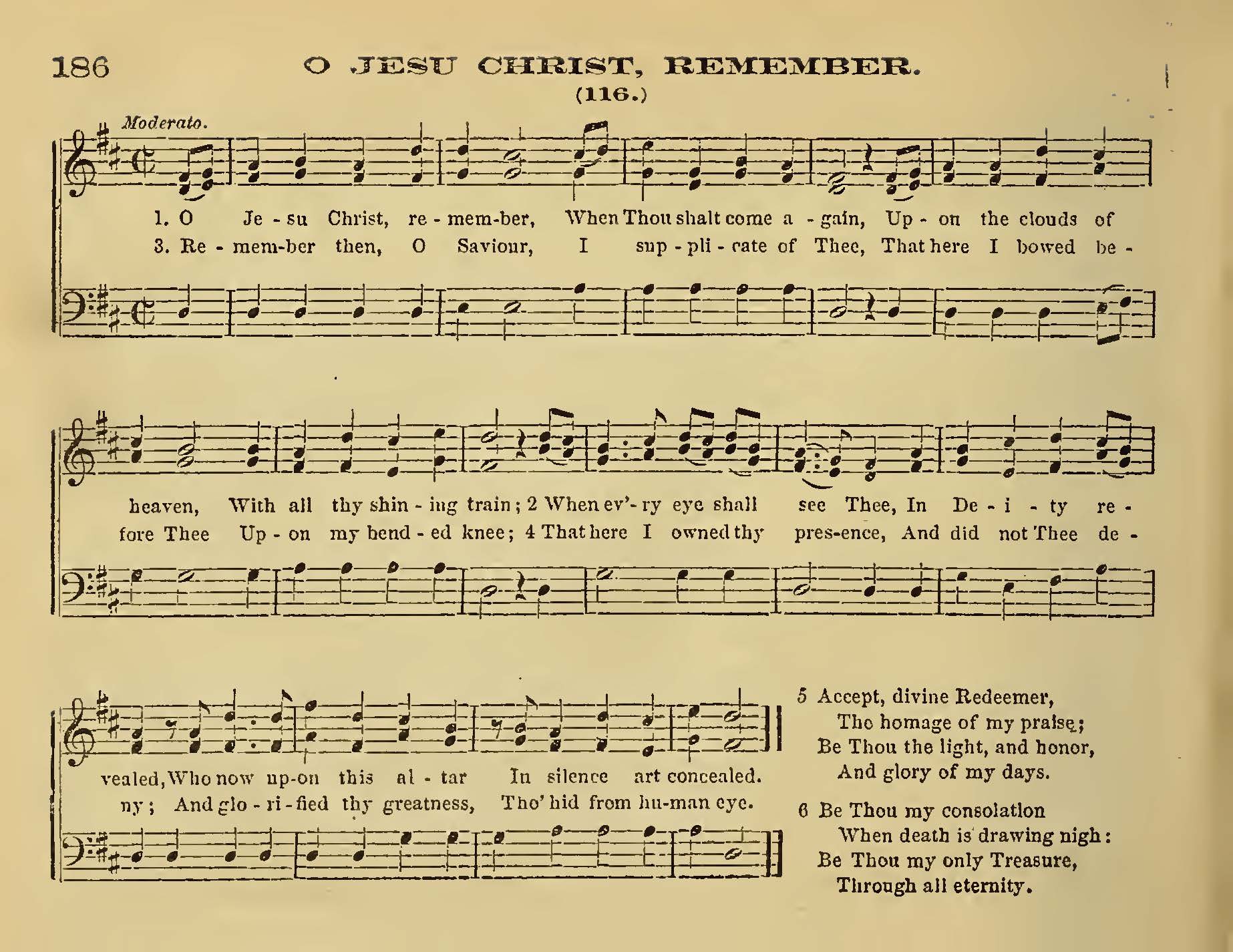
I have found more than eighteen different melodies for this hymn, and so, I have selected four of the melodies which I hope will highlight the musical richness and heritage without becoming overwhelming. The melody that I am most familiar with, and is the most common to the hymn, first appeared in the LAUDIS CORONA published in 1880, No. 116. There is no sign of the composer’s name, however, in the Preface of the hymn book it says:

The tunes in this collection were selected by a lady in Baltimore. They have been arranged for the press by Prof. Francis A. Harkins, M.A., of Boston College. The object has been to give Sunday Schools and Sodalities of youth something that all can sing. To this end, the Christmas Carols and the May Hymns will prove particularly useful. 

Thanks are returned to the Sisters of Notre Dame for their kindness in granting the use of May Chimes, to Mr. Fred Eversmann, Jr., of Baltimore, to Mr. Harry Sanders, of the same city; and to Mr. RoSewig, Music Publisher, of Philadelphia. 

Boston:

Feast of the Sacred Heart,

June 4, 1880.

Laudis Corona, 1880
Laudis Corona, 1880

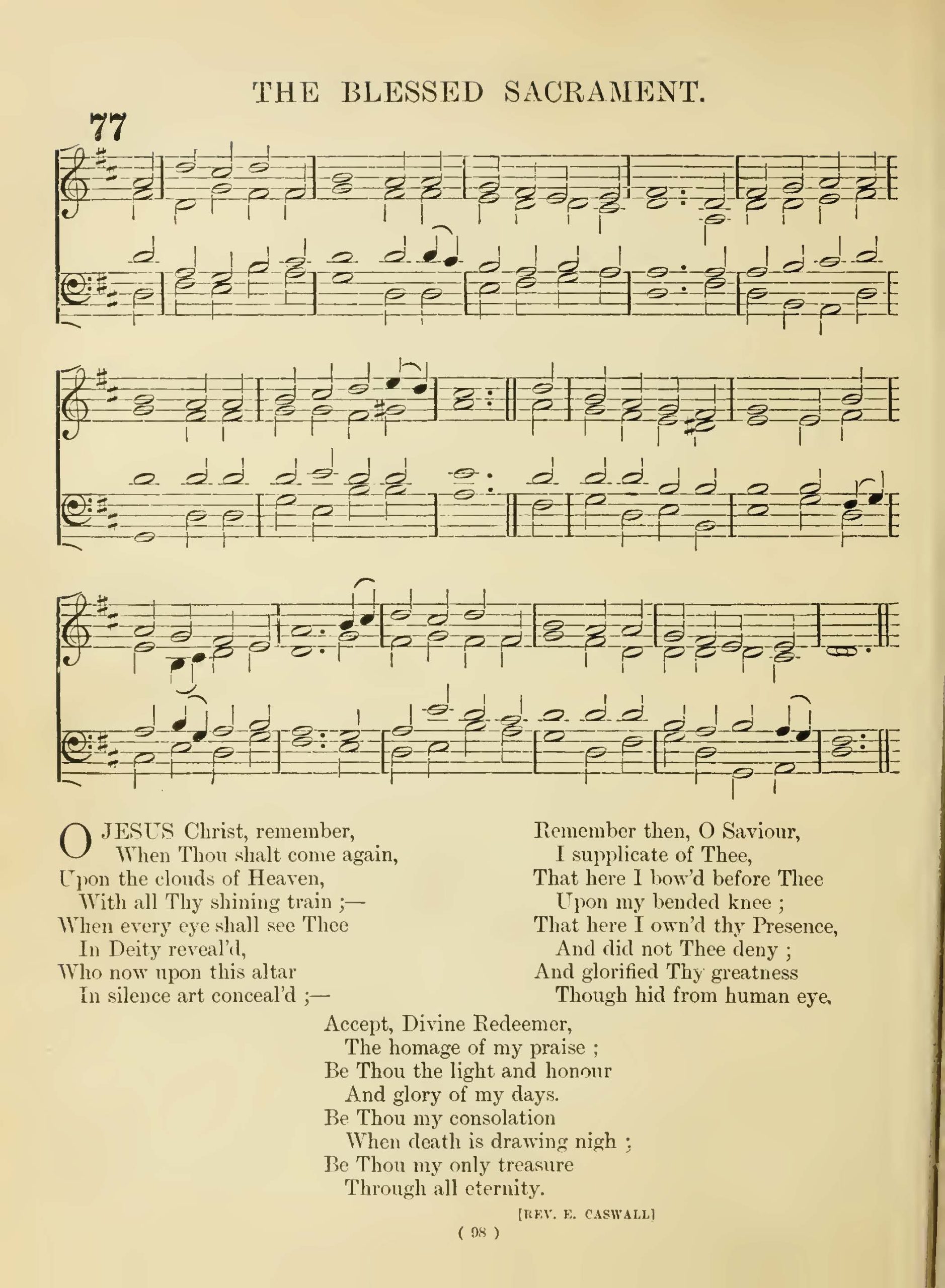
The hymn appeared in St. Basil’s Hymnal from 1888 thru 1918. It’s removal from later editions maybe tied to the hymnal’s condemnation by the Society of St. Gregory of America in October 1918. The Black List as it became known was an attempt by the Society to condemn as many of the popular Catholic hymnals of the day in favor of its own St. Gregory and Choir Book. Since the St. Basil’s Hymnal was by far the most dominant hymnal across the United States, it received the harshest criticism and was deemed objectionable, so far as its liturgical, literary and artistic value is concerned, should not be tolerated in any school or church. (The Catholic Choir Master, Vol. 4. No. 4. October 1918, pg.96) The hymn and melody also appeared in the Crown Hymnal published in 1913.

Some of you may recognize this melody as it is also commonly used for the hymn O Lord, I am not Worthy that thou shouldst come to me.

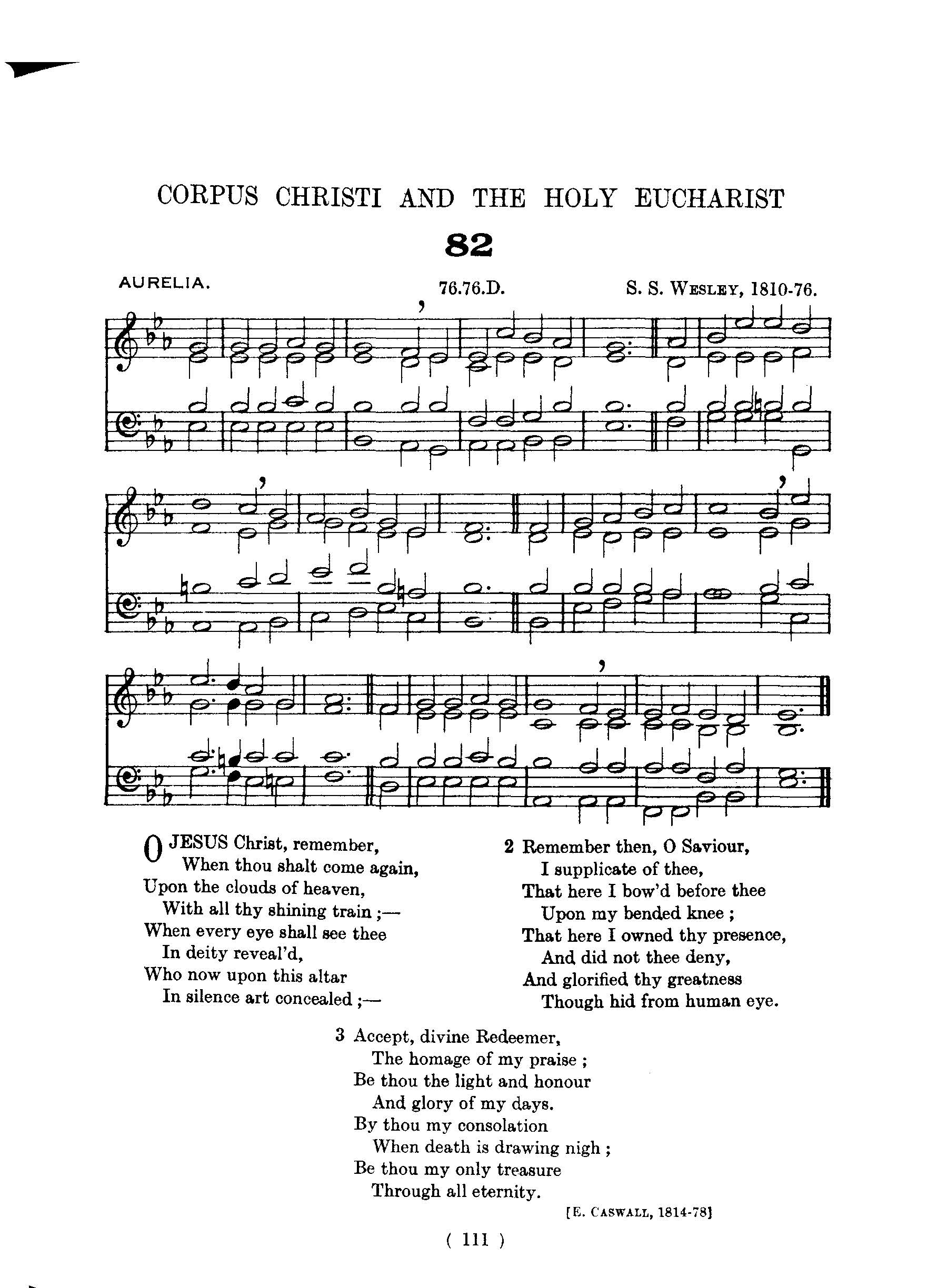
The next most common melody for the hymn O Jesus Christ Remember, was composed by Samuel S. Wesley (1810-1876), a tune also known as AURELIA. Samuel Wesley was the grandson of Charles Wesley who along with his brother John, formed the Methodist Church. The earliest appearance that I could find was in the WESTMINSTER HYMNAL published in 1939, No. 82.

The Westminster Hymnal, 1939

The same arrangement appears in the 1952 edition of the WESTMINSTER HYMNAL; the ST. ANDREW HYMNAL published in 1964 in Scotland; and the CATHOLIC HYMNAL AND SERVICE BOOK published by the Benzinger Brothers in 1966. Interestingly, this is not the same melody that appears in the 1912 edition of WESTMINSTER HYMNAL edited by Richard R. Terry, that melody was composed by Robert Pearsall, which I will cover later. The tune AURELIA is commonly associated with the hymn of The Church’s One Foundation.

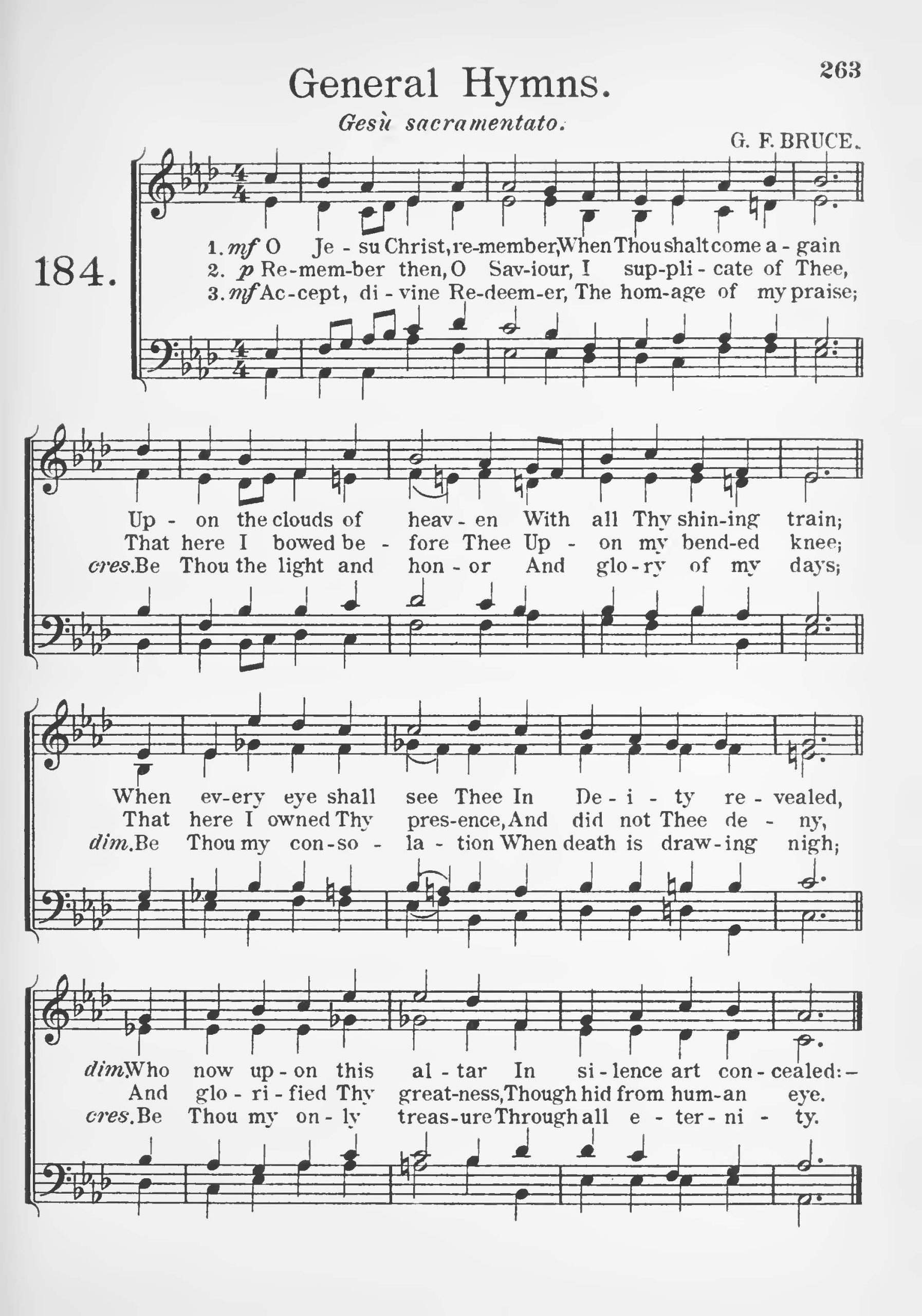
Another melody appeared early on and can be found in Augustus Tozer’s CATHOLIC HYMNS, published in London in 1898. This collection of hymns is a musical edition of the ST. DOMINIC’S HYMN BOOK. The composer was G. F. Bruce. He was appointed organist and choirmaster at the Beddington Parish Church, Wallington, Surrey on December 8, 1894. He composed a melody for another hymn Now Let the Earth with Joy Resound, both compositions appear in THE CATHOLIC CHURCH HYMNAL published in 1905 and edited by Tozer.

Augustus Edmonds Tozer (1857-1910) was a convert to Catholicism and received his Doctorate from Oxford University and was named a Knight of St. Sylvester for his work in the reform movement in England. His CATHOLIC CHURCH HYMNAL published later was helpful in church music reform in both England and America.

This melody also appeared in the A TREASURY OF CATHOLIC SONG published in 1915 and edited by Father Sidney S. Hurlbut (1858-1920), who was at the time of publication pastor of St. Mary’s Church in Hagerstown, Maryland. The hymn book is a collection comprising some two-hundred hymns from Catholic sources old and new. 

Father Hurlbut was a native of Wisconsin, born in 1858 of New England Protestant parents, and was engaged in secular activity until a period of very discreet man-hood, in the city of Chicago, except for two years, 1885-86, when he held a position in the Treasury Department. His studies for the priesthood were had among the Passionists in the Balkan countries, and ordination was received in Bucharest, Rumania, in 1898.

Continuing his theological studies for one year in Rome, he returned to America in poor health, and after a year or more of convalescence in Washington, the time being spent at the University and at the St. Paul’s Church on V Street, he was adopted into the Baltimore Archdiocese and given pastoral work in Rockville, Md., in 1900, Clarksville, Md., 1900-1911, and from 1911 till his death at St. Mary’s in Hagerstown, Md. He died on June 9, 1920. 

The information about Fr. Hurlbut was taken from the History of Sacred Music in the District of Columbia by Frank Metcalf and published in 1926.

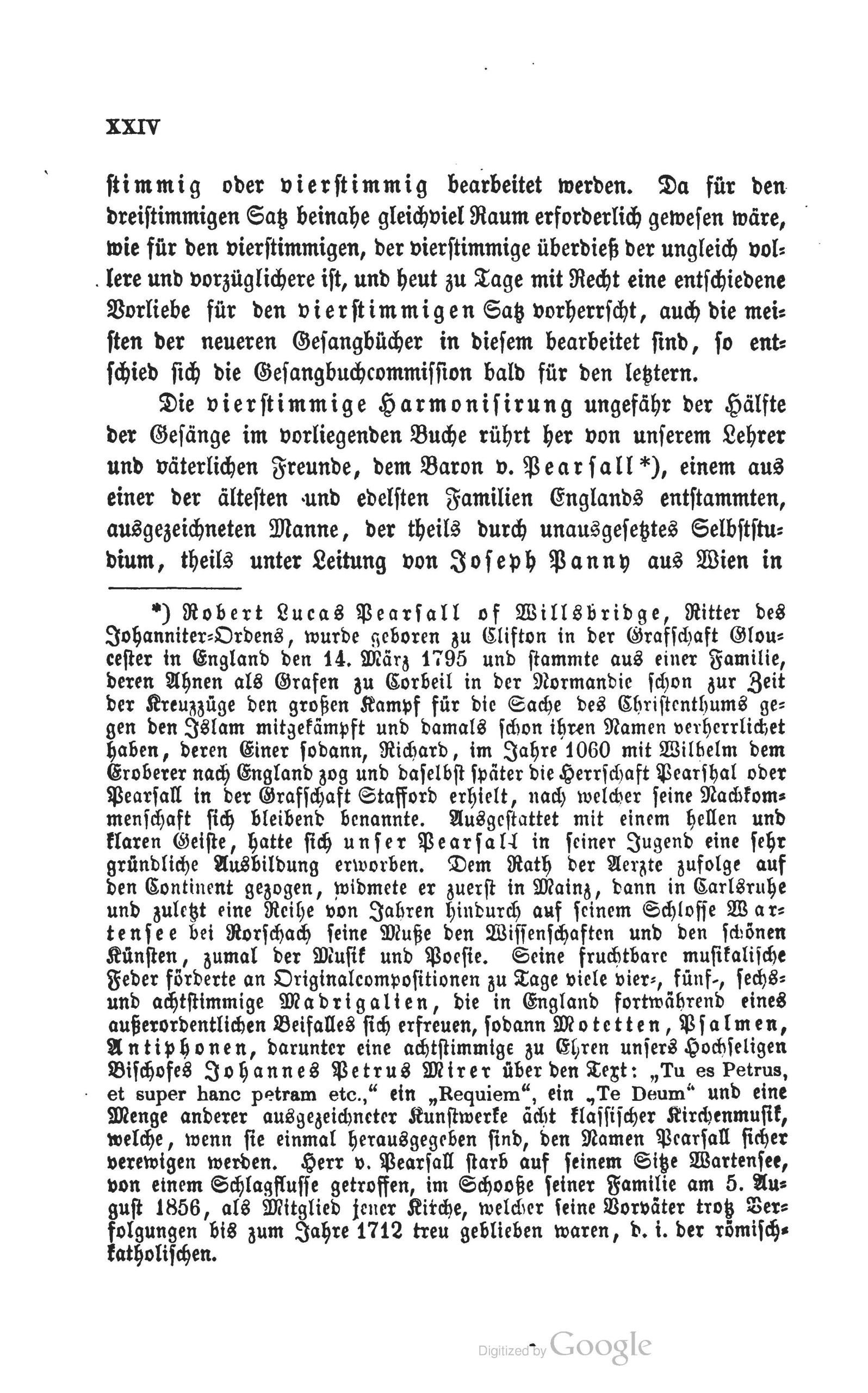
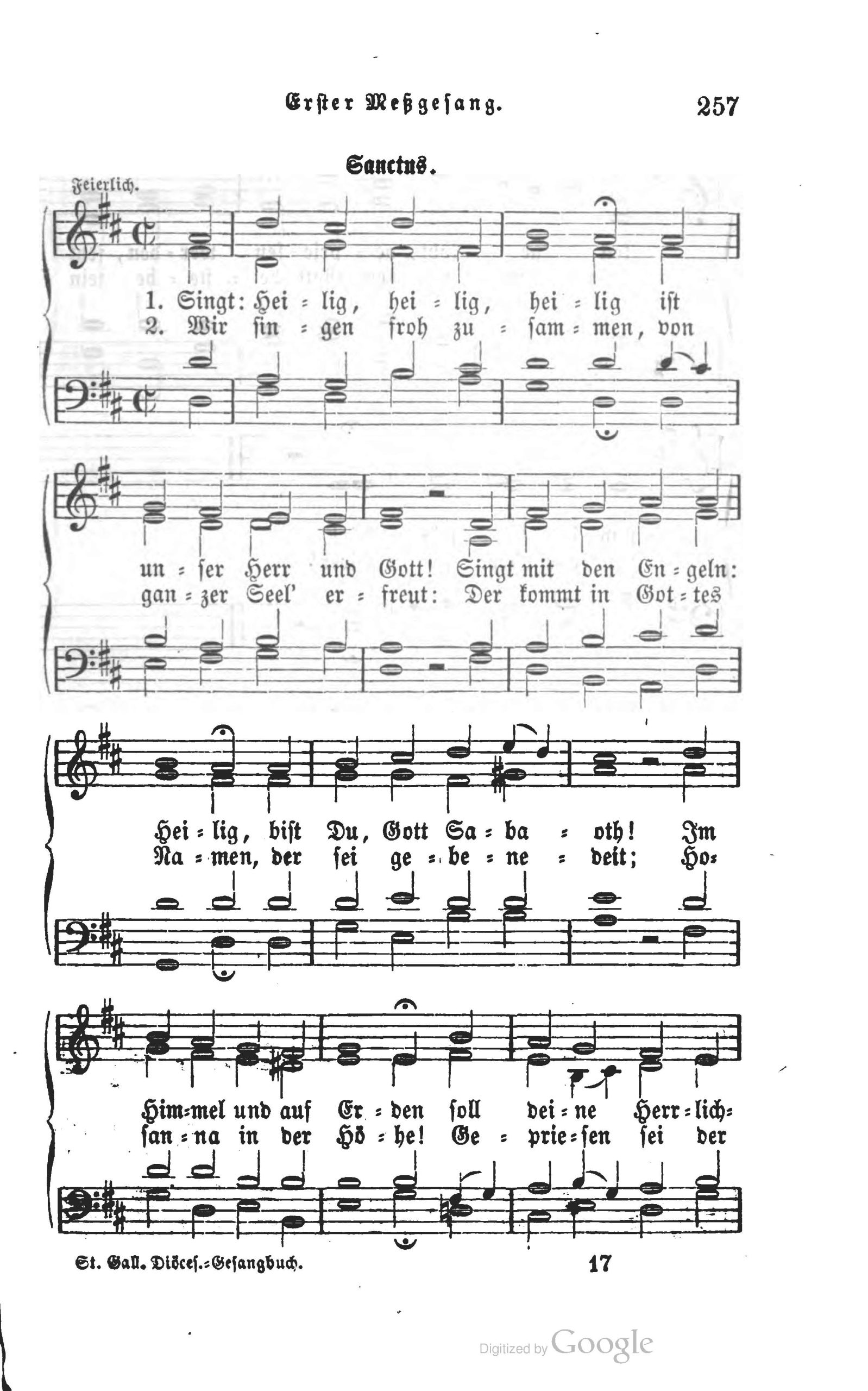
Robert L. Pearsall (1795-1856) composed a melody that was widely used and appeared in both American, English, German, and Scottish hymnals. The earliest appearance I could find for the melody was in the KATHOLISCHES GESANGBUCH of St. Gallen published in 1863 for the Sanctus. No composer’s name is given but in the Preface of the book it indicates: The four-part harmonization of approximately half of the chants in this book is the work of our teacher and fatherly friend, Baron von Pearsall. (Click on any image to enlarge)

Catholic Church Hymnal, 1898, 1905 and 1933
Katholisches Gesangbuch, 1863

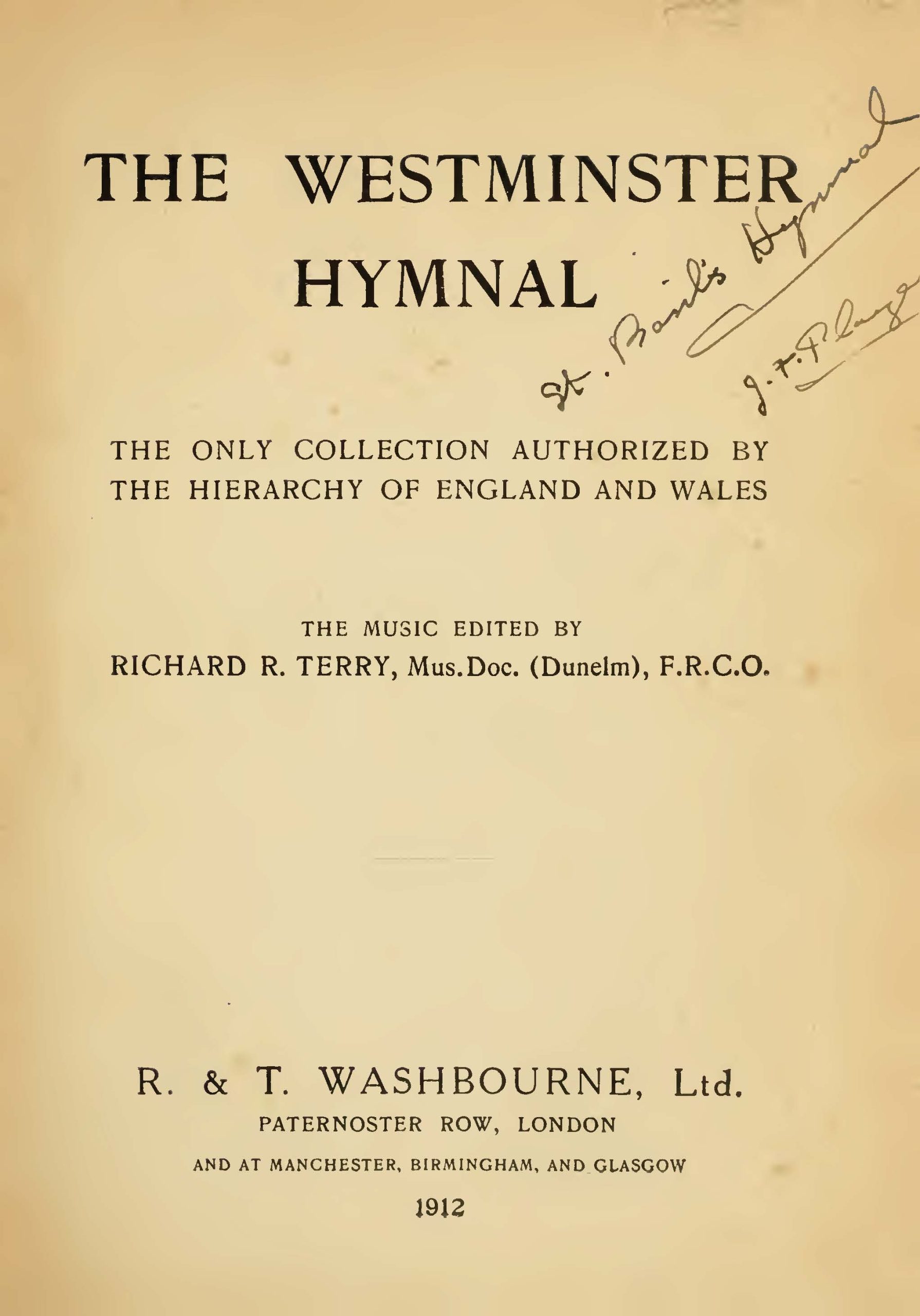
The earliest use of the melody for the hymn that I could find was in the WESTMINSTER HYMNAL published in 1912 by R & T. Washbourne Ltd., London and edited by Richard R. Terry.

The Westminster Hymnal, 1912

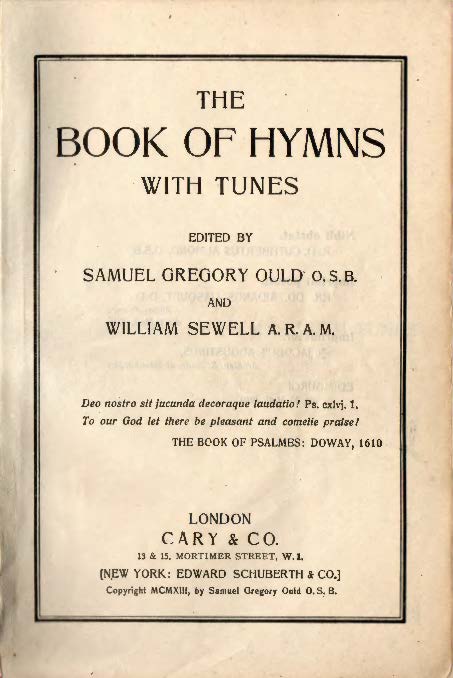
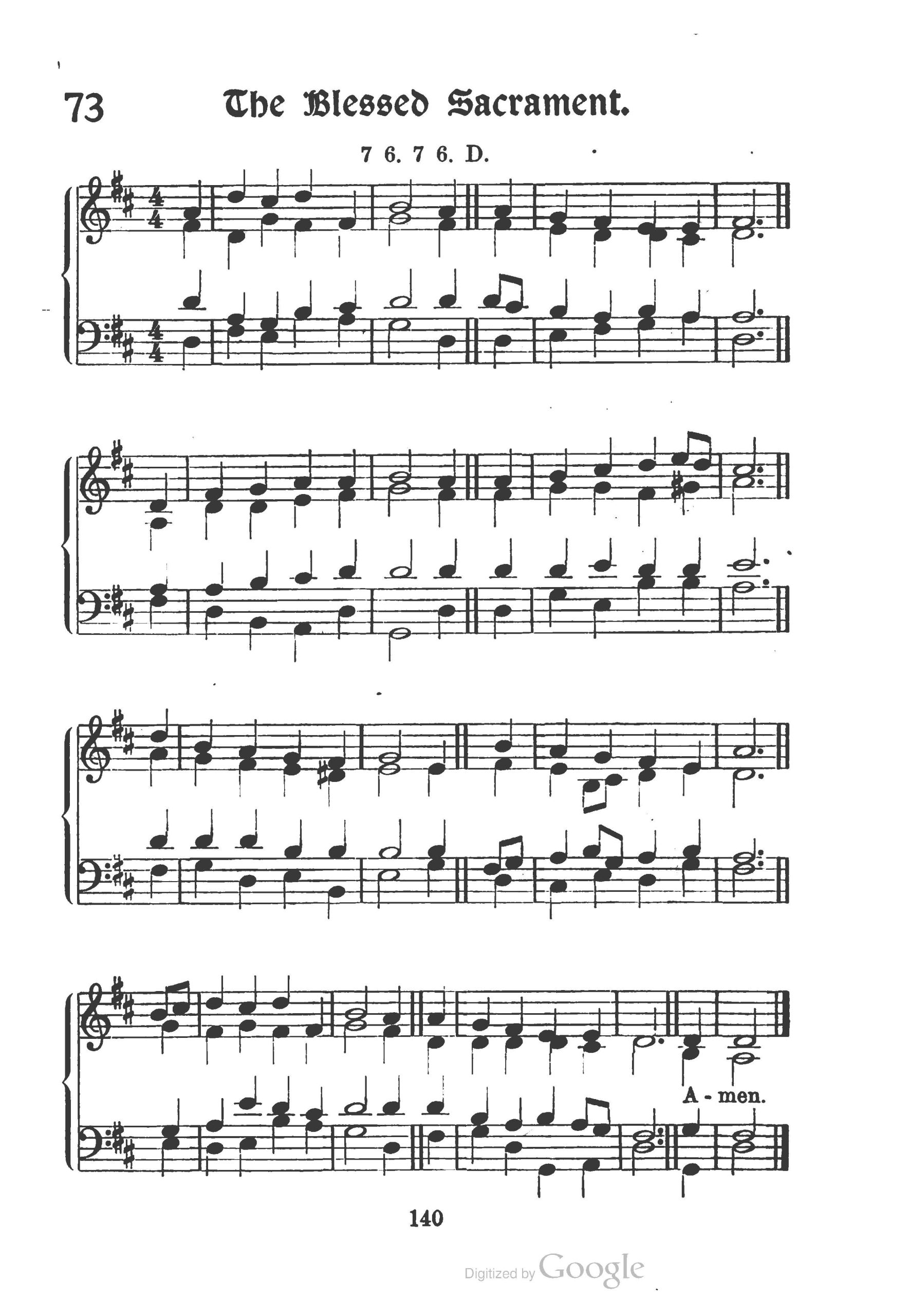
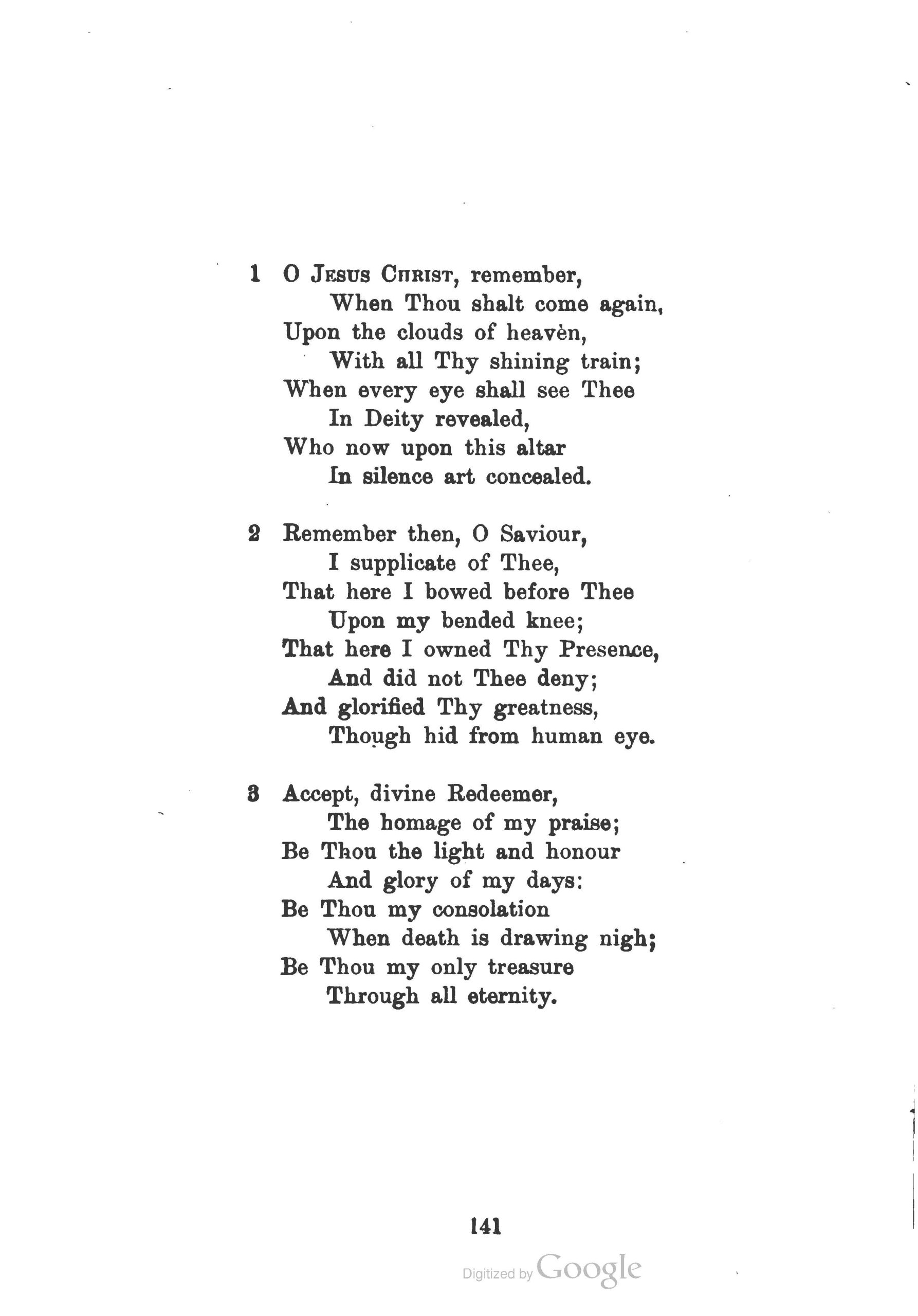
The same melody also appeared in the BOOK OF HYMNS WITH TUNES published in 1913 by Cary & Co., London and edited by Father Samuel G. Ould, O.S.B., and William Sewell. This collection of hymns was also published in New York by Edward Schuberth & Co.

The Book of Hymns with Tunes, 1913

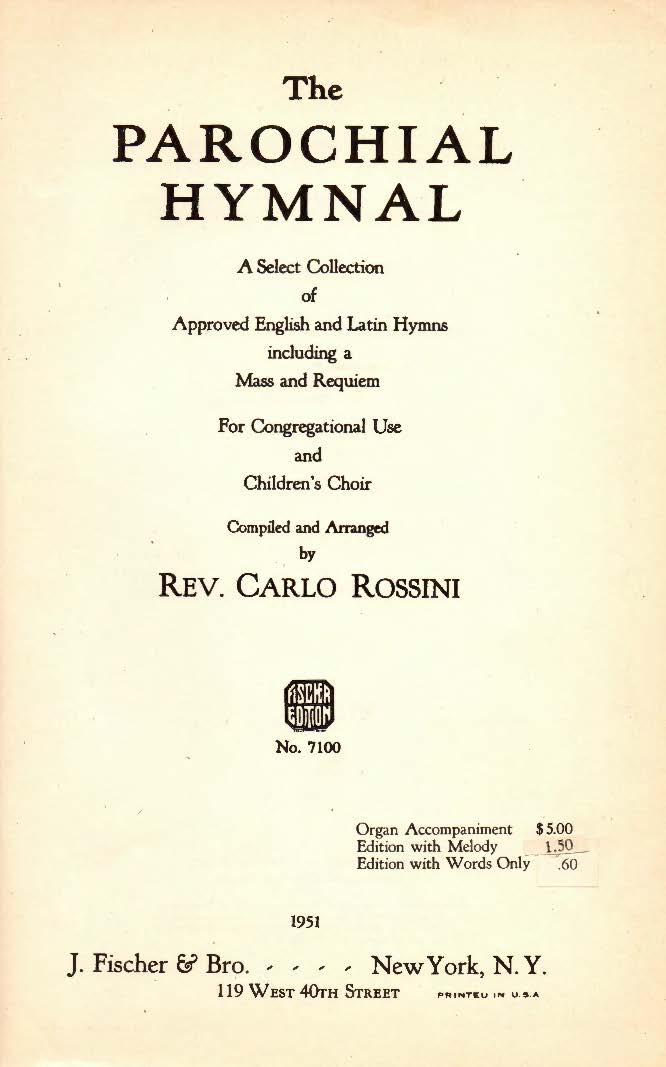
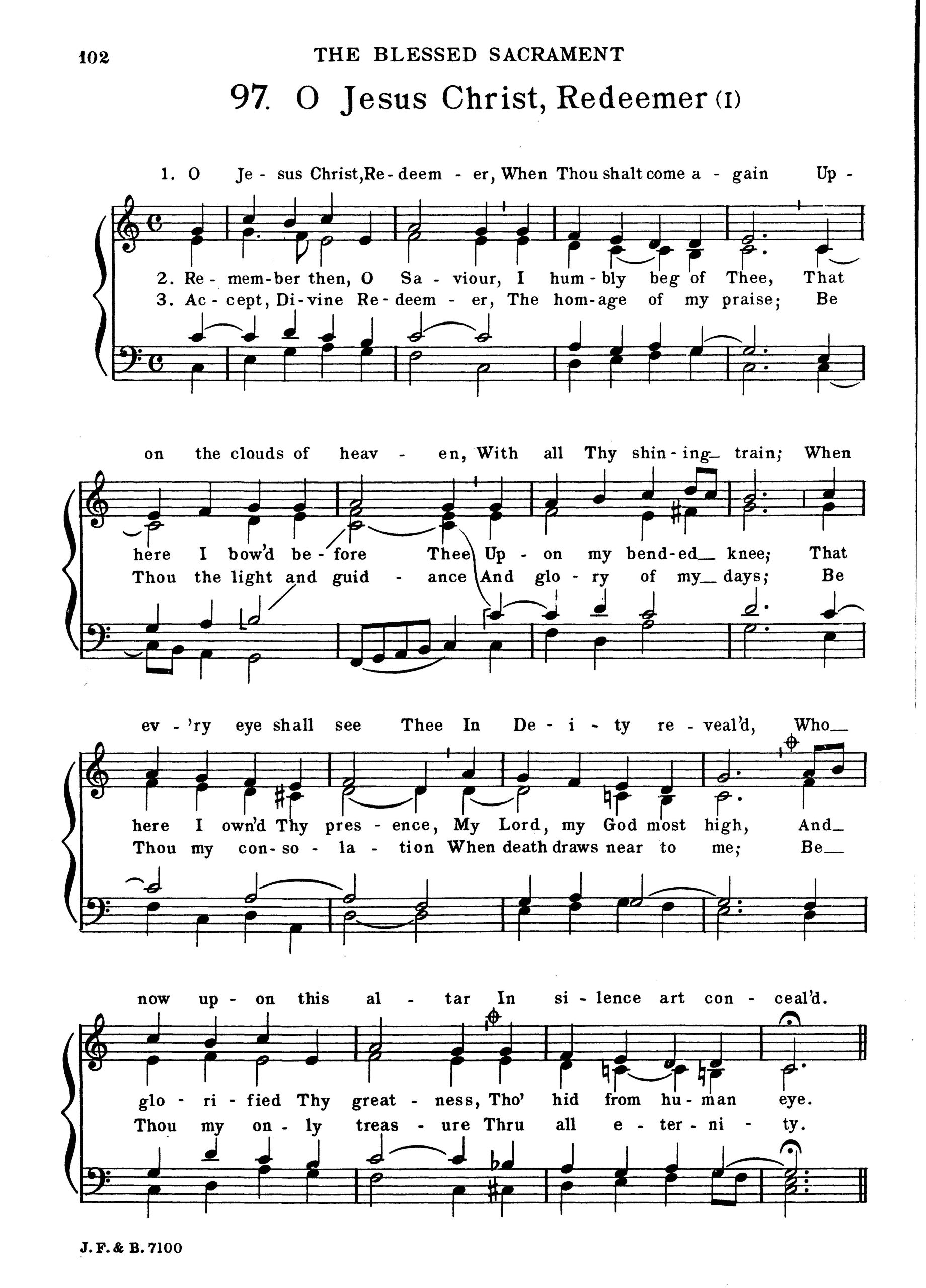
The melody also appeared in the PAROCHIAL HYMNAL published in 1951 and edited by Father Carlo Rossini. Father Rossini chose to alter the text of the hymn from O Jesus Christ Remember to O Jesus Christ Redeemer. The motive behind this change by Rossini is unclear. Perhaps he was aiming to place more emphasis on the redemptive role of Jesus Christ rather than merely his remembrance.

The Parochial Hymnal, 1951

The hymn O Jesus Christ, Remember appears in numerous hymnals beyond those previously mentioned, as evidenced by a survey of my own collection of 160 hymnals spanning from the 1840s to today. They include: Cantica Sacra or Hymns for the Children of the Catholic Church, published in 1880; The Roman Hymnal, published in 1884, by Fr. J. B. Young, S.J.; The Catholic Hymnal published in 1888 by Fr. Alfred Young; Hymns with Tunes published in 1889 by Edmund G. Hurley; The Sunday School Manual or Youth’s Manual for Church and School, published in 1908 by Thomas J. Flynn & Co.; St. Mary’s Manual, published in 1924 by Christian A. Zittel; Manual of Select Catholic Hymns and Devotions, published in 188 and 1925 by P. M. Colonel, C.SS.R; Sursum Corda – A collection of hymns for the use of Catholic Schools, published in 1925 by Fr. Florian Zettel, O.F.M.; The Ordinary of the Mass and a Complete Manual of Hymns, published in 1935 by the Public Press; The Ave Maria Hymnal, published in 1936 by Fr. Joseph J. Pierron; Cantate Omnes, published in 1958 by Cantate Omnes Publications; Cantus Populi, published in 1964 by Theodore Marier; The Catholic Hymnal and Service Book, published in 1966 by Benzinger Ed., Inc.; the Adoremus Hymnal, published in 2011 by Ignatius Press; and A Catholic Book of Hymns, published in 2020 by Sacred Music Library.

Reflection

I learned this hymn while singing in St. Mary’s Choir many years ago. We used the St. Basil’s hymnal which uses the first melody I discussed. The verses are a plea to Jesus Christ to remember us, when he comes again, because we took time to honor Him in the Blessed Sacrament.

Many years ago, a monthly Catholic magazine Messenger of the Sacred Heart, featured a short article by Father Matthew Russel, S.J., who captured quite eloquently the essence of Father Caswall’s hymn. The article was a letter addressed to the Irish Central Director. Father Russel was a Jesuit priest serving the needs of American Indians. Here is an excerpt of that letter.

…Editors and others shrink from having too many quotations; else I should last month have added Father Caswell’s expression of the feeling on which we dwelt a little—that feeling which makes us say before the Tabernacle, This is He Who will judge me!  The following simple lines may be found useful by some in their visits to the Blessed Sacrament— 

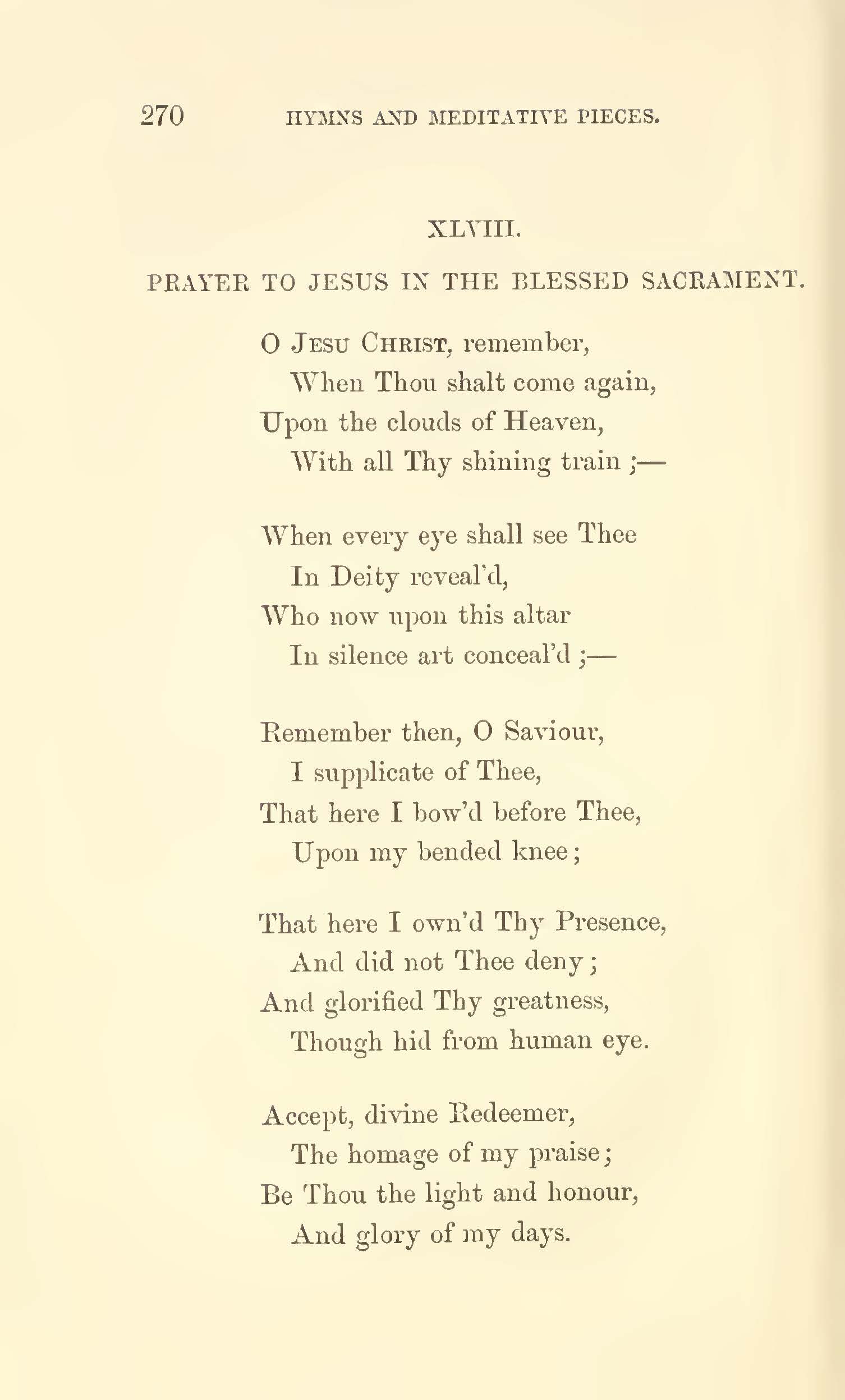
O Jesus Christ, remember, When Thou shalt come again,

Upon the clouds of Heaven, With all Thy shining train;

When every eye shall see Thee in Deity reveal’d,

Who now upon this altar, In silence art conceal’d:

Remember then, O Savior, I supplicate of Thee,

That here I bowed before Thee, Upon my bended knee;

That here I own’d Thy Presence, And did not Thee deny,

 And glorified Thy greatness, Though hid from human eye. 

The substance of these lines may very naturally occur to us when kneeling before the altar and may increase our sense of the happy security of our faith. Such a plea will surely avail with Him Who has promised to confess before His Heavenly Father all who confess Him before men. He will not disown us, but recognize us as His special friends, if we on earth recognize Him under every disguise of His love, and pursue Him untiringly with the faithful worship of our love. ~ Fr. Mathew Russell, S.J., May 10, 1885.

The scripture-based songs we sing today like We Remember how you loved us; or Jesus, Remember Me; or We Remember One who loved us well, can’t compare to this hymn. O Jesus Christ, Remember would make an excellent hymn to sing when kneeling before the Blessed Sacrament. I think too, this would make a wonderful Offertory or Communion hymn!

Below is a choice of the melodies listed above which have been composed for the hymn. These are computer generated sound files. The tempo is approximate but should provide the listener with a good sense of what the hymn sounds like.

I would also like to thank Peter Meggison who produces The Devotional Hymns Project for allowing me to share a recording by the choral scholars from St. Peter’s Church in Columbia, South Carolina

album-art

00:00