Introduction
Over the last four years, I have surveyed hymns to the Sacred Heart of Jesus from my collection of Catholic hymnals. I have decided to present some of the findings of that research in this preliminary analysis. This study draws on a robust and expanding dataset that represents the culmination of this long-term archival research and recovery.
Drawn from a wide range of English-language Catholic hymnals spanning the 19th and early 20th centuries, this study maps the historical footprint of a defining Catholic devotion. While approximately forty additional hymnals remain to be integrated into the final index, the present dataset contains exactly 1,392 occurrences across 161 unique historic hymnals. It yields clear, undeniable patterns in devotional emphasis, textual theology, musical style, and repertoire stability.
Scope of the Current Index and Horizons for Future Expansion
While the current iteration of Sacred Heart Hymnody represents a robust foundational dataset, it is bounded strictly by the content of bound, English-language parish hymnals. It does not yet reflect the full breadth of ephemeral or localized devotional music from the era. To preserve a clear horizon for future expansion, it is important to note what remains outside the current index.
A substantial secondary collection of historical source materials is currently slated for future integration. This includes individual published sheet music pieces and pamphlets/booklets specifically printed for Sacred Heart devotions. Furthermore, the dataset will be expanded internationally to include transpacific traditions, beginning with multiple editions of The Australian Catholic Hymn Book spanning 1884 through 1916.
Finally, future phases of this recovery project will systematically index vital Catholic musical periodicals and institutional collections, including:
- The Catholic Choirmaster (1915–1923)
- The Caecilia Magazine (1927–1965)
- The Messenger of the Sacred Heart periodical (1880–1908)
- A rare, localized collection of hymns and motets Used by the Pupils of the Sisters of the Sacred Heart, documenting historic devotional footprints in Paris, France, and Roehampton, England (1865–1908).
Incorporating these ephemeral, periodical, and international resources will ultimately transform this survey from a study of mainstream hymnal publishing into an exhaustive, definitive global atlas of Sacred Heart hymnody.
A Note on Methodology: Occurrences vs. Usage
It is vital to clarify a critical distinction regarding the nature of this dataset: this survey documents the occurrence of hymn texts within published hymnals, not their actual parish usage. The data tracks editorial choice, publisher distribution, and repertoire availability across 161 historic volumes; it does not provide historical records of how frequently these hymns were actively performed or selected by local parish musicians.
While one might reasonably infer that a hymn printed 106 times across multiple decades enjoyed widespread popularity, these numbers strictly quantify a hymn’s systemic presence in the Catholic publishing market. Acknowledging this boundary preserves the academic integrity of the survey, shifting our focus to how a stable devotional repertoire was curated and made available to the faithful, rather than attempting to measure the unrecorded weekly choices of historic choir directors.
Far from offering a static spreadsheet of titles, this survey exposes a living tradition. The data charts the physical, transatlantic migration of the devotion from European centers to American metropolitan hubs, uncovers the clever corporate strategies of historic music publishers, and traces how immigrant communities preserved their native cultural voices in the parish pew.
Ultimately, the goal of this analysis is twofold: first, to decode a historically fragmented publishing record by identifying the core, prominent hymns that sustained generations of Catholics ; and second, to provide immediate, practical recommendations for parishes seeking to ground modern liturgies, Holy Hours, and national consecrations in a deeply rooted, historically proven pastoral legacy.
1. Historical & Analytical Findings
The dataset spans from 1807 to 1966, with a massive concentration between approximately 1890 and 1935 (median date: 1913). This period corresponds closely with the height of Sacred Heart devotion in Catholic life, particularly following the spread of the devotion after the revelations to St. Margaret Mary Alacoque and its formal encouragement by the Holy See in the 18th and 19th centuries.
A decade-by-decade breakdown of the data reveals that publishing activity swelled significantly in the 1880s (147 entries) and 1890s (185 entries), remaining incredibly strong through the turn of the century (195 entries in the 1900s). The absolute historical peak of publishing occurred during the 1920s, which yielded an astonishing 237 unique entries. The clustering of hymnody in this period suggests that Sacred Heart devotion was not merely theological but deeply embedded in parish practice, devotional societies, and popular hymnody. The sharp decline in representation after the mid-20th century likely reflects broader shifts in liturgical and devotional priorities rather than a loss of theological importance.
The Transatlantic Migration of Tradition
The dataset simultaneously tracks a literal “migration” of Catholic tradition. In the mid-19th century, the musical repertoire was heavily anchored in European hubs like London (129 entries) and Dublin (24 entries). However, by the 1920s, the “center of gravity” shifted dramatically to the United States. This era saw an explosion of publishing activity dominated by massive metropolitan hubs like New York (371 entries) and Boston (272 entries), rapidly scaling up production to serve growing immigrant populations.
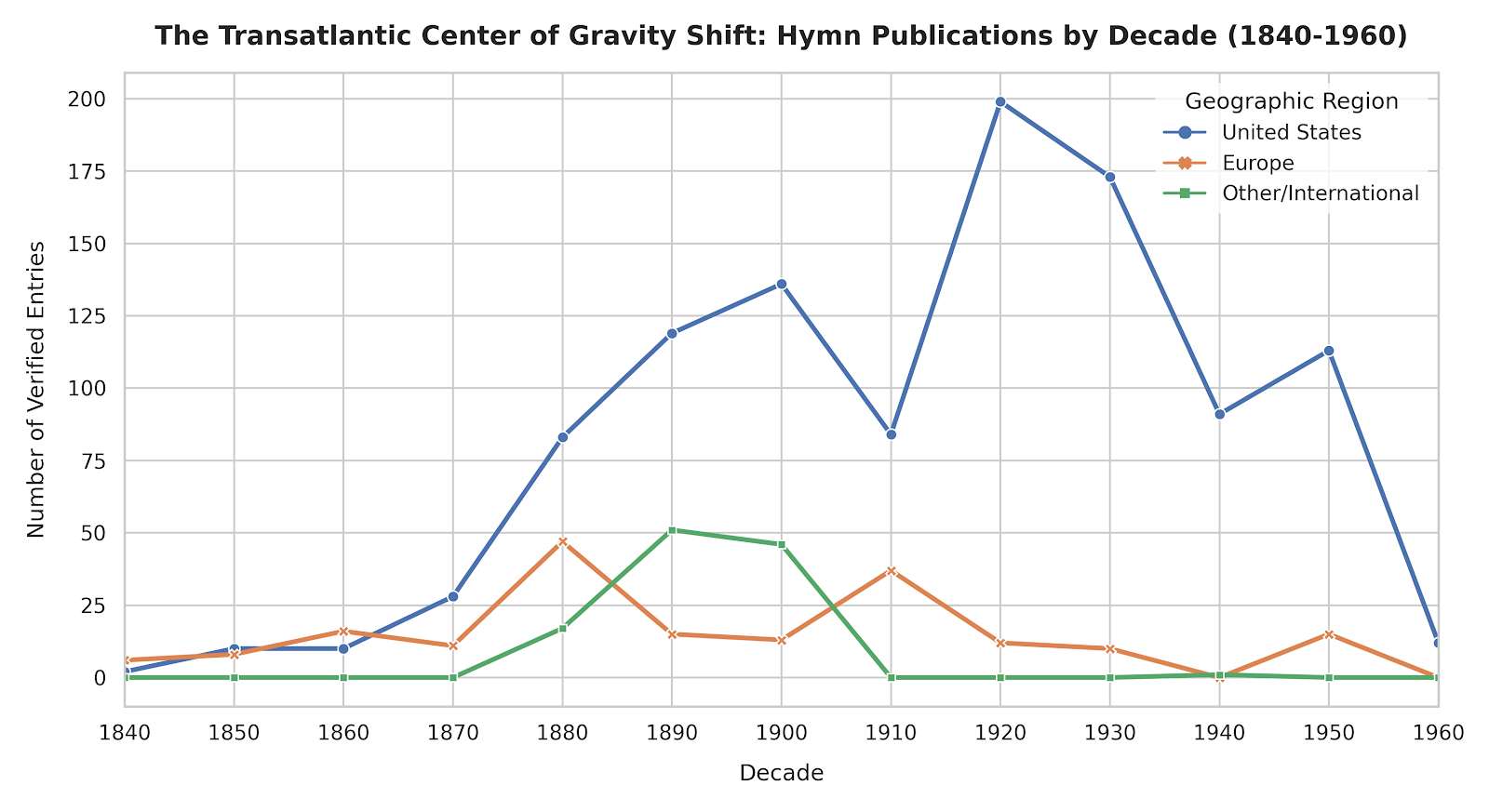
This visualization above, captures the precise rise and fall of the publishing eras. You can visually track how the American publishers began aggressively scaling up right around the 1880s, hitting that dramatic historical peak in the 1920s before dropping off in the mid-20th century.
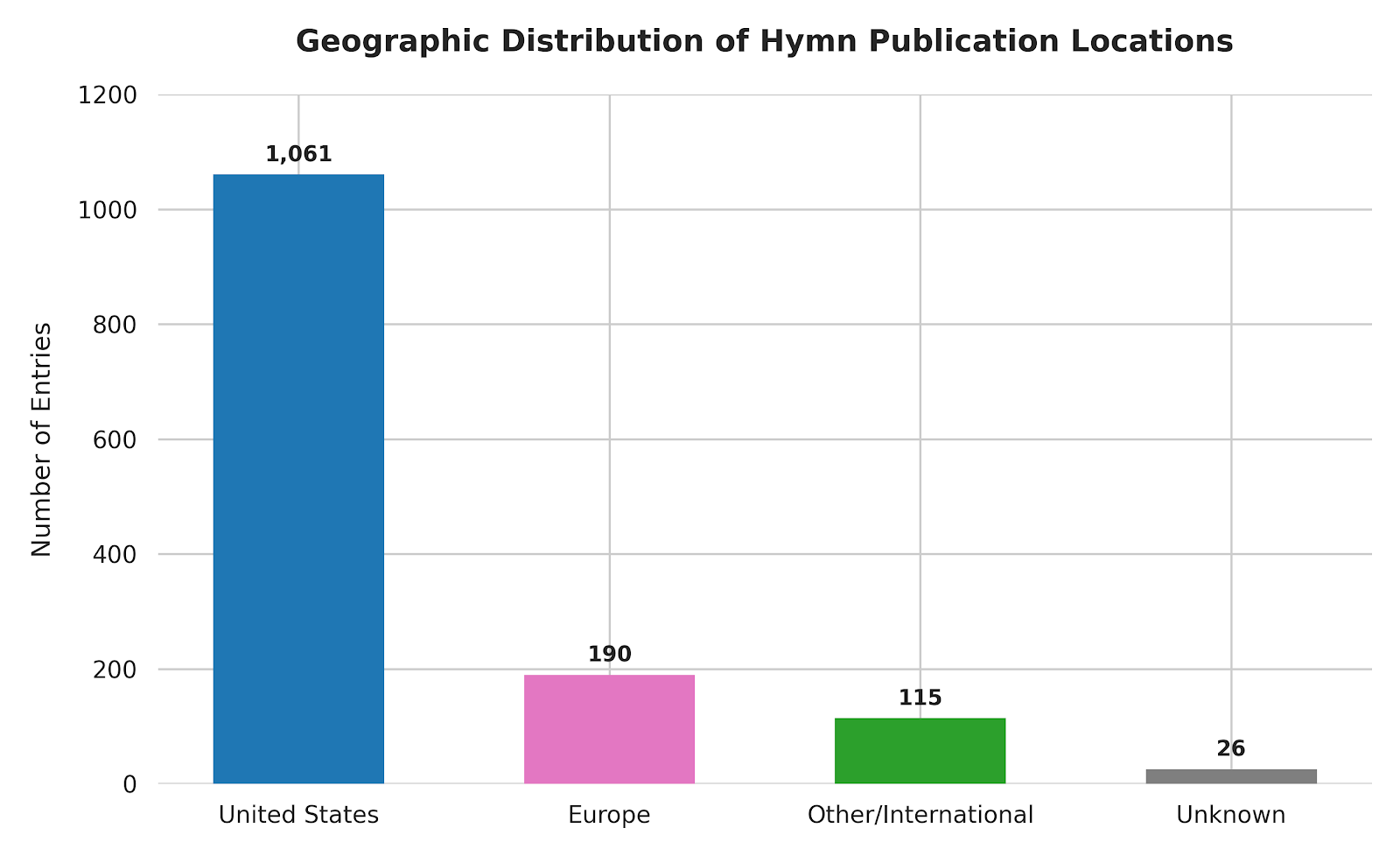
The chart above displays consolidated publication locations grouped into their true regional baselines, showcasing the clear dominance of the American market.
2. Repertoire Stability and Core Hymns
A striking feature of the dataset is the emergence of a relatively small group of highly recurrent hymns, suggesting a stable “core repertoire” used across multiple hymnals and generations.
Most frequently occurring hymns include:
- To Jesus’ Heart All Burning (93 named occurrences; 106 first-line matches)
- Hear the Heart of Jesus Pleading (20 occurrences)
- Sweet Heart of Jesus [Fount/Source] of Love and Mercy (20 occurrences)
- Sacred Heart in Accents Burning (19 occurrences)
- To Christ the Prince of Peace (18 occurrences)
- O Sacred Heart, O Love Divine (18 occurrences)
- O Sacred Heart, Our [Home/Hope] lies deep in Thee (16 occurrences)
- O Cor Amoris Victima (21 occurrences)
- Cor Dulce, Cor Amabile (7 occurrences)
This repetition across sources highlights a stable devotional core, yet it simultaneously uncovers a “nomenclature trap” for modern researchers. Dominant historic publishers frequently assigned custom titles (such as Cor Amoris or Praise to the Sacred Heart) to the exact same text. For example, while To Jesus’ Heart All Burning is explicitly titled as such 93 times, a text-match search of its opening first line (“To Jesus’ Heart all burning with fervent love for men”) reveals 106 separate occurrences. By tracking these variations down to their unique first lines, this survey unifies what otherwise appears to be a fragmented tradition.
The Latin selections featured above are highly representative of the broader historical repertoire. By pairing O Cor Amoris—one of the most widely distributed texts in the national survey—with the beautifully accessible Cor Dulce, Cor Amabile, these pieces collectively capture both the widespread institutional footprint and the practical, lived choral traditions of the era.
Note on Methodology: The number of occurrences shown above reflects the text’s frequency across the nation and is not an evaluation of the regional melodies. While a single text often wandered between various regional settings and musical compositions, these figures strictly document the historical distribution of the metrical verse itself. As a point of data limitation, these metrics quantify the historical presence of hymns within printed hymnals rather than documenting daily parish usage frequencies.
3. Theological Themes in the Texts
The textual incipits and titles reveal a consistent theological framework centered on several key motifs:
3a. Affective Devotion
Many hymns emphasize emotional intimacy with Christ:
- “Sweet Heart of Jesus, fount [or source] of love and mercy”
- “I dwell a captive in this Heart”
This reflects the affective spirituality characteristic of Sacred Heart devotion, focusing on love, consolation, and personal union with Christ.
3b. Reparation and Consolation
Texts frequently present the Heart of Jesus as wounded by human sin and in need of consolation:
- “Hear the Heart of Jesus pleading”
This aligns with the theology of reparation, central to Sacred Heart devotion.
3c. Eucharistic and Liturgical Resonance
Some hymns connect the Sacred Heart with Eucharistic imagery and perpetual adoration:
- “Upon the altar night and day”
This reinforces the integration of Sacred Heart devotion with the liturgical life of the Church.
3d. Kingship and Sovereignty
Certain texts emphasize Christ’s kingship and authority:
- “To Christ the Prince of Peace”
This theme provides a natural bridge to national consecration contexts.
3e. Latin Hymnody and Devotional Context
The dataset maintains a vital link to the universal language of the Church, featuring a robust tradition of Latin hymnody. Rather than existing as isolated relics, these texts frequently reappeared in creative variations across the centuries, serving as stable pillars of doctrinal clarity:
- Cor Jesu / Cor Jesu Variants: (46 combined occurrences; 12 as an exact standalone Cor Jesu)
- Cor arca legem continens: (9 occurrences)
- Cor dulce cor amabile: (7 occurrences)
- Cor Jesu cor purissimum: (5 occurrences)
- Summi Parentis Filio: (5 occurrences)
3f. Inculturated Devotion and the “Native Voice”
While the dataset primarily highlights English and Latin traditions, it simultaneously uncovers how deeply embedded and adaptable this devotion was across cultural lines. The archival record reveals the “Native Voice” of immigrant communities—particularly within the German-American settlements of the Great Lakes region.
The inclusion of historic German titles such as “Dem Herzen Jesu singe” (sung to the same architectural structure as To Jesus’ Heart All Burning) demonstrates that as immigrant populations migrated, they did not abandon their heritage. Instead, they utilized their native tongue to weave familiar European devotional expressions into the emerging American parish landscape.
This inculturation was heavily championed by local hierarchy; most notably, Bishop Joseph Schrembs (the first Bishop of Toledo and later Archbishop of Cleveland) appears 11 times in the dataset as a composer. His pastoral work focused heavily on providing accessible musical settings that allowed German-American congregations to sing in unison, bridging their European devotional inheritance with their new American parish life.
4. Musical Characteristics and Publisher Dynamics
The musical landscape of the dataset reflects a transition from traditional European part-singing to highly accessible, community-focused parish hymnody. Rather than being dictated by a single aesthetic standard, the musical characteristics were heavily driven by the commercial and pastoral strategies of dominant historic publishers.
4a. Publisher Footprints and Corporate Strategy
The sheer volume of entries in the dataset underscores the immense influence of a handful of publishing houses in defining the soundscape of American Catholic devotion. Foremost among these are McLaughlin & Reilly Co. (122 total entries) and J. Fischer & Bro., whose massive catalog contributes 119 total entries (including 85 unique titles) to this study.
Publishers like Fischer and McLaughlin & Reilly did not merely print music; they actively curated the tradition. By commissioning prolific lyricists like Eleanor C. Donnelly (who leads the dataset with 57 authored entries) and frequently re-titling existing melodies (the “nomenclature trap” outlined in Section 2), they successfully established brand dominance and ensured their hymnals became indispensable staples of parish choir lofts across the United States.
4b. Melody, Repertoire, and Community Accessibility
Musically, the repertoire prioritizes melodic familiarity and ease of congregational participation. A significant portion of the English-language entries utilizes melodies widely familiar to a community—serving as a true “Common Meter” of the people that bypassed complex musical notation in favor of immediate utility.
This focus on accessibility explains the massive longevity of core hymns like To Jesus’ Heart All Burning (106 first-line occurrences). Its structural rhythm perfectly aligned with the predictable pulse required for large, untrained assemblies to sing in unison, ensuring the devotion could easily migrate from formal choral performance to spontaneous parish prayer.
5. Implications for Contemporary Parish Use
The historical data strongly refutes the modern assumption that suitable Sacred Heart hymnody is scarce or inaccessible. Instead of looking for entirely new compositions, parishes preparing for devotional milestones can draw from a deeply rooted, historically proven repertoire that is both theologically rich and pastorally accessible.
Recommended Core Hymns & Liturgical Placement
The following hymns are highly recommended due to their high historical frequency, theological clarity, and capacity for congregational singing:
- Entrance or Exposition: O Sacred Heart, O Love Divine
- During Adoration: To Jesus’ Heart All Burning or Sweet Heart of Jesus [Fount/Source]
- Act of Consecration: To Christ the Prince of Peace (ideal for themes of Kingship and sovereignty)
- Reposition or Closing: Hear the Heart of Jesus Pleading
Choral Note: For parish choirs capable of polyphony, the underlying themes of adoration, love, and reparation highlighted throughout this survey align perfectly with standard historical Sacred Heart motets. Utilizing these core congregational hymns alongside traditional polyphonic settings allows a choir to elevate the liturgy while maintaining an unbroken, accessible musical dialogue with the pews.
Pastoral Application
The most fruitful approach for contemporary renewal is not the creation of new materials, but the deliberate recovery of this inherited tradition. These hymns do not just provide an enduring vocabulary for divine love, reparation, and the kingship of Christ—they connect modern worshipers to a musical legacy that has successfully sustained parish devotion for generations. By restoring these core hymns to the standard parish repertoire, local leadership can ground modern devotions in a stable, accessible, and historically rich tradition.
Conclusion
Even in its preliminary state, this survey reveals a coherent and deeply rooted tradition of Sacred Heart hymnody, characterized by theological unity, musical adaptability, and remarkable consistency across time. The evidence suggests that parishes preparing for a national consecration would benefit most not from novelty, but from a deliberate retrieval of this tradition.
Readers interested in exploring this repertoire further or incorporating it into parish life are encouraged to consult two complementary resources: the Devotional Hymns Project, which provides curated access to historic Catholic hymn texts and recordings, and the Sacred Music Library, a broader repository of liturgical and devotional music, especially “A Catholic Book of Hymns”. Together, these platforms offer practical tools for clergy, musicians, and scholars seeking to engage more deeply with the living tradition of Sacred Heart hymnody.
As additional hymnals are incorporated into the dataset, it is highly likely that these patterns will be further reinforced rather than overturned, continually strengthening the case for a historically grounded, pastorally rich response.
The Living Repertoire – Devotional Recordings from St. Mary’s (Akron, Ohio)
As definitive proof of the enduring longevity and pastoral utility of this core repertoire, this survey concludes with a historic archival audio collection from St. Mary’s Church in Akron, Ohio. Recorded during a special parish devotion in honor of the Sacred Heart of Jesus in June 1982, these live selections demonstrate how the exact hymns curated by 19th- and early 20th-century publishers continued to shape the organic devotional life of mid-western American parishes generations later.
Featured prominently in this audio collection is “O Sacred Heart, O Love Divine“ (the parish Hymn of the Month), alongside live parish recordings of the survey’s most historically frequent selections, including the definitive “To Jesus’ Heart All Burning,” the Eucharistic-centered “Peace Be Still, Our God is Dwelling” (first published in 1891), and the devotional act of thanksgiving, “Heart of Jesus, We Are Grateful.”