Introduction: A Shared Anthem, A Distinct Devotion
For generations of American Christians, Sarah F. Adams’ 1841 text and Lowell Mason’s 1856 melody, Bethany, have served as the quintessential anthem of Christian hope, mortality, and final rest. While universally recognized as a staple of Protestant hymnody, Nearer, My God, To Thee holds a fascinating, deeply localized, and often overlooked history within the Roman Catholic Church in the United States. Far from being a simple borrowing of Protestant culture, the hymn underwent a profound theological inculturation during the late 19th and early 20th centuries, finding a home in major Catholic hymnals, parish obituaries, and the private devotional lives of the faithful.
The Sacred Heart Verses: An Anonymous Inculturation (1868–1935)
As waves of European Catholic immigrants established parishes across the United States in the mid-to-late 19th century, publishers sought to provide English-language hymnody that resonated with the American context while remaining fiercely protective of Catholic doctrine. The historical cornerstone of this movement was Peter F. Cunningham’s The Hymn-Book.
While an 1868 edition explicitly links the text to prayers for Mass and the anonymous Sacred Heart verses, an extraordinary archival discovery from the May 31, 1856, issue of The Boston Pilot page 2, right-hand column, reveals that this publication was already a legendary staple of American Catholic life long before the dawn of the American Civil War. The 1856 advertisement reveals that The Hymn Book had already reached its “Seventh Edition” by the spring of that year, selling for a mere 6 cents a copy (or 50 cents per dozen) and boasting that it comprised “all the best and most popular Catholic Hymns as now used all over the country, with the Approbation of our Right Rev Bishop.” (Click on any image to enlarge)

By the time later publisher catalogs advertised that the text had reached its “180th thousand” print run, it had achieved a staggering saturation of the American Catholic market. Because it was priced for the working class, immigrant families carried it in their pockets to daily Mass, parish missions, and family devotions.
The 1856 Boston Pilot clipping, however, introduces a fascinating historical and musicological puzzle. Lowell Mason did not compose Bethany—the melody universally associated with Nearer, My God, To Thee—until 1856. This timeline creates two compelling possibilities for how the hymn evolved within the Catholic consciousness:
- The Evolution of Melody: If the Sacred Heart verses were already nestled inside the 1856 Seventh Edition, they were initially sung to an older, lost traditional melody, only marrying Mason’s famous Bethany tune later when it swept the nation.
- A Living, Growing Compilation: Alternatively, The Hymn Book was an evolving text. Having established itself as a national bestseller by 1856, later editions (such as the 1868 printing) actively absorbed and baptized Nearer, My God, To Thee with the anonymous Sacred Heart verses once Mason’s tune became a cultural phenomenon.
In either scenario, this staggering print volume completely recontextualizes the hymn’s history. It proves that for a vast portion of the American Catholic faithful in the late 19th century, the traditional Protestant imagery of Jacob’s ladder was thoroughly supplanted. For an entire generation of believers, the familiar melody did not conjure images of a stony pillow, but rather served as a direct, intimate, and widely shared prayer of reparation to the Pierced Heart of Jesus.
While the identity of the poet who adapted these verses remains shrouded in historical anonymity, the publishing ecosystem of Peter F. Cunningham strongly suggests a monastic origin. Cunningham frequently collaborated with the Religious of the Sacred Heart of Jesus (‘The Ladies of the Sacred Heart’) to translate and compose English devotional materials. It is highly likely that a sister of this order, operating under the traditional veil of religious humility, penned these verses. In doing so, she chose to leave her own name forgotten, ensuring that the listener’s focus remained entirely fixed on the wounded Heart of Christ.
By supplanting the original lyrics—which draw heavily on the Old Testament imagery of Jacob’s dream at Bethel—with verses centered on the pierced Heart of Christ, this anonymous Catholic author transformed a hymn of general providence into an intimate, Christocentric prayer of reparation. For nearly seventy years, this version flourished across a wide spectrum of Catholic instructional and devotional materials:
- It was curated by religious orders for the formation of youth, as seen in the Sisters of Notre Dame’s Sunday School Hymn Book (1887–1935) and the Basilian Fathers’ prominent St. Basil’s Hymnal (1888–1918).
- It found a home in standard parish collections across major immigrant hubs, including Laudis Corona (1880), Father A. Police’s Parochial Hymn Book (1897), and Francis J. Butler’s The Holy Family Hymn Book (1904).
Interestingly, its inclusion was not always without pastoral reservation. In the 1908 collection Hymns for the Ecclesiastical Year, compiler Alphonsus Dress appended a strict pedagogical note: the hymn was to be sung “only at Mission for Non-Catholics” (a restriction shared with John Henry Newman’s Lead, Kindly Light). This reveals an early liturgical tension, showcasing how some clergy viewed the melody as a pastoral bridge for converts, rather than standard fare for the high Latin liturgy. By 1935, as the Church in America consolidated its identity and moved toward stricter liturgical standardization, the Sacred Heart verses faded from print.
Pre-Vatican II Funerary Practice: A Hymn for the Requiem
Despite its eventual disappearance from standard hymnals, historical obituaries demonstrate that Nearer, My God, To Thee remained deeply embedded in the lived experience of Catholic grief and hope during the first half of the 20th century. It served as a powerful emotional bookend to the rigorous, objective ritual of the Latin Requiem Mass.
Archival accounts suggest a flexible pastoral application of the hymn within the funeral liturgy, echoing alongside traditional Latin chants like the Miserere and Pie Jesu:
- The Processional: In 1932, at the funeral of Sister Mary Rose (Alvina Woisard) in Connecticut, the hymn was utilized to accompany the solemn entry of the casket into the church. (The Catholic Transcript, Thursday 3-24-1932, pg.7)
- The Recessional: Conversely, the 1921 obituary of Mary Gertrude Drumright in Oklahoma notes the hymn’s execution at the conclusion of the Mass as a recessional.
- The Graveside Committal: For many families, the hymn accompanied the deceased to their final resting place. Records for Blazius Brzozowski (1931) and Daniel Daley Jr. (1936) indicate that Nearer, My God, To Thee—frequently paired with other devotional hymns like Sweet Name Which Makes the Dying Live—was sung at the graveside, offering comfort in the open air where the strictures of church rubrics were relaxed.
Because these accounts highlight a diverse cross-section of the faithful—ranging from a religious sister to prominent citizens—it is clear that the hymn was a beloved staple across American Catholic parishes during the pre-Vatican II era.
Musicological Evidence: A Survey of the Catholic Scores
While historical records tell us these hymnals existed, the surviving musical scores provide concrete evidence of how the text was preserved, altered, and sung across different generations of Catholic life. A close textual analysis of the scores from Laudis Corona, the Sunday School Hymn Book, the Parochial Hymn Book, and St. Basil’s Hymnal reveals the consistent retention of the Sacred Heart verses alongside evolving musical arrangements.
1. Laudis Corona (1880/1885)
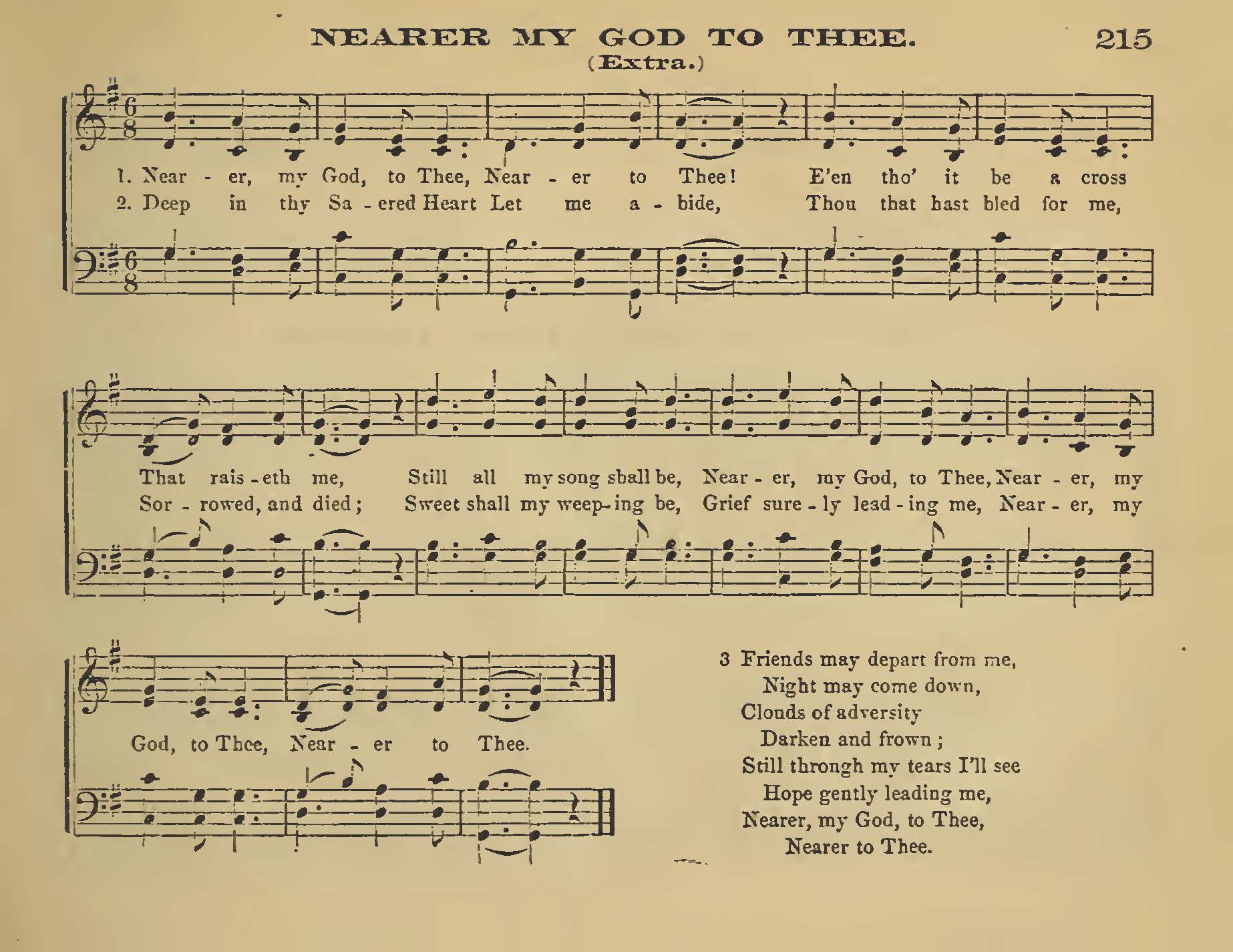
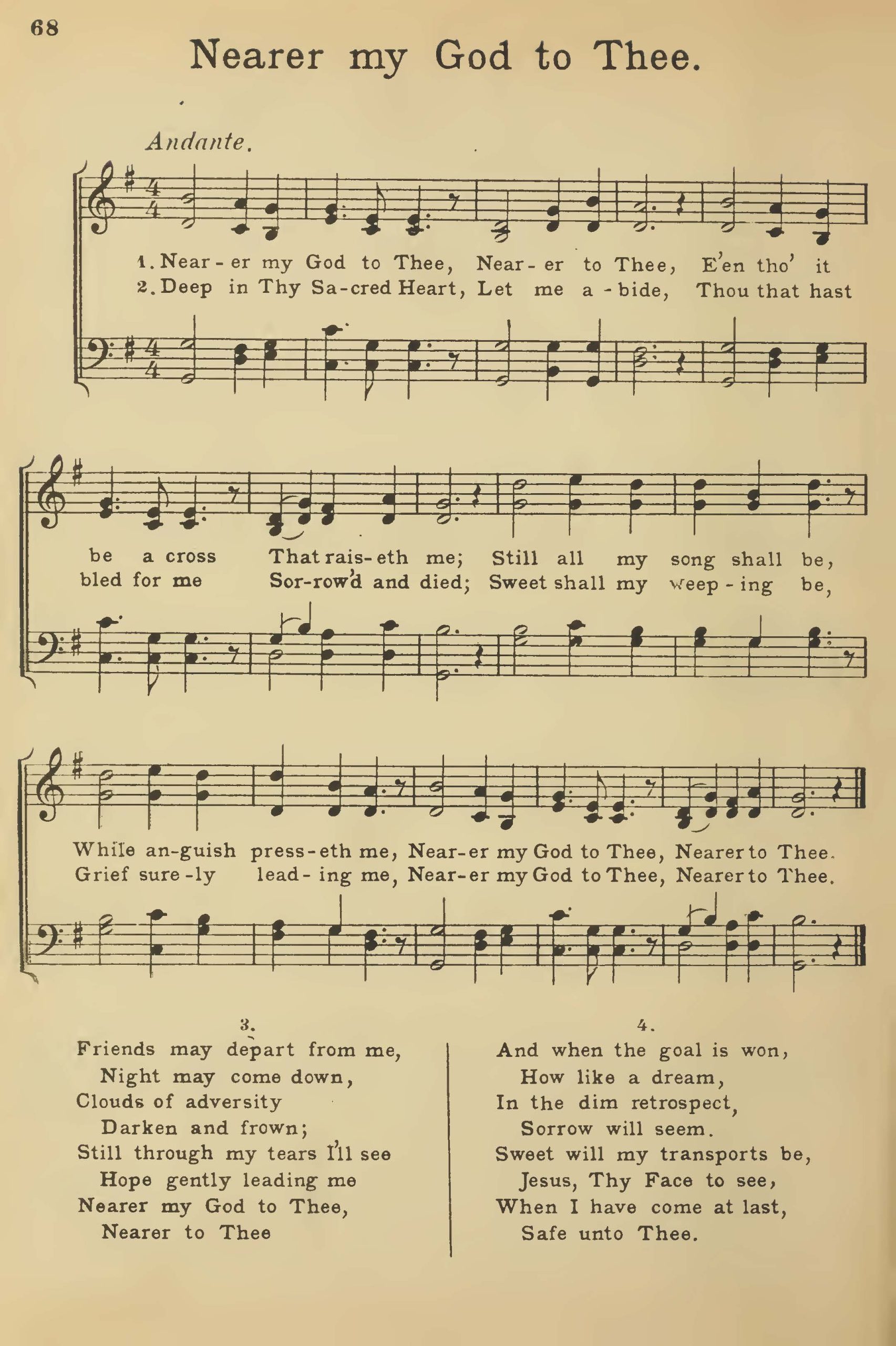
The score from Laudis Corona is a critical piece of evidence because it demonstrates that by 1880, the Sacred Heart verses were explicitly standardized into a five-stanza structure. The score sets the text to a standard melodic frame, but the poetry immediately shifts focus away from Bethel’s wilderness to the Pierced Heart:
“Deep in Thy Sacred Heart / Let me abide, / Thou that hast bled for me, / Sorrowed, and died…”
This score is crucial to the narrative because it proves that within twelve years of Cunningham’s first publication, the text had been successfully picked up by East Coast compilers and distributed nationally by major houses like Sadlier.
2. Sunday School Hymn Book (1887–1935)
Compiled by the Sisters of Notre Dame, the score in this volume features simpler, child-friendly voicing meant for pedagogical use. The presence of Nearer, My God, To Thee in this specific collection indicates that the Sacred Heart version was not considered adult-only devotional material. Rather, the music score shows that the Sisters were actively using this melody and its Christocentric words to catechize young children, embedding the devotion to the Sacred Heart into their spiritual muscle memory from a young age.
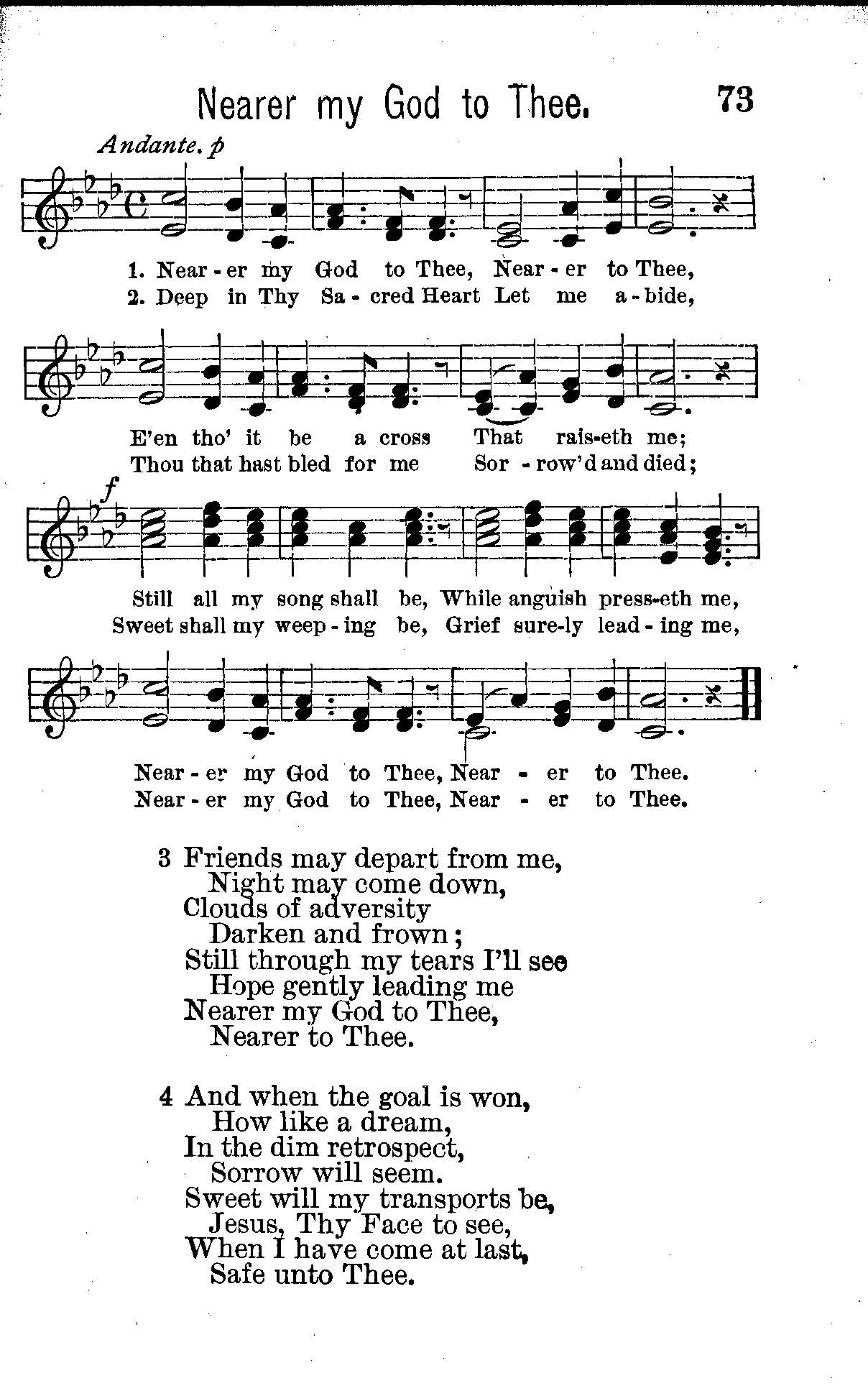
3. The Parochial Hymn Book (1897)
Father A. Police’s Parochial Hymn Book is famous for its transatlantic scope, serving parishes in New York, London, and Dublin. The musical score in this volume represents a higher level of liturgical or choral sophistication. Incorporating this score demonstrates that the Sacred Heart verses were not just an American anomaly; the music traveled the English-speaking world, offering a uniform, globalized Catholic alternative to the Protestant original text.
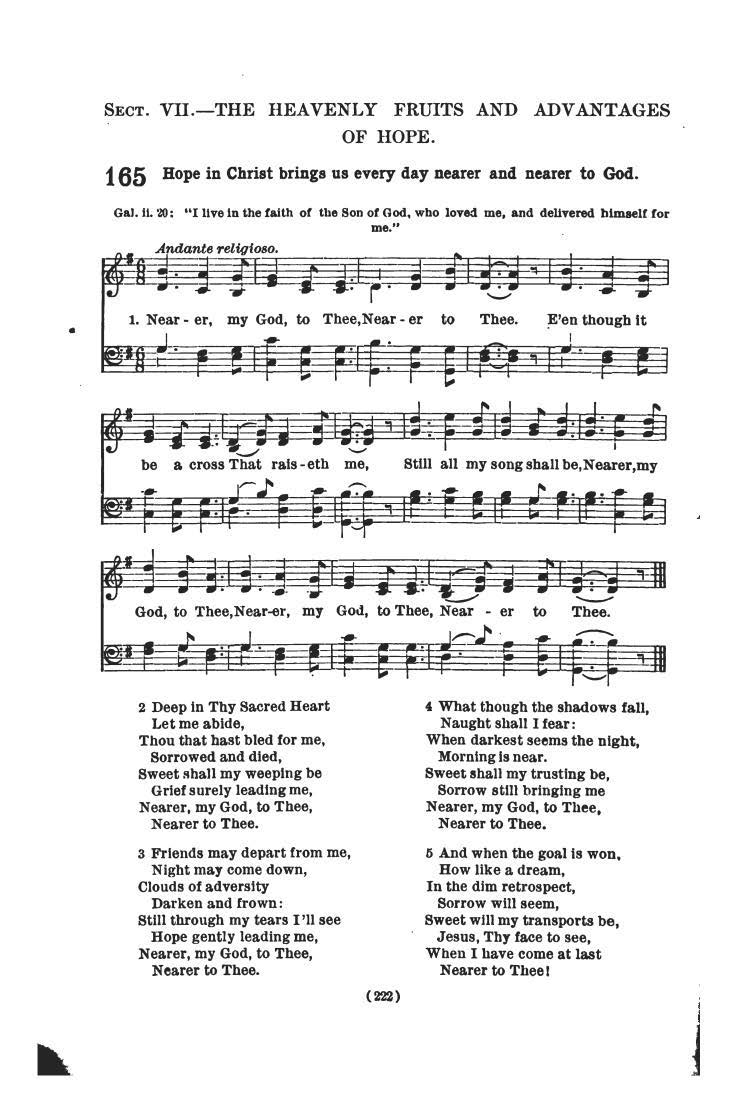
4. St. Basil’s Hymnal (1888–1918)
As perhaps the most widely used and influential American Catholic hymnal of its era, the score from St. Basil’s represents the peak of the hymn’s mainstream Catholic usage. Set to the familiar four-part harmony of Lowell Mason’s Bethany, the St. Basil’s score acts as the definitive musical snapshot of this tradition before it began to fade from twentieth-century prints after 1925.
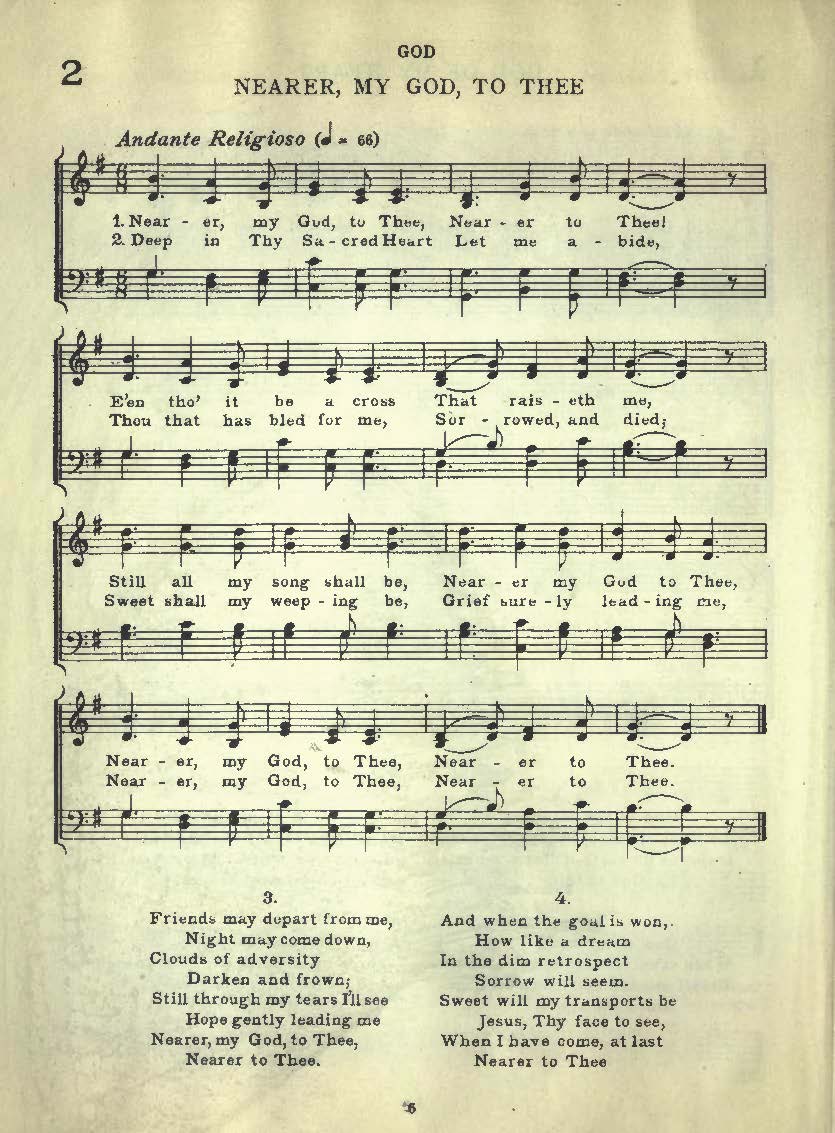
5. Other Hymnals
Beyond the widespread reach of the St. Basil’s Hymnal, further historical and musicological evidence of these unique Catholic text variations is preserved across several notable late-nineteenth and early-twentieth-century collections:
Hymns with Tunes (compiled by Rev. Edmund G. Hurley, 1889)
The Holy Family Hymn Book (compiled by Francis J. Butler, 1904)
The Youth’s Manual (published by Thomas J. Flynn & Co., 1908)
Additionally, a significant textual lineage is found in the publications of The Bergé Music Company, compiled under the direction of Louis Bergé. These volumes include:
The Book of Gems (1904)
New Catholic Hymn Book (1906)
Young Peoples Catholic Hymn Book (1911)
The inclusion of the Bergé collections is particularly vital to illuminating what was lost in the later push for uniformity. These volumes do not merely alter a few words; they contain a distinctive Marian stanza of verses. Rather than maintaining a purely sentimental or generalized narrative, editors like Bergé deliberately introduced explicitly Marian imagery. This served to deeply anchor the hymns within the liturgical, devotional, and theological culture of the Catholic faith, proving that these revisions were treated as intentional pieces of sacred art.
The list above does not represent an exhaustive search of my entire hymnal collection for every occurrence of “Nearer, My God, to Thee,” these specific volumes offer definitive evidence of a rich, intentional tradition of Catholic textual adaptation.
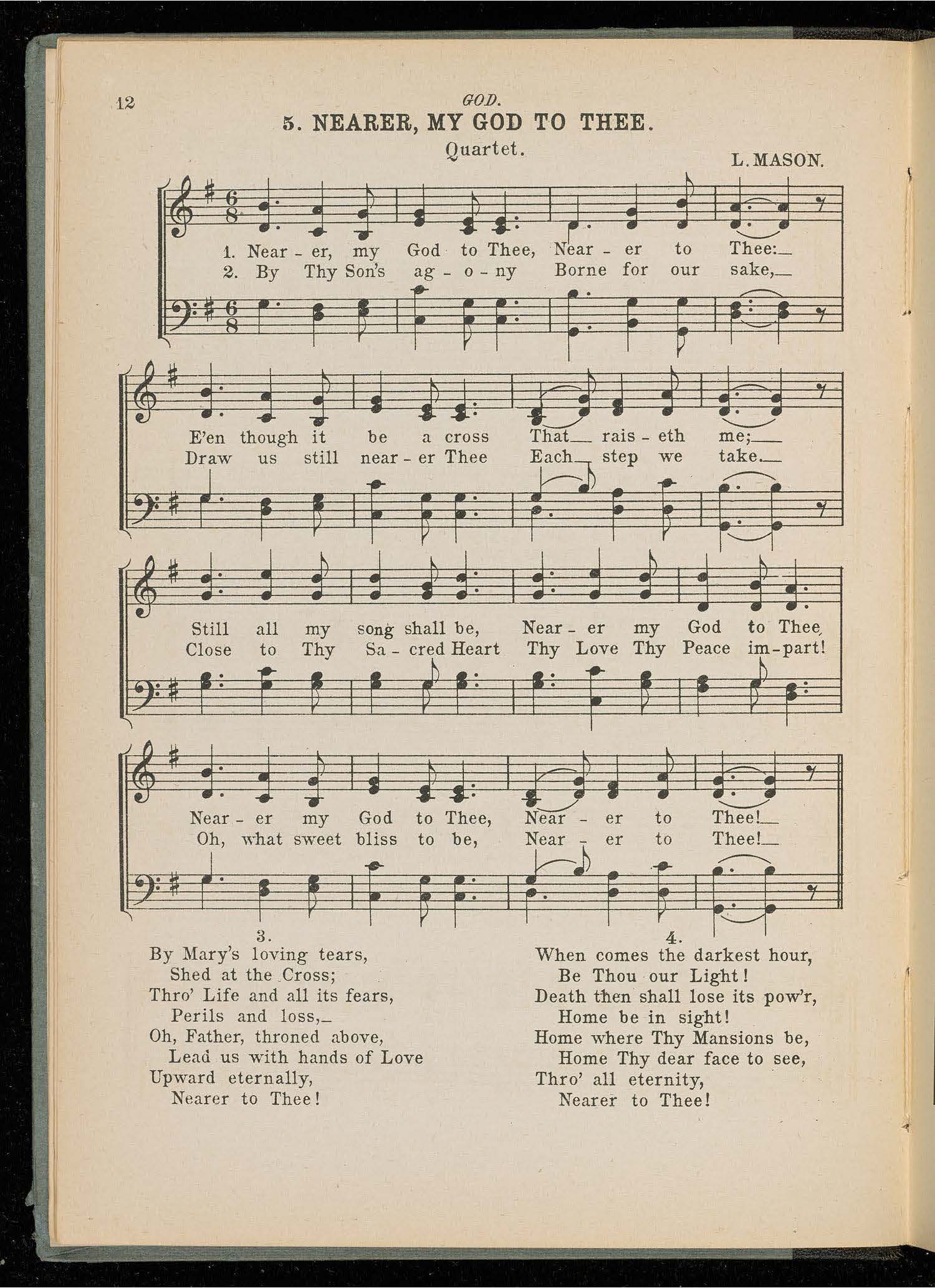
Rhythmic Variance and the Scottish Roots of Bethany
Beyond textual variations, surviving Catholic scores reveal considerable flexibility in how compilers presented Lowell Mason’s Bethany. Collections such as Laudis Corona and St. Basil’s Hymnal alternate between 6/8 and 4/4 meter. The former preserves a gentler, folk-like character suited to devotional and educational settings, while the latter transforms the melody into a more stately chorale appropriate for funerals and congregational worship.
The melody itself may have deeper roots than Mason’s 1856 composition. Hymnologists have noted similarities between Bethany and the traditional Scottish air “The Auld House“, suggesting that Mason may have drawn upon older folk traditions when shaping the tune. Whether consciously or not, the resulting melody represented a remarkable cultural journey. By pairing it with the anonymous Sacred Heart verses, Catholic editors effectively baptized a tune shaped by Scottish folk music and American Protestant hymnody into a distinctly Catholic expression of devotion and reparation.
Lyrical Analysis: The Total “Baptism” of a Text
When we look at the exact verses preserved across Laudis Corona, St. Basil’s, and the Sunday School Hymn Book, we see a highly unified, intentional effort to rewrite the hymn’s theology from scratch. While the opening stanza retains Sarah Adams’ universal cry of a soul longing for God through suffering, the remaining four stanzas are a total departure.
Here is how the anonymous Catholic author masterfully transformed the text:
Stanza 1: The Shared Threshold
Nearer, my God, to Thee, / Nearer to Thee! / E’en tho’ it be a cross / That raiseth me…
The Catholic version intentionally keeps this first stanza intact. The imagery of the “cross” raising the believer serves as the perfect theological bridge. While Adams originally used the cross metaphorically, for a Catholic reader, it immediately anchors the mind to the literal Crucifixion and the physical Holy Sacrifice of the Mass.
Stanza 2: Entering the Pierced Heart
Deep in thy Sacred Heart / Let me abide, / Thou that hast bled for me, / Sorrowed, and died…
Here, the Protestant narrative is completely discarded. In Adams’ original second stanza, she writes about a wanderer where “the sun gone down, darkness be over me, my rest a stone.” The Catholic version brilliantly shifts the “resting place” from a cold stone in the wilderness to the literal Sacred Heart of Jesus. The emphasis turns immediately to Christ’s Passion (“Thou that hast bled for me”), transforming a song about a lonely wanderer into an act of deep, intimate reparation.
Stanza 3 & 4: Transforming Grief into Hope
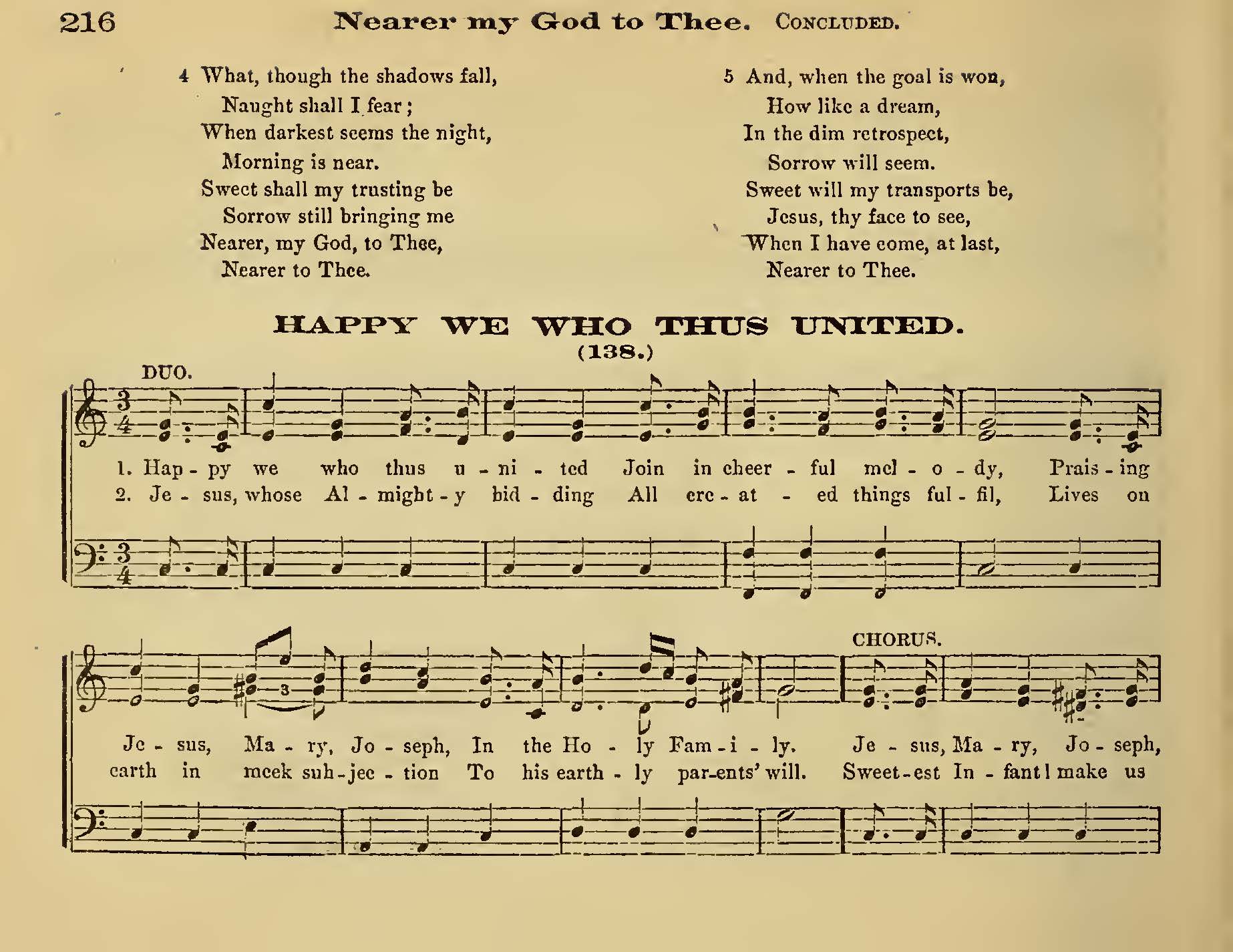
(Stanza 3) Still through my tears I’ll see / Hope gently leading me… (Stanza 4) When darkest seems the night, / Morning is near. / Sweet shall my trusting be…
Where the original Protestant text spends its middle stanzas detailing Jacob’s dream of a ladder with angels beckoning him, the Catholic verses pivot to an interior, pastoral psychology of grief. It addresses the real-world trials of the immigrant church—abandonment by friends, clouds of adversity, and dark nights of the soul—and re-frames sorrow not as a punishment, but as a grace-filled vehicle (“Sorrow still bringing me / Nearer to Thee”). This explains why the hymn became an absolute staple at pre-Vatican II Catholic gravesides; it met grieving families exactly where they were.
Stanza 5: The Beatific Vision
And, when the goal is won… / Sweet will my transports be, / Jesus, thy face to see, / When I have come, at last, / Nearer to Thee.
The hymn closes with a breathtakingly distinct Catholic eschatology. While Adams’ original final stanza imagines flying upward through the sky, forgetting the sun, moon, and stars, the Catholic lyricist keeps the focus entirely Christocentric. The ultimate goal of the soul is not just an upward escape into the cosmos, but the Beatific Vision—the ecstatic joy of looking directly upon the face of Jesus (“Jesus, thy face to see”).
The Modern Paradigm: Ecumenical Revival and Liturgical Planning
Following the liturgical reforms of the Second Vatican Council, which fully embraced vernacular hymnody, Nearer, My God, To Thee experienced a significant resurrection within Catholic spaces. However, this modern revival came with a twist: the historic Sacred Heart verses had completely faded from the collective memory of the faithful. In their place, the original Protestant text by Sarah F. Adams returned, embraced for its raw, scriptural evocative power.
Today, a survey of modern Catholic parish funeral music guides—stretching from St. Joseph in Libertyville to St. Stanislaus Kostka—reveals that the hymn is frequently suggested as an option for the Liturgy of Christian Burial. It is highly regarded by contemporary pastoral musicians for several reasons:
- Ecumenical Pastoral Care: In an era where Catholic funerals are frequently attended by non-Catholic family members and friends, the hymn provides a comforting, universally recognized touchstone of shared Christian hope.
- Theological Alignment with Resurrection: The original text’s trajectory—moving from the darkness of a stony pillow to an upward journey of praise (“Cleaving the sky, sun, moon, and stars forgot”)—complements the modern Catholic funeral liturgy’s emphasis on the Paschal Mystery and the soul’s journey to the heavenly Jerusalem.
Reflection
Silent Night and Nearer, My God, to Thee are historical parallels.
The story of Nearer, My God, to Thee is not unique. Another beloved hymn, Silent Night, followed a remarkably similar path in American Catholic life. Both hymns circulated in distinctly Catholic forms that reshaped popular texts inherited from outside the Catholic tradition. These adaptations were not acts of hostility toward their sources, but expressions of a conviction that even the most beloved hymns should proclaim the fullness of Catholic faith.
The parallels run deeper than editorial revision. Both hymns begin in darkness and suffering before leading the soul toward divine light. Silent Night transforms a cold and silent world through the dawn of redeeming grace. Nearer, My God, to Thee transforms loneliness, sorrow, and death into a pathway toward heaven. Together, they embody a profoundly Christian insight: God often reveals Himself most clearly amid grief, longing, and sacrifice.
Catechesis Through Melody
Earlier Catholic editors understood hymnody as catechesis through melody. Sacred music was not simply intended to express faith; it was intended to form it. Through the hymns sung week after week, generations of Catholics learned the mysteries of the Trinity, the Incarnation, the Sacred Heart, and the Real Presence as surely as they learned them from sermons and catechisms.
The standardization of American hymnals in the twentieth century undoubtedly fostered greater unity and familiarity. Yet it also coincided with a shift in emphasis. Congregational song moved from a predominantly theocentric and Eucharistic expression of worship toward a more personal and experiential language of faith, one that often emphasized the believer’s journey more than the mysteries celebrated upon the altar.
If the life of a parish flows from its worship, then the songs it sings matter profoundly. Hymnody is one of the Church’s most enduring teachers, shaping what believers come to love, remember, and believe. The forgotten Catholic verses of Nearer, My God, to Thee and Silent Night therefore represent more than a historical curiosity. They remind us of a time when sacred music was expected not merely to inspire, but to direct hearts upward—away from the self and toward the living God.