Sweet Name Which Makes The Dying Live

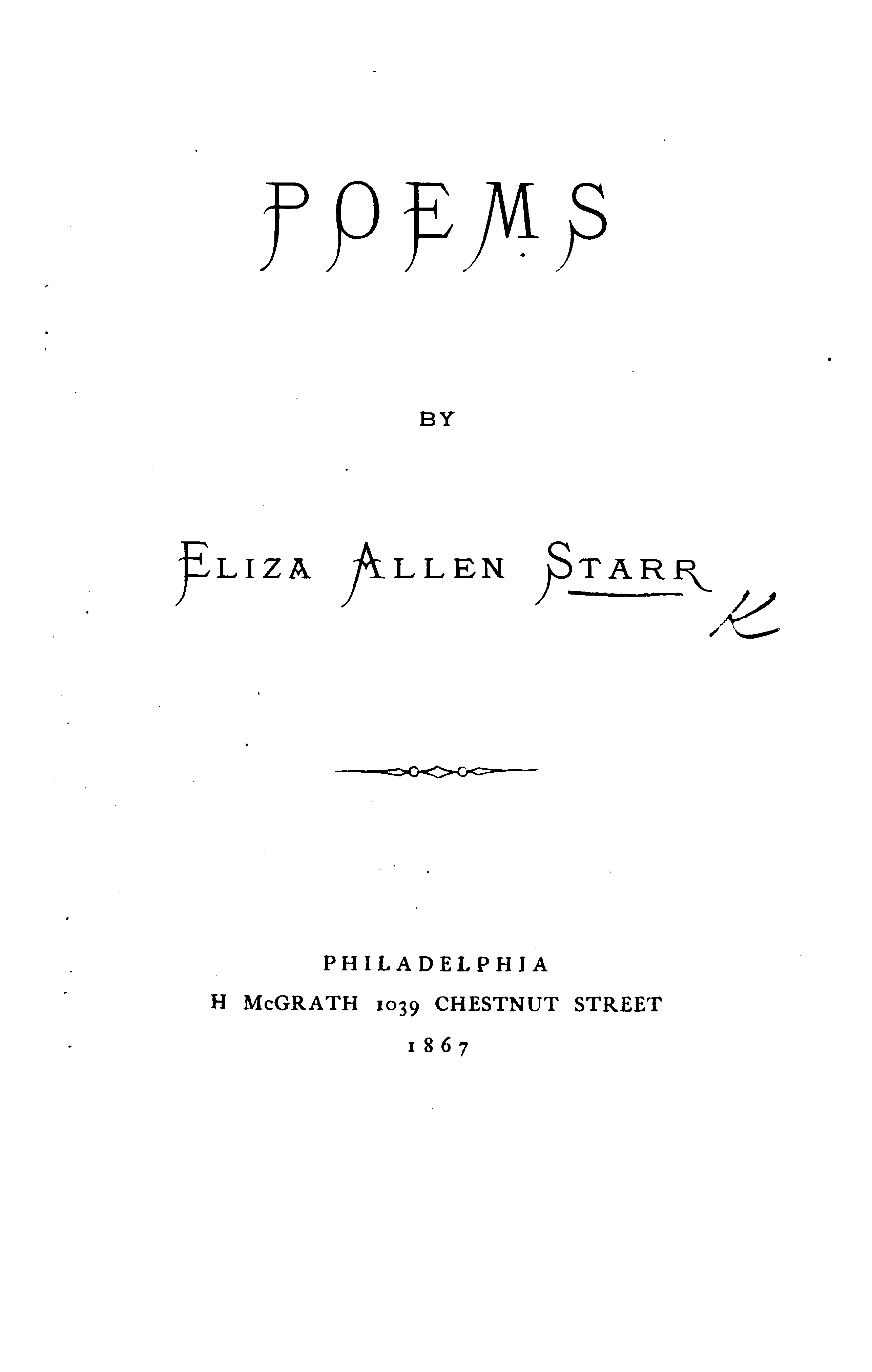
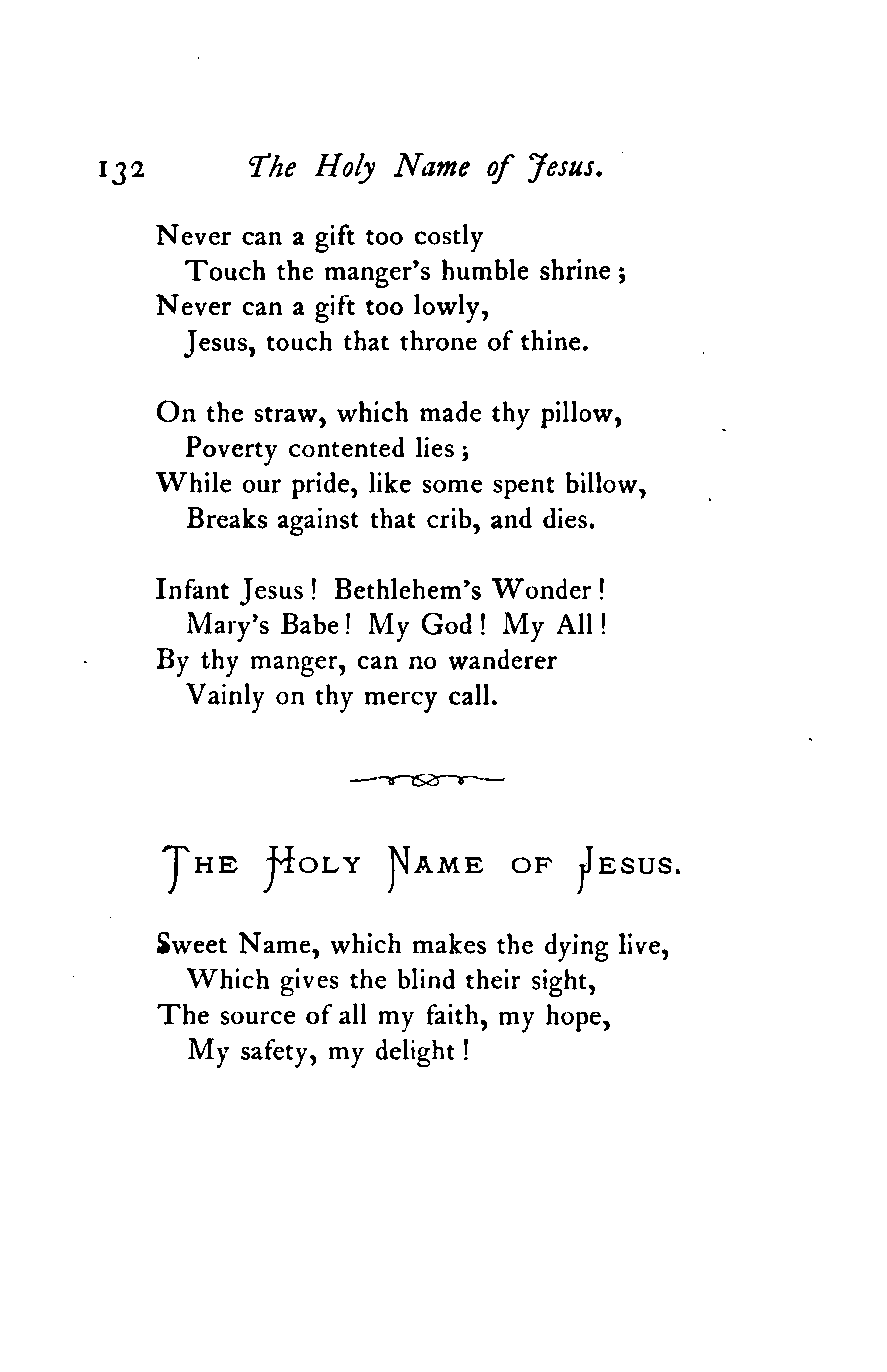
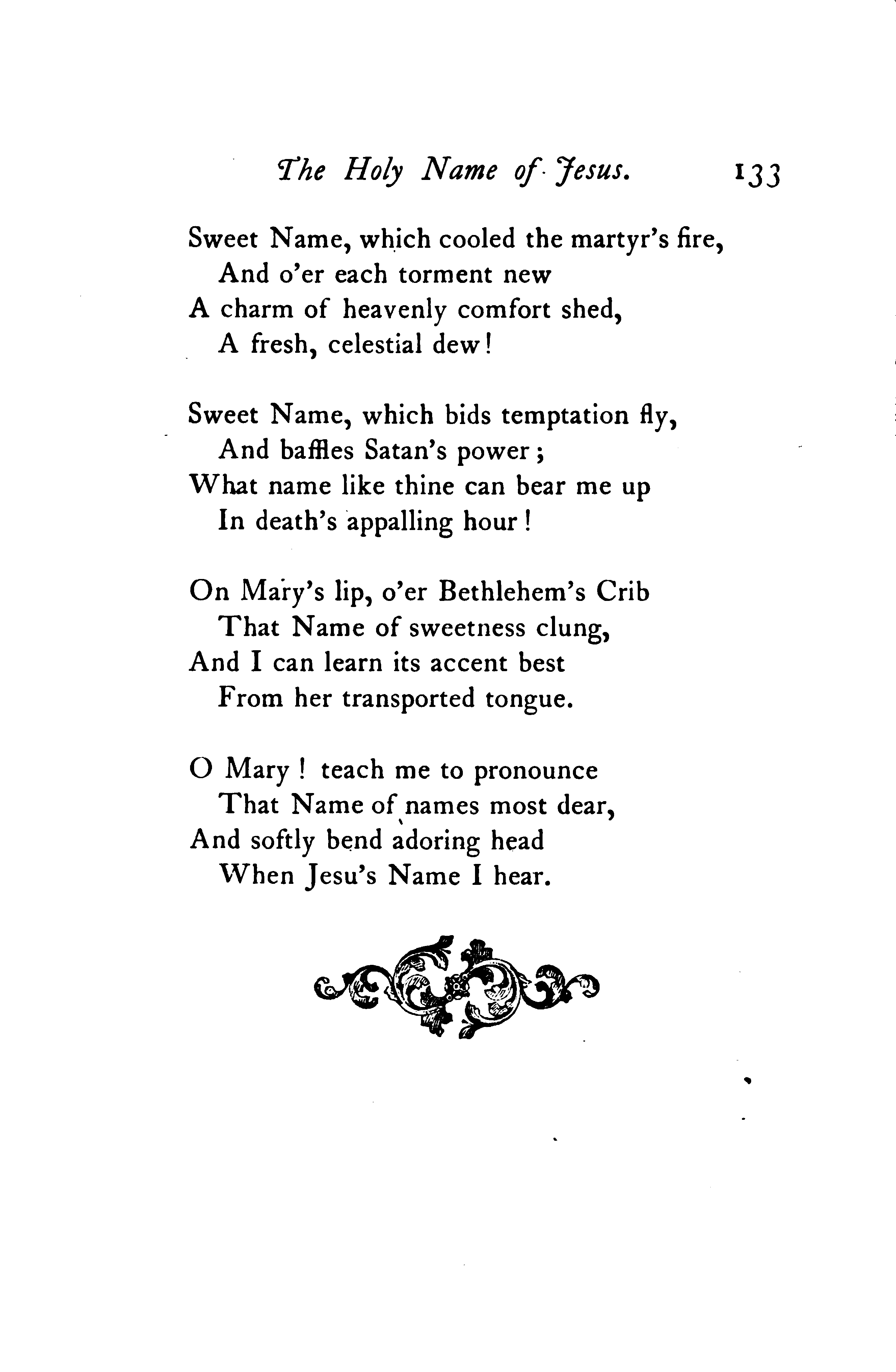
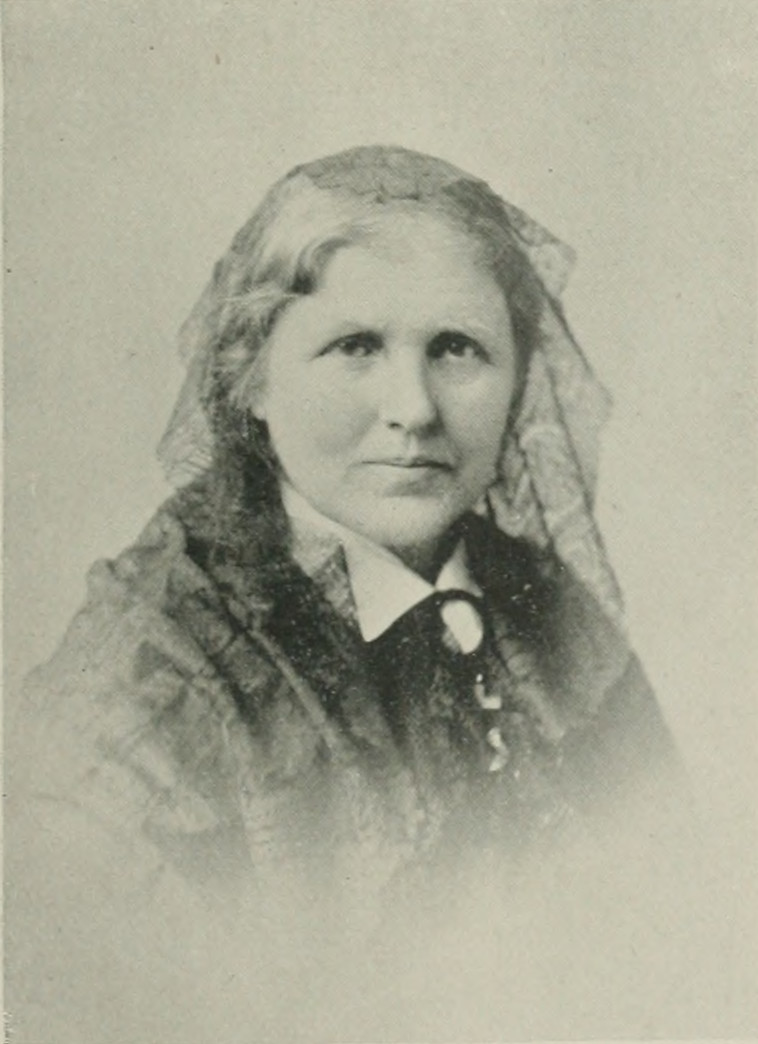
Eliza Allen Starr (1824-1901) wrote the words of this hymn in 1866, and they appeared in her collection of Poems published by H. McGrath of Philadelphia in 1867. The poem was captioned The Holy Name of Jesus. Eliza was a prolific poetess, art teacher, and lecturer. She grew up in Deerfield, Massachusetts, and studied art in Boston. She taught art in Brooklyn, Philadelphia, and Natchez, Mississippi, and under the auspices of Archbishop Peter R. Kenrick (1806-1896), she joined the Church of Rome in 1854 at the old Holy Cross Cathedral in Boston.

Eliza Allen Star
Eliza Allen Star

In 1856, Eliza moved to Chicago where she remained for the rest of her life devoting her time to authoring poems, teaching art, and giving art lectures and courses at schools and academies throughout Chicago. In 1876, her career as an artist took her Italy, France, and England; and in 1885, Notre Dame University conferred upon her the Laetare Medal, she was the first woman ever to receive this prestigious award.  In 1893, she received a gold medal from the World’s Columbian Exposition also known as the Chicago World’s Fair, as an art teacher. Pope Leo XIII honored Eliza in 1900 with a cameo medallion as a mark of his approbation of her literary labors.

Poems by Eliza Allen Starr, 1867

Eliza was the author of Patron Saints, Pilgrims and Shrines, Songs of a Life Time, Isabella of Castile, Christian Art in Our Own Age, Christmas-Tide, The Seven Dolors of the Virgin Mary, and Three Archangels and the Guardian Angels in Art. A short biographical sketch of her life was published in the 1893 Woman of the Century – Leading American Women by Frances Willard and Mary Livermore. Also, in the Who’s Who in America, 1901/1902 by John Leonard. Eliza was a well-respected author and art critic known throughout America and Europe.

She was also the author of the hymn, O Face Divine! found in the HOLY FACE HYMNAL, 1891 with music composed by Sister Mary Alexis Donnelly of the Sisters of Mercy at St. Xavier’s Convent, Providence, Rhode Island. Sr. Mary Alexis Donnelly was one of the major contributors to American Catholic music in the late 19th and early 20th century period. Eliza never married and later in life she joined the Third Order of St. Dominic. She died at the age of seventy-seven after a short illness while visiting her brother in Durand, Illinois. She was buried at Calvary Catholic Cemetery in Chicago wearing the Dominican habit.

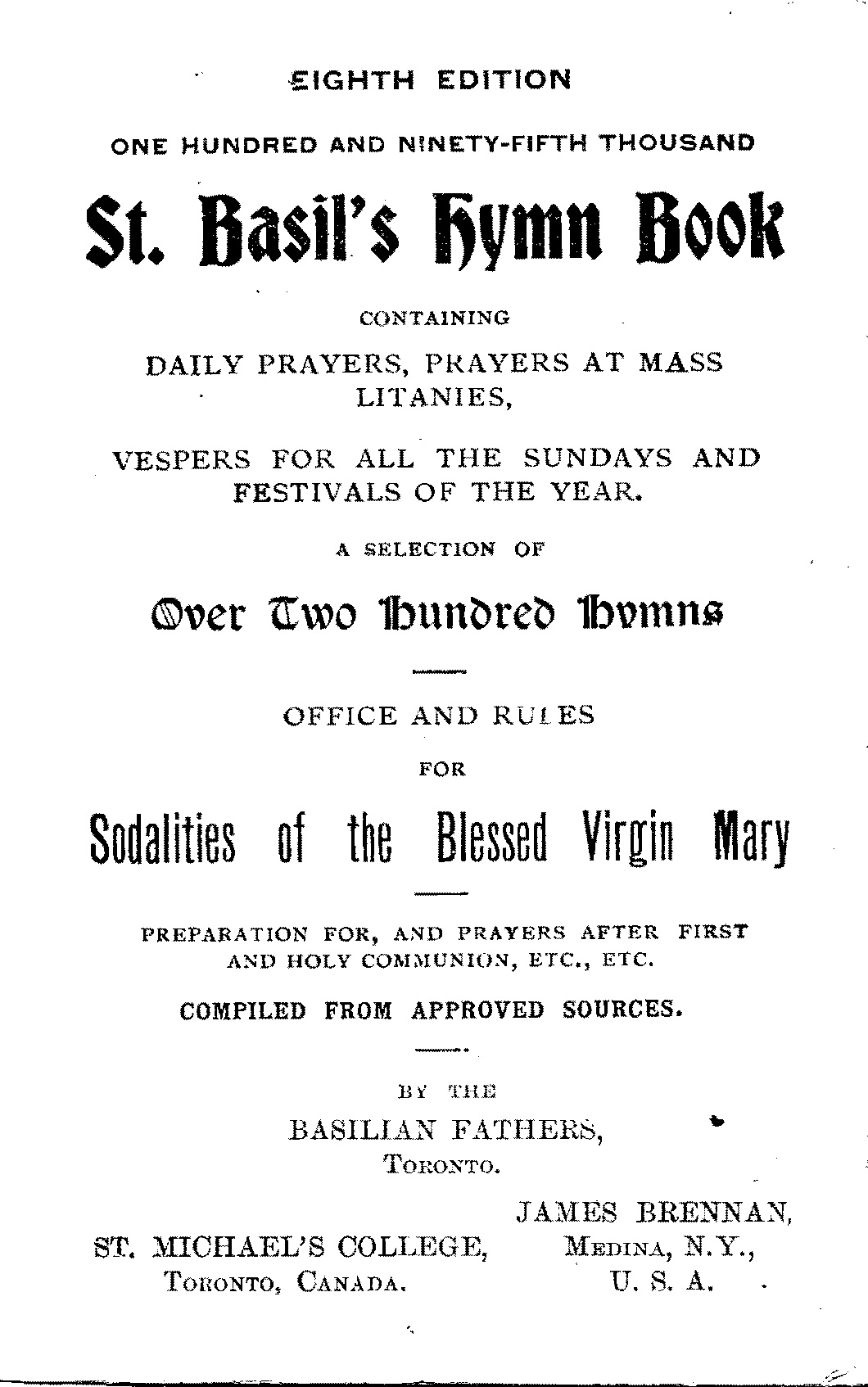
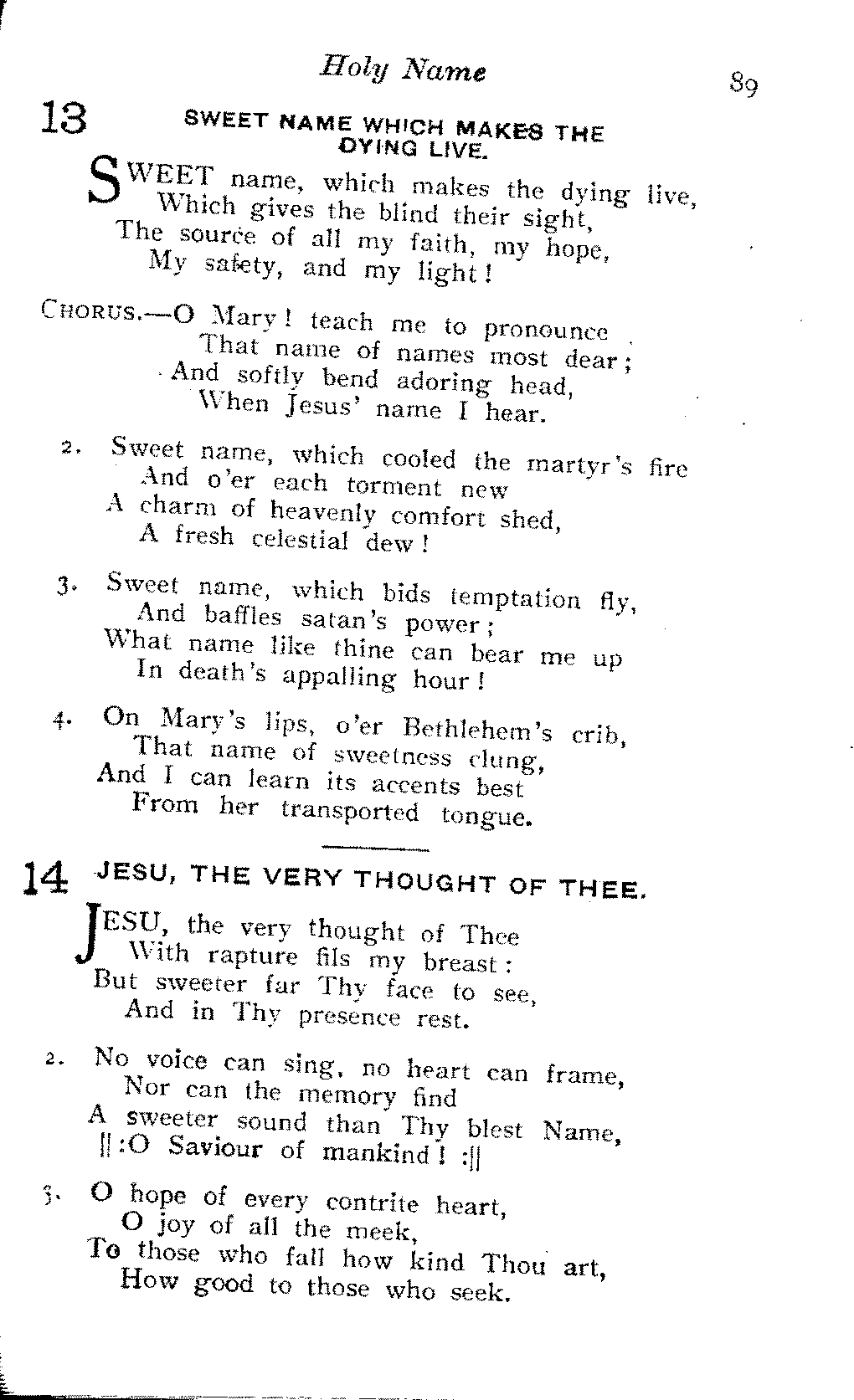
The earliest that Sweet Name Which Makes the Dying Live appears in any Catholic hymnal is in the ST. BASIL’S HYMNAL, 1904 8th ed., and it continued to appear in later editions until 1925; also SELECTED HYMNS ca. 1926, Church Academy School, published by Angel Guardian Press, Jamaica Plain, Mass; It also appeared in the ST. JOSEPH’S HYMNAL, 1930 compiled by the Sisters of St. Joseph in Nazareth, Michigan; the SAINT ANDREW HYMNAL, 1945 compiled by Philip Kreckel and published by McLaughlin & Reilly Co.; the HOLY NAME HYMNAL, 1947; and in the PARISH HYMNAL, 1954 of St. Francis Church, Cleveland, Ohio.

St. Basil's Hymnal 8th ed. - 1904

The Melodies

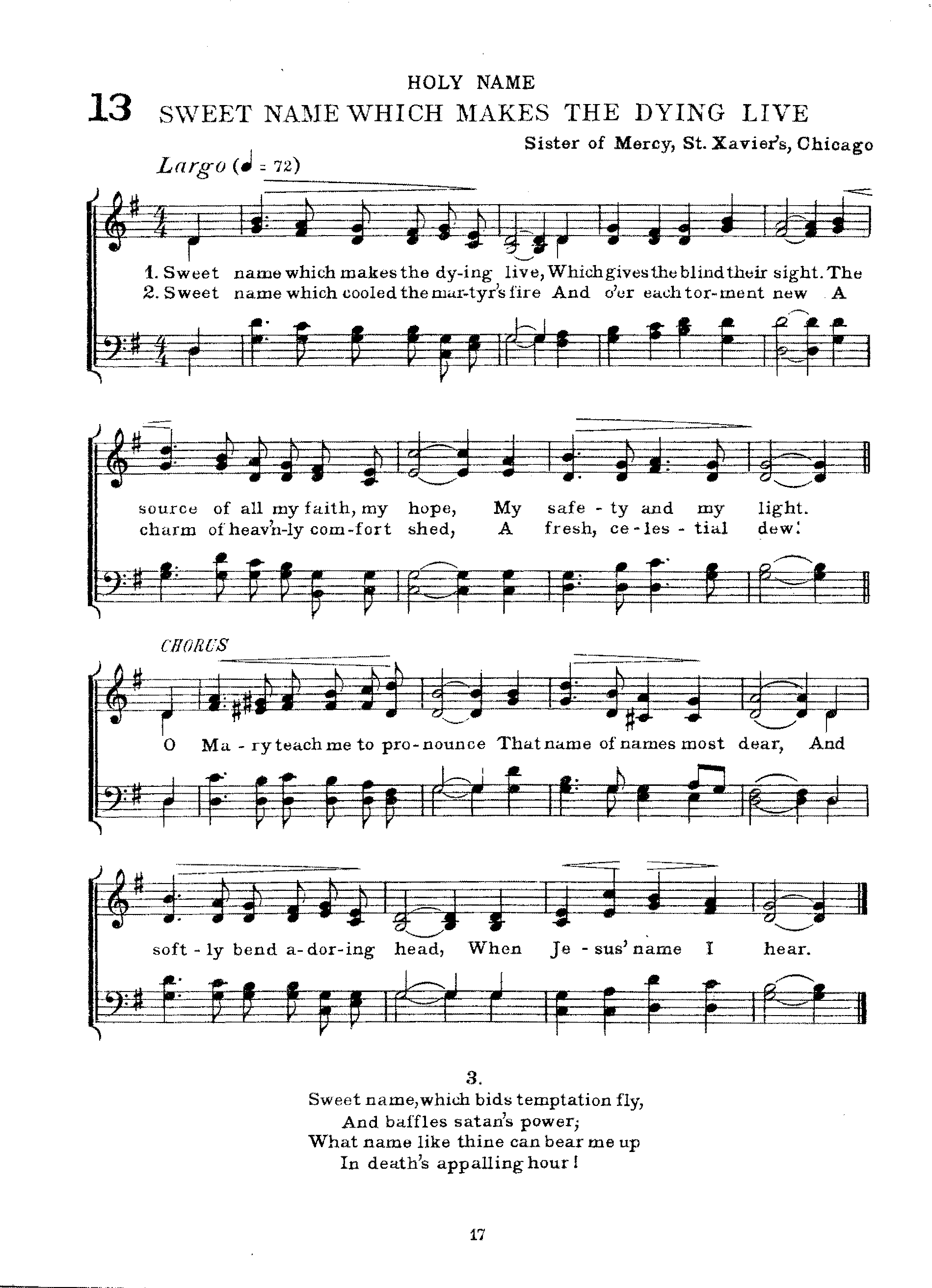
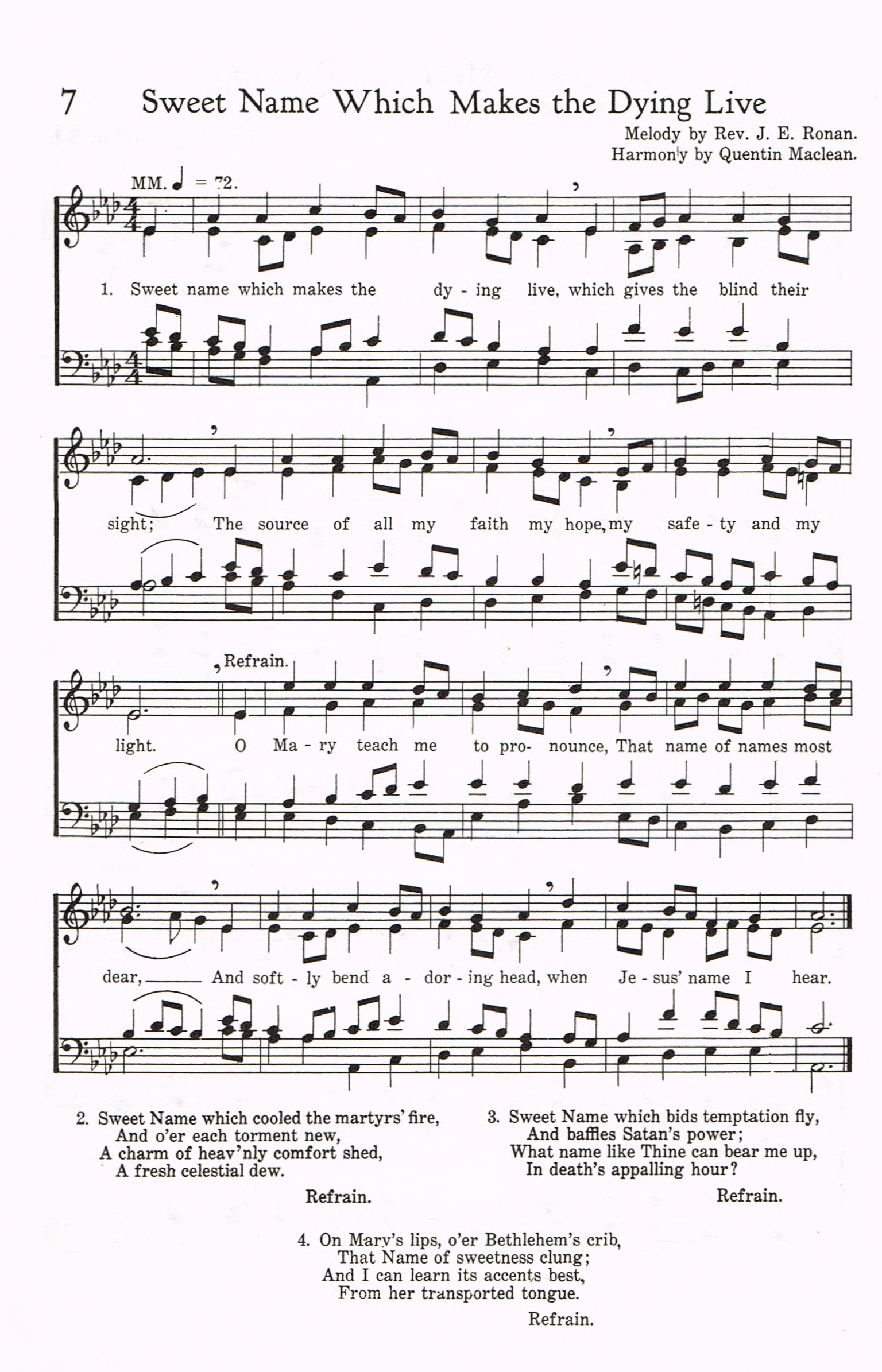
Two melodies have been located for this hymn, a melody composed by a Sister of Mercy from St. Xavier’s in Chicago, and a melody found in the JUBILEE HYMNS BOOK, 1942 compiled and composed by Monsignor John Edward Ronan (1894-1962). The Jubilee series of hymn books were published in three volumes between 1942 and 1952 in Toronto, Canada.

The Sisters of Mercy, St. Xavier’s, Chicago

On the authority of the Mercy Heritage Center archivist, very few records of the sisters exist before 1929. In many of the former provinces, researchers/archivists have gone back and recreated files for historical sisters. However, this was not done in Chicago. This brief account of the sisters and their musical talents is taken from the sources listed below.

The identity of the Sister of Mercy who composed the melody that is traditional to this hymn remains a mystery yet there are a few who are worth mentioning because their musical abilities were well known among the sisters.

  • Sister Mary Vincent McGirr (Mary Anne McGirr), a famous musician. Sister Mary Vincent entered the Sisters of Mercy in Pittsburgh, She was one of the first novices who traveled with Mother Francis Warde and Mother Agatha O’Brien at the request of Bishop William Quarter (1806-1848) to establish the Sisters of Mercy in Chicago. Sister Mary Vincent professed her vows in 1846, and later she served as Mother Mary Vincent during the great Chicago fire of 1871. Sister Mary Vincent McGirr was under twenty-one when she professed her vows, and she died in 1909. Her father and brother were both doctors at Mercy Hospital.
  • Sister Mary Xavier McGirr (Catherine Cassie McGirr) sister of Sister Mary Vincent McGirr. Both were accomplished musicians according to the Illinois Catholic Historical Review, 1920, page 347 (see link below). Sister Mary Xavier went on to serve as Mother Mary Xavier the first superior for the Sisters of Mercy in Ottawa, Illinois. Mother Mary Xavier died May 2, 1876. Both her and her sister were born in Youngstown, Ohio, both entered the Order of Mercy in Pittsburgh, Pennsylvania, and both professed their vows in Chicago.
  • Sister Mary Angelica Mahon, whose eyes failed from constant daily copying of music to oblige others and giving music lessons by gas light. Eventually, she went blind. She died in 1907, after twenty-five years of religious life.
  • Sister Mary Louis Broderick, a music teacher of instrumental and vocal music. She died a few years later around 1912 but no date is actually given.

The Sisters of Mercy were quite influential in setting up schools and hospitals in and around the Chicago area. The Motherhouse was opened in 1846 and St. Xavier’s Academy in 1847. Mercy Hospital opened a few years later in 1851. Their nursing skills were called upon during the Cholera epidemic of 1854 and 1873, and during the Civil War they were summoned by Colonel Mulligan, who had organized the Irish Brigade and were placed in charge of the Jefferson City Hospital and the steamboat Empress. Many of the soldiers from both sides were still on the battlefield in tents deprived of every comfort, while suffering from wounds of every description. The steamboat Empress made many trips with suffering soldiers ferrying them to better care facilities including Pittsburg Landing near Shiloh, Keokuk in Iowa, Louisville, and St. Louis.

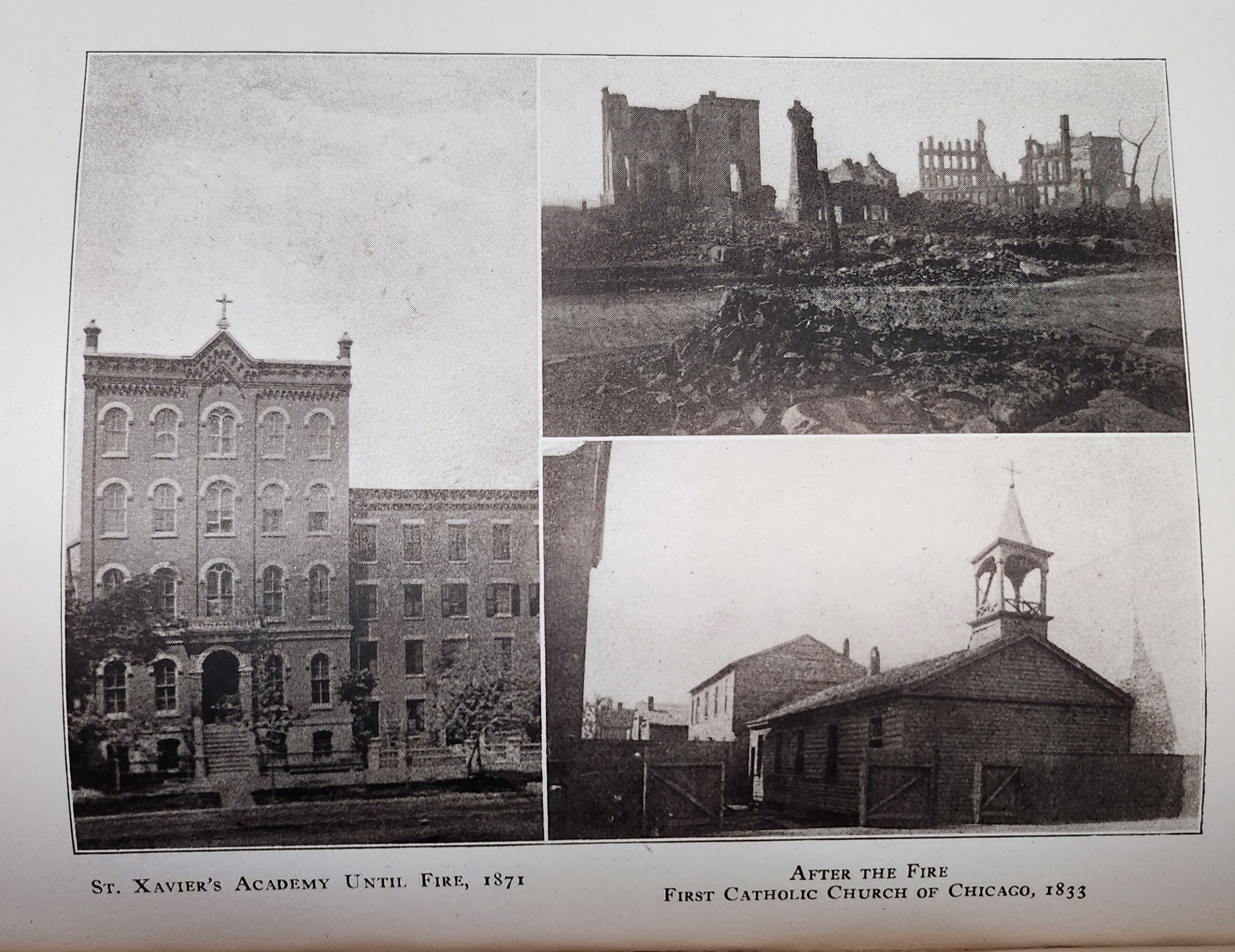
The great Chicago fire of 1871 which destroyed much of the city also destroyed the convent, boarding school and the Academy located on Wabash and Madison streets. Only small items which the sisters could carry out and some religious paintings cut from their frames were saved. Everything else was lost in the fire. The sisters were homeless. Mercy Hospital which had only recently been expanded survived and was soon over flowing with patients. The sisters saw to the needs of thousands of individuals, attending to people in numerous ways, the severely burned and those so covered with smoke and soot that they could not tell black from white or who was who. In a single night more than one hundred thousand people were rendered homeless.

from REMINESCENSES OF SEVENTY YEARS (1846-1916)

There is much more that could be written about the Sisters of Mercy and their great accomplishments and trials in Chicago, but this is beyond the scope of this short write-up. A fascinating history of the Sisters of Mercy of St. Xavier’s can be found in the REMINESCENSES OF SEVENTY YEARS (1846-1916) published in 1916 by The Fred J. Ringley Co., of Chicago as well as the LEAVES FROM THE ANNALS OF THE SISTERS OF MERCY, published between 1881 and 1889, and the ILLINOIS CATHOLIC HISTORICAL REVIEW published in 1920.

Monsignor John E. Ronan composed the second melody. John Ronan was born in 1894 and studied music at St. Michael’s College in Toronto. He was drawn to the priesthood completed his seminary studies and was ordained in 1922. He continued to study church music in New York, Paris, Rome, Vienna, and Munich. He would go on to become a prolific composer of sacred music. He taught music in Catholic schools in Toronto and in time established the St. Michael’s Cathedral Choir School for boys in Toronto. In 1947, Father Ronan was given the title of Monsignor in recognition of his dedicated work in sacred music.

Though many of his compositions are unpublished more than nine hundred of his hand written manuscripts were discovered, catalogued, and digitized. Monsignor Ronan continued to teach music and served as principal of St. Michael’s Cathedral Choir School until his death in 1962.

St. Basil's Hymnal, 1918
Jubilee Hymns Book, 1942 (© St. Michael’s Choir School, 2015)

Reflection

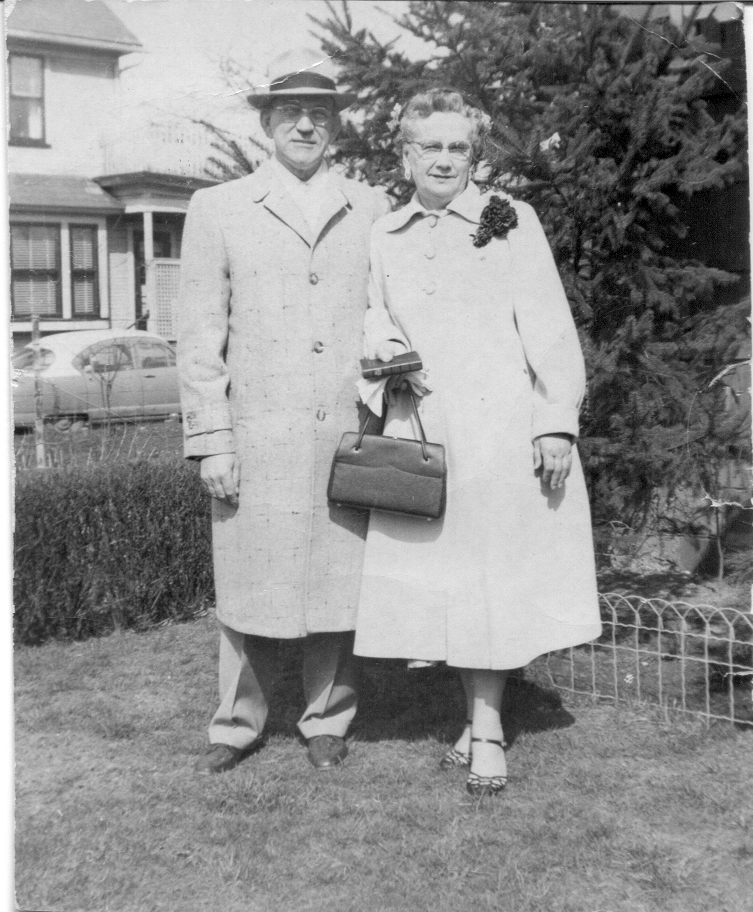
St. Mary’s Choir sang this hymn at my grandfather France’s funeral as the recessional hymn when the funeral procession leaves the church and heads to the final resting place. Grandpa France died in March 1957 of a fatal heart attack while working for McNeil Machine & Engineering Co., in Akron, Ohio. I remember being told that grandpa died praying the rosary. He worked in the tool crib and often many hours would go by that no one signed out any tools and so he would pray his rosary. On this particular day I am also told that before going to work he and grandma had a disagreement about something, and heated words were exchanged between the two of them. I would like to think grandpa was praying the rosary that morning for any harsh words or remarks he may have said to grandma.

Roland & Margaret France 1943

My grandfather was born in 1895 and raised Methodist and my grandmother was raised Catholic. He married my grandmother on April 17, 1917 in the Methodist church on North Arlington Street, Akron, Ohio and six months later after grandpa joined the Catholic Church they were married in St. Joseph’s Church in Cuyahoga Falls, Ohio. My grandmother was a wonderful Catholic woman, a mother of eight, and a foster-mother to twenty-eight children.

I remember being told that grandpa played the violin and grandma played the piano, and that they would often play together at home sharing hymns and songs that each of them knew. I wish I had known my grandfather, because from the stories I have heard, he was quite the character, but he died a year before I was born. Grandpa was also a member of the Holy Name Society at St. Mary’s in Akron, Ohio.

I learned the melody from ST. BASIL’S HYMNAL when I sang in St. Mary’s Choir (1977-2010). I really love this hymn and would like it to be the hymn the choir sings at my funeral. Every time I hear it the melody and words linger with me all day long and sometimes into the next day.

There are many poetic images from the bible in these verses, how many can you find?

The hymn is also a prayer, O Mary, teach me to pronounce that name of names most dear, and softly bend adoring head, when Jesus name I hear. This would make an excellent hymn to sing during November, for All Souls Day, and anytime a loved one is remembered.

In addition to my anecdotal evidence, there is other proof that this hymn and others were used at Catholic Requiem Masses either before Mass, when the funeral procession enters the church (ex., Sister Mary Rose – The Catholic Transcript, Thursday 3-24-1932, pg.7); as a recessional hymn (ex., Mary Gertrude Drumright – Drumright Evening Derrick, Monday 1-24-1921, pg1); and at the grave side (ex., Blazius Brozozowski, The Gonzales Inquirer 5-28-1931, Find-a-Grave); also (Daniel Daley Jr., The Lusk Herald (Lusk, WY), Thursday 2-27-1936, Niobrara County Library);  Other evidence was located in the Oshkosh Daily Northwestern (Oshkosh, Wisconsin) February 15, 1938, and August 17, 1953; however these obituaries were only available with subscription.

Other hymns were also listed in the evidence above including Miserere, Pie Jesu, Lead Kindly Light, Be Comforted Ye that Mourn, O Salutaris, Face to Face, Heaven is His Eternal Home, O Thou Sacred Heart, O What Could My Jesus Do More, and Nearer, My God to Thee – with verses written to honor the Sacred Heart of Jesus.

Though these funeral accounts highlight prominent citizens of some stature and one religious it does show that the hymn Sweet Name Which Makes the Dying Live was used at Requiem Masses throughout Catholic parishes in the United States during the first half of the 20th century.

A special thank you to Peter Meggison producer of the Devotional Hymns Project for allowing me to link to the choir of St. John the Guardian of Our Lady from Clinton, Massachusetts. Please take a moment to listen to this beautiful collection of hymns and the wonderful hymn Sweet Name Which Makes the Dying Live.

Below are the melodies composed for the hymn Sweet Name Which Makes the Dying Live. These are computer generated sound files. The tempo is approximate but should provide the listener a good sense of what the hymn sounds like. Music directors, if you use any of these selections in your Sunday or weekly music programs and you make a recording, contact the author and I may feature it in the What’s New section of the website. 

album-art

00:00

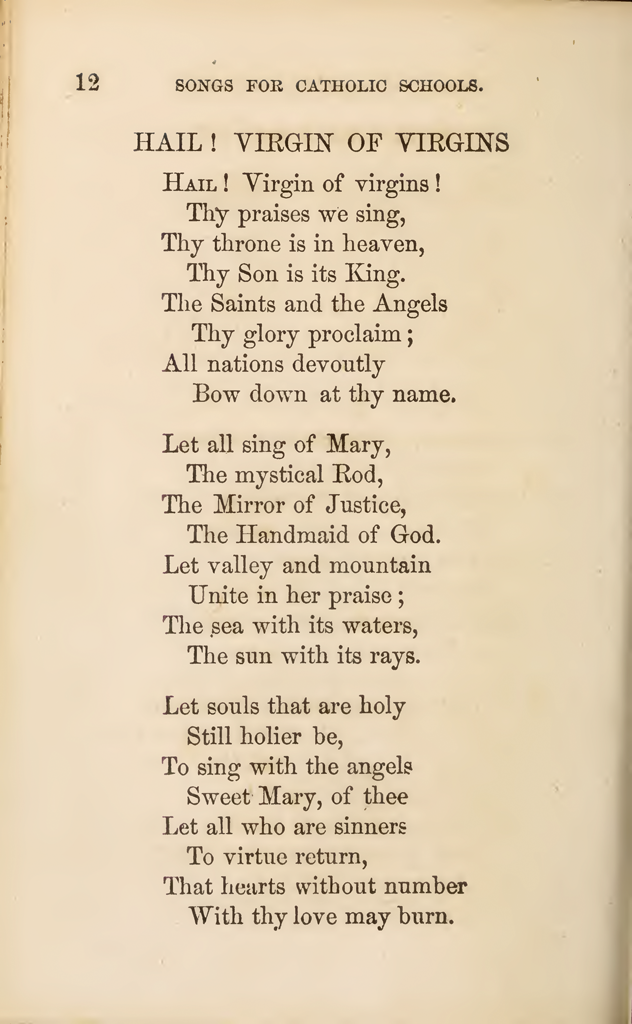
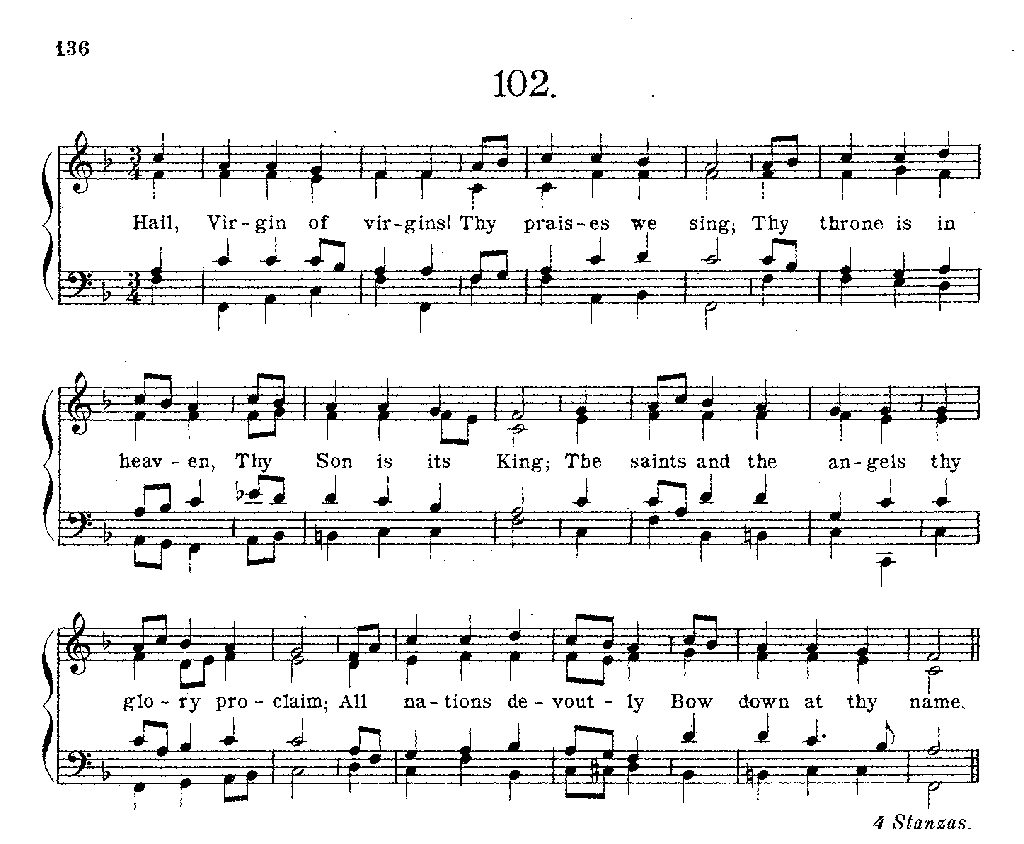
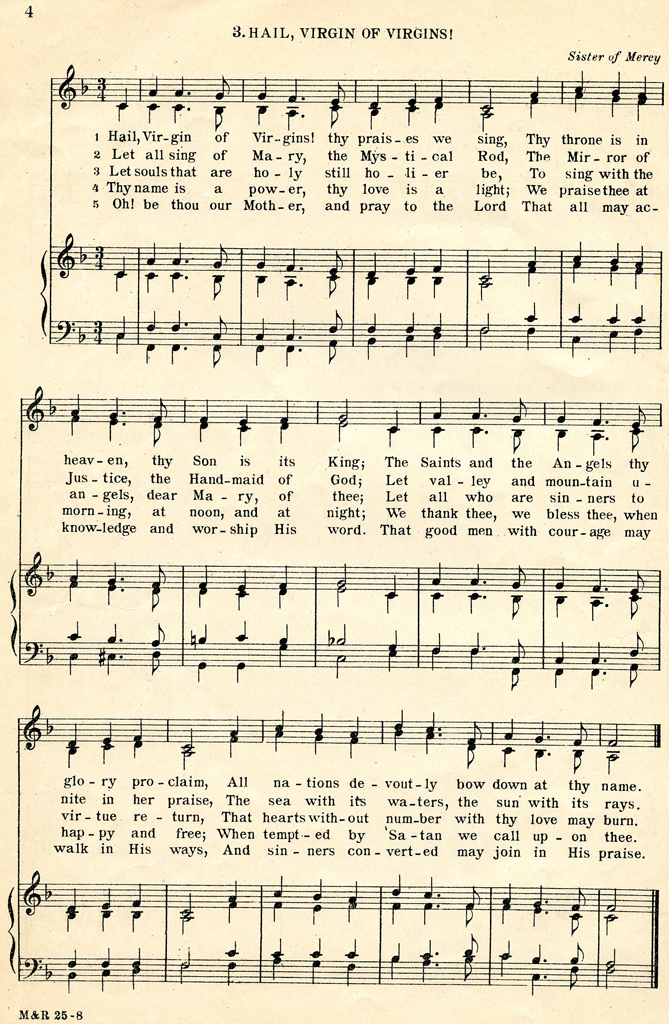
Hail! Virgin of Virgins

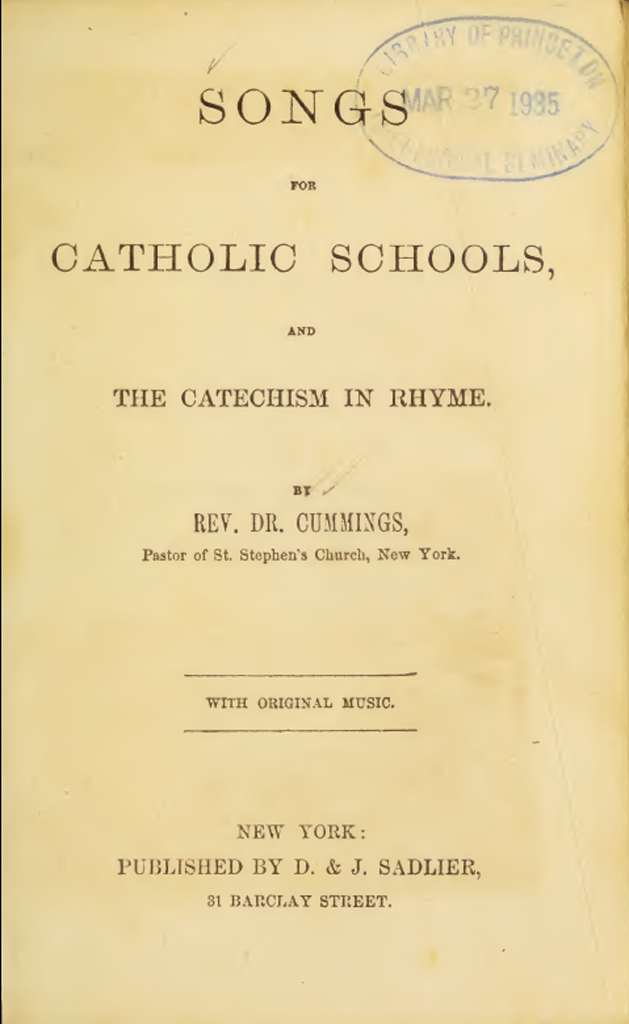
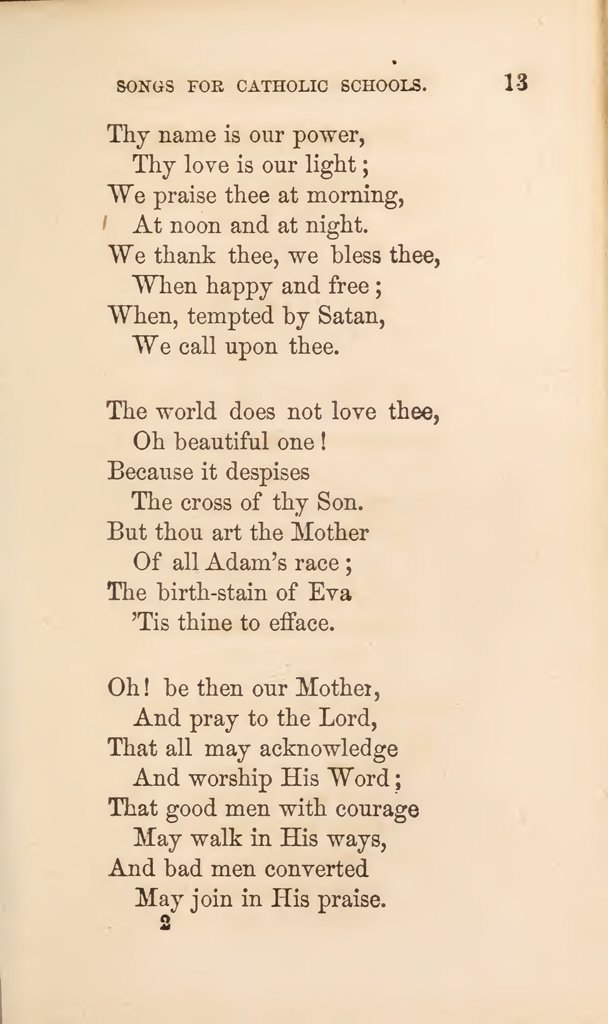
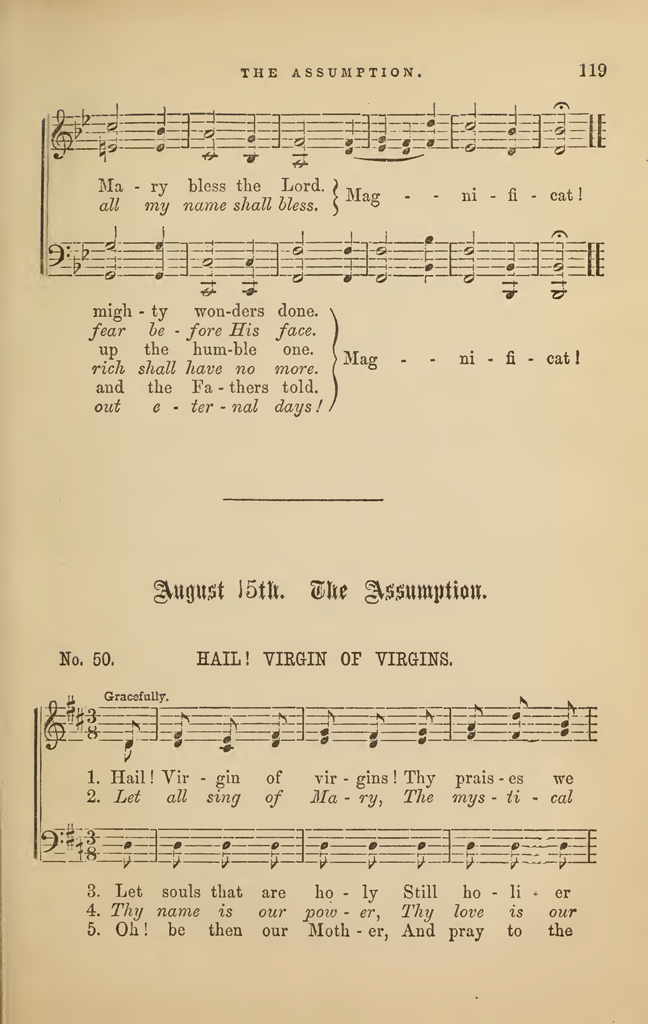
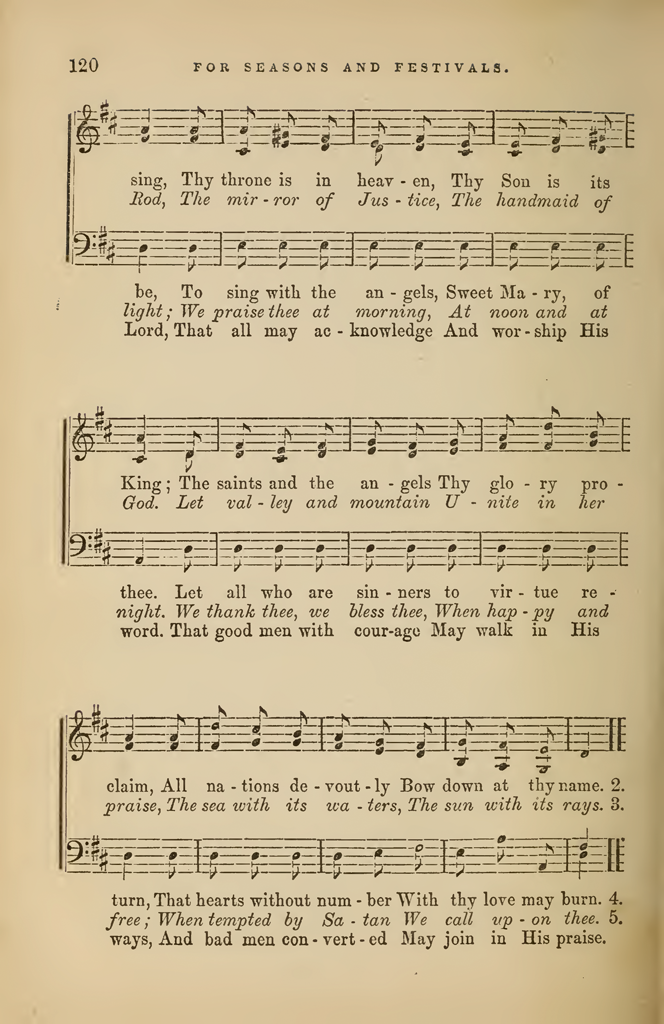
Father Jeremiah William Cummings, D.D., (1814-1866) wrote the text of this hymn for the Feast of the Assumption. It first appeared in his SONGS FOR CATHOLIC SCHOOLS AND AIDS TO MEMORY FOR THE CATECHISM. The first edition was published in 1860 by P. O’Shea and contained sixty hymns. The second edition was published in 1862 by J. & D. Sadlier and contained ninety-two hymns. One of the hallmarks of Father Cummings hymn book was the attention given to the education of school children which focused on Catholic fundamentals like the Ten Commandments, the Seven Sacraments, and Theological Virtues and adapting them into hymns. These two publications are quite significant and until 1860, the only Catholic collection of original hymns, the first of its kind, by an American author.

Songs for Catholic Schools, 1862

Father Cummings was born in Washington, D. C., and after his father died, he and his mother moved to New York City. From a youthful age he wanted to become a priest, but he and his mother were as poor as church mice. In September 1834, and through the good graces of Father J. P. McGerry of the New York Archdiocese, he was accepted to the College of the Propaganda in Rome. He was a gifted student and gained the degree of Doctor of Divinity. He returned to New York and was assigned to St. Patrick’s Cathedral and later he was appointed pastor of the new St. Stephen’s Parish where he oversaw the building of the church and school. He had a great fondness for music, and soon took charge of the choir. Oftentimes as were the case, well-known singers from the Metropolitan Opera House joined the choir. Through his influence the choir gained the esteem of the people who came from all over the city to Sunday High Mass. St. Stephen’s Church became one of the largest Catholic parishes of the day with over 28,000 parishioners. Father Cummings remained pastor of St. Stephen’s parish until his death in 1866.

Father Cummings was one of the first American Catholic hymn writers with over ninety original hymns to his credit. He is referred to as The Forgotten American Hymnodist in an article written by Monsignor Hugh Thomas Henry (1862-1946) that appeared in THE CATHOLIC HISTORICAL REVIEW, Vol. 1, No. 2 (Jul. 1915), pp. 139-147. Some of Father Cummings hymns which achieved popular success include, Christ is Risen from the Dead; O Brightness of Eternal Light; Let a Pious Pray Be Said; Great God, Whatever through Thy Church; Daughter of God the Father, and Most Holy Trinity One God. Father Cumming’s Christ is Risen from the Dead was a favorite Easter hymn when I sang in St. Mary’s Choir.

In addition to the hymnals noted above Hail! Virgin of Virgins appeared in the following Catholic hymnals: CATHOLIC HYMNS AND CANTICLES and THE COMPLETE SODALITY MANUAL, 1863, compiled by Father Alfred Young, C.S.P.; THE CATHOLIC YOUTH’S HYMNAL, 1871, compiled by the Christian Brothers; THE MANUAL OF SELECT CATHOLIC HYMNS, 1885 and 1925, compiled by Father P. M. Colonel, C.SS.R; the CATHOLIC HYMNAL, 1885, 1888, 1894 and 1909, compiled by Father Alfred Young, C.S.P.; PSALLITE, 1901, 1907, and 1928 compiled by Father Alexander Roesler, S.J,; the CATHOLIC HYMNAL, 1920, compiled by Father John G. Hacker; THE STANDARD CATHOLIC HYMNAL, 1921, compiled by James A. Reilly; the ST. MARY’S MANUAL, 1924, compiled by Christian A. Zittel, and OUR LADY OF MERCY HYMNAL, 1899, VOL. 1 and 1927, Vol. 2., compiled by the Sisters of Mercy with music by Sister Mary Alexis Donnelly, R.S.M; also the CATHOLIC HYMNAL AND SERVICE BOOK, 1966, Benziger edition. Many of the hymnals listed above are available from the CCWATERSHED.ORG website.

The melodies:

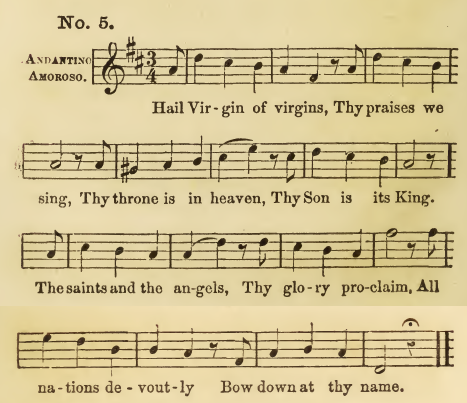
One of the first melodies to appear in American Catholic hymnals was composed by Signor Domenico Speranza (ca. 1860). He was a highly respected Italian composer known for his system of musical instruction for the children of Turin. He was a professor of vocal and instrumental music and the Director of the Italian Musical Institute in San Francisco. He was also connected to the Academy of Music in New York City. Father Cummings chose him to prepare the music for the hymnal SONGS FOR CATHOLIC SCHOOLS, and with the exception of five of the hymns, Signor Speranza composed all the music in the first edition.

Songs for Catholic Schools, 1862

A second melody appears in the CATHOLIC VOLCALIST, and in the CATHOLIC YOUTH’S HYMNAL. The CATHOLIC VOLCALIST was a Catholic periodical of the 1860s made up of Sacred Music including litanies, anthems, motets, hymns, for the use of churches, schools, and private families. The Christian Brothers of New York compiled the CATHOLIC YOUTH’S HYMNAL. The Brothers were a mix of German and French backgrounds and taught in the Catholic schools surrounding St. Stephen’s Parish. Around twenty-five of the hymns were composed by the Brothers and fifteen melodies were composed by Father Louis Lambillotte, a French Jesuit priest (1796-1855). Father Lambillotte is best known today for his compositions Come Holy Ghost, Creator Blest; On This Day O Beautiful Mother, and ‘Tis the Month of Our Mother.

The Catholic Volcalist, 1860
The Catholic Youth's Hymnal, 1871

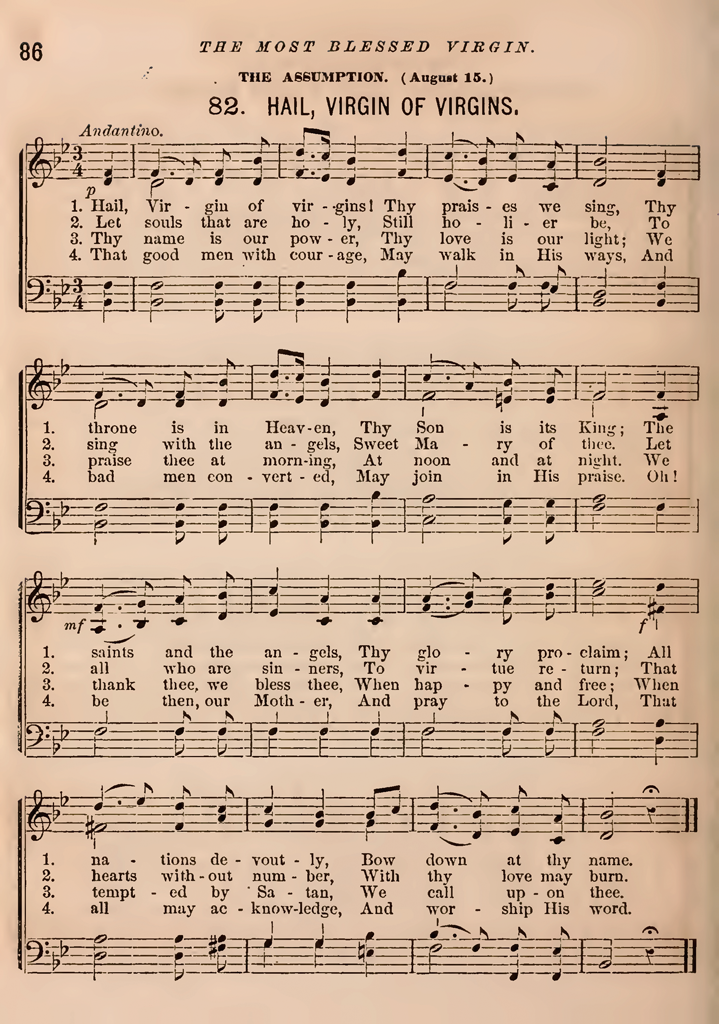
A third melody appeared in CATHOLIC HYMNS AND CANTICLES and THE COMPLETE SODALITY MANUAL compiled by Father Alfred Young, C.S.P. (1831-1900). The composer of this melody is not known although in the Preface of both hymnals several individuals are mentioned for their contributions to the hymnals but a special thank you is given to T. J. Wallace, Esq., organist of St. Paul the Apostle Church located in New York City for his contributions.

Catholic Hymns and Canticles, 1863

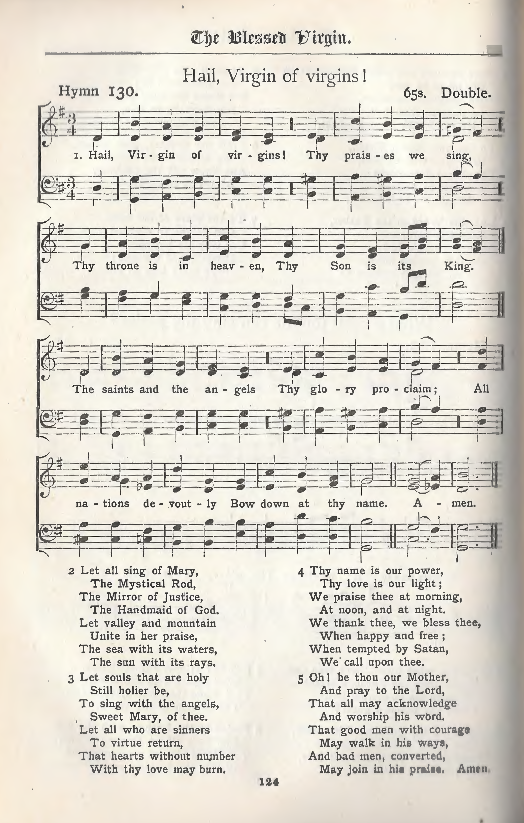
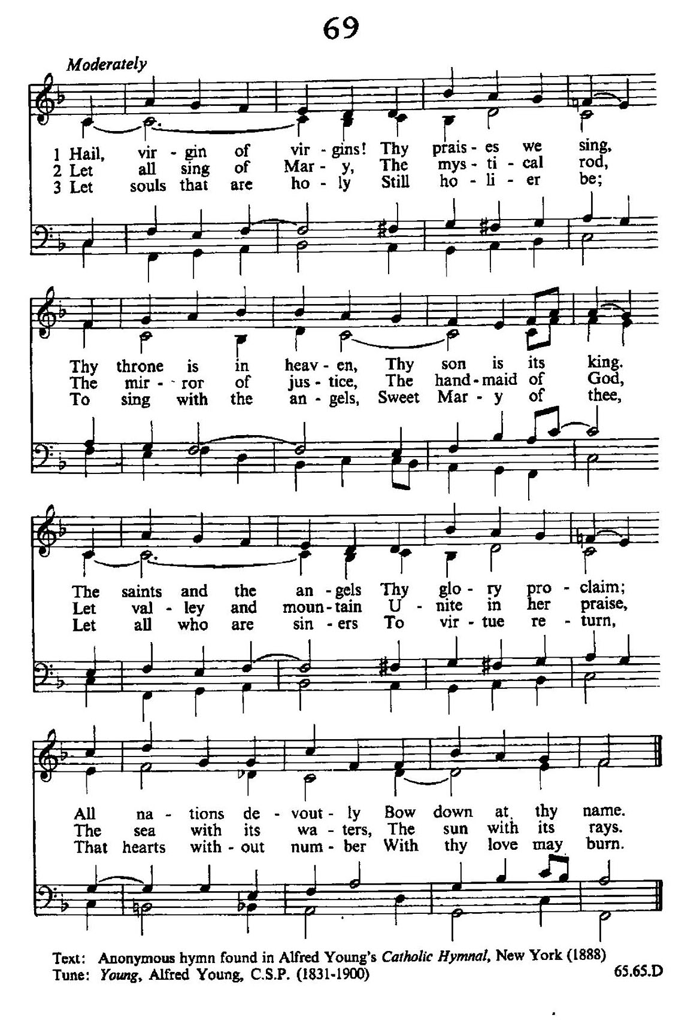
In 1885, a melody appeared in the Father Alfred Young’s CATHOLIC HYMNAL. This hymnal saw subsequent printings in 1888, 1894 and 1909. More than half a century later the same melody appeared in the Benziger publication of the CATHOLIC HYMNAL AND SERVICE BOOK, 1966.

The Catholic Hymnal, 1885
Catholic Hymnal and Service Book, 1966

During the early part of the twentieth century the hymn was adapted to a tune from Bone’s Cantate, 1858 and appeared in the Catholic hymnal PSALLITE, Father Hacker’s CATHOLIC HYMNAL and the ST. MARY’S MANUAL. The tune is known as Wie schön scheint die Sonn (time index ~ 2:30)

St. Mary's Manual, 1924

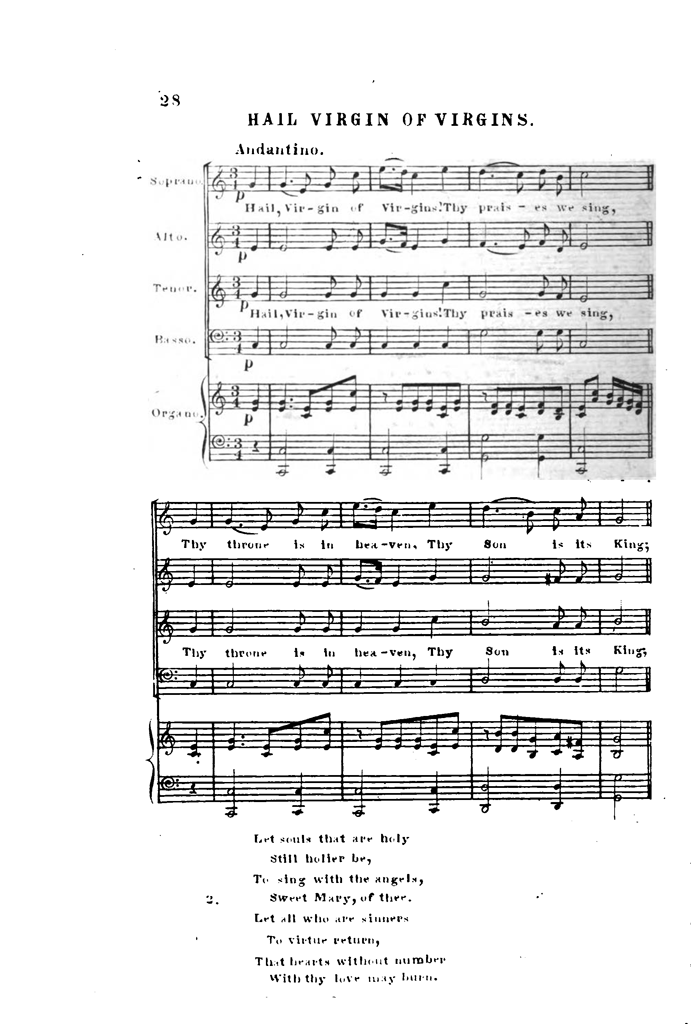
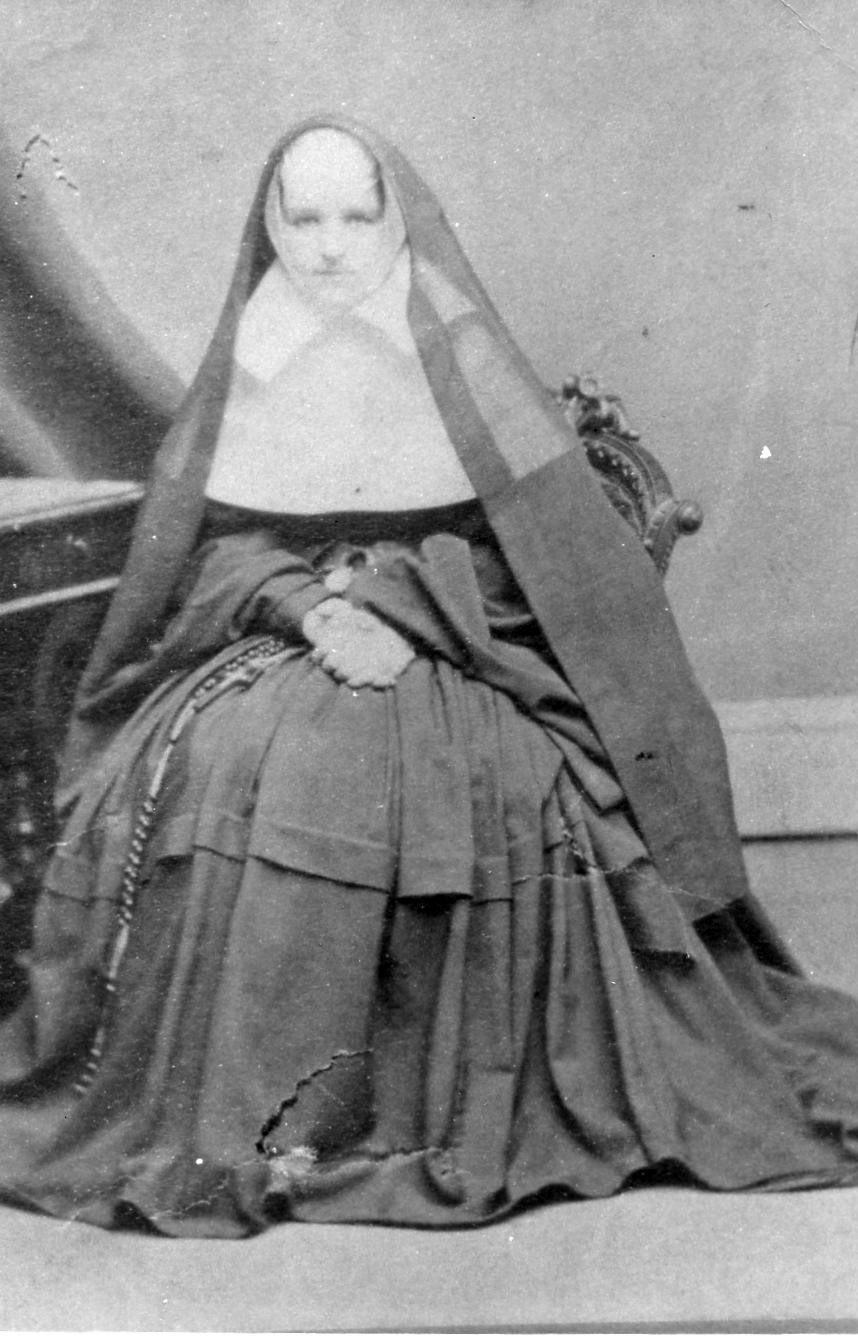
Among the several melodies that were composed for this beautiful hymn the melody that achieved the greatest success was by Sister Mary Alexis Donnelly, R.S.M. (1857-1936) of the Order of Mercy, St. Xavier’s Convent, Providence, RI., Her composition was published by J. Fischer & Bros., in song sheet form and by McLaughlin & Reilly, Co., in their hymn-pamphlet No. 25, HYMNS TO THE BLESSED VIRGIN MARY published in 1906. This hymn pamphlet and others that featured her musical compositions appropriate for various occasions or use proved to be an enormous success for McLaughlin & Reilly and were sold continually during the company’s existence. This arrangement also appeared in OUR LADY OF MERCY hymnal published in 1899 and OUR LADY OF MERCY Vol. 2 published in 1927. Both of these hymnals were compiled by the Sisters of Mercy with music by Sister Mary Alexis Donnelly. It also appeared in the STANDARD CATHOLIC HYMNAL published by McLaughlin & Reilly, Co., in 1921.

Sister Mary Alexis Donnelly, R.S.M.,
courtesy of catholicdevotionalhymns.com
Our Lady of Mercy, 1899

Reflection

When I meditate on the verses, I can see several allusions to biblical passages in the hymn. For example, thy throne is in heaven, thy Son is its King, a reference to Psalm 45:10, the Queen takes her place at your right hand in gold of Ophir. The Mystical Rod pointing to Isaiah 11:1, a shoot shall sprout from the stump of Jesse. Also, the Handmaid of God a reference to Luke 1:38, Behold, I am the handmaid of the Lord, and again the sun with its rays calling to mind Rev. 12:1, a woman clothed with the sun, and we bless thee, from Luke 1:48, all generations shall call me blessed. I also see a reference to John 19:27 in the phrase Oh be thou our Mother. Each person who reflects on these verses will see something different or nothing at all. What can you see? 

This would make a wonderful hymn to sing at the beginning of Mass, at offertory, or as a recessional during the month of August and for the Feast of the Assumption. At St. Mary’s where I grew up and sang in the choir for more than thirty years, we didn’t wait for a feast day to arrive to honor Mary, she was our patroness and the Mother of God, so we honored her with hymns on most Sunday’s throughout the year. Be spontaneous and see what graces and help will come from Our Blessed Mother when you express your love for her through hymns.

On another note, Father Cummings is sometimes credited as the author of the hymn Immaculate Mary, Thy praises we sing. This is FALSE. This hymn first appeared in the CANTATE OMNES Catholic hymnal published in 1952 and the words are by an unknown author or editor. The hymn was offered as a substitute for the beloved Marian hymn Immaculate Mary, Our hearts are on fire. This brings to mind an interesting narrative I read in the Introduction to the PEOPLE’S HYMNAL published in 1955 by THE HYMN COMMITTEE of THE THEOLOGICAL COLLEGE, Washington, D.C., Catholic devotion, as the Church takes care to emphasize, should represent, not what we would wish to feel, but what we actually do feel. There is no need for saying that our hearts are on fire when really, they are not.

Hmm…We’re not our hearts burning inside us as he talked to us on the road and explained the Scriptures to us (Luke 24:32)

A beautiful Harp solo of Sister Mary Alexis Donnelly’s composition and many of her other compositions can be found by visiting The Devotional Hymns Project website produced by Peter Meggison. 

Below is a selection of the melodies composed for the hymn Hail! Virgin of Virgins described above. These are computer generated sound files. The tempo is approximate but should provide the listener a good sense of what the hymn sounds like. All the hymns are in the public domain. Music directors, if you use any of these selections in your Sunday or weekly music programs and you make a recording, contact the author and I may feature it in the What’s New section of the website. 

album-art

00:00

Lord, for Tomorrow and Its Needs (Just for To-Day)

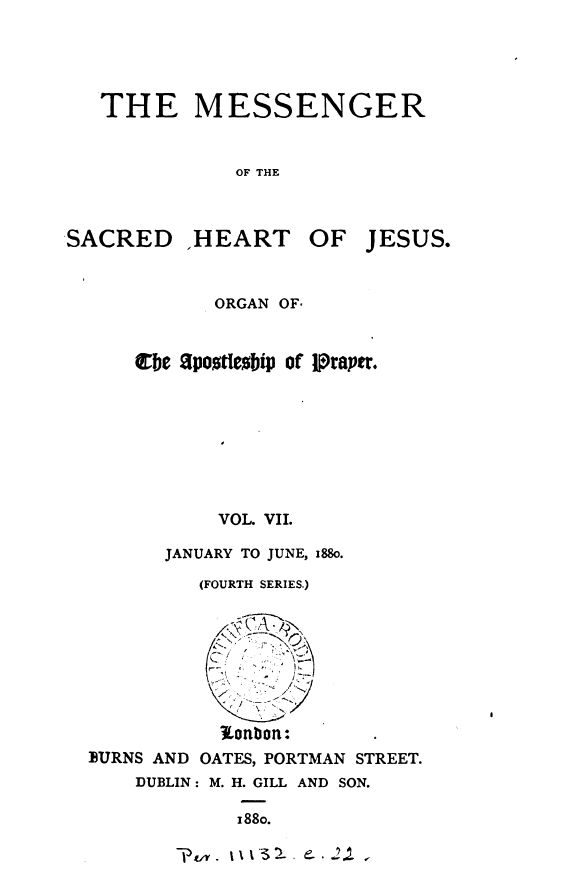
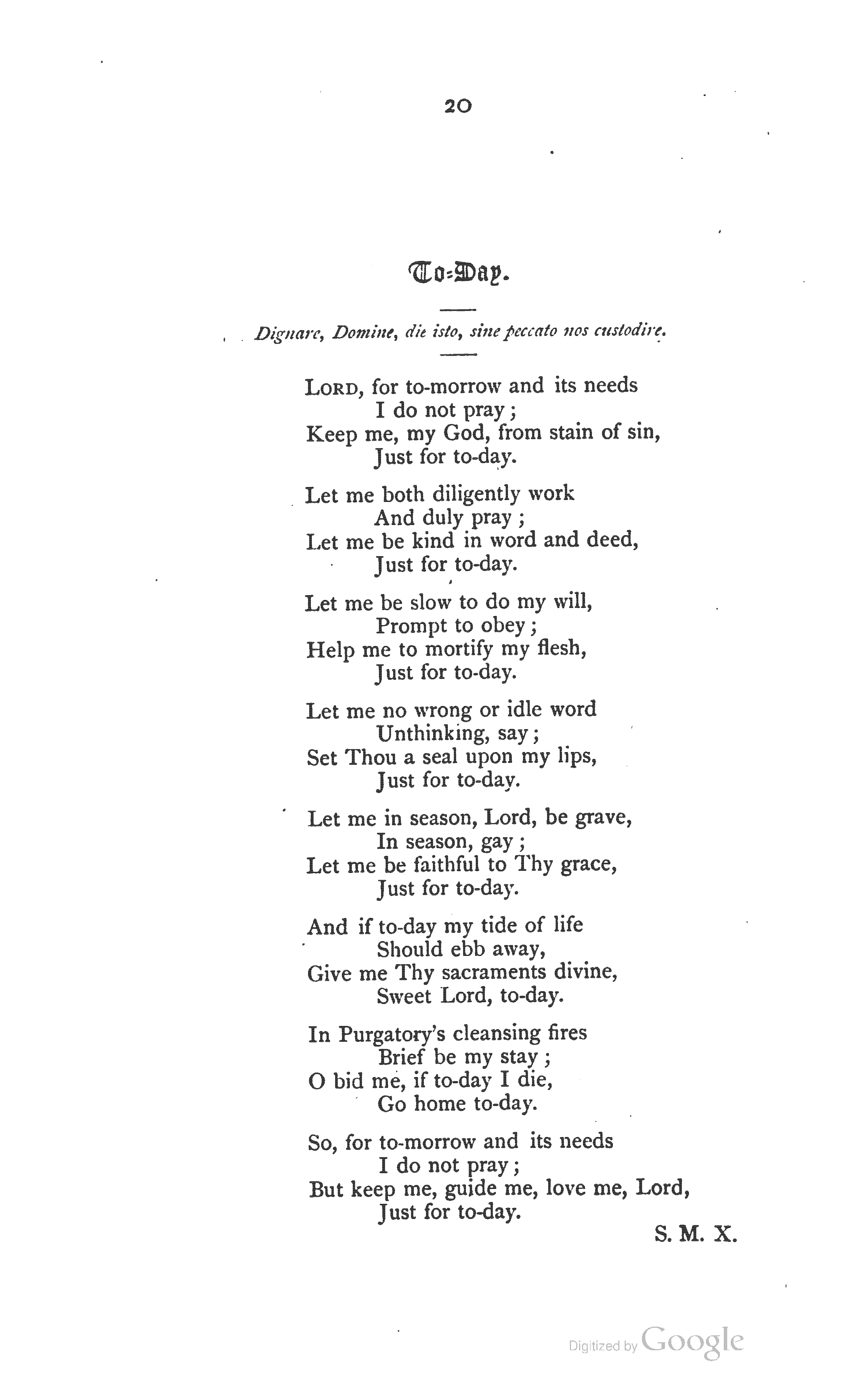
The words of this hymn were written in the early morning hours of 1877 by Sister Mary Xavier while attending the bedside of an elderly nun whose life was ebbing away. The lines were of great comfort to the patient. In time, Sister Mary Xavier sent the words of the hymn to her mother, who had them published in the January issue of the MESSENGER OF THE SACRED HEART, 1880. This is the earliest known publication of the hymn to exist.

When conducting my research, I noted some inconsistencies found among the online sources with regards to Sister Mary Xavier, not the least of which is when she was born. So, I contacted the archivist of the Mount Pleasant Community in Liverpool, England to see if she could supply the correct biographical details of Sister Mary Xavier which she did.

Sister Mary Xavier was born Sybil F. Partridge on April 11, 1850, in London. Her father Professor Richard Partridge (1805-1873) was a London Doctor of Medicine and president of the Royal College of Surgeons. The family was distinguished for literary and artistic gifts. Three sisters entered Religion and died before Sister Mary Xavier. Her brother, Sir John Bernard Partridge (1861-1945), the famous cartoonist, joined the staff of Punch a British weekly magazine.

In 1873 Sybil Partridge offered herself as a Postulant at the Mother House of the Sisters of Notre Dame in Namur, Belgium. Not long after she was clothed in the Religious habit and took the name Sister Mary Xavier. In 1876 she made her Religious Profession at Namur, after which she was sent to the Convent of Notre Dame, Mount Pleasant, Liverpool. During this period, she also presented herself for examination gaining the Parchment which qualified her for teaching in the Training College. From the beginning of her career, she showed herself to be an exceptionally gifted teacher, and under the leadership of Sister Mary of St. Philip (Frances Mary Lescher) (1825-1904), contributed much to the fame of the Training College during the years she worked there.

In 1898 she became the first Principal of St. Mary’s Hall, a Secondary Training College opened in connection with the Notre Dame Convent, Mount Pleasant. In 1903, Sister Mary Xavier, at the request of former students and colleagues, published a book, IN HYMNIS ET CANTICIS, a collection of her poems, both sacred and profane.

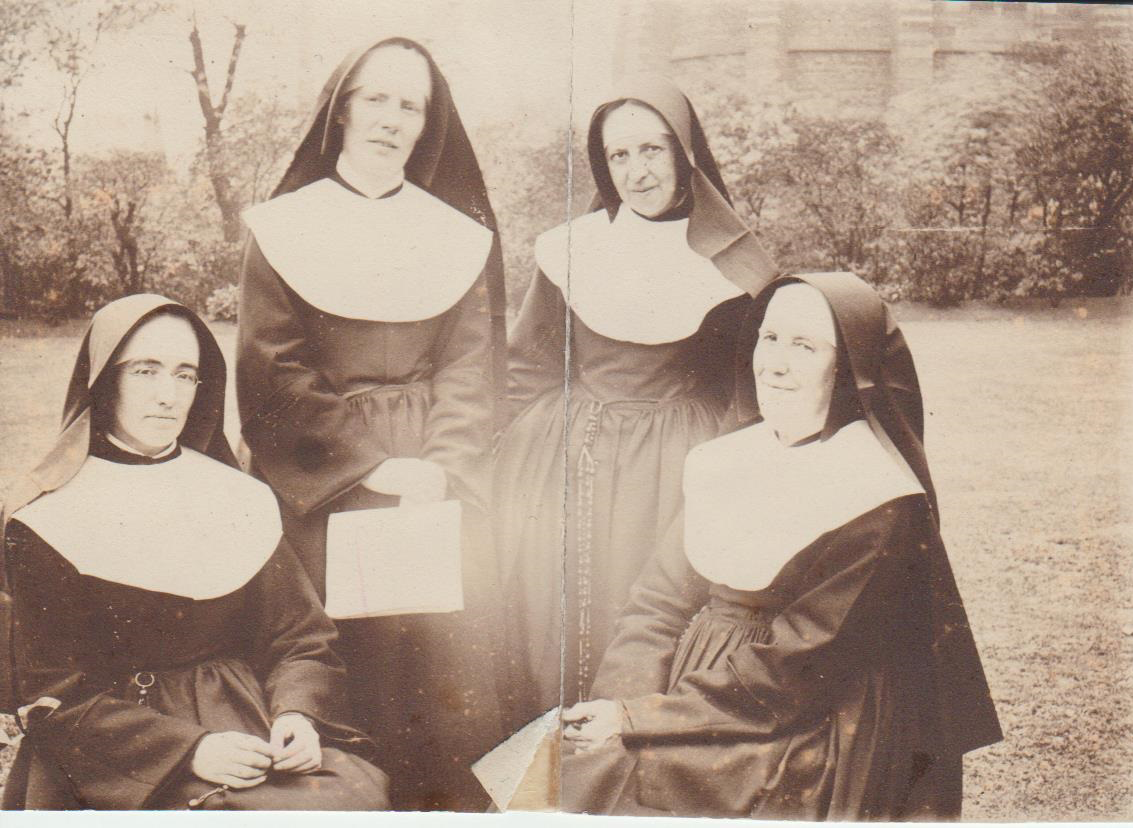
The Sisters of St. Mary's Hall
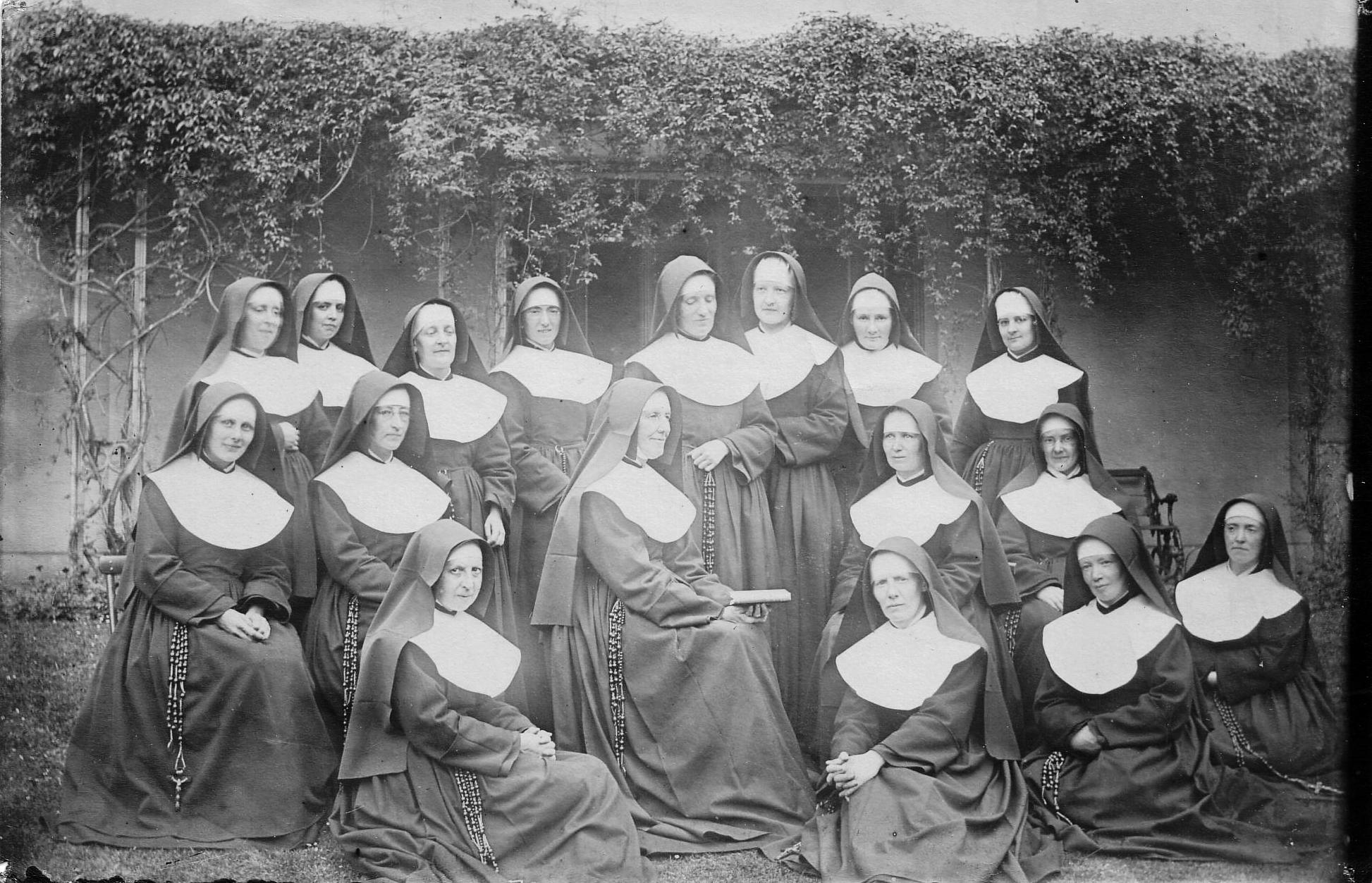
Training College Sisters

The Mount Pleasant Community archivist supplied the above photos. The photo on the left captioned The Sisters of St. Mary’s Hall was marked with names on the back and if we accept that the naming is correct we have from left to right, Sister Julie of St. Agnes (Julie des Agnes), Sister Mary Xavier, Sister Rose of St. Joseph, and Sister Mary of St. Philip. The photo captioned Training College Sisters was not marked with any names. However, the four sisters who have been named already are in the second photo. Sister Mary of St. Philip is in the center (seated), in the first row on the left and right of Sister Mary of St. Philip and seated on the ground is Sister Rose of St. Joseph (left) and Sister Mary Xavier (right). Sister Julie of St. Agnes is seated in the second row, second from the left. The date of these photos is not known but were taken a few years apart and before 1904. Few photographs exist of the Sisters but clearly there were times when groups were photographed. Sisters were not usually allowed to have photographs taken until the late 1960s which makes these photographs incredibly special.

Sister Mary Xavier was twenty-seven years of age when she composed what was to become her most famous hymn. She composed as many as nineteen hymns and most of them appear in the NEW HYMNS by the Sisters of Notre Dame, published by Cary & Co., London circa 1892. Also in the AMERICAN CATHOLIC HYMNAL, 1913 and 1921, more than ten of Sister Xavier’s hymns appear in this one hymnal. Among the more widely used hymns of Sister Mary Xavier were her communion hymn Jesus, Thou Art Coming, her hymn Mother of Christ (Mater Christi), and Mother of all that is pure and glad (Causa Nostrae Laetitiae) also known as the Holiday Hymn.

In 1916, Sister Mary Xavier retired from Mount Pleasant and moved to Birkdale – part of the seaside town of Southport, just north from Liverpool. There was a good-sized community there for many years. Sister Mary Xavier died on February 23, 1917. She was buried in one of the Southport Catholic parish church graveyards. 

The hymn appeared in the following Catholic hymnals: the 1912 and 1939 WESTMINSTER HYMNAL, a melody by Laurence or Lawrence Ampleforth, this is a pseudonym used by Richard R. Terry (1865-1938); the ST. BASIL’S HYMNAL, 1918 thru 1953, to a melody by James Edmund Jones; the ST. GREGORY HYMNAL, 1920, to a melody by Nicola Montani; the AMERICAN CATHOLIC HYMNAL, 1913 and 1921, to a melody by F. M. S. (Marist Brothers); in SELECTED HYMNS, 1930, a small book of hymns (words only) by the Sisters of St. Joseph of the Archdiocese of Boston; also in A DAILY HYMN BOOK, 1948, to a melody by Fr. F. M. de Zulueta, S.J.; the ALVERNO HYMNAL Part III, 1953, to a melody attributed to R. R. Terry and slightly altered; the MANUAL OF HYMNS FOR THE CATHOLIC SCHOOL, 1948 (words only) published especially for the Catholic Parochial Schools; and in the NEW ST. BASIL’S HYMNAL, 1958, to a melody by John Lee. Many of the hymnals listed above are available from the CCWATERSHED.ORG website.

The hymn is also found in many non-Catholic hymnals with melodies by various composers including Horatio R. Palmer (1834-1907), George C. Stebbins (1846-1945), and Thomas T. Noble (1867-1953). The authorship of the hymn has been pirated many times. Attributions to Bishop Samuel Wilberforce (1805-1873) and his son Bishop Ernest Wilberforce (1840-1907) both from the Church of England are commonly found in the hymnals. In an interview with Bishop Ernest Wilberforce about a month before he died, he denied any authorship to the hymn. Another name was William Huckle a convict from Dominion Penitentiary in Canada who claimed to have written the verses in a moment of inspiration. Being a character of more than unusual disreputableness William Huckle’s claim was dismissed. Some of the verses especially the Catholic verse beginning In Purgatory’s cleansing fires are left out of the non-Catholic hymnals.

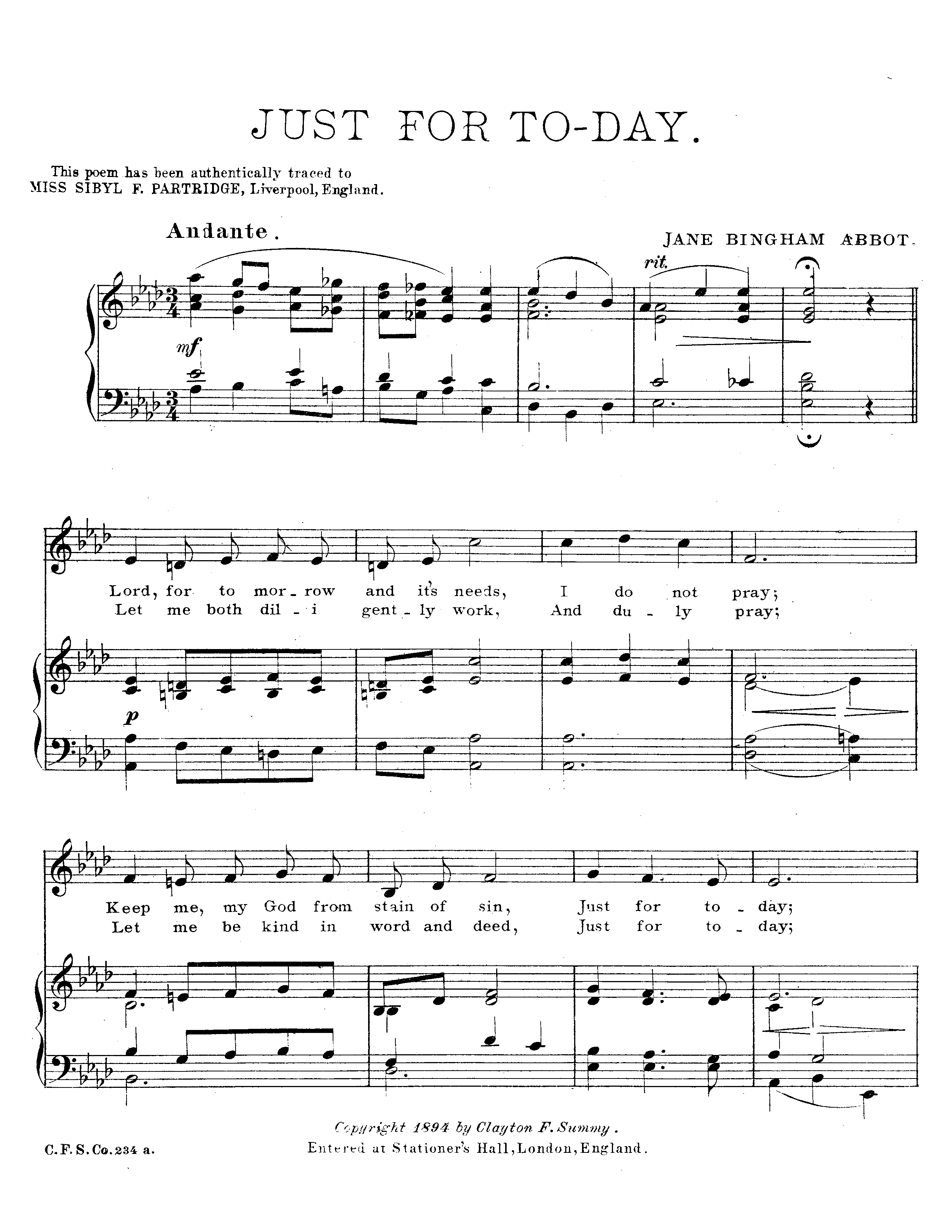
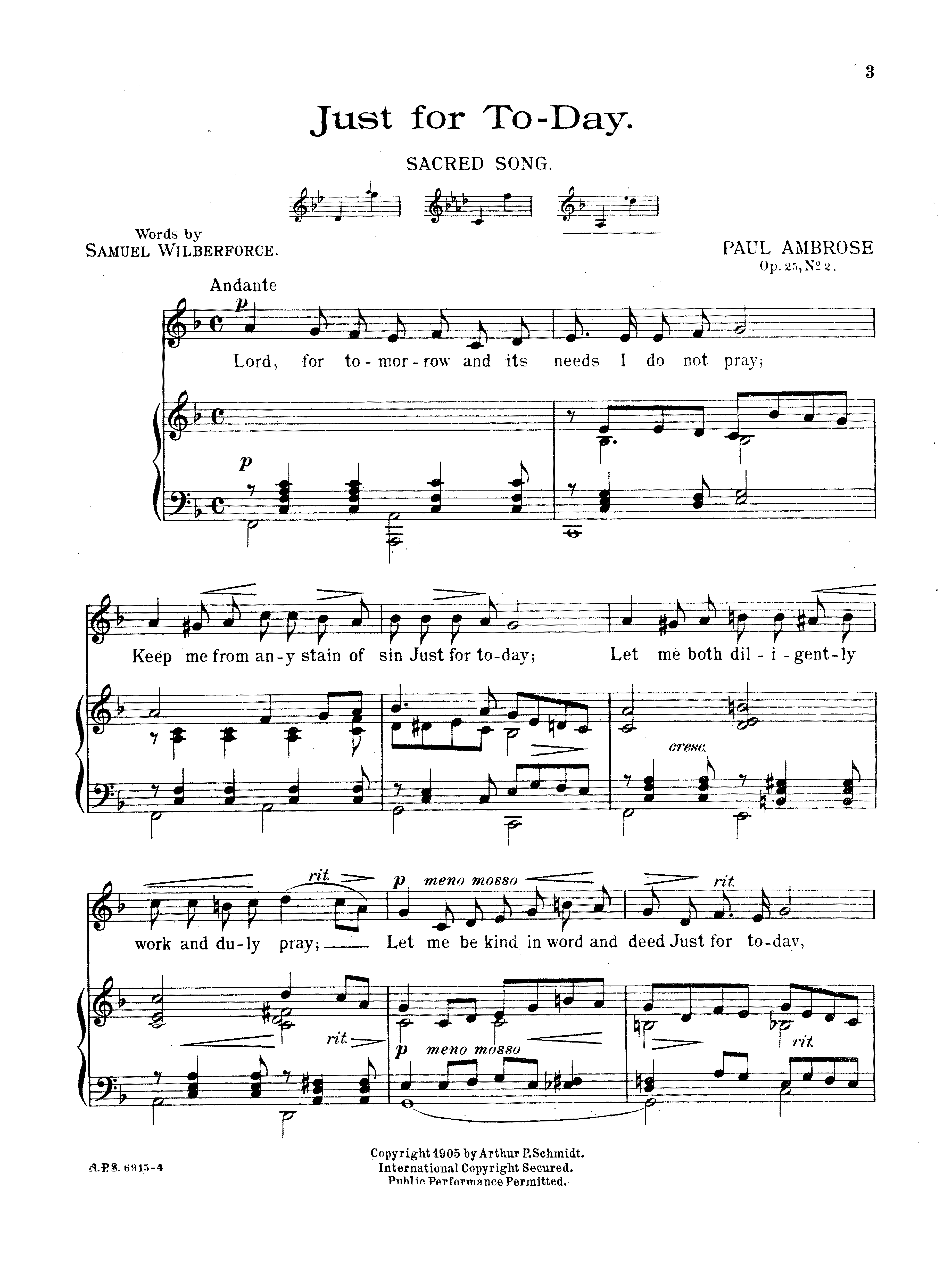
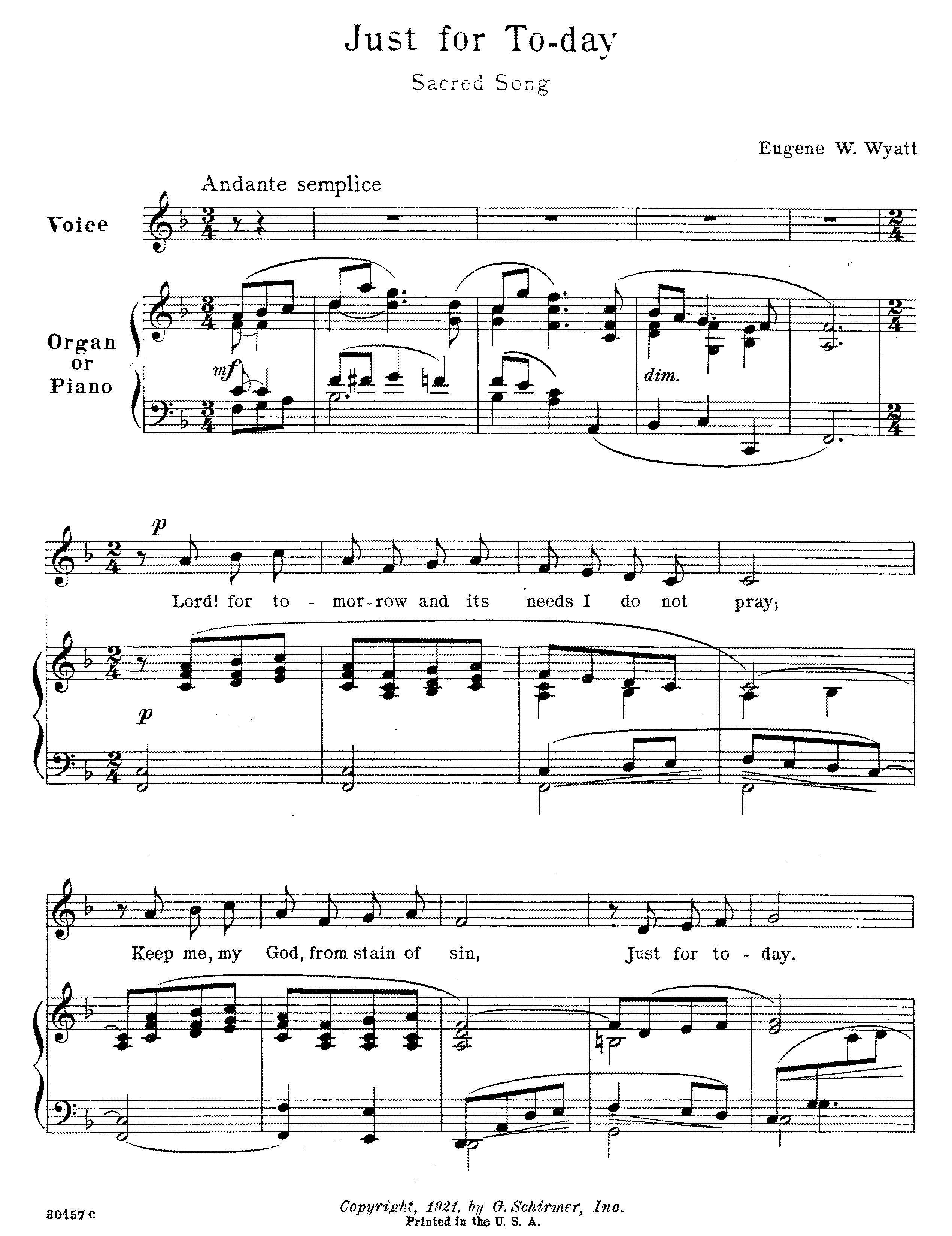
The hymn appeared in sheet music form with music composed by several musicians. The first was composed by Jane Bingham Abbott published in 1894 by Clayton F. Summy Co. of Chicago and Weekes & Co., London and later sung by contralto Christine Miller on Edison records in 1914. Paul Ambrose (1868-1941) composed a melody in 1905 which was published by The Arthur P. Schmidt Co. of Boston. Between 1910 and 1921, several compositions were published by G. Schirmer, Inc., of New York. These include Mary Turner Salter (1856-1938) in 1910, Frederick Flaxington Harker (1876-1936) in 1914, and Eugene W. Wyatt (1880-1927) in 1921.

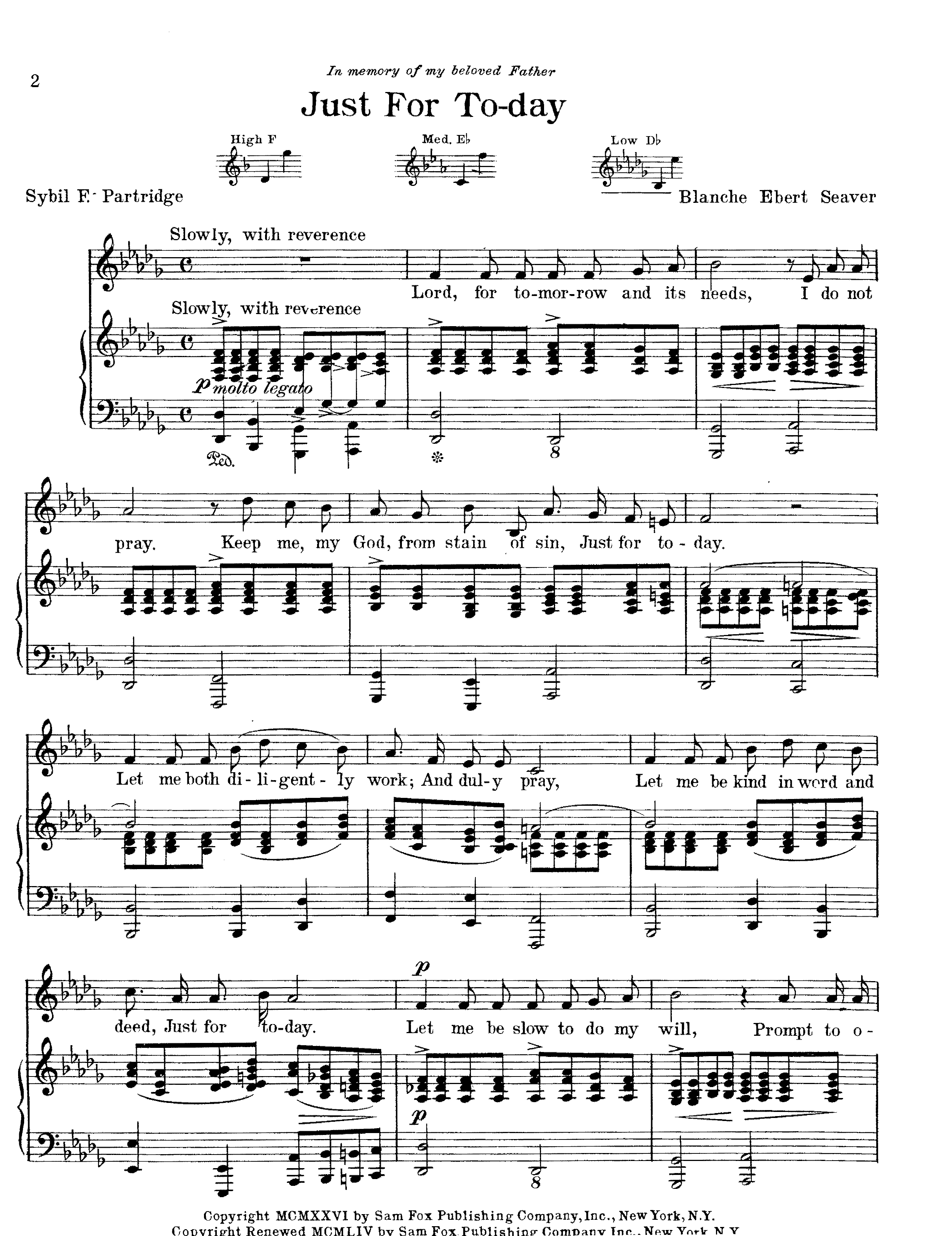
The melody that became the most widely used gained its great popularity through the 1930 film Song O’ My Heart, produced by the Fox Film Corporation and sung by the well-known Irish tenor John McCormack. Blanche Ebert Seaver (1891-1994) composed the music for the hymn in 1926. The melody by Blanche Seaver touched the hearts of many and its popularity grew. Baritone John Charles Thomas, accompanied by pianist Carroll Hollister, also sang Just For Today on Victor Red Seal records and radio during the 1930s and 1940s. Copies of the sheet music published by Sam Fox Publishing Company can be found on eBay.

In the CAECILIA magazine archives of the Church Music Association of America there is a wonderful write-up on the origins of the hymn and its author from which some of the details given in this story have been taken. You can read the full article in the November 1936 edition, page 445, captioned THE HYMN JUST FOR TODAY.

Just for To-day by Jane Bingham Abbot, 1894
Just for To-day by Paul Ambrose, 1905
Just for To-day by Eugene W. Wyatt, 1921
Just For To-day by Blanche Ebert Seaver, 1926

Reflection

During my earlier years in St. Mary’s Choir (1977-2010) this hymn was sung on various occasions before Mass by my friend and fellow tenor Tom McNeil (1933-2019). Over the years this prayerful hymn would find its way back to me, and I would hum the melody and sing the words that I once heard long ago. How wonderful to discover that the melody Tom sang was composed by Blanche Seaver and the words composed by Sister Mary Xavier. The verses reflect the words of Our Lord, Enough then, of worrying about tomorrow. Let tomorrow take care of itself. Today has troubles enough of its own (Matt. 6:34).

Another wonderful reflection of this hymn appeared in the CAECILIA magazine mentioned above in the article, WHAT QUALITIES SHOULD A GOOD HYMN HAVE? page 448. This review examines the following characteristics: Simplicity, Freshness, Reality of Feeling, Consistent Elevation of Tone, and A Rhythm Easy and Harmonious.

Simplicity – The more you enter those stanzas, the more you are enraptured by the childlike simplicity of a soul that trustfully longs for her God and of a soul that has, grasped the wonderful lesson of the Gospel: Be not solicitous for your life … Behold the birds of the air. Consider the lilies of the field. Be not solicitous for to-morrow (Matt. 6:25-34).

Freshness – Like a clear bubbling fountain these lines issue forth from the well-spring of a deep, loving heart. There is no laboring, digging and artificial hymn-smithing; the inspiration is right there, and the pen can hardly keep pace with the mental rapture; that’s why the World so eagerly has taken to these verses.

Reality of feeling – What is more real than death? And what is more certain than that the present day may be our last one? If under pressure of this awful reality, the soul embraces her God with every fiber. Can anyone say that these lines are destitute of sound feeling?

Consistent elevation of tone – There is no monotony in these lines; one mental vista seems to chase the other; the sanctified daily routine of cloistered life: Work and pray and obey and deny thyself’ passes quickly before our mental gaze; we hold our breath and admit that the program of every Christian is held up before our eyes.

A rhythm easy and harmonious – Easy, yes, it is easy, not labored rhythm; it is playful, joyful, inviting, and for this reason it is harmonious rhythm: it is music for the soul, inspiration for the mind, a vigorous incentive for the will.

The hymn Lord, for Tomorrow and Its Needs appears in A Catholic Book of Hymns published by the Sacred Music Library. This is a wonderful collection of 295 time-honored Catholic traditional hymns.

Newly commissioned recordings of some of the hymns written by Sister Mary Xavier can be found by visiting the Devotional Hymns Project website produced by Peter Meggison. Look for these hymns written by Sister Mary Xavier:

  • Jesus, Thou Art Coming
  • Mother of Christ
  • Mary, O Turn Thine Eyes Upon Us
  • Fierce and Loud is the battle raging
  • Lord, for Tomorrow and Its Needs
  • Mother! Mother! I’m Coming Home
  • O Lord of Host
  • O King and Lord
  • Nunc et in hora mortis
  • Heart of Jesus! Sacred Heart!
  • Queen and Mother

Visit the Devotional Hymns Project website often because new recordings of Catholic devotional hymns are always being added.

St. Mary Parish May Crowning

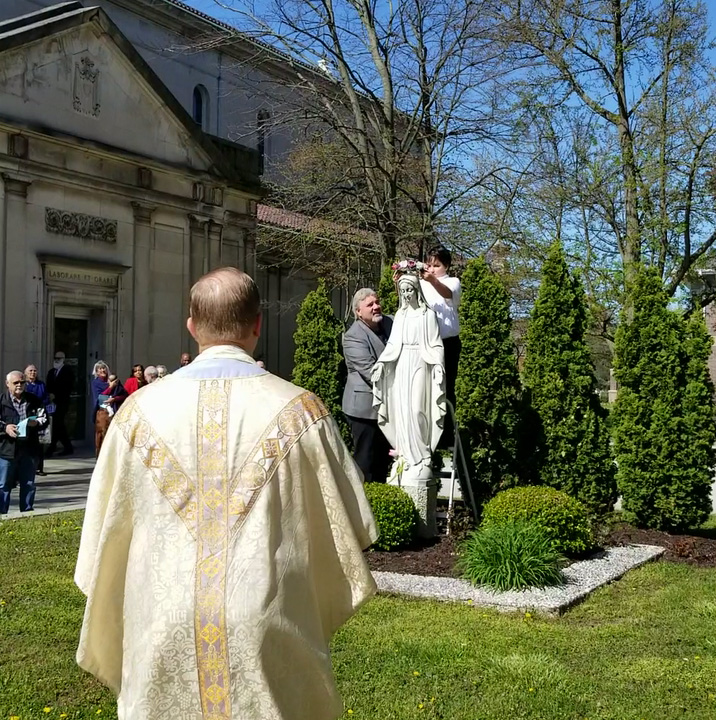
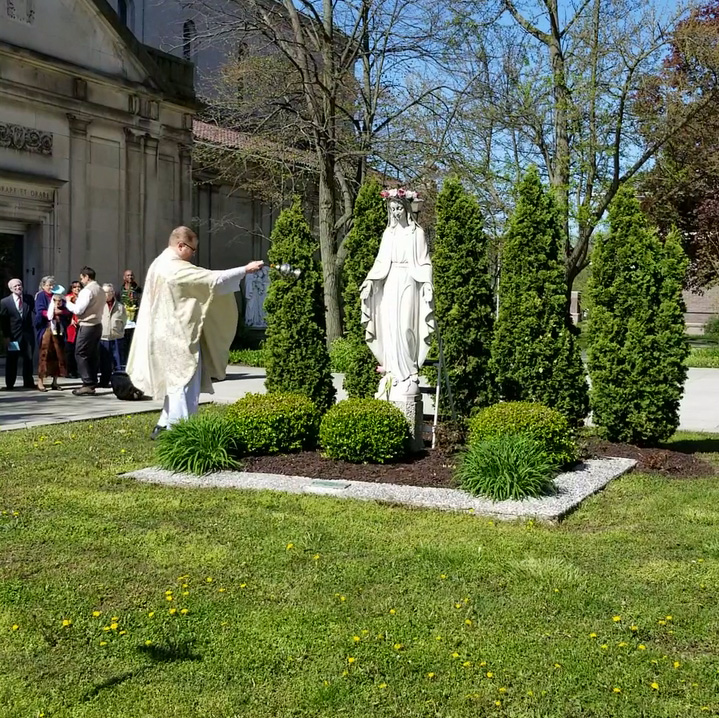
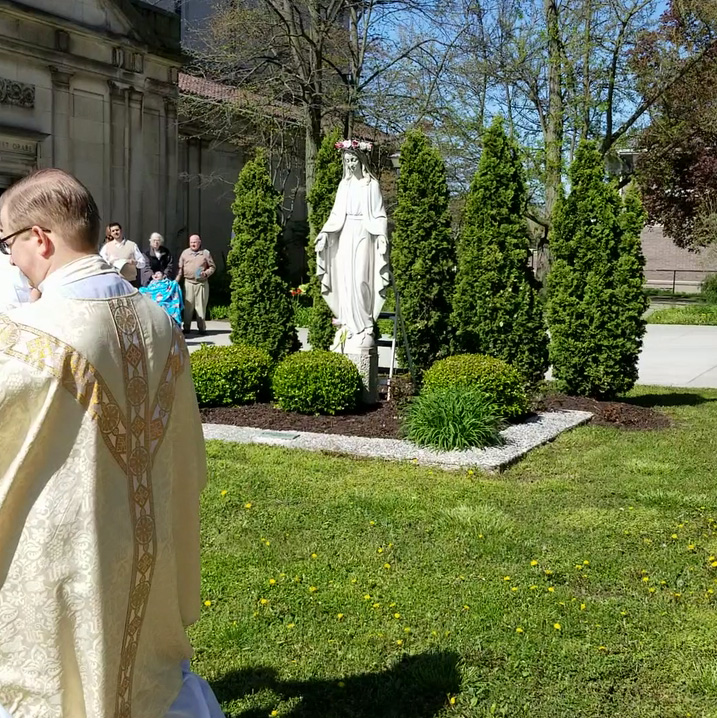
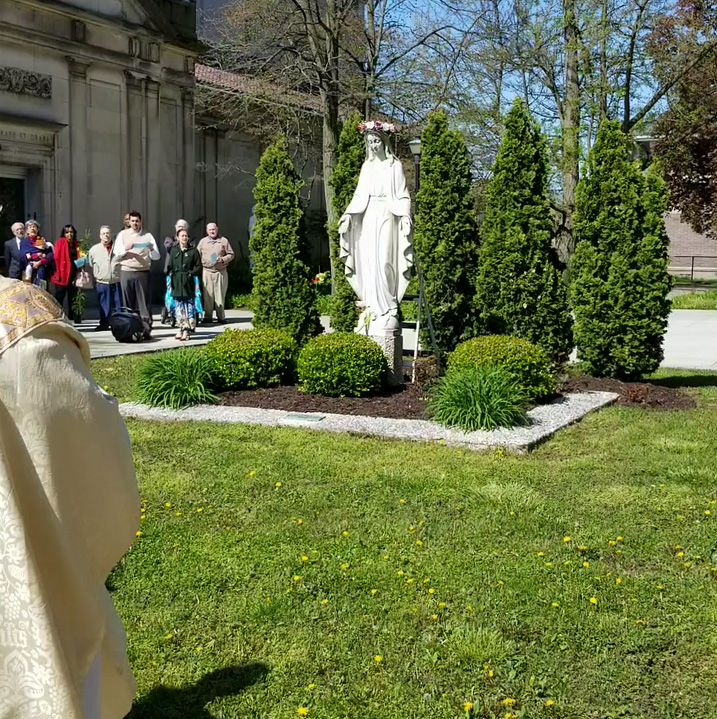
On May 2, 2022, I emailed Father Chris Zerucha, Pastor of St. Mary Parish in Akron, Ohio to share with him my short story on the origins of the most widely used May Crowning hymn in the Catholic Church, Bring Flowers of the Rarest. I grew up in St. Mary’s Parish and sang in the choir for over thirty years (1977-2010). I was happy when Father Zerucha invited me to attend the 9AM Mass at St. Mary’s on May 8, Mother’s Day. They celebrated a First Communion and had a May Crowning after Mass. It was beautiful sunny day for an outdoor gathering to crown Our Lady. 

Everyone received a small blue leaflet entitled May Crowning with the words of the hymns printed on the pages and on the back page of the leaflet were the words of Bring Flowers of the Rarest. There was a small ensemble of singers that led the congregation. It brought back a lot of memories. The Mass included some exceptionally good hymn selections including, Jesus Christ is Risen Today; Jesus My Lord, My God My All, and O Lord I Am Not Worthy for the First Communion hymn. When I arrived, they were praying the rosary before the Blessed Sacrament.

To my surprise Father Zerucha featured my hymn reflections in St. Mary’s weekly bulletin. God Bless you and thank you Father Chris Zerucha.

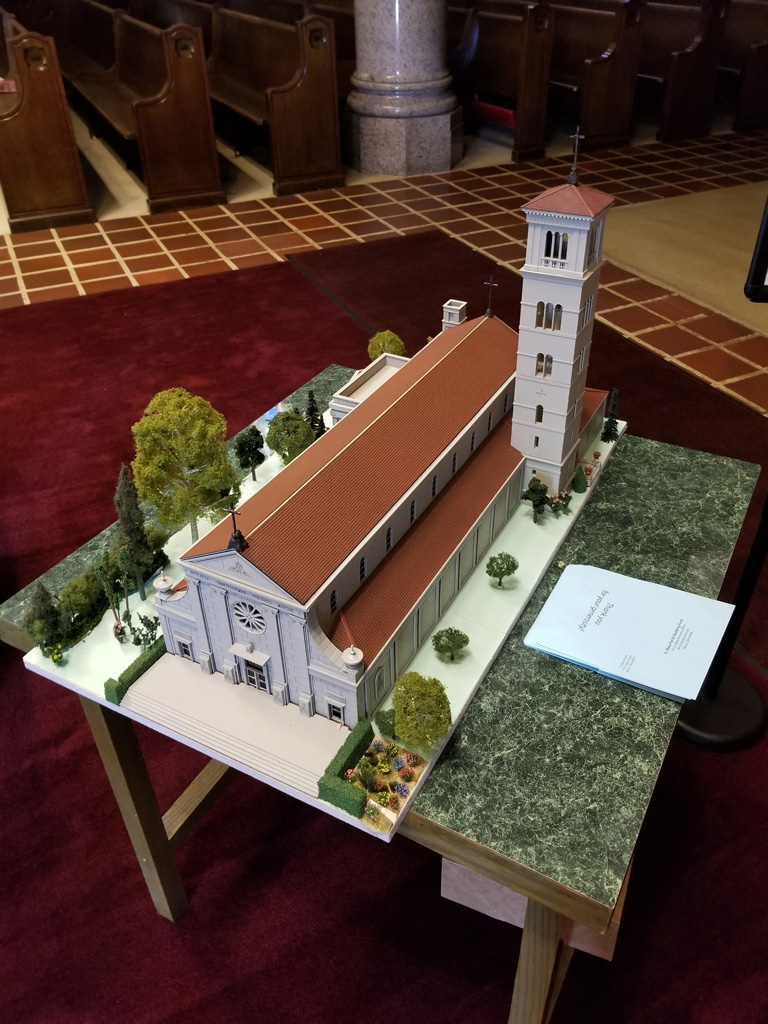
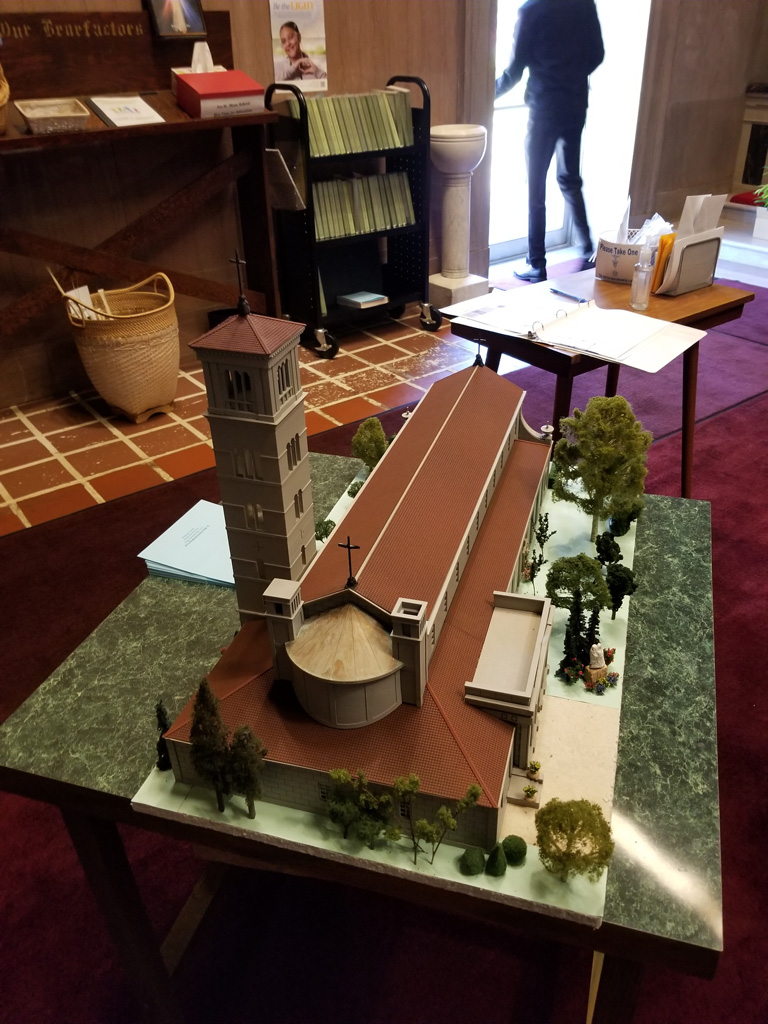
I took a few photos which I thought you might enjoy. As you enter from the side entrance, they have this beautiful scale model of St. Mary’s Church. The parish is currently engaged in a $1 million dollar restoration project.

May Crowning
May Crowning
May Crowning
May Crowning
St. Mary's Church
St. Mary's Church
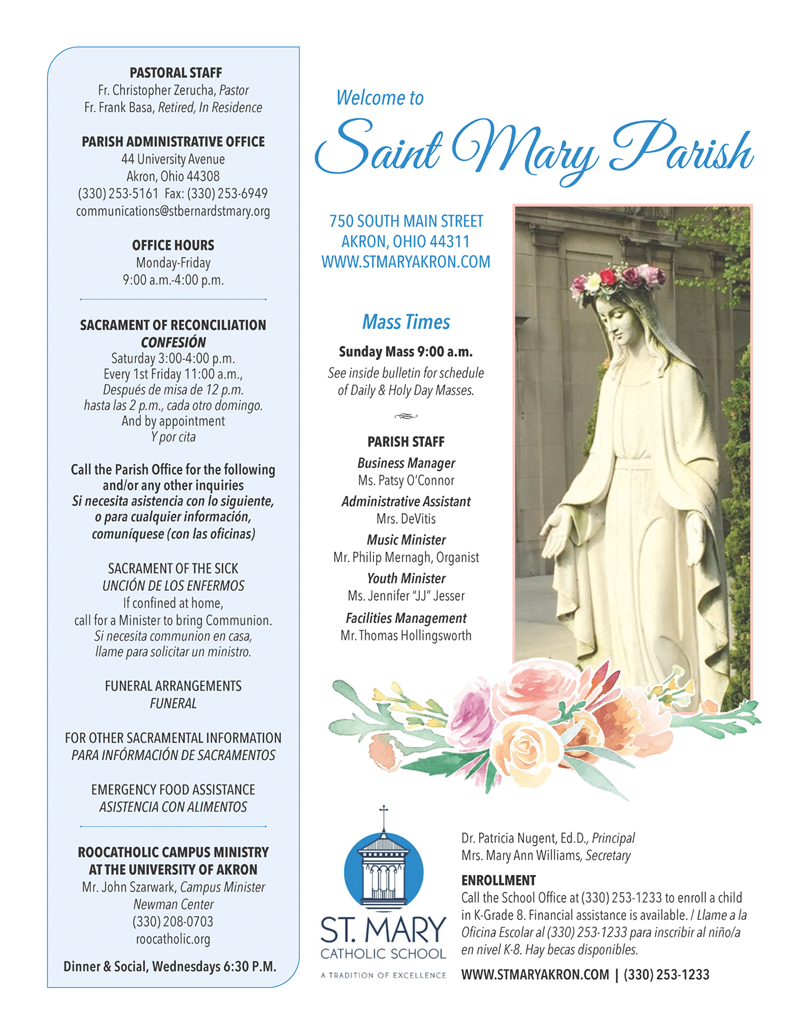
Parish Bulletin Cover
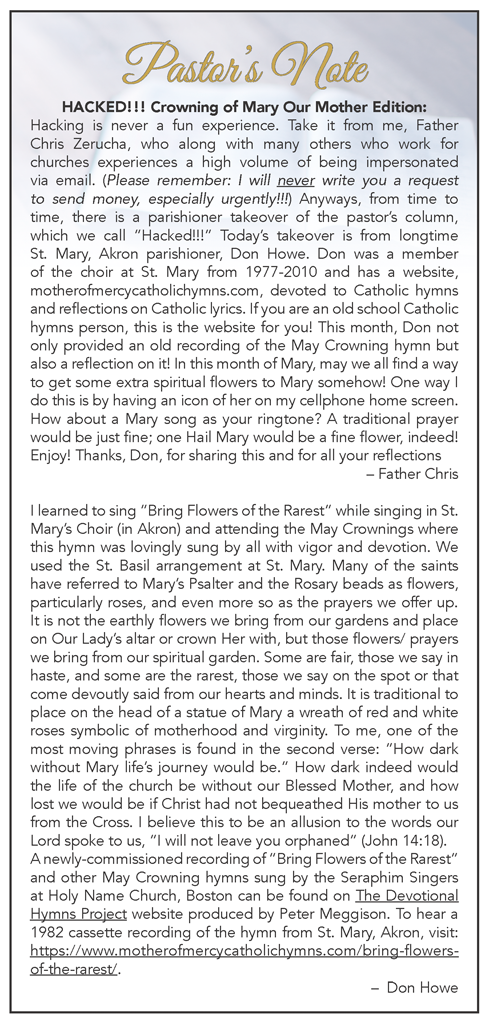
Pastor's Note
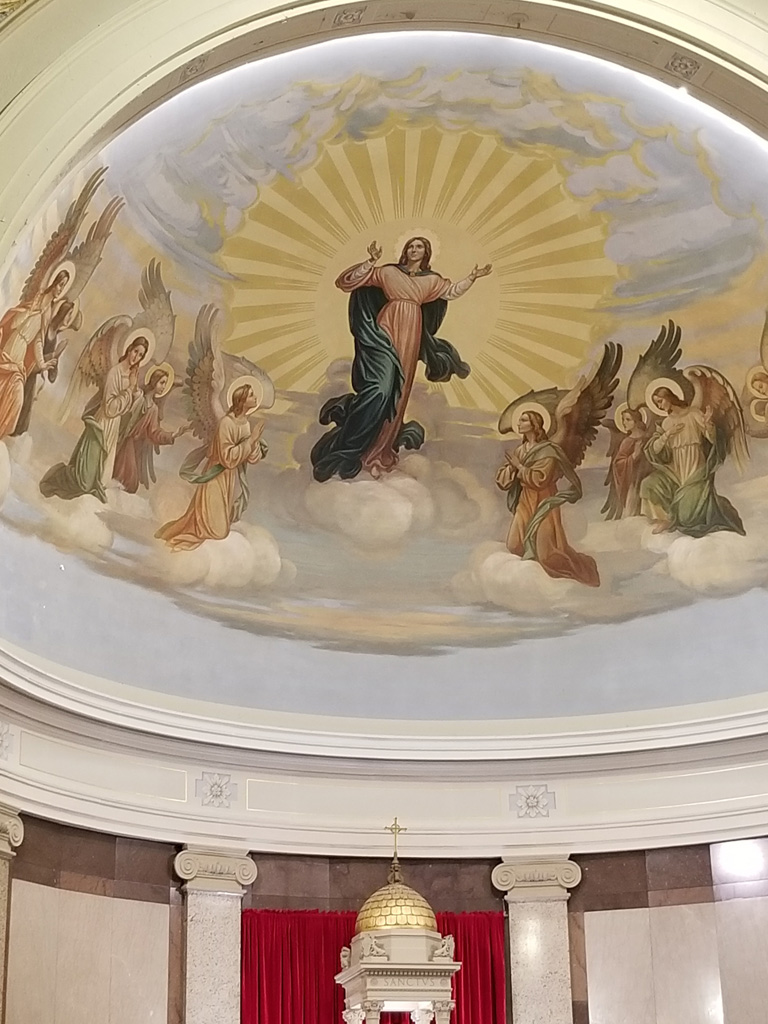
Over the high altar

Bring Flowers of the Rarest

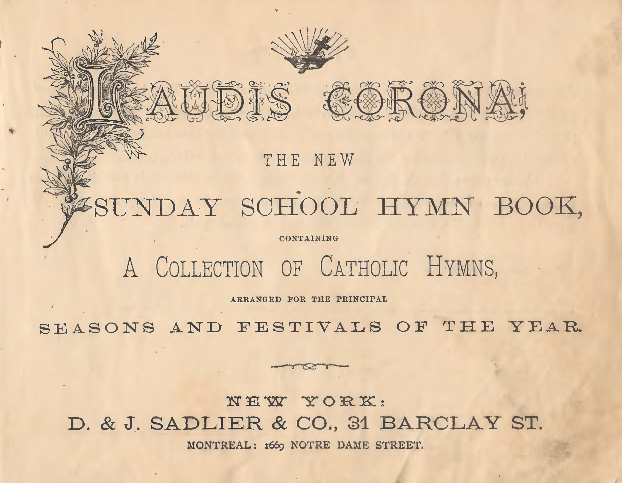
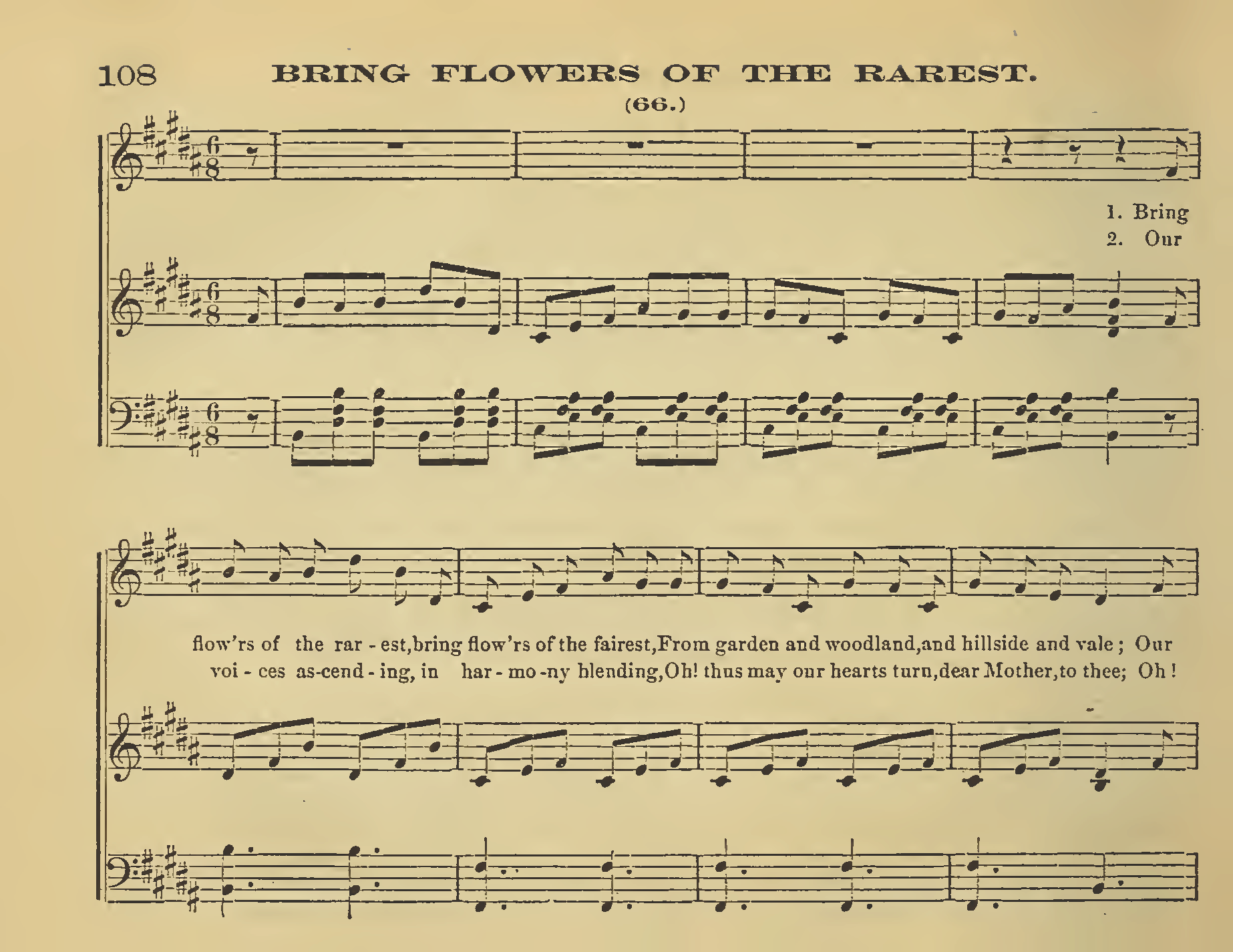
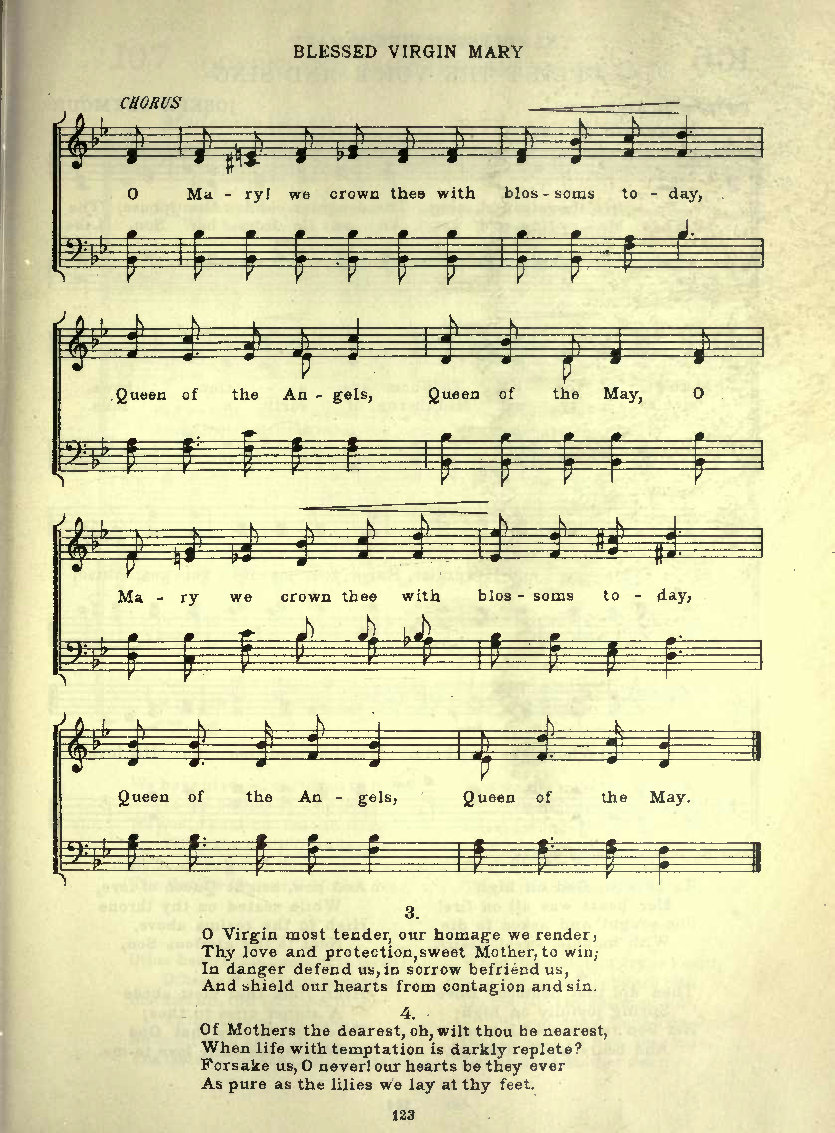
This hymn, sometimes referred to as the Crowning Hymn because of its chorus, O Mary, We Crown Thee with Blossoms Today, is the most widely used and well-loved of all Marian hymns for May Crowning. Even though other crowning hymns were composed, this hymn was never superseded. The earliest appearance of the hymn is found in the LAUDIS CORONA, 1880 hymnal with no attribution given to the author or composer. In the Preface of this hymnal the publishers give thanks to the Sisters of Notre Dame for their kindness in granting permission to use selections from their hymnal MAY CHIMES, 1871.

Laudis Corona 1880
Laudis Corona 1880

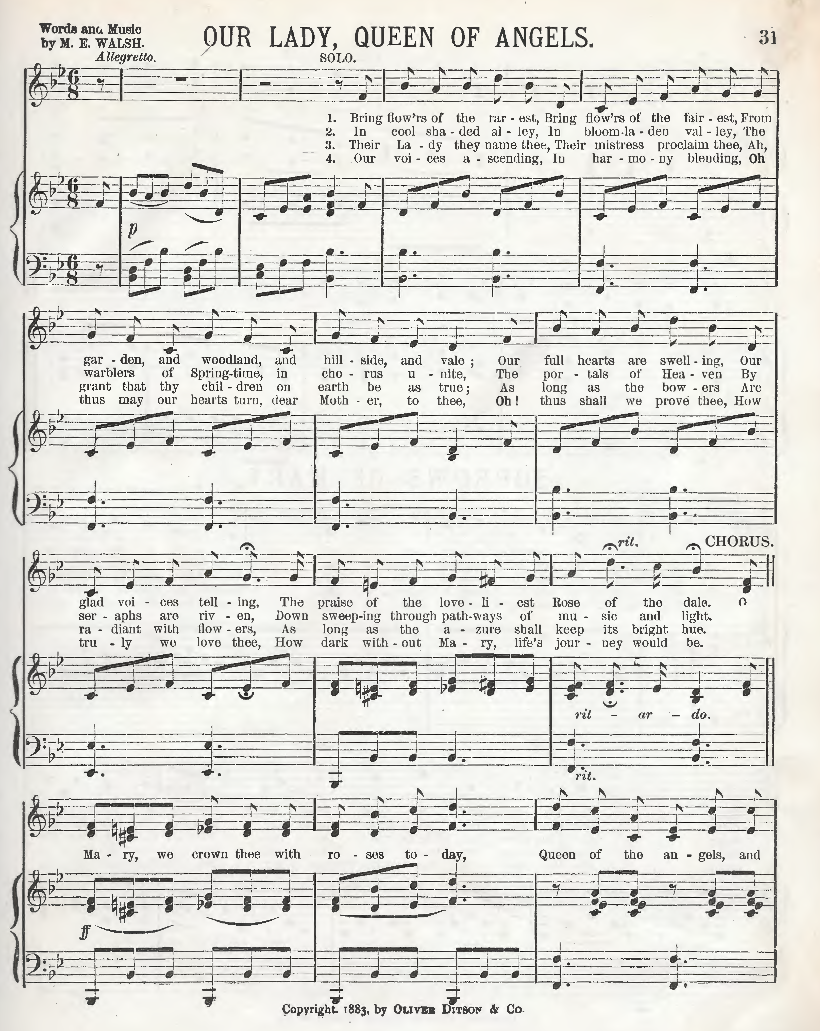
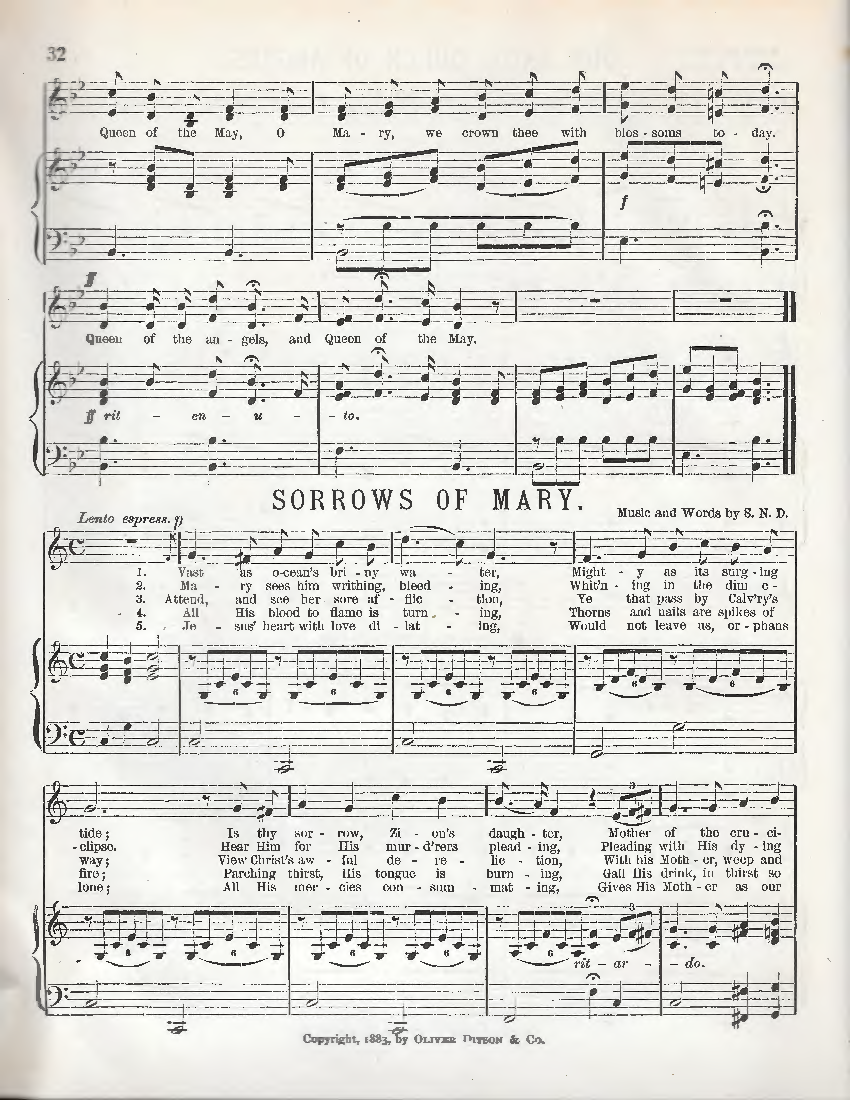
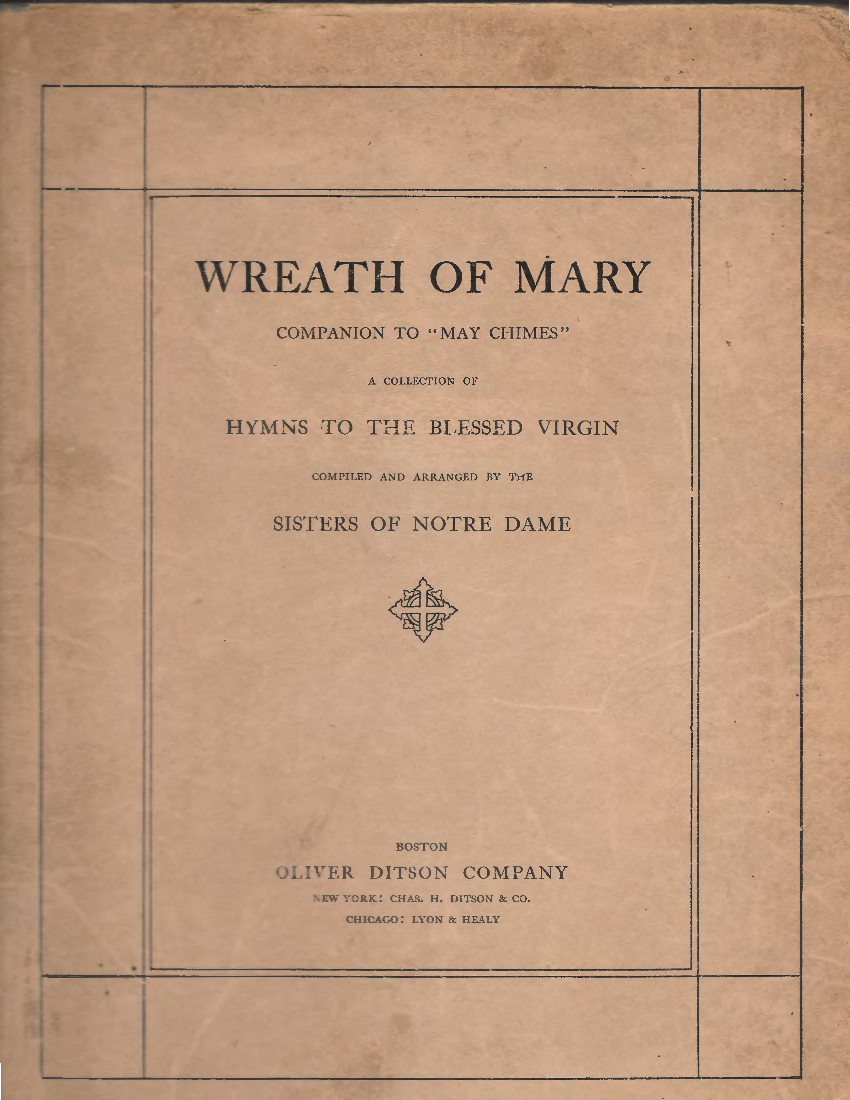
A few years later the hymn was published in the WREATH OF MARY, 1883 and captioned Our Lady, Queen of Angels with attribution for the words and music by Mary E. Walsh. This hymnal was compiled and arranged by the Sisters of Notre Dame de Namur of Cincinnati, Ohio. 

Wreath of Mary 1883
Wreath of Mary 1883

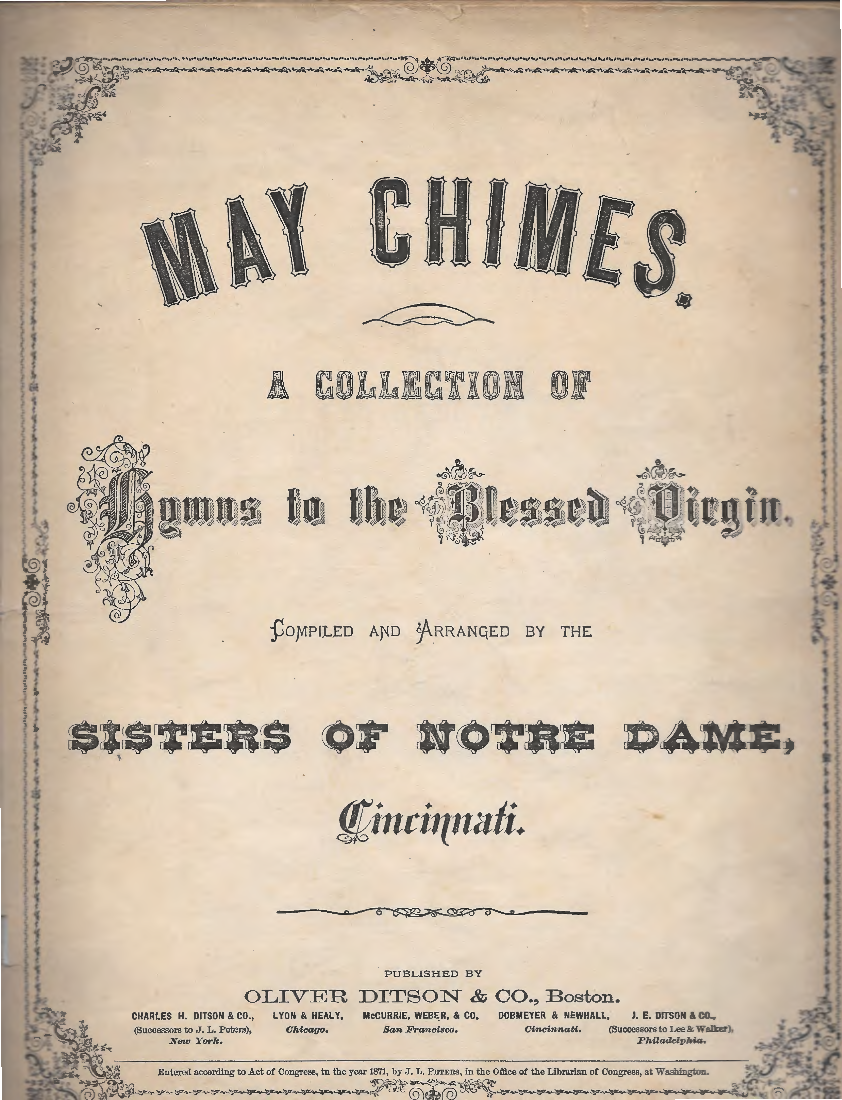
The Sisters of Notre Dame de Namur came from Belgium and arrived in Cincinnati, Ohio in 1840. They began teaching in the Philadelphia area in 1856. The Sisters of Notre Dame de Namur of Cincinnati, Ohio compiled the WREATH OF MARY and MAY CHIMES hymnals. The hymnals consist mainly of Marian hymns written and composed by the Sisters and their students. The hymnals were published by the Oliver Ditson, Co., Boston. The Oliver Ditson Company was one of the major publishing houses of the late 19th century with offices in New York, Chicago, San Francisco, Cincinnati, and Philadelphia.

May Chimes Hymnal 1871
Wreath Of Mary Hymnal 1883

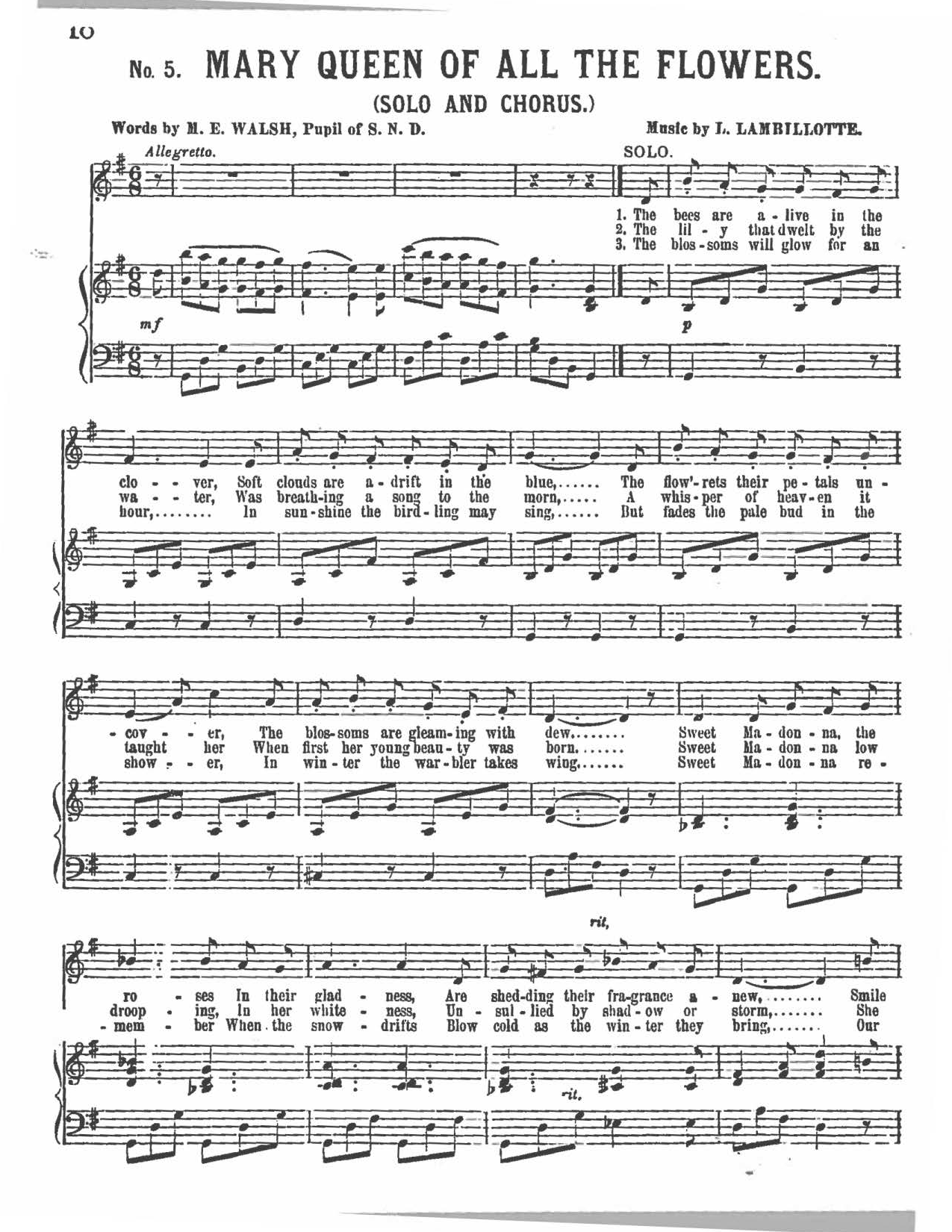
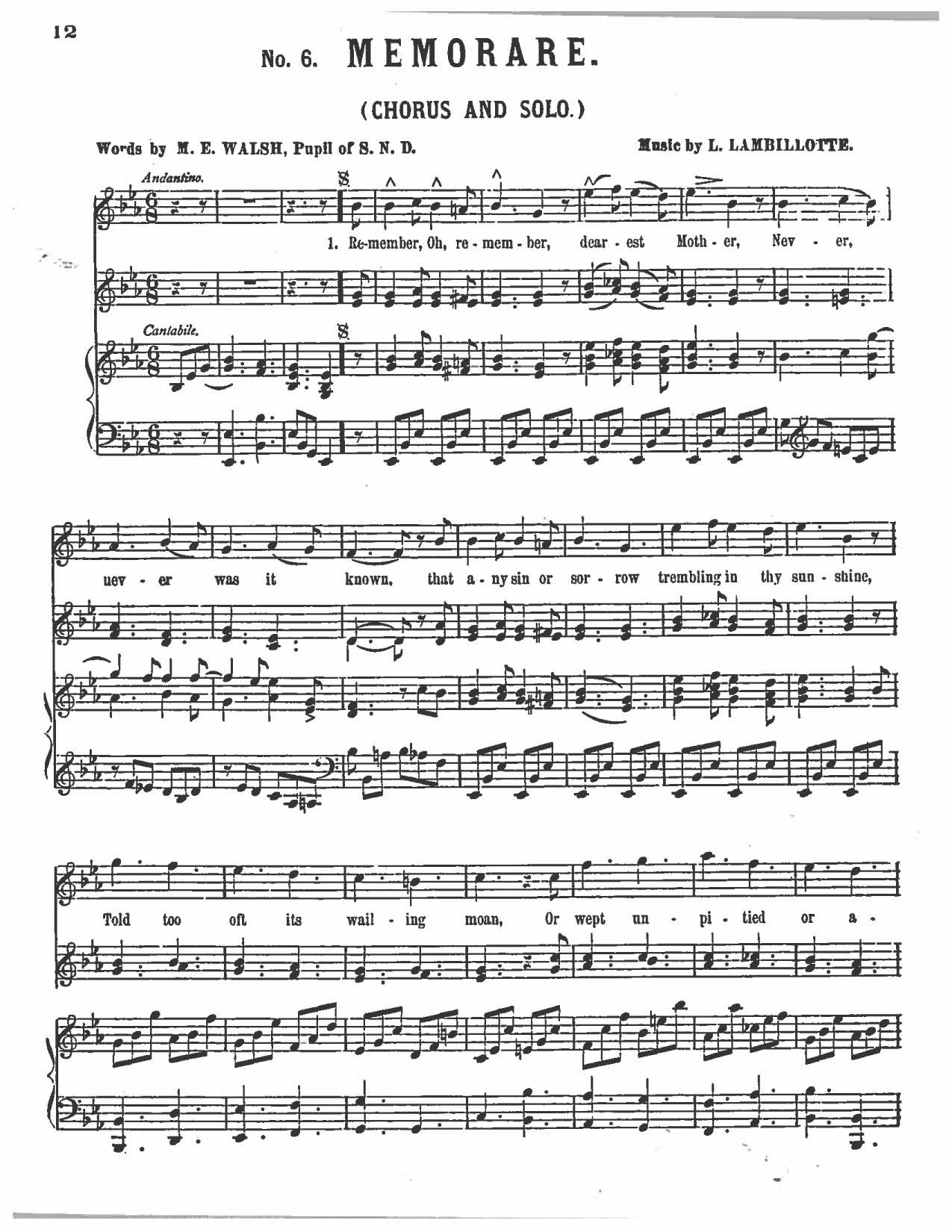
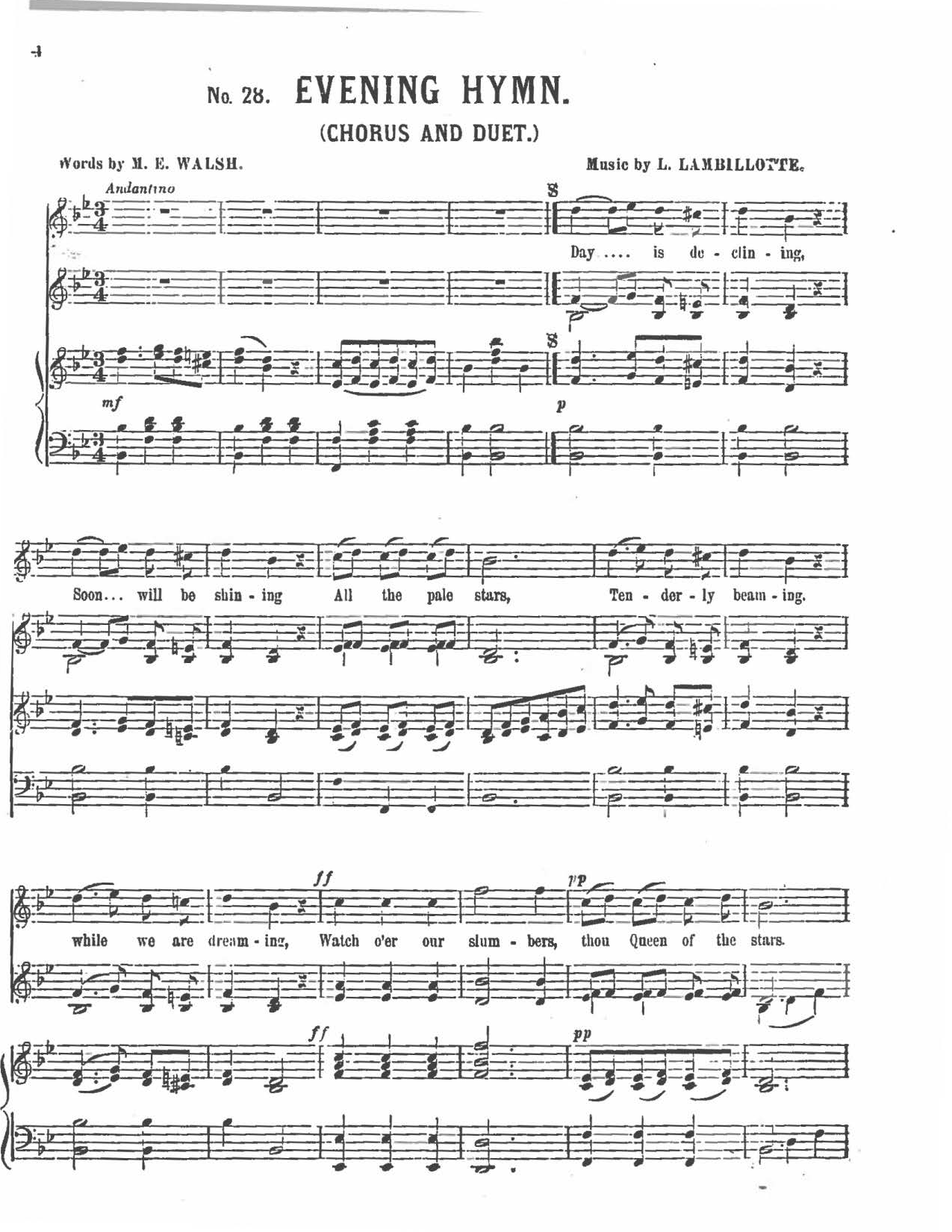
Mary E. Walsh wrote three other hymns including Mary Queen of All the Flowers, the Memorare, and Evening Hymn. These appeared in the hymnal MAY CHIMES.

May Chimes 1871
May Chimes 1871
May Chimes 1871

Bring Flowers of the Rarest appeared in other Catholic hymnals including the CONVENT HYMNS AND MUSIC, 1891 (London); the SUNDAY SCHOOL HYMN BOOK, 1887, 1907, and 1935 editions; the HOLY FAMILY HYMN BOOK, 1904; ST. BASIL’S HYMNAL, 1888 thru 1953; the NOTRE DAME HYMN TUNE BOOK, 1905 (London); The STANDARD CATHOLIC HYMNAL, 1921; ST. JOSEPH’S HYMNAL, 1930; HYMNS USED BY THE PUPILS OF THE SISTERS OF NOTRE DAME, 1921 and 1948 editions; the ALVERNO HYMNAL PART 3, 1953: and THE CATHOLIC CHAPEL HYMNAL, 1944, 1949, 1958 and 1968 editions. 

Two other melodies were composed for this hymn. The first is by Peter Piel (1835-1904) a well-known German composer with over forty mass settings and other compositions for music in the church. Then the hymn was set to a melody composed by Michael Haydn (1737-1806) an Austrian composer and younger brother of the more celebrated Joseph Haydn. These melodies never attained wide use and were soon forgotten.

The history books are silent when it comes to Mary E. Walsh, not much is known about her. So, I contacted the archivist with the Sisters of Notre Dame de Namur located in Cincinnati, Ohio and the archivist had this to say, I find no Mary Walsh of any kind that entered our community and was born before the song was written. Some of the works of Mary E. Walsh show that she was a pupil of the Sisters of Notre Dame. The archivist could not verify that Mary E. Walsh was a student and indicated, that there are very few surviving student lists, and they do not go back far enough. 

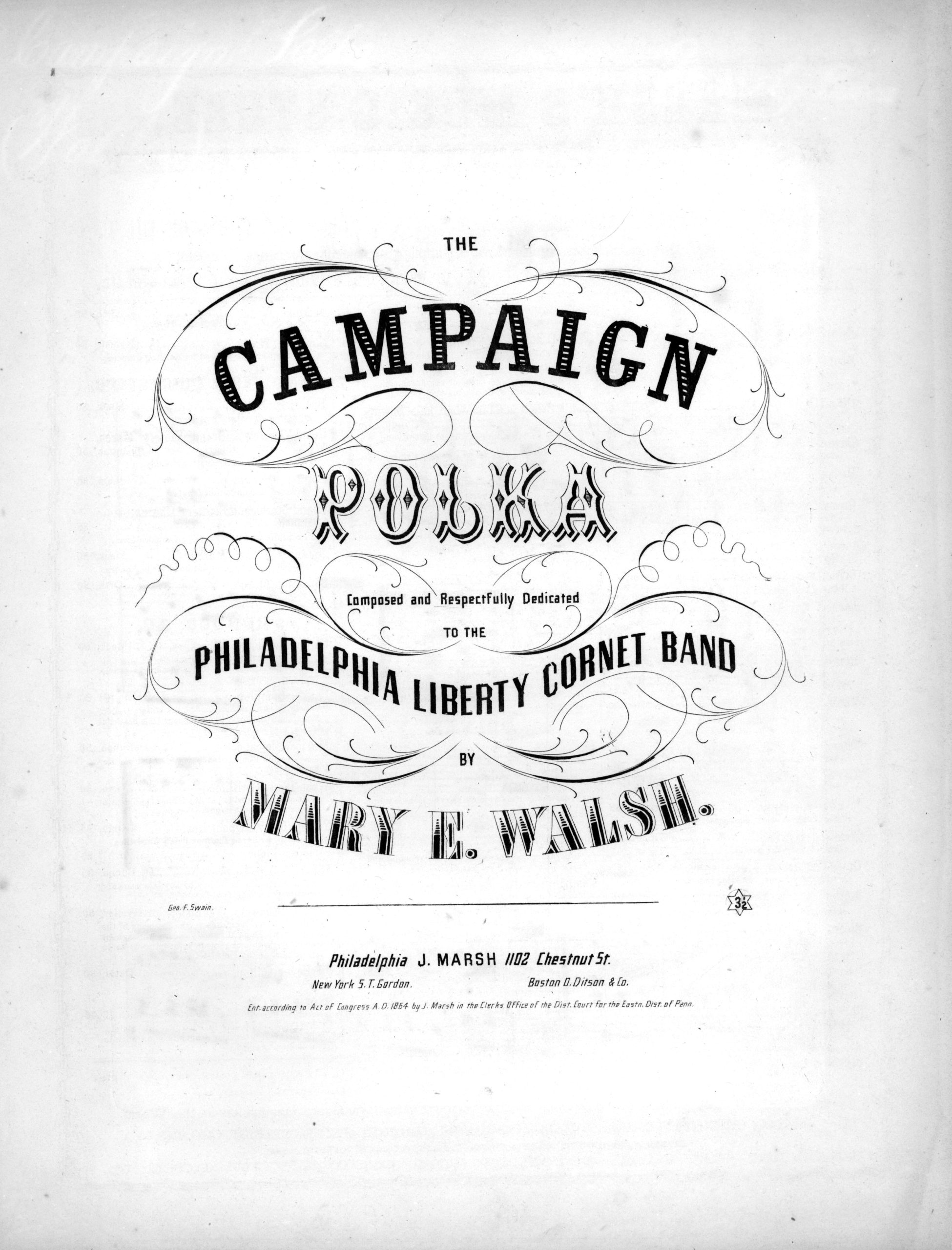
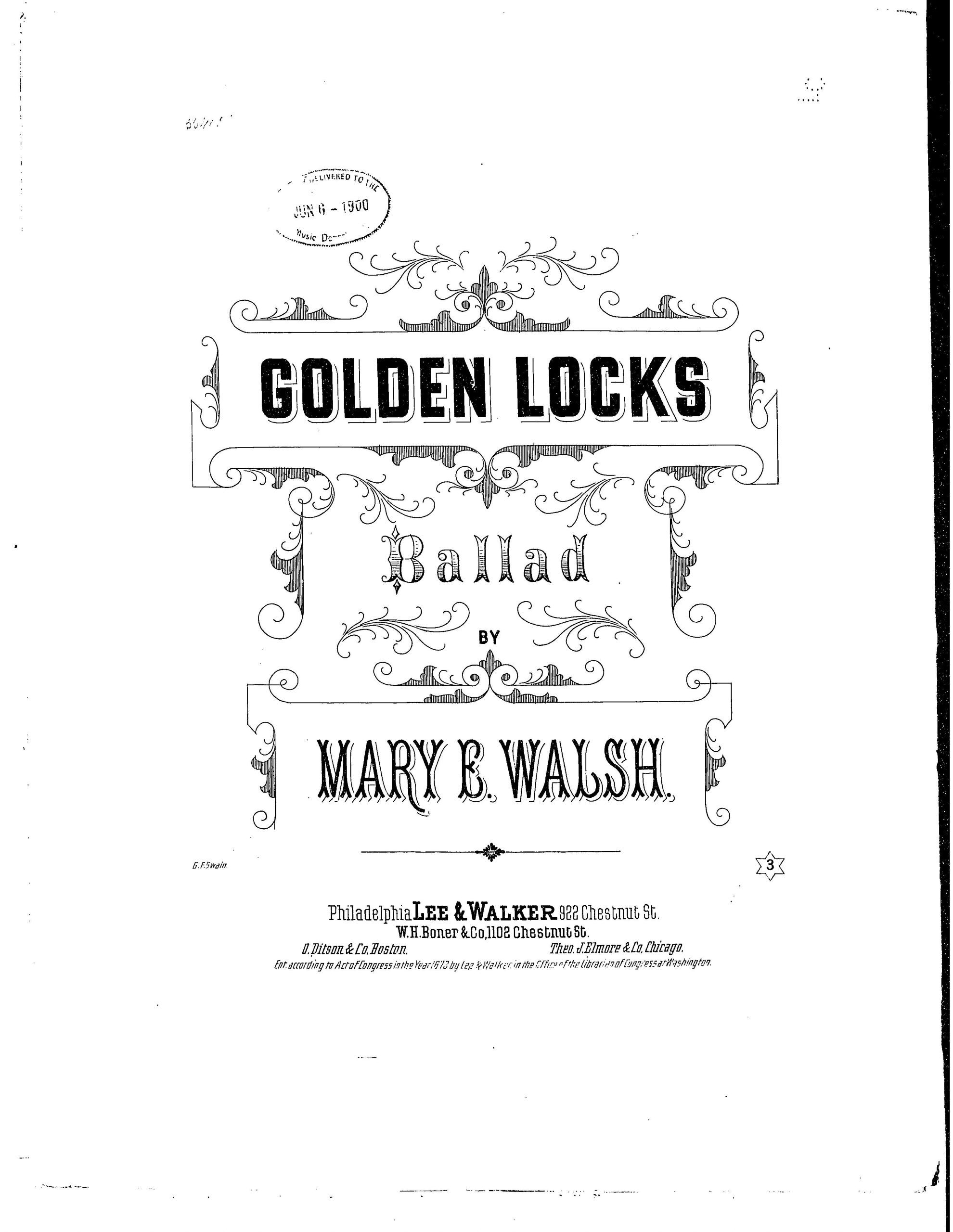
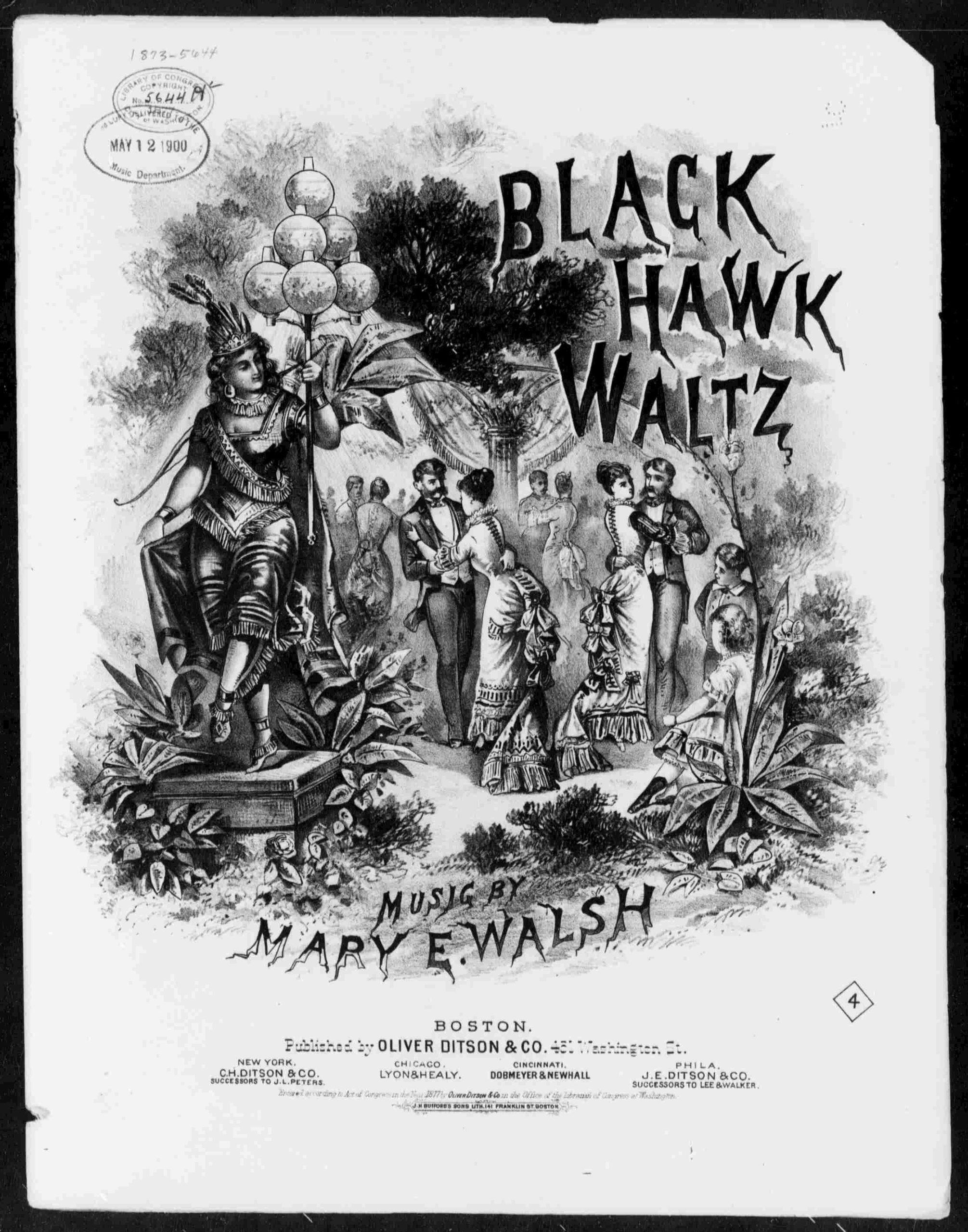
Mary E. Walsh’s other contributions are in the secular field, and they include, The Campaign Polka, a musical composition for the Philadelphia Cornet Band published 1864; the Golden Locks Ballad, published in 1873, by Lee & Walker a Philadelphia music company, and the Black Hawk Waltz, published in 1874 by the Oliver Ditson Co., and is based on the story of the famed Chief Black Hawk (1767-1838). The Black Hawk Waltz is still popular today and is used by some music teachers as an important teaching piece.

Campaign Polka 1864
Golden Locks 1873
Black Hawk Waltz 1874

Reflection

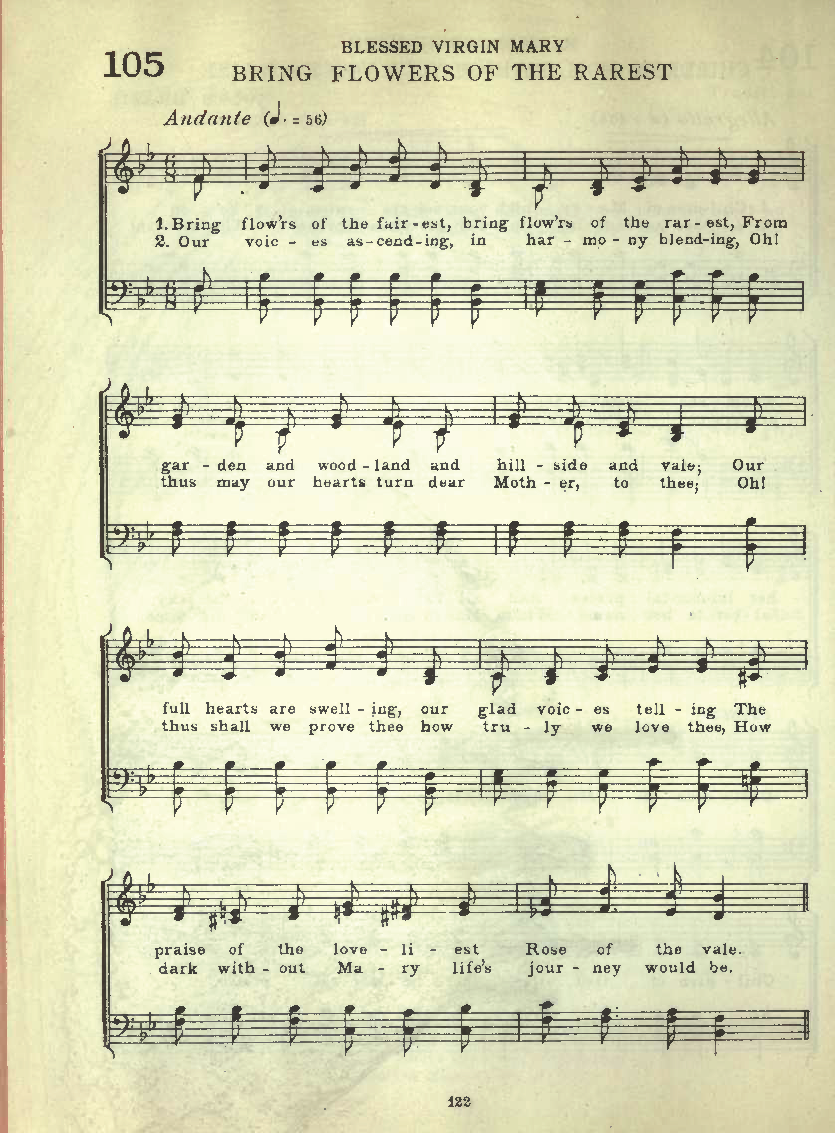
I learned to sing Bring Flowers of the Rarest while singing in St. Mary’s Choir (in Akron, Ohio) and attending the May Crownings where this hymn was lovingly sung by all with vigor and devotion. We used the ST. BASIL’S arrangement at St. Mary’s.

St. Basil's Hymnal 1918

Many of the saints have referred to Mary’s Psalter and the Rosary beads as flowers, particularly roses and even more so as the prayers we offer up. It is not the earthly flowers we bring from our gardens and place on Our Lady’s altar or crown Her with but those flowers/ prayers we bring from our spiritual garden. Some are fair, those we say in haste, and some are the rarest, those we say on the spot or that come devoutly said from our hearts and minds. It is traditional to place on the head of a statue of Mary a wreath of red and white roses symbolic of motherhood and virginity. 

To me, one of the most moving phrases is found in the second verse, How dark without Mary life’s journey would be. How dark indeed would the life of the church be without our Blessed Mother and how lost we would be if Christ had not bequeathed His mother to us from the Cross. I believe this to be an allusion to the words our Lord spoke to us, I will not leave you orphaned (John 14:18).

As mentioned above we would sing Bring Flowers of the Rarest at St. Mary’s for our May Crowning which was usually an outdoor parish event that took place on the parish grounds (weather permitting) around 2 o’clock in the afternoon, otherwise the May Crowning was in the church.

The May Crowning program for 1982 consisted of the following Marian hymns: Mary, Dearest Mother; Mother Dear, O Pray for Me; Bring Flowers of the Rarest; O Queen of the Holy Rosary; ‘Tis the Month of Our Mother; Mother Dearest, Mother Fairest, followed by a prayer of consecration to Our Blessed Mother and benediction which included the traditional O Salutaris, Tantum Ergo, the Divine Praises; Holy God We Praise Thy Name and finally Jubilate Deo (Glory to God) composed by Alphonse Weiss and arranged for four voices by James A. Reilly of McLaughlin and Reilly Music Co.

Below are recordings from a cassette tape of the hymns we sang at St. Mary’s May Crowning in 1982. After almost forty years I was surprised that this cassette tape played at all. It’s wonderful to hear my friends who sang in the choir. 

A newly commissioned recording of Bring Flowers of the Rarest and other May Crowning hymns sung by the Seraphim Singers at Holy Name Church, Boston can be found on The Devotional Hymns Project website produced by Peter Meggison.

All the hymns presented here are in the public domain. It is my hope that these hymns will once again become a favorite of parish or choir repertoire. 

album-art

00:00

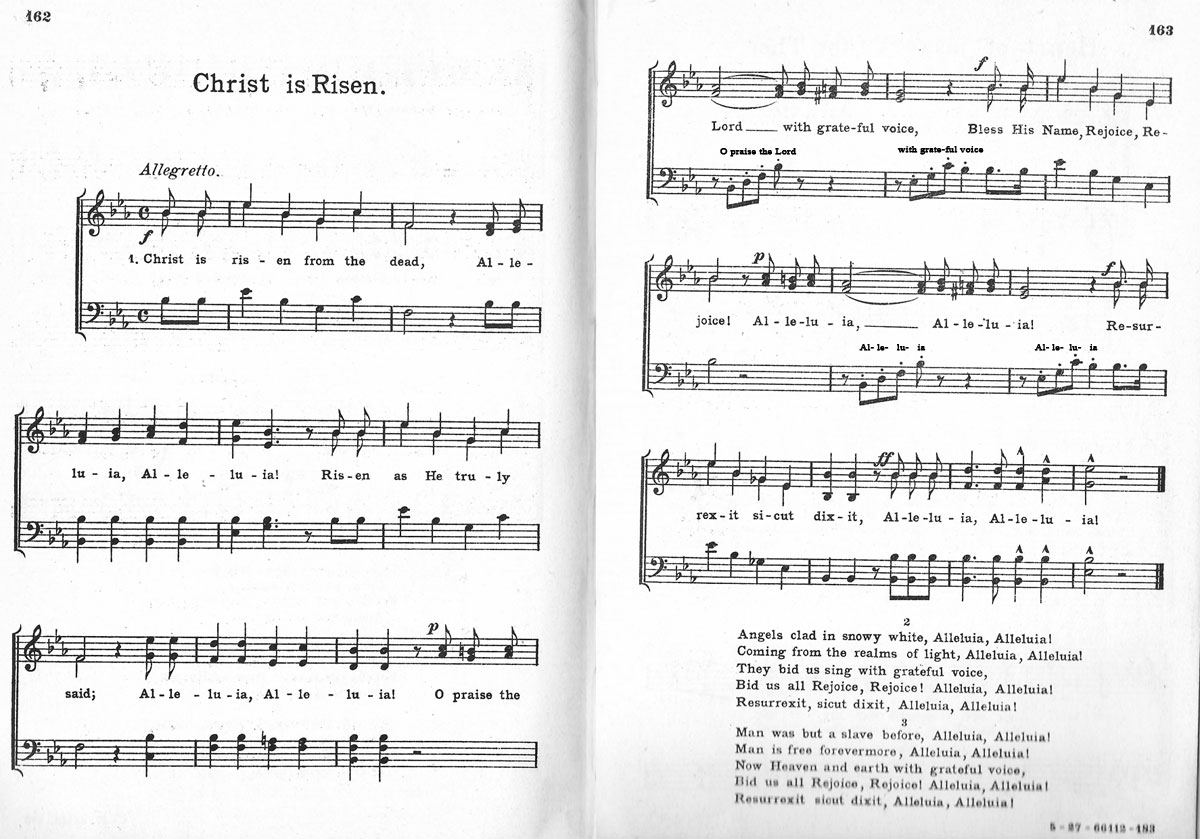
Christ Is Risen

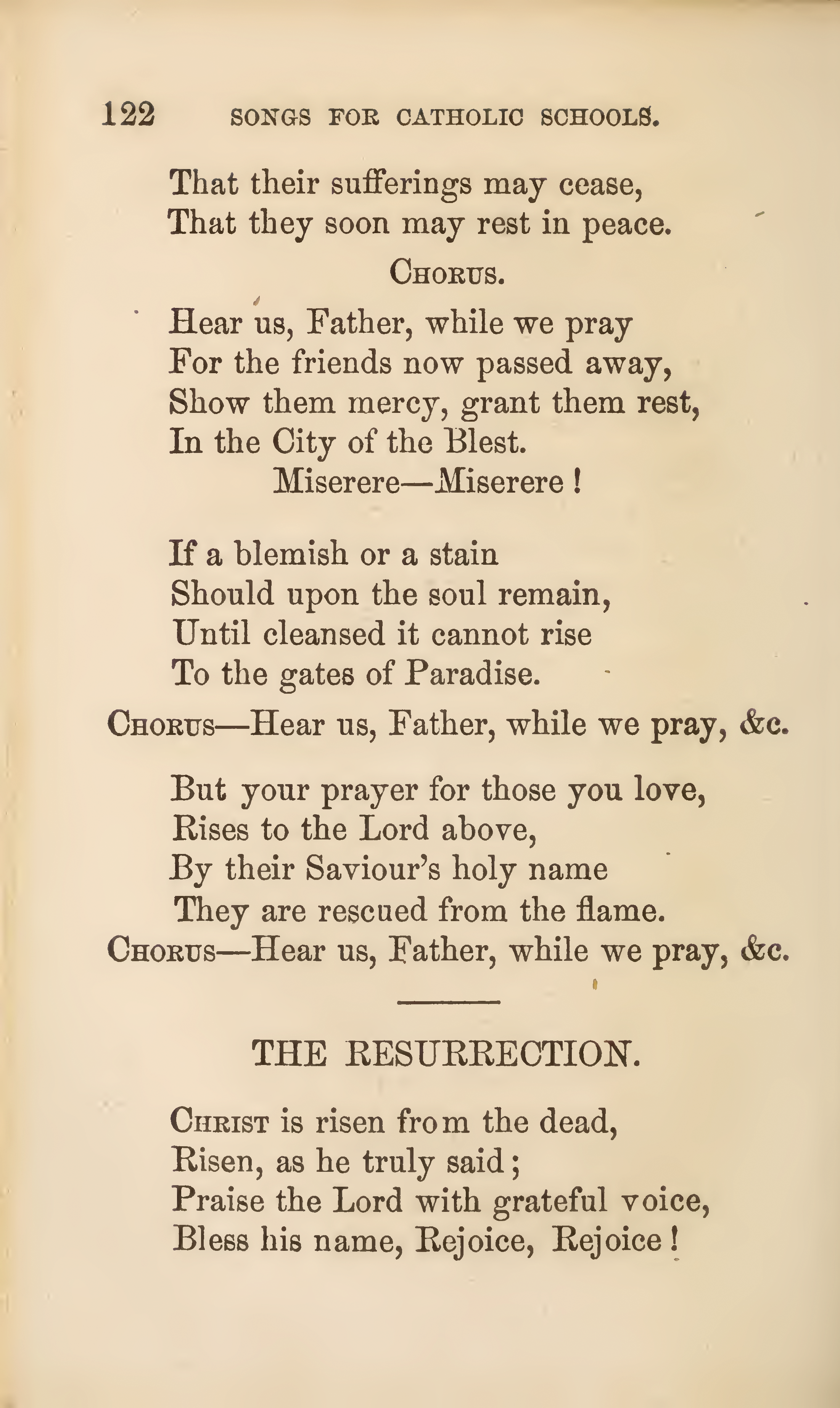
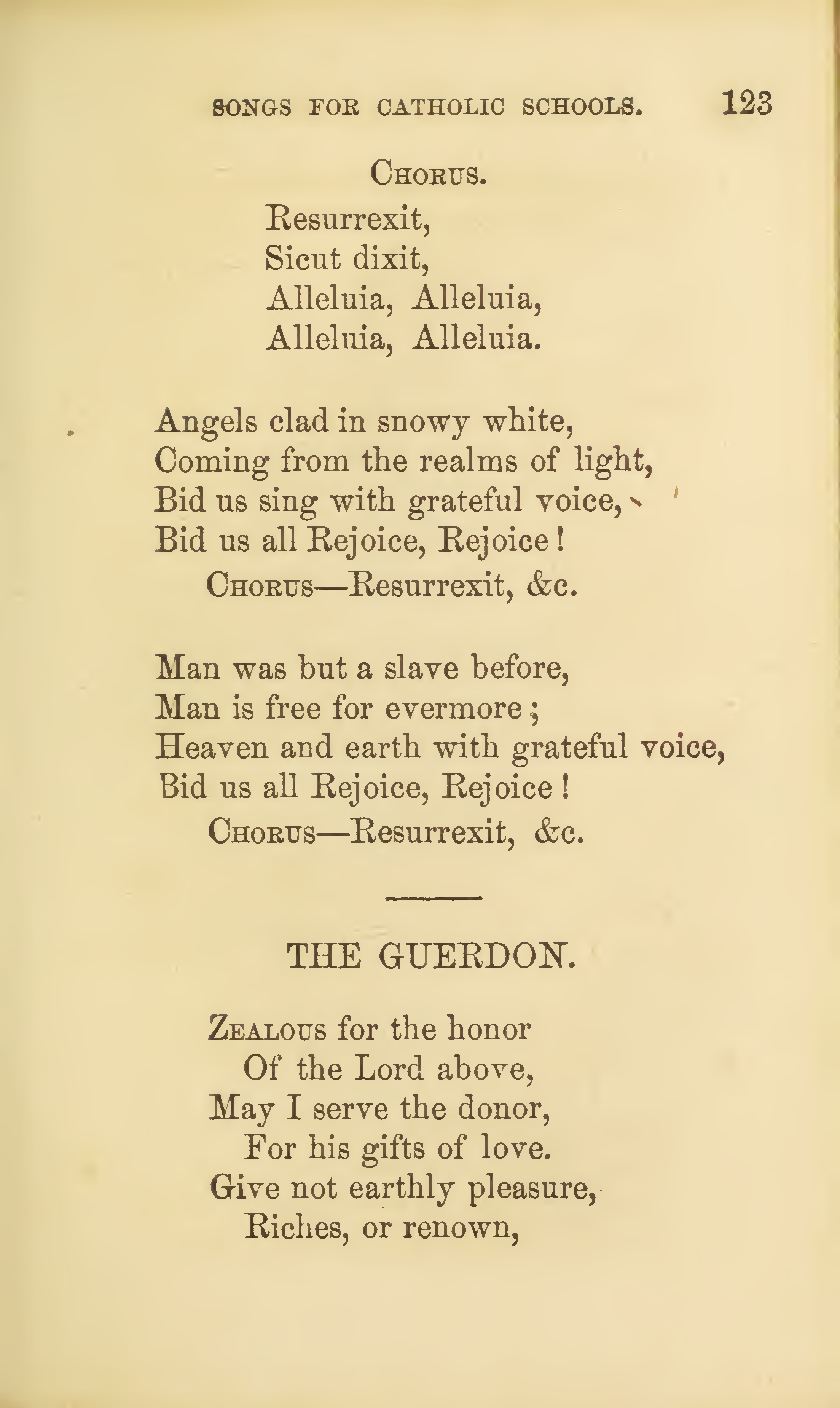
This wonderful Easter hymn was written by Father Jeremiah Cummings (1814-1866) and it first appeared in his SONGS FOR CATHOLIC SCHOOLS, 1862 and was captioned The Resurrection.  Father Cummings mother converted to Catholicism shortly after he was born. After his father’s death they moved to New York. He was young man when he was accepted as an ecclesiastical student in Bishop Dubois seminary in Nyack. He went to the College of the Propaganda at Rome to make his theological studies and was ordained as a priest on January 3, 1847. He earned his Doctor of Divinity and returned to New York and served as a priest at the Old St. Patrick’s Cathedral. During his service at St. Patrick’s, he proved himself as linguist, writer, and musician, and a popular preacher and lecturer. In November of 1848, he was appointed pastor of St. Stephen’s Parish by Bishop John Hughes where he continued to serve until his death.

Songs for Catholic Schools, 1862

All the hymns found in the SONGS FOR CATHOLIC SCHOOLS except for one, Canticle on the Blessed Sacrament, were written or translated by Fr. Cummings. Several of Dr. Cumming’s hymns including Great God, whatever through Thy Church; O brightness of eternal Light, and Hail, Virgin of Virgins, appeared in Catholic hymnals but no attribution was given to Fr. Cummings. Fr. Hugh Thomas Henry (1862-1946) a noted author and translator of hymns including Long Live the Pope wrote a wonderful article that sheds light on the carelessness of some publishers and gives detailed proof of Fr. Cummings authorship. The article appeared in THE CATHOLIC HISTORICAL REVIEW, Volume One, No. 2, July 1915, captioned A Forgotten American Hymnodist.

The hymn text for Christ Is Risen also appeared in other Catholic hymnals including the CANTA SACRA, 1865; LAUDIS CORONA, 1880; the ROMAN HYMNAL, 1884; the SUNDAY SCHOOL HYMN BOOK, 1887 thru 1935; the CATHOLIC HYMNAL, 1920; the MANUAL OF SELECT CATHOLIC HYMNS, 1885 and 1924; and the PAROCHIAL HYMNAL, 1951. Other melodies were composed for the text including an adaptation of Mendelssohn’s Hark the Herald Angels Sing found in the LAUDIS CORONA.

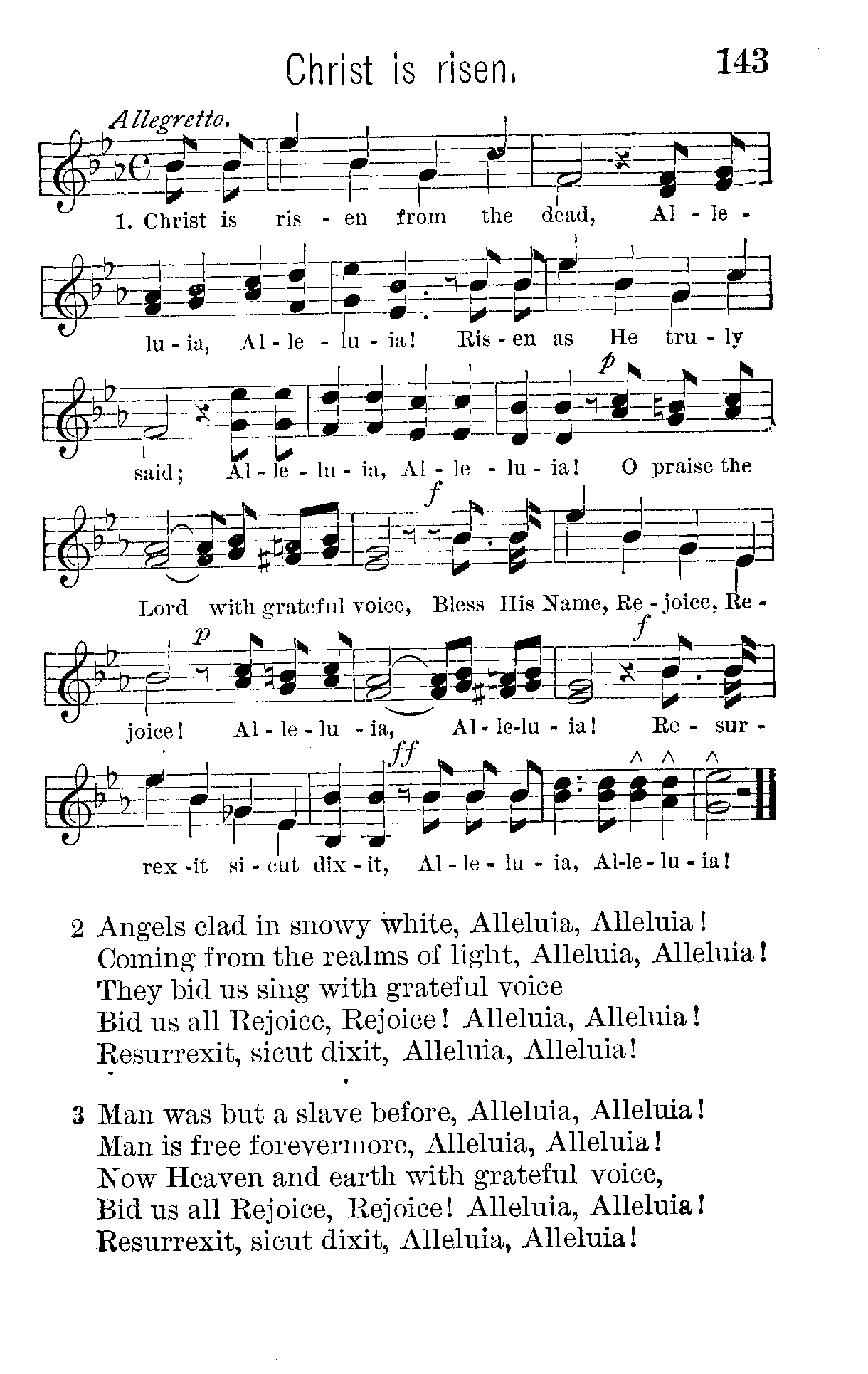
The melody that I learned to sing was composed by a Sister of Notre Dame from the Philadelphia community and was first published in the SUNDAY SCHOOL HYMN BOOK, 1887. I don’t know which sister composed the melody because in those days’ authorship was not given to the individual but to the whole community. This melody and text also appeared in the 1907 and 1935 editions of the SUNDAY SCHOOL HYMN BOOK.

Sunday School Hymn Book, 1887

Reflection

This hymn was traditionally used as a recessional in our music program for Easter Vigil, Easter Sunday, and Sundays throughout Easter at St. Mary’s. The tenors would ad lib beginning in the first verse starting at measure ten, we would echo the sopranos and alto’s, O praise the Lord with grateful voice and again in measure fourteen, echoing Alleluia, Alleluia. I have included this adaptation though it was not original to the hymn. This is a lovely Easter hymn that preserves some of the Latin, Resurrexit sicut dixit which means He is risen as he said.

This hymn was written during a period that produced many hymns for school children, and we can see this in the simplicity of the verses which echo the Gospel account of Matthew.

After the sabbath, as the first day of the week was dawning (Matt. 29:1) Our Lord rose from the dead, Christ is risen from the dead, Alleluia. An angel appears from heaven, rolls back the stone, and sits down upon it and his appearance was like lightning and his cloths white as snow (Matt. 29:2-3), Angels clad in snowy white, coming from the realms of light. He announces to the women, go quickly, and tell the disciples, They bid us sing with grateful voice, bid us all Rejoice, Rejoice! that He is risen from the dead, Resurrexit sicut dixit, Alleluia! Alleluia! (Matt. 29:7). Even though the hymn was written for school children it is still a wonderful hymn to sing and should appeal to people of all ages.

Sunday School Hymn Book, 1907

You can play all of the hymns below.

The first recording is a computer generated sound file. The tempo is approximate but should provide the listener a good sense of what the hymn sounds like. The second recording is from a cassette tape of St. Mary’s Choir Easter Vigil, 1982. This hymn in the public domain. Music directors, if you use this hymn in your Easter Vigil or Easter Sunday program and you make a recording, contact the author and I may feature it in the What’s New section of the website. Bible verses cited above are from the NEW AMERICAN CATHOLIC BIBLE, 1971 edition.

album-art

00:00

Ave Maria, Bright and Pure

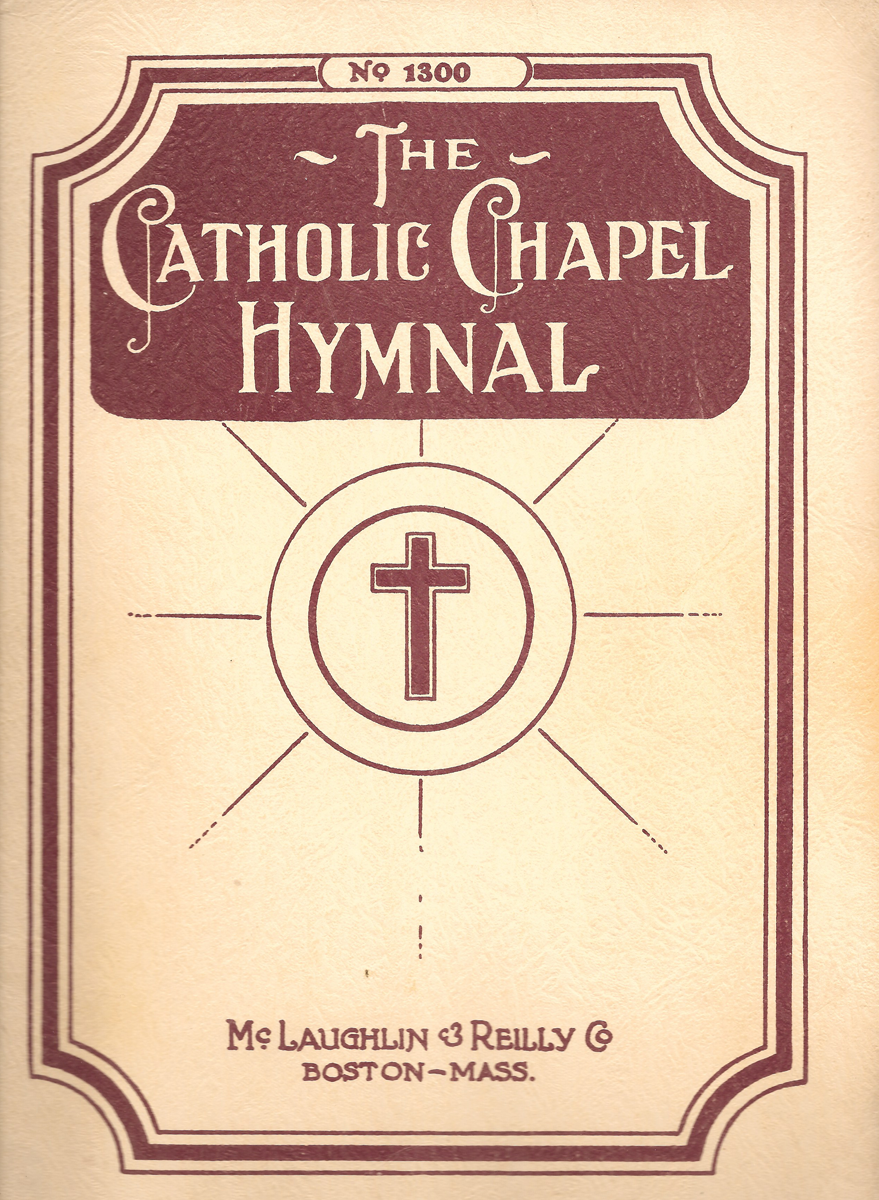
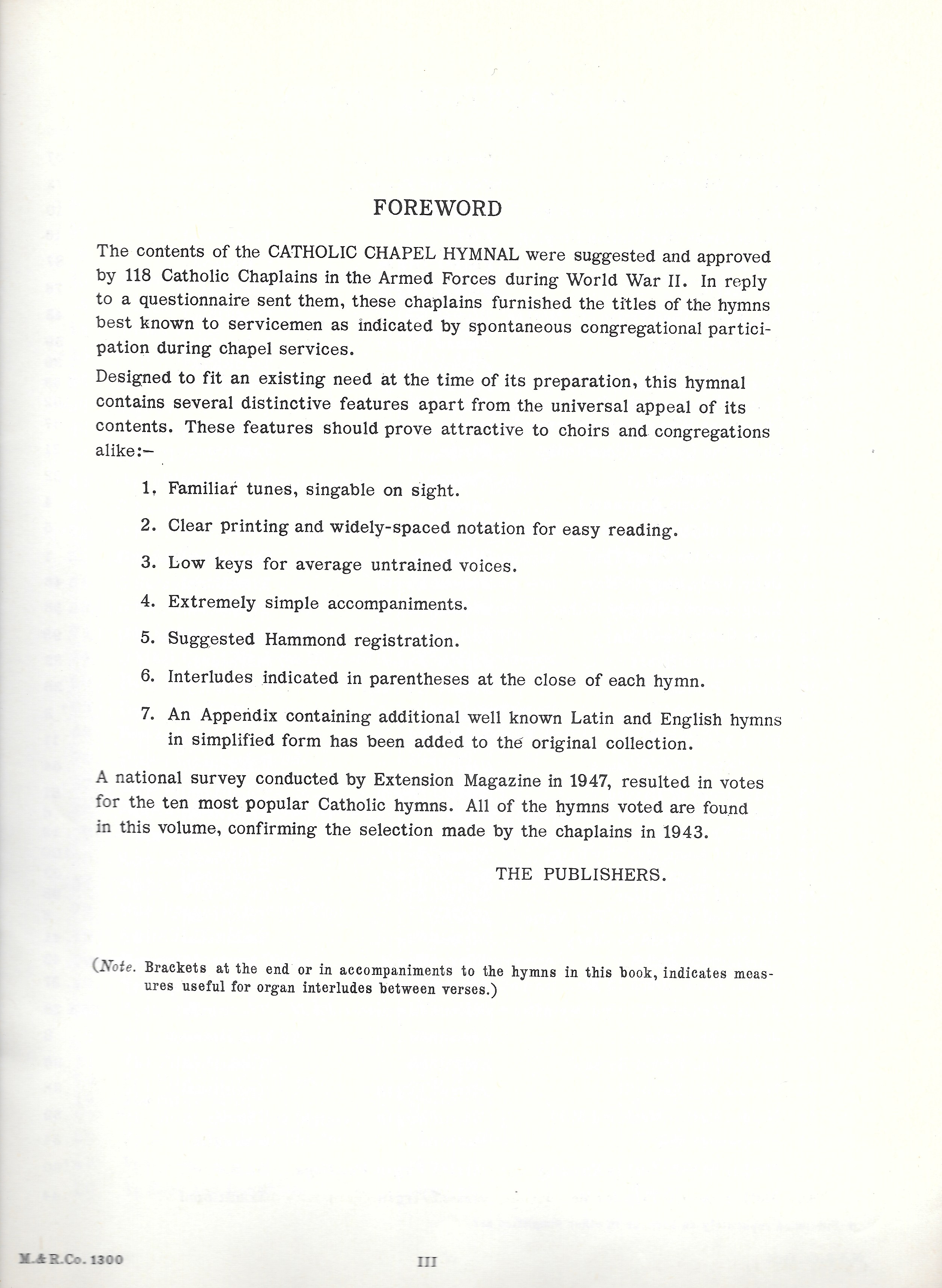
In editions of the CATHOLIC CHAPEL HYMNAL there is a reference to a national survey conducted by Extension Magazine in 1947 of the ten most popular Catholic hymns. This is a short story about this survey and the beautiful hymn Ave Maria, Bright and Pure. The CATHOLIC CHAPEL HYMNAL is a unique collection of Catholic hymns approved by 118 Catholic Chaplains in the Armed Forces during World War II and was published by McLaughlin & Reilly from 1944 thru 1968.

The Catholic Chapel Hymnal, 1958

Adelaide A. Procter (1825-1864) wrote the words to the hymn Ave Maria, Bright and Pure. It appears in her book A CHAPLET OF VERSES, 1862. There is a note by the author in the contents of this collection that indicates some of the poems were written 20 years earlier and only three have been previously published. So, it is possible this poem was written as early as 1842. Adelaide was born in 1825 and was a prolific poet, philanthropist, and a soul of good charity. She labored extensively helping the homeless and unemployed women of 19th century England. Her first poem submitted under the pseudonym of Mary Berwick, was published in a weekly journal Household Words whose principal editor and publisher was Charles Dickens.

Adelaide converted to Catholicism in 1851 and it was this and what she saw around her that heavily influenced her poetry. She was a highly educated woman for her time fluent in German, French and Italian. It is said that she was Queen Victoria’s favorite poet. In 1862, she contracted tuberculosis because of her tireless work on behalf of suffering women. She struggled against this illness for 15 months and died at the early age of thirty-eight. Adelaide was the author of several books of poetry including Legends and Lyrics and a Chaplet of Verses. Many of her poems were composed to hymns like How Pure, How Frail and White and Of All The Queens In Month Of May.

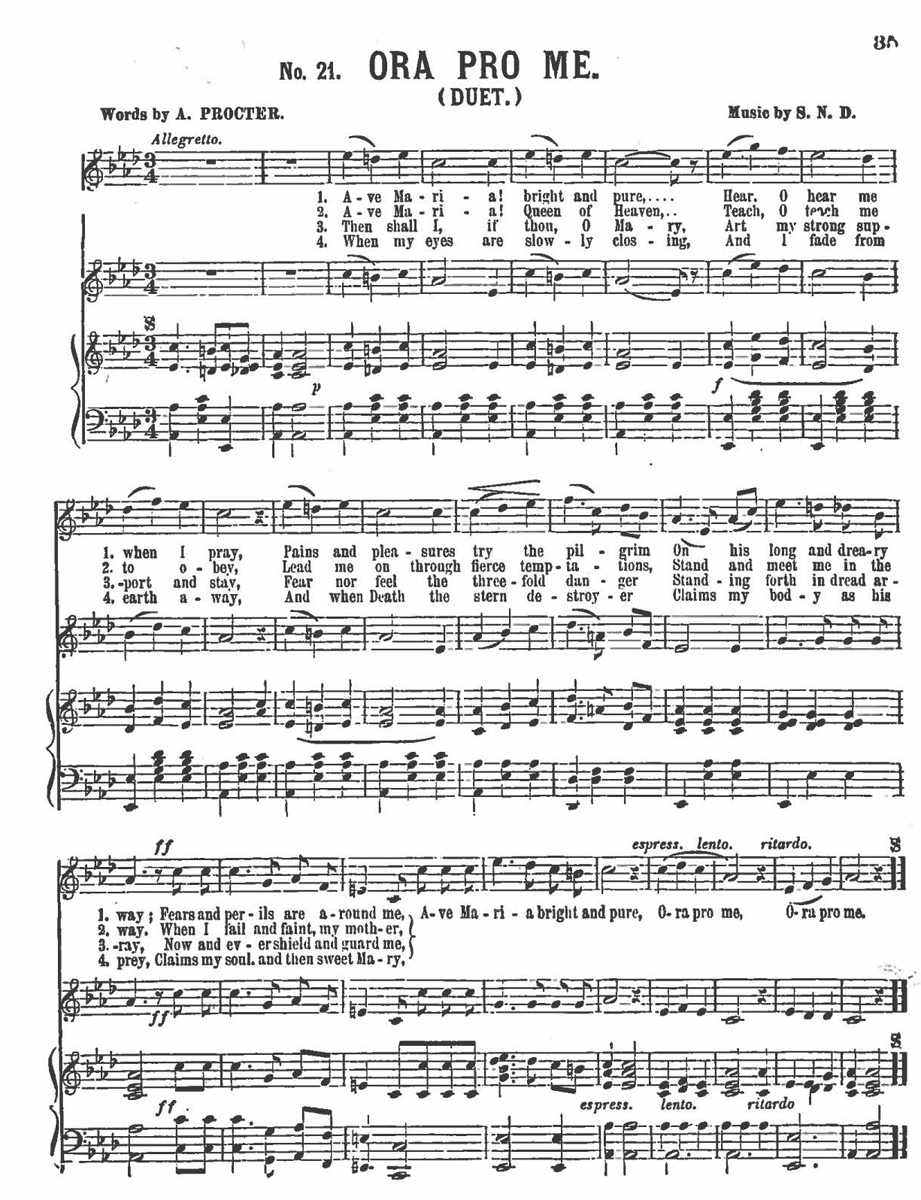
In my search for melodies, I could only find two for Ave Maria, Bright and Pure. A Sister of Notre Dame composed the first melody. It first appeared in MAY CHIMES, 1871, a hymnal compiled by the Sisters of Notre Dame of Cincinnati, and it was captioned Ora Pro Me for duet. It appeared in other Catholic hymnals including PETERS’ SODALITY MANUAL, 1872 and 1914; in MAY BLOSSOMS, 1872, the MANUAL OF SELECT CATHOLIC HYMNS, 1885 and 1925; LAUDIS CORONA, 1880; the ST. BASIL’S HYMNAL from 1906 to 1925; ST. JOSEPH’S HYMNAL, 1930, and HYMNS USED BY THE PUPILS OF THE SISTERS OF NOTRE DAME, 1921 and 1948. All of these hymnals use the melody composed by the Sister of Notre Dame. Since it was a customary practice in many religious communities not to give credit to individuals but the whole community, the identity of this sister remains hidden.

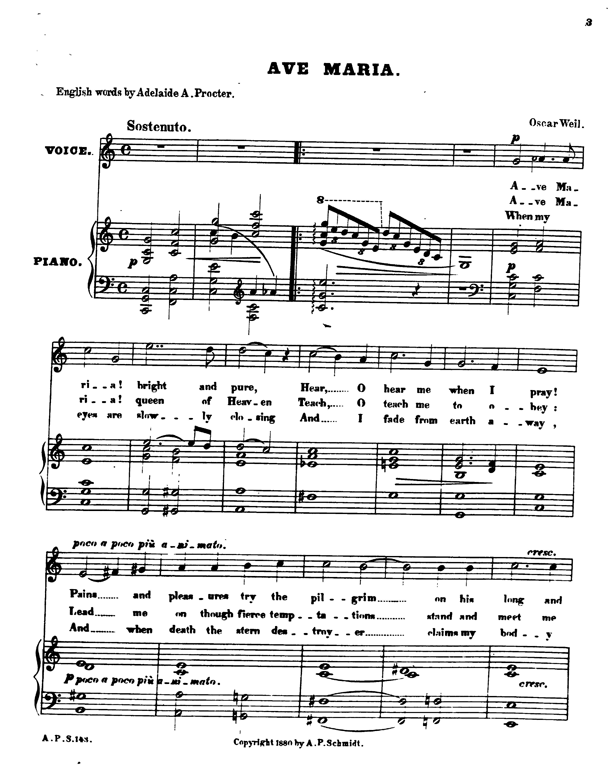
Oscar Weil (1839-1921) composed the second melody, and it was published in Boston by the Arthur P. Schmidt Music Company in the year 1880. It was published as sheet music only and never appeared in any Catholic hymnals. Oscar Weil studied music in Germany and Paris the violin being his instrument of choice. While he was overseas studying, the Civil War broke out in the United States. He returned home and enlisted in the U.S. Army. He rose to the rank of major, decorated twice for bravery and suffered a severe injury to his hand during one of many battle engagements. He retired from the Army, traveled to Germany, and resumed his musical studies earning a teaching degree in music composition. He returned to the United States and settled in San Francisco where he helped to establish the San Francisco Institute of Music. He composed several operas, choral pieces, piano works and was a regular contributor to the San Francisco newspaper Argonaut as a music critic. He died in 1921 having suffered a series of heart attacks.

May Chimes, 1871
Oscar Weil, 1880

In December 2021, I was granted access to archived issues of the Extension Magazine from January 1946 to December 1947 and with the help of the communications coordinator at Catholic Extension Magazine located the Extension Magazine issues related to the contest.

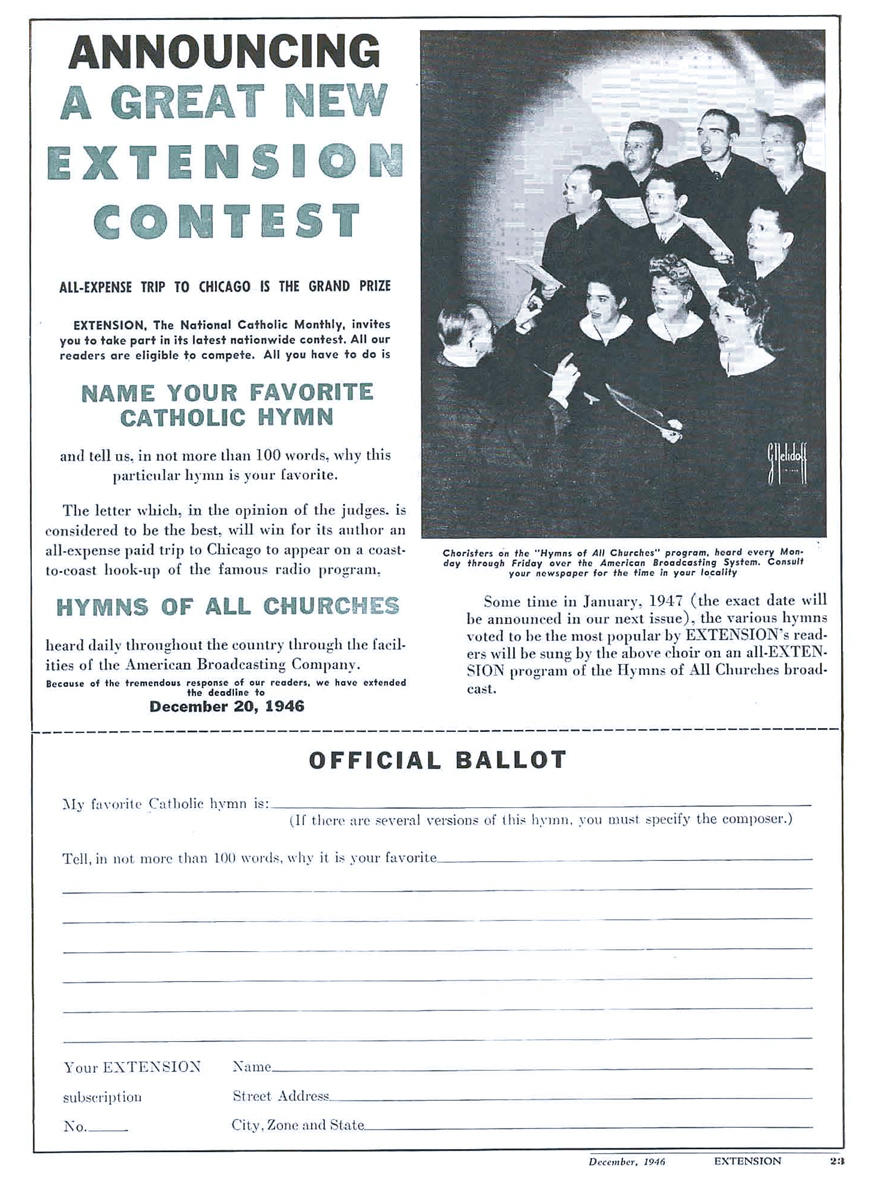
The contest was announced in the November issue 1946 with a deadline for submissions by November 20. The contest rules were simple, name your favorite Catholic hymn and tell in not more than one hundred words, why this hymn is your favorite. If there are several versions of this hymn, you need to specify the composer. The winner wins an all-expense paid trip to Chicago to appear on a cost-to-coast hook-up of the famous radio program HYMNS FOR ALL CHURCHES, heard daily throughout the country through the facilities of the American Broadcast Company. The deadline was extended until December 20 due to the tremendous response of readers.

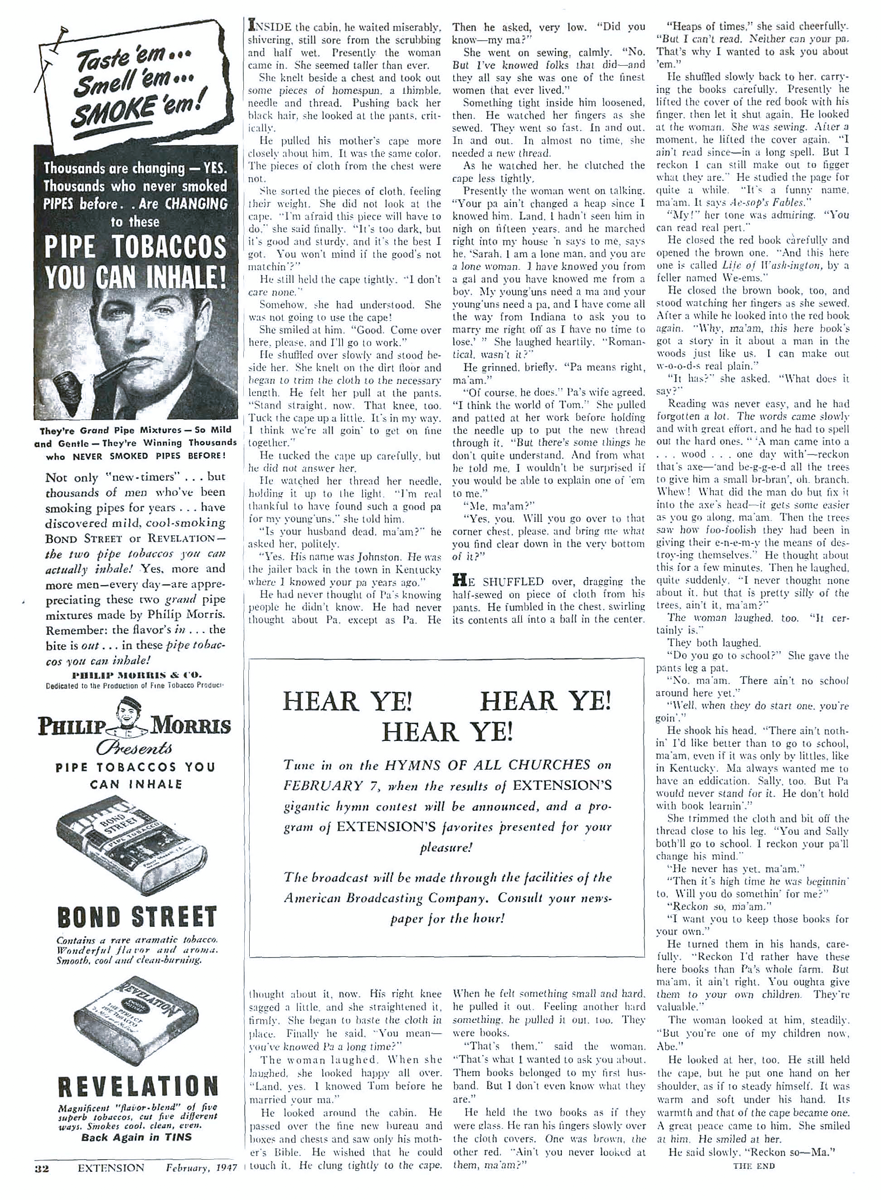
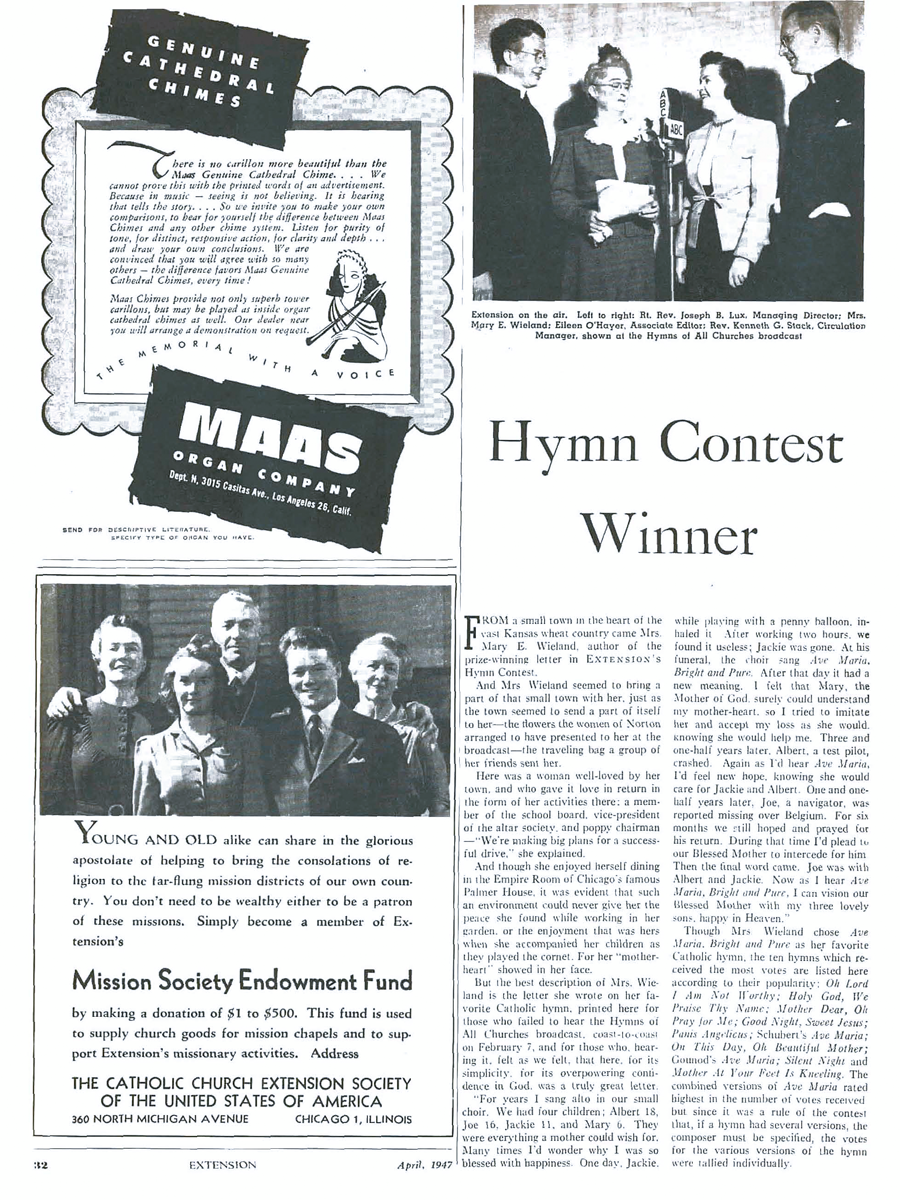
In the February issue 1947, an announcement was made for the HYMNS OF ALL CHURCHES radio program. Choristers will sing the hymns from the results of the contest scheduled for Feb. 7, 1947, readers should check their local newspapers for radio times. In the April issue 1947, the winner of the hymn contest was announced and a list of the ten hymns voted the most popular. The winner was Mrs. Mary E. Wieland who came from a small town in the heart of Kansas. The Extension judges chose Mrs. Wieland not for her hymn Ave Maria, Bright and Pure, but for her letter explaining why it was her favorite hymn. Mrs. Weiland writes: 

For years I sang alto in our small choir. We had four children: Albert 18, Joe 16, Jackie 11, and Mary 6. They were everything a mother could wish for. Many times, I would wonder why I was so blessed with happiness. One day, Jackie while playing with a penny balloon, inhaled it. After working two hours, we found it useless; Jackie was gone. At his funeral, the choir sang Ave Maria, Bright and Pure. After that day it had a new meaning. I felt that Mary, the Mother of God, surely could understand my mother-heart. So, I tried to imitate her and accept my loss as she would, knowing she would help me. Three and one-half years later, Albert, a test pilot, crashed. Again, as I would hear Ave Maria, I would feel new hope knowing she would care for Jackie and Albert. One and a half years later, Joe, a navigator, was reported missing over Belgium. For six months we still hoped and prayed for his return. During that time, I’d plead to our Blessed Mother to intercede for him. Then the final word came, Joe was with Albert and Jackie. Now as I hear Ave Maria, Bright and Pure, I can vision our Blessed Mother with my three lovely sons, happy in Heaven.

Extension Magazine, December 1946
Extension Magazine, February 1947
Extension Magazine, April 1947

Though Mrs. Wieland chose Ave Maria, Bright and Pure as her favorite hymn, the ten hymns which received the most votes were listed according to their popularity.

  1. Oh Lord I Am Not Worthy
  2. Holy God We Praise Thy Name
  3. Mother Dear, Oh Pray for Me
  4. Good Night, Sweet Jesus
  5. Panis Angelicus
  6. Schubert’s Ave Maria
  7. On This Day, Oh Beautiful Mother
  8. Gounod’s Ave Maria
  9. Silent Night
  10. Mother At Your Feet Is Kneeling

The combined versions of Ave Maria rated highest in the number of votes received but since it was a rule of the contest that, if a hymn had several versions, the composer must be specified, the votes for the various versions of the hymn were tallied individually. The submission ballots and letters from listeners of their favorite hymn(s) do not exist anymore. By 1950, subscriptions for the Extension Magazine had reached more than 600,000.

Reflection

I think you will agree Mrs. Weiland’s letter is quite moving and inspirational even today. The melody by Oscar Weil is a beautiful arrangement that I came across by chance. I often wonder if the Blessed Mother is guiding my hand and would like a certain melody or story to be known again. There is not much I can offer as a reflection for this hymn more then what Mrs. Weiland has already said. She was deeply touched by the verses of this hymn and was nourished by them as she struggled with the loss of her sons. 

This would be a wonderful hymn to sing before mass, during offertory or communion especially on Marian feast days.

Don’t underestimate the providence that can come from hearing these beautiful traditional Catholic hymns. Like the Prodigal son who was lost and is found, these hymns have been lost to us and have been found. 

I would like to extend a special thank you to Catholic Extension for their help in locating the magazine issues featured in this story. Also, to Library of Congress, Music Division for the music by Oscar Weil. 

You can play all of the hymns below.

These are computer generated sound files. The tempo is approximate but should provide the listener a good sense of what the hymn sounds like. All the hymns are in the public domain. Music directors, if you use any of these selections in your Sunday or weekly music programs and you make a recording, contact the author and I may feature it in the What’s New section of the website. 

album-art

00:00

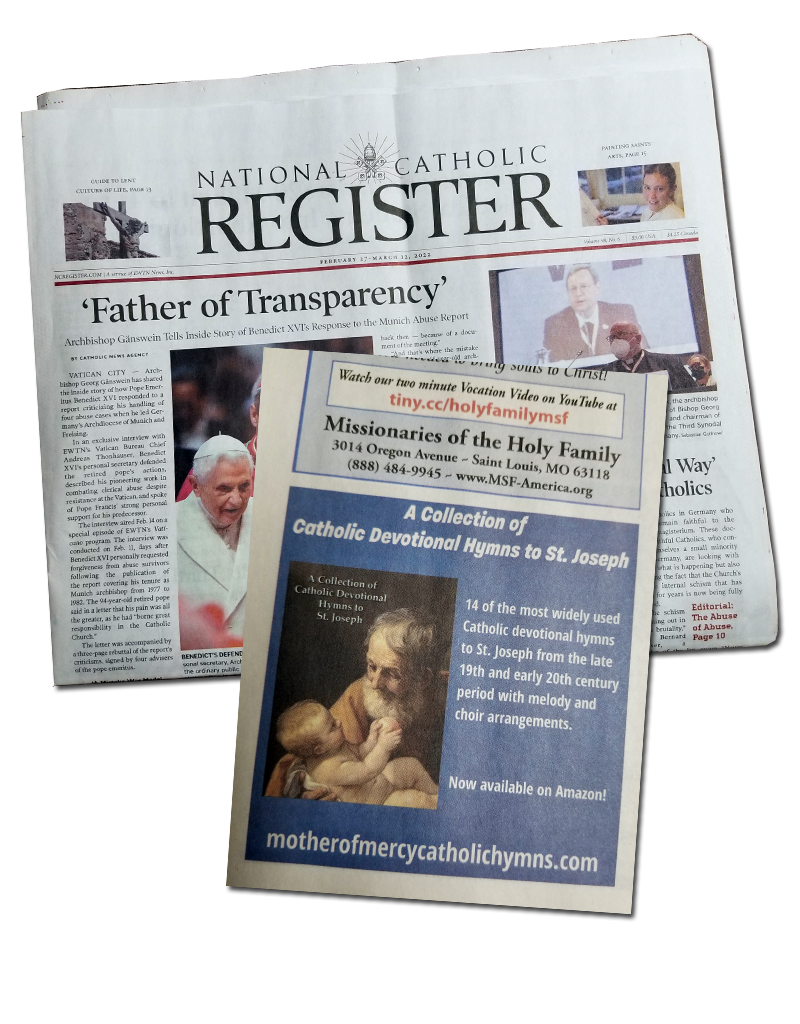
National Catholic Register features Hymns to St. Joseph

I recently bought ad space in the National Catholic Register to promote my collection of hymns to St. Joseph. These traditional Catholic hymns to St. Joseph are available in melody and choir arrangements. I’m very proud of this accomplishment and I believe very strongly about putting approved Catholic devotional music back in the hands of Catholic musicians.

Just in time for the Feast of St. Joseph. These are fourteen of the most widely used hymns to St. Joseph with melody and choir arrangements that are easy to sing with approved text by the Catholic Church. Be sure to look for this ad and buy a copy for yourself and one for your music director. 

Hymn of the Month

I am pleased to announce the latest development for the Mother of Mercy Catholic Hymns website! HYMN OF THE MONTH. Each month I will feature a story on a new old hymn with a short biography on the author and composer with links to hymn sources and when possible, newly commissioned recordings granted by Peter Meggison, Producer of The Devotional Hymns Project.

Many of the hymns that I will feature are hymns that I sang in St. Mary’s Choir (1977-2010) and new hymns that I have added to my repertoire. These hymns have kept me grounded in my Catholic Faith and I turn to them in good times and bad. They are a source of comfort and spiritual nourishment to me, and I hope for you as well. They are prayerful and meaningful with approved texts by the Catholic Church. Don’t under estimate the providence that can come from hearing these beautiful hymns.

The first hymn of the month is Dear Guardian of Mary in honor of the Feast Day of Saint Joseph, March 19th. So, Like or Bookmark this page to follow along or check back often. I hope you will find my selections and my reflections intuitive and helpful.

Mother of Mercy Catholic Hymns Facebook Page

I am excited to announce the launch of the Mother of Mercy Catholic Hymns Facebook page. Be sure to Like this page to follow along to keep updated on current news and project developments.