
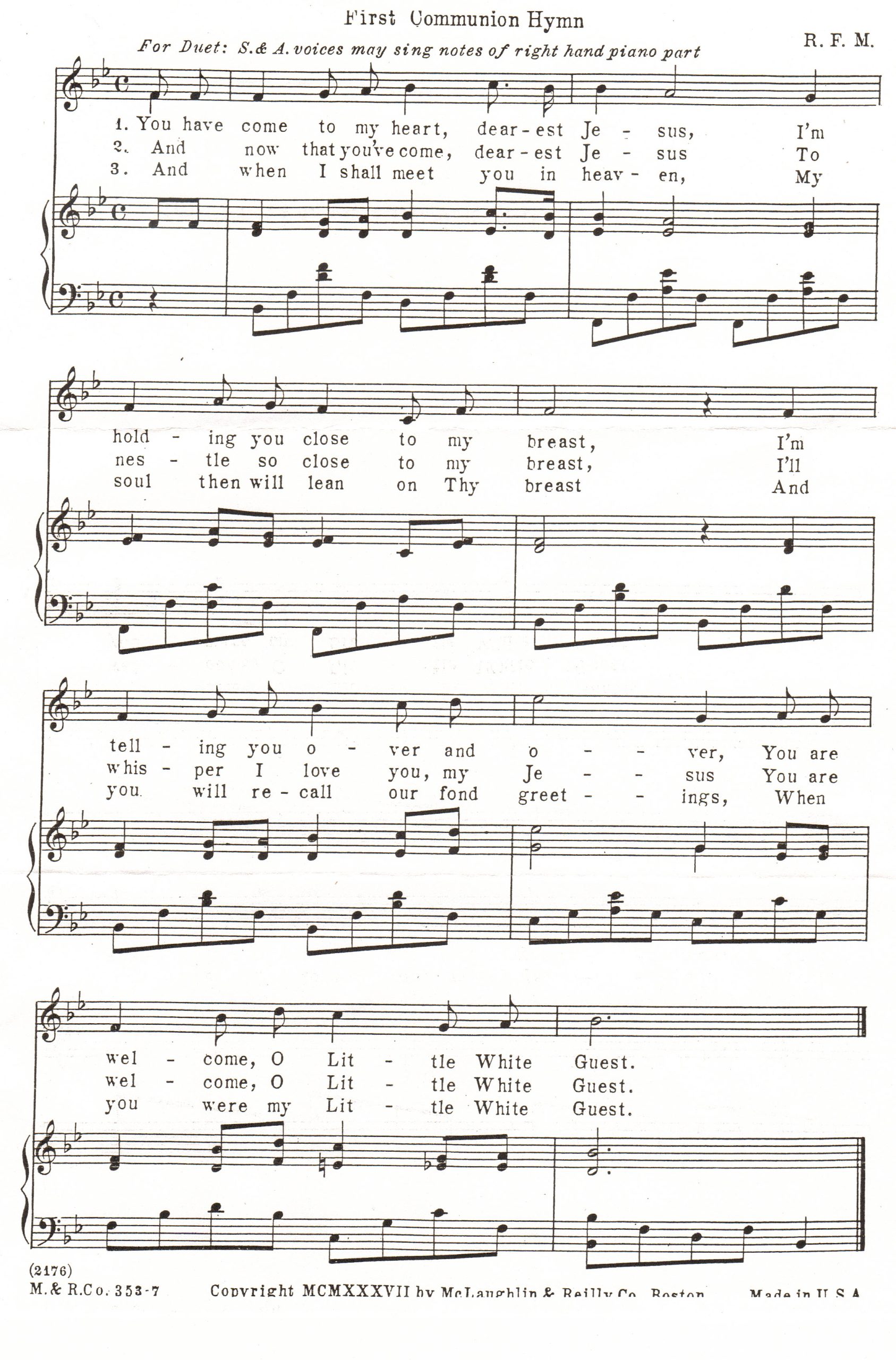
The history of this First Communion hymn begins not with a single name, but with a puzzle of initials. For decades, the melody published in 1937 by McLaughlin & Reilly Co. was attributed simply to “R.F.M.” Through meticulous research into the 1907 Musical Times and the 1937 Catalog of Copyright Entries, the identity of this composer finally emerges as Richard Frank Martin Akerman (1871–1938). Akerman was a figure of significant liturgical stature: one of the earliest students at the Royal College of Music and an assistant at St. George’s Chapel, Windsor. His background in Anglican vocal church music and his role at Eton College suggest a composer who understood the power of disciplined, beautiful melody.
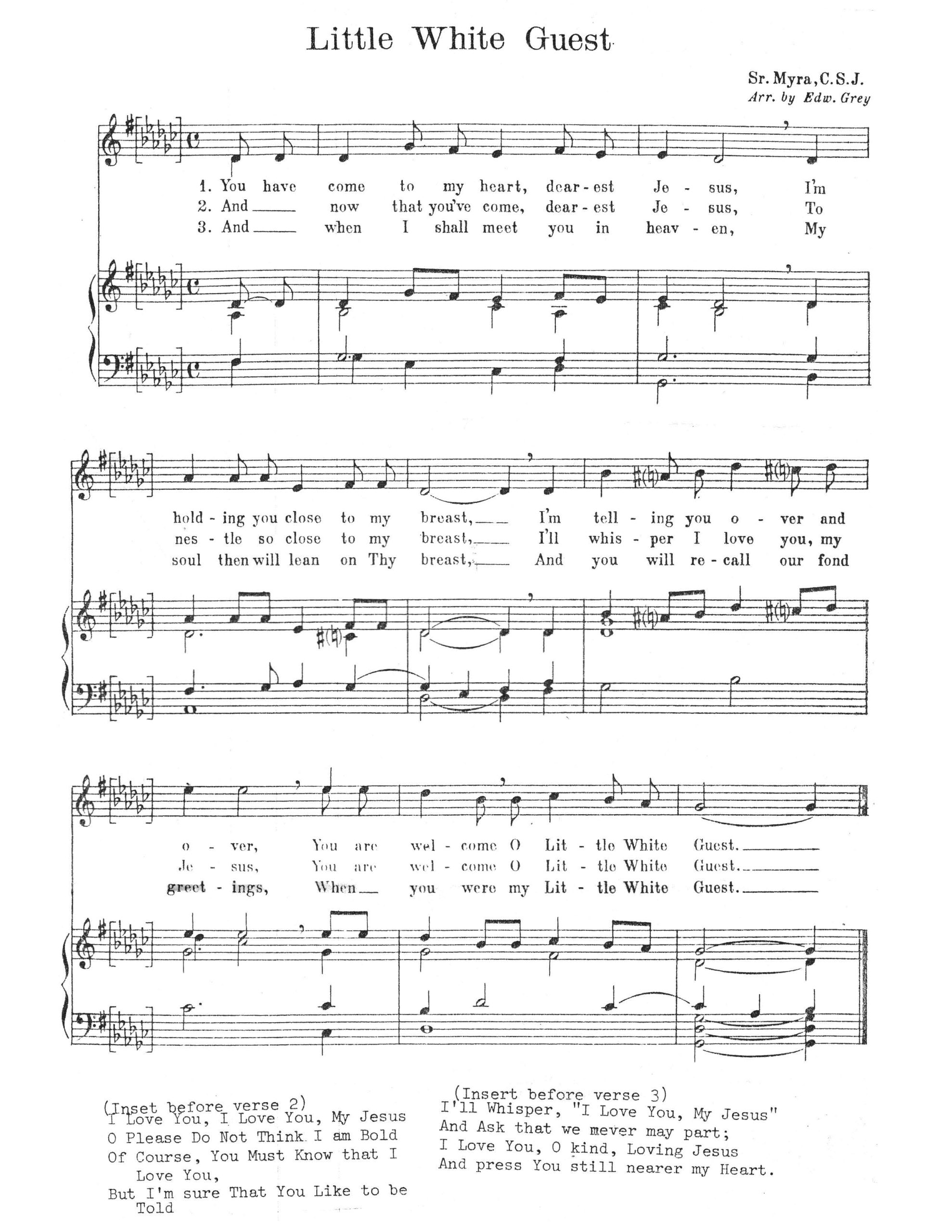
Parallel to this English tradition is a second melody published in 1958 by Sr. Myra, C.S.J. (Margaret Mary Farrell). A dedicated music educator at Regis College (Weston, Massachusetts) and Mount Saint Joseph Academy (Brighton/Boston Massachusetts), her version—arranged by “Edward Grey” (a pseudonym for Fr. Joseph Portelance)—carried the hymn into the mid-century American parish. While much of Sr. Myra’s work was tragically lost to history after her death, her contribution to this hymn survives as a testament to the musical life of the teaching sisters.
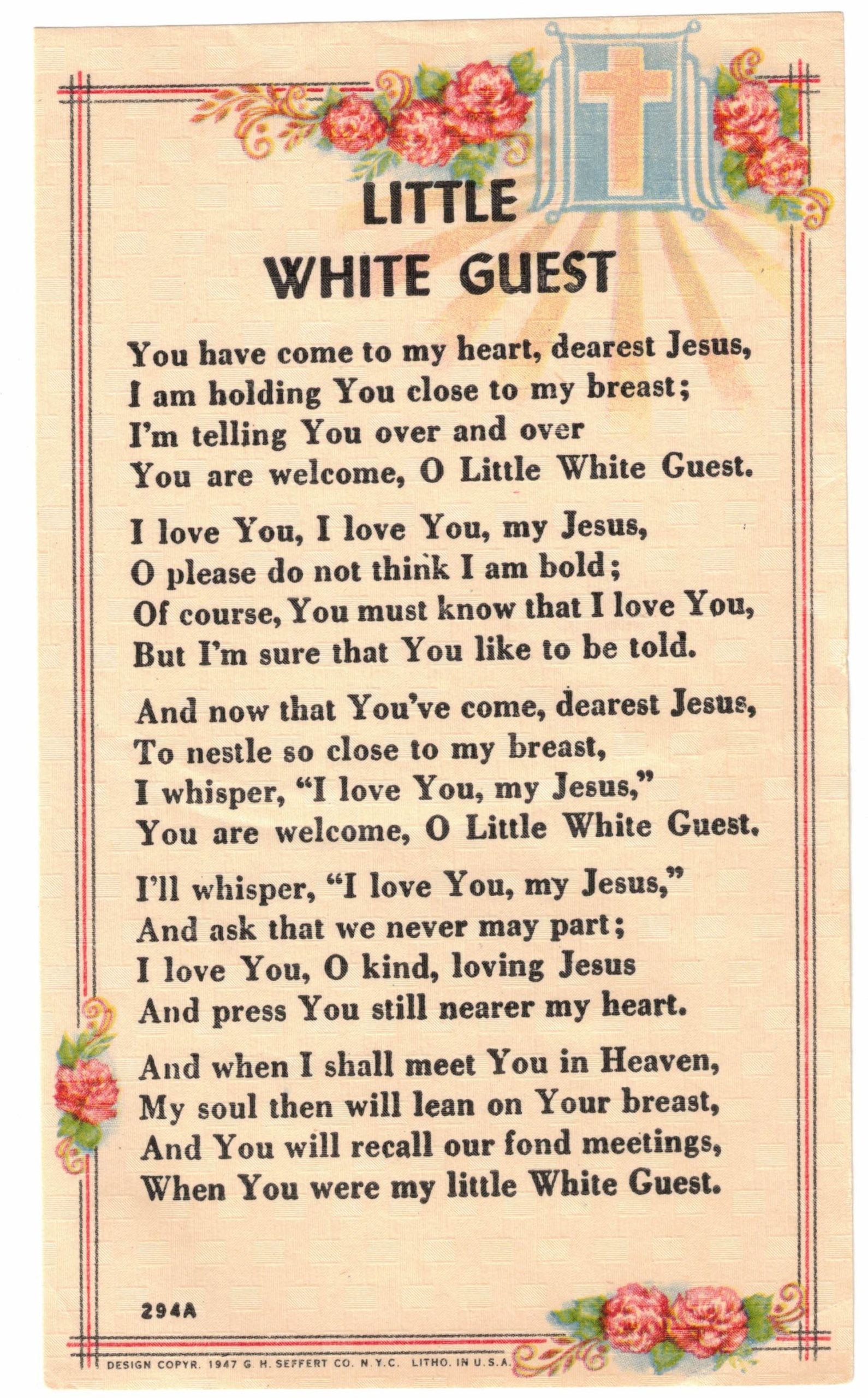
The enduring significance of this hymn is perhaps best evidenced by its persistent life outside the choir loft. Decades after its mid-century peak, Little White Guest remains a staple of the devotional landscape, with its accompanying prayer cards still widely available through major religious retailers like the EWTN Religious Catalogue and Catholic Supply. These cards, often featuring the classic Fratelli Bonella artwork of the Christ Child, continue to be sold in the thousands for First Communion ceremonies and parish distribute. This ongoing commercial and devotional presence suggests that the hymn is not merely a museum piece of “old-fashioned” sentimentality, but a living “souvenir of faith” that continues to provide a tangible, prayerful anchor for new generations.
Online forums and social media are filled with testimonials from individuals who, decades after their own First Communion, still recite the verses from memory after receiving the Eucharist. This persistent popularity suggests that the hymn serves as a “living bridge,” connecting the structured sacramental preparation of the past with the personal, interior prayer life of the present.
Little White Guest
You have come to my heart, dearest Jesus,
I’m holding you close to my breast,
I’m telling you over and over,
You are welcome, O Little White Guest.
I Love you, I Love you, My Jesus,
Please do not think I am bold
Of course, you must know that I Love You,
But I am sure that You like to be told.
And now that you’ve come, dearest Jesus
To nestle so close to my breast,
I’ll whisper “I love you, my Jesus”
You are welcome, O Little White Guest.
I’ll Whisper, “I Love You, My Jesus”
And ask that we never may part;
I Love You, O kind, Loving Jesus
And press You still nearer my Heart.
And when I shall meet you in heaven,
My soul then will lean on Thy breast
And you will recall our fond greetings,
When you were my Little White Guest.
To the modern critic, the lyrics of Little White Guest are sometimes labeled as “sentimental.” However, this critique overlooks the hymn’s profound pedagogical and mystagogical purpose. In the era of the Baltimore Catechism, children were not just taught information about the Eucharist; they were given a structure for an interior life.
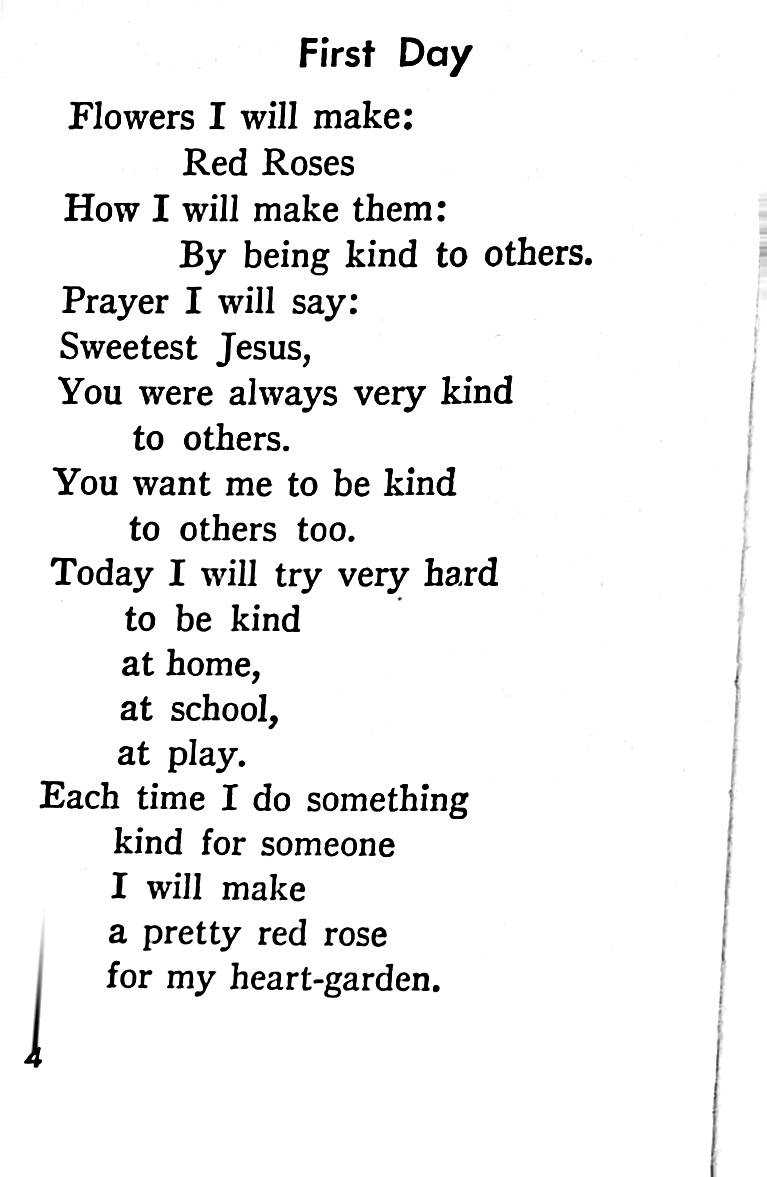
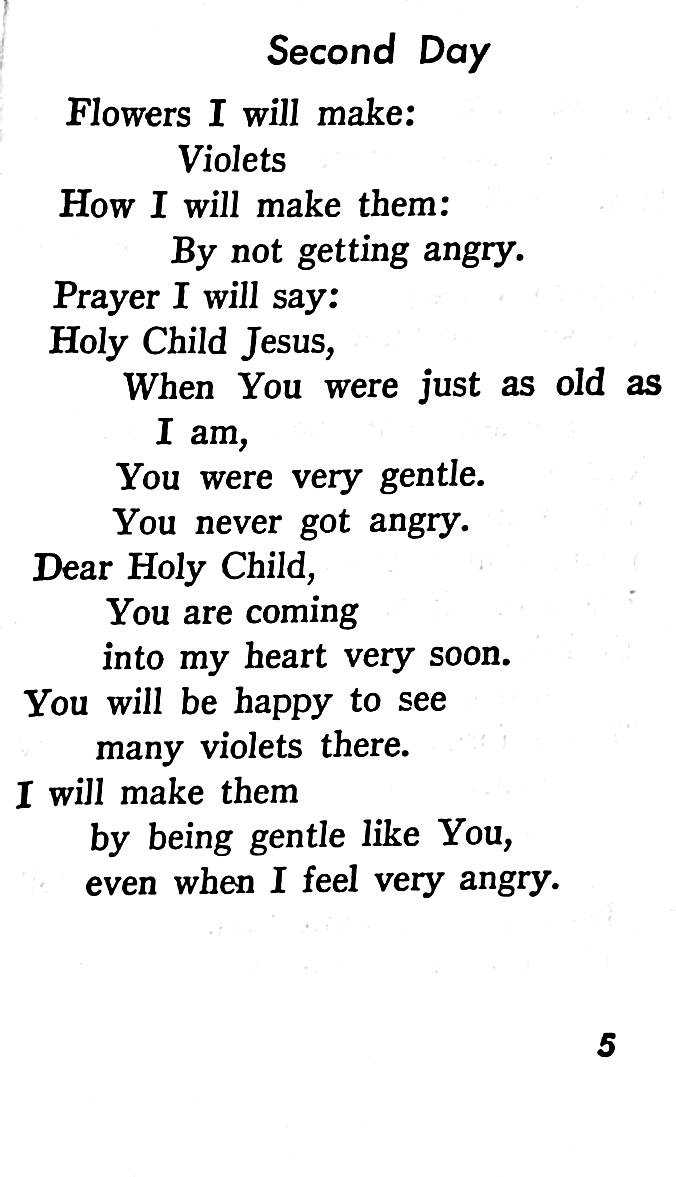
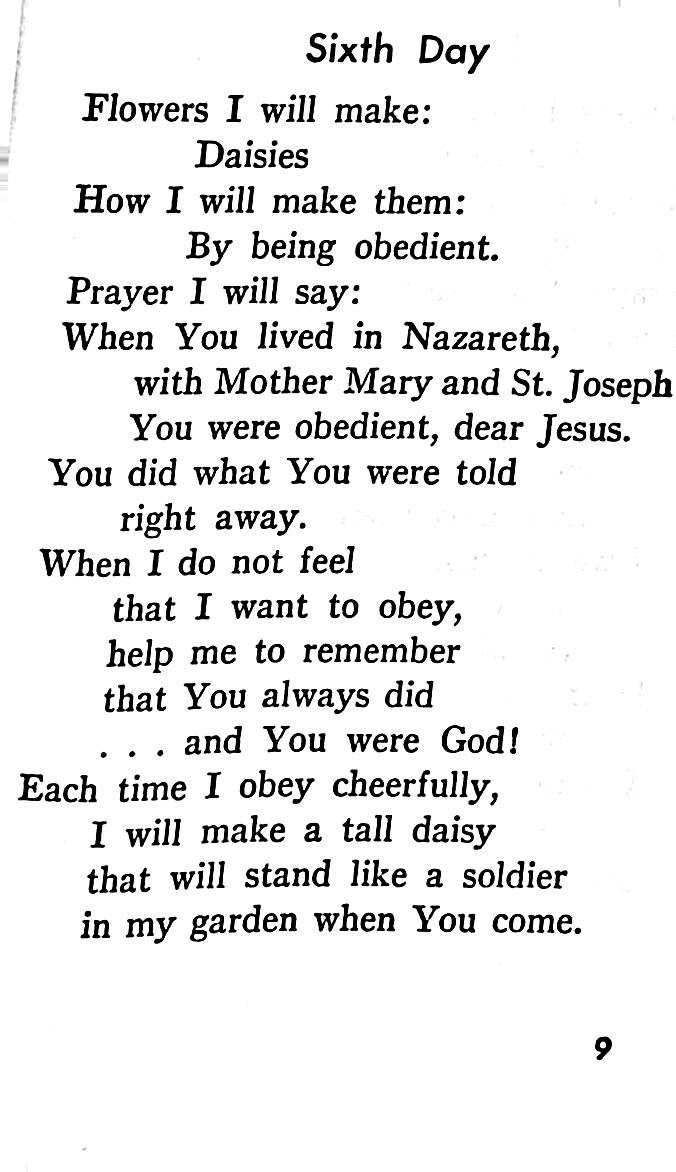
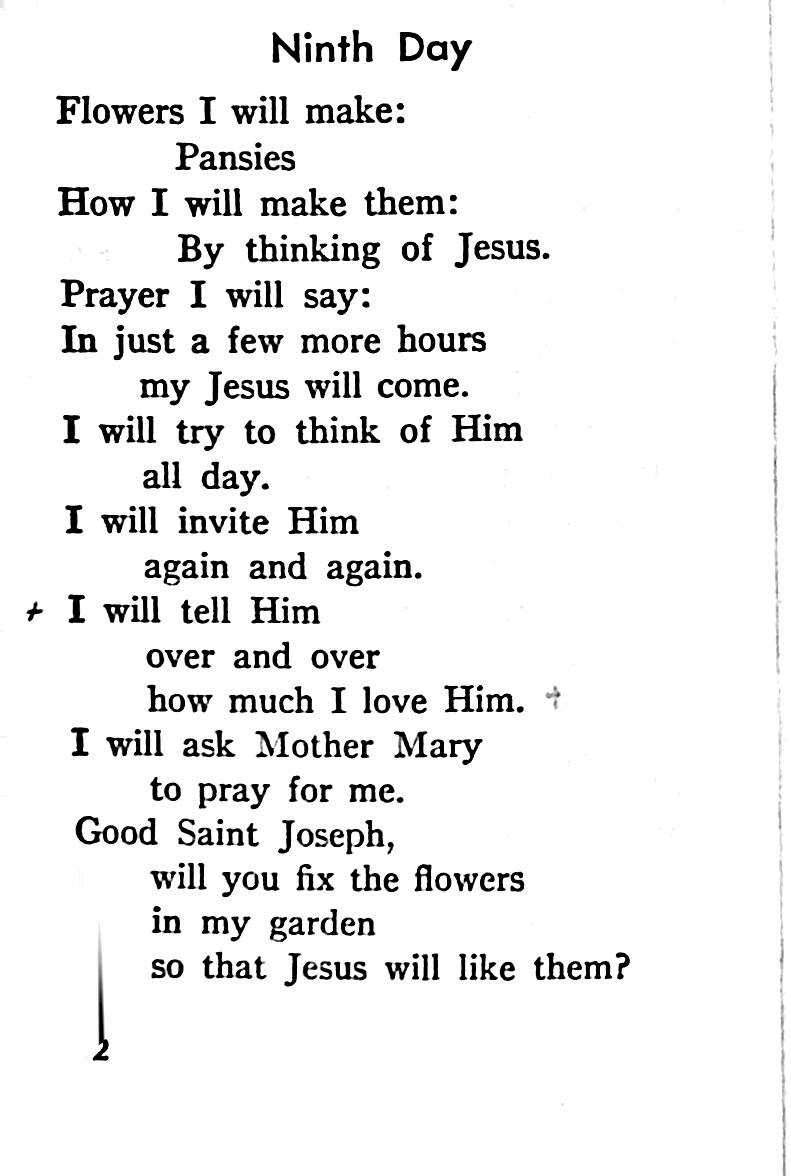
This is best exemplified by the Heart-Garden Novena that accompanied the hymn. The preparation was a nine-day labor of active virtue. Each virtue was represented by a specific bloom:
In this context, the Little White Guest is not a diminutive title, but an Incarnational one. By framing the Eucharist as a “Guest,” the hymn teaches the logic of hospitality. The child learns that their soul is a home that must be swept, decorated, and made ready for a Royal Visitor. In this way, the hymn is valuable within its proper theological and liturgical limits. It meets the child where they are.
The choice of the word ‘Guest’ is not merely a charming sentiment for children; it is a profound echo of the Church’s high liturgy. In the Veni Sancte Spiritus—the ancient ‘Golden Sequence’ of Pentecost—the Holy Spirit is addressed as Dulcis Hospes Animae, or the ‘Sweet Guest of the Soul.’ By using this language, Little White Guest performs a vital mystagogical service, translating the abstract mystery of the Divine Indwelling into the accessible ‘logic of hospitality.’ It teaches the young communicant that the soul is not an empty space, but a sanctuary prepared for a Royal Visitor. This framework transforms the act of receiving the Eucharist into a personal encounter, grounding the ‘warm’ devotional experience in the ‘high’ theological reality of the Roman Missal.
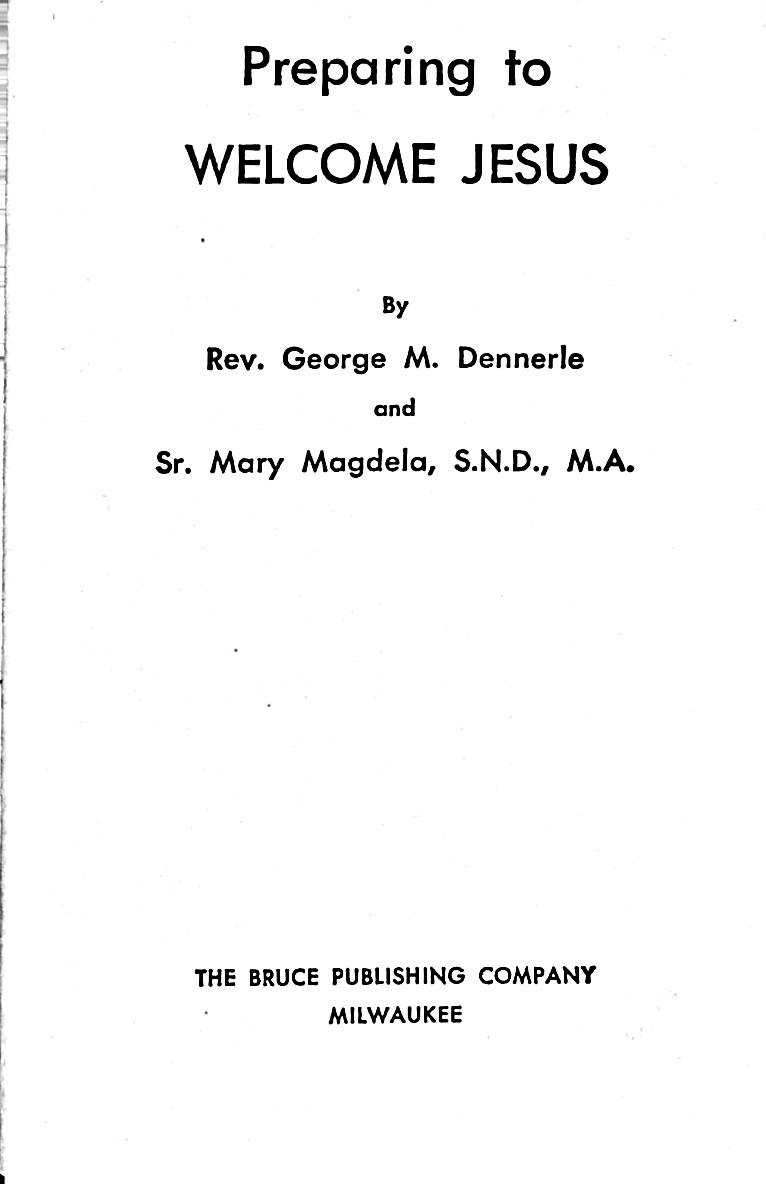
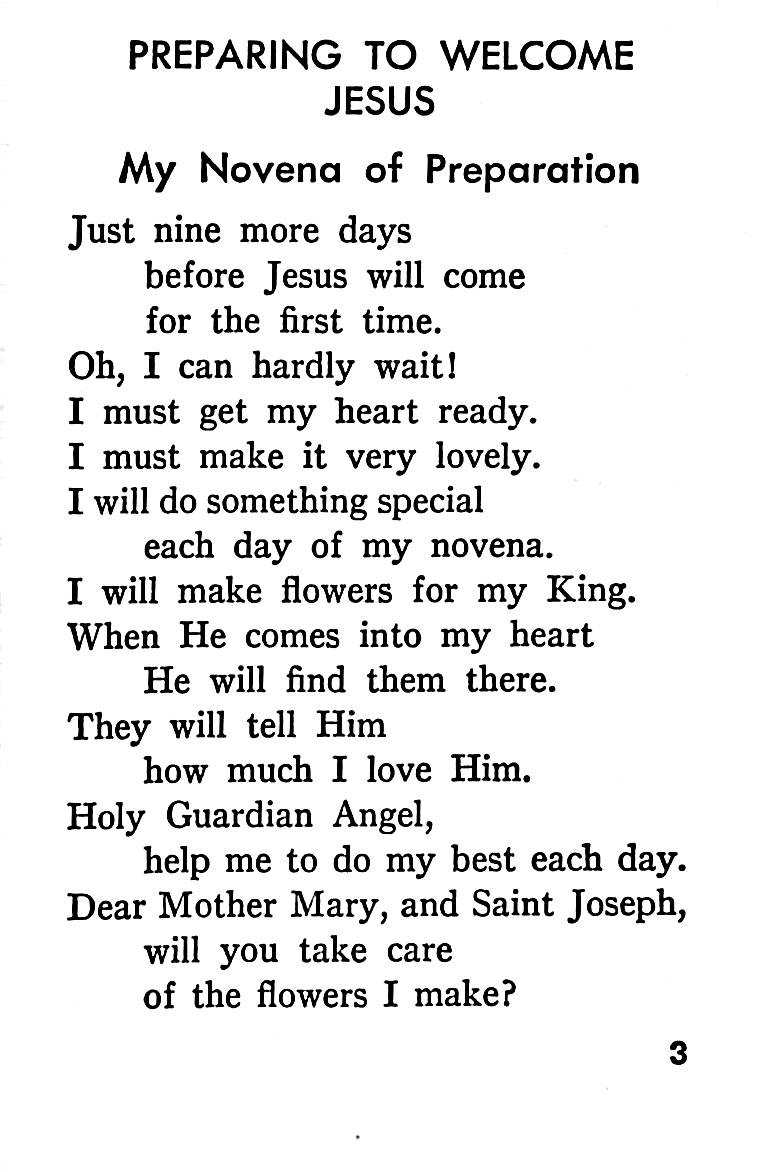
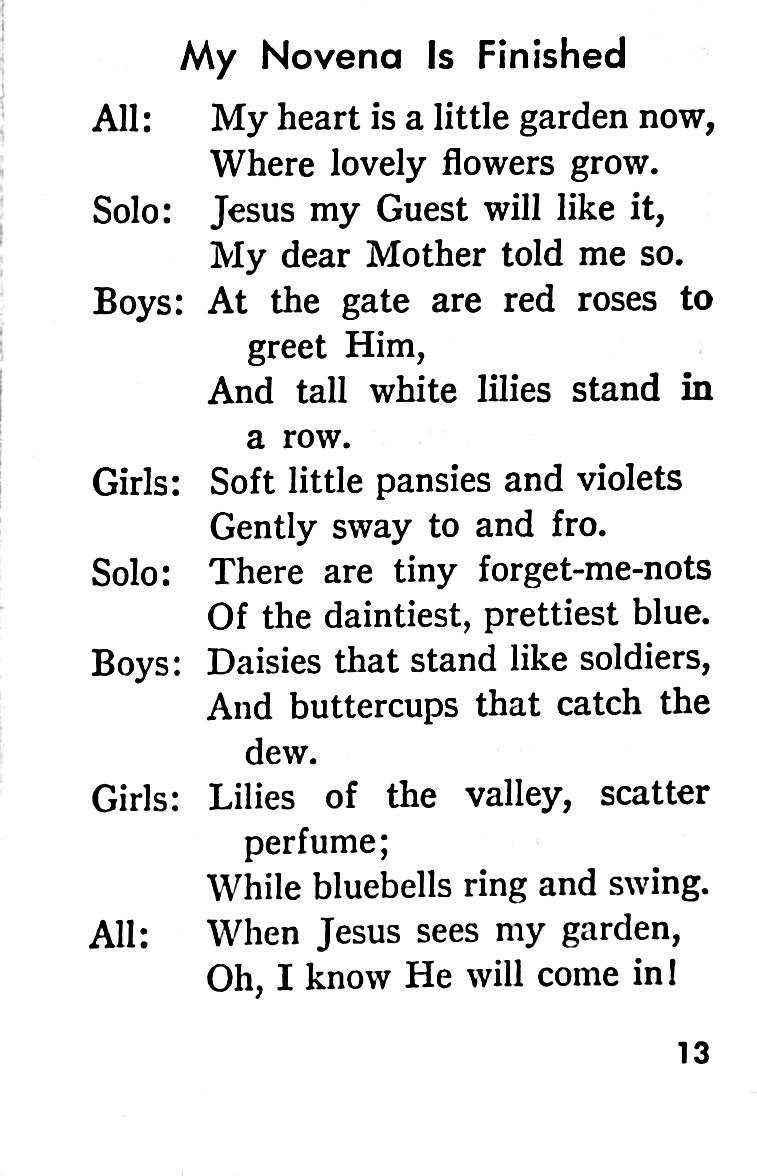
The following excerpts are taken from a First Communion preparation text “Preparing to Welcome Jesus” used during the catechetical period of the author. They illustrate a structured approach to forming the interior life of the child through symbolic and devotional language, often described as the “heart-garden”.
Preparing to Welcome Jesus (1952)
Fr. George M. Dennerle & Sr. Mary Magdela, S.N.D.
The following booklet, originally published in 1952 by The Bruce Publishing Company of Milwaukee, is provided here as a historical devotional resource associated with First Holy Communion preparation in the mid-twentieth century. Its language and spiritual approach reflect a particular moment in Catholic catechetical practice—marked by affective devotion, child-centered piety, and an emphasis on personal intimacy with Our Lord in the Eucharist.
This document is presented not as a normative model of Catholic hymnody or Eucharistic theology, but as a representative artifact of a widely shared devotional culture. Its inclusion is intended to assist readers in understanding the pastoral and imaginative framework that shaped the religious experience of many Catholics in the context of First Communion. This booklet is believed to be in the public domain; if a valid copyright claim exists, it will be removed upon request.
Within the framework of this study, Little White Guest is best understood as a devotional hymn. In this classification, such hymns are recognized for expressing a personal and affective response to the reception of Christ, while not necessarily articulating the fullness of Eucharistic doctrine, particularly with regard to the objective reality of Christ’s presence in the sacrament. This distinction is important. The hymn does not serve as a primary expression of the Church’s liturgical voice, but accompanies it, giving the communicant—especially the child—a language of love in response to a mystery already received.
Examining this hymn today reveals a significant shortcoming in modern catechesis. When we were taught by religious sisters using the Baltimore Catechism, we were given a “musical spine” for our faith. The sisters lived a life centered on the Eucharist, and they passed that interiority down to us through these simple devotions.
Today, many lay teachers—often through no fault of their own—have had less exposure to this kind of liturgical and devotional formation. Modern pedagogy often emphasizes the “communal meal” or the “gathering,” but it can neglect the interior silence and the personal conversation with Christ. Without the structured “small steps” of the Heart-Garden, children may learn about the sacrament without learning how to love the Person within it.
There is a growing movement today to recover this lost inheritance. Schools like the Chesterton Academy network are returning to a classical model of Catholic education, emphasizing the integration of faith, reason, and beauty.
While these modern classical schools rightly focus on the “high” traditions of Gregorian chant, there remains a vital place for the “warm” traditions of the devotional hymn. The Chestertonian spirit—one of “Catholic joy” and common sense—aligns perfectly with the Little White Guest. By reintroducing these hymns, we bridge the gap between a rigorous mind and a tender heart. We offer children more than just facts; we offer them the “whisper” of a post-Communion heart that says, “I love You, my Jesus.”
When I invite readers to review these verses, I am inviting them to look past the notes and see the spiritual landscape they create. This hymn was once a staple of the Choir Loft radio broadcasts in 1937, and for over thirty years, it has echoed in my own experience in the choir at St. Mary’s in Akron, Ohio. It is more than a song; it is the final result of a soul prepared.
As I reflect on the journey of the Little White Guest, I am reminded of the words that conclude the nine-day journey of preparation:
“Now my Novena is finished, and my heart is a little garden where lovely flowers grow. Jesus my Guest will like it, my dear Mother Mary told me so. When Jesus sees my garden, oh, I know He will come in! I’ll whisper, I Love You, I Love You, My Jesus. He is coming in this morning, to be my Little White Guest.” This beautiful hymn says it all.
A special thank you to Peter Meggison, producer of The Devotional Hymns Project for allowing me to link to his recordings of Little White Guest. I particularly wish to highlight the beautiful selections he produced at St. Paul Church in Harvard Square, Cambridge, Massachusetts. On June 28, 2013, vocalists Lisa Correnti and Sarah Mitchell performed the melody by Sr. Myra, C.S.J., under the direction of organist John Robinson, who served as music director of both the church and the renowned St. Paul Choir School.
The collaboration continued in August 2014, when additional selections were recorded at the same location by John Robinson with vocalists Clare McNamara and Camila Parias. Their performance of the melody by Richard Frank Martin Akerman further honors the tradition of exceptional sacred music associated with this distinguished institution.

In the days leading up to this project, my sister wrote to me searching for a recording of Terra Tremuit, the Easter alleluia we grew up singing at St. Mary’s. She had found versions online, but none carried the sound or spirit she remembered. Her message stirred something in me — the same longing for a music we once knew so well, a music that seemed to have slipped beyond reach. In replying to her, I unearthed an old cassette from Easter Morning, 1991, and began the careful work of digitizing it. What started as a simple attempt to help my sister hear a beloved melody again became the doorway into this entire tribute: a return to the voices, memories, and grace of St. Mary’s Choir at Easter.
Easter at St. Mary’s in Akron was never simply a date on the calendar. It was the summit of the parish’s musical and spiritual life, the moment when the choir’s year‑long devotion blossomed into something luminous. Long before the first bells rang or the first alleluia was sung, the choir loft was already alive with quiet purpose. Rehearsals took on a different tone in those weeks—gentler, more focused, as though everyone sensed that what we were preparing was not merely music, but an offering.
Holy Week always marked a turning. Palm Sunday carried its own solemnity, but it was the Triduum that shaped the choir’s deepest work. On Holy Thursday, the music softened into contemplation; on Good Friday, it nearly disappeared into silence. And then came the long, breath‑held waiting before the Vigil, when the church sat in darkness and the choir waited with it, ready to give voice to the first light of the Resurrection.
Every other year, when the Easter Vigil in the Ordinary Form—the Novus Ordo—was celebrated in Latin, St. Mary’s felt like a doorway into the Church’s deep memory. The darkness, the fire, the Exsultet, the slow return of light—these were not performances. They were encounters. Even within the reformed liturgy, the choir’s Latin Ordinary gave the Vigil its solemn backbone, and when the Gloria finally burst forth—bells ringing, lights blazing, organ swelling—it felt as though the entire parish rose with Christ from the tomb.
Easter morning had its own radiance. Where the Vigil was ancient and solemn, Easter morning was bright and full‑voiced. Parishioners arrived early, not out of obligation but out of desire, knowing that the choir would offer a half‑hour of sacred music before Mass. These preludes became a cherished tradition, a kind of musical procession leading the parish into the joy of the Resurrection.
One Easter in particular—1991—captures the spirit of those years with remarkable clarity. The program from that morning Mass, celebrated by Father Raymond Smith, reveals a choir unafraid to draw from every era of sacred music so long as it lifted hearts toward God. The prelude began with The Dawn Was Purpling O’er the Sky from the 1918 St. Basil’s Hymnal, a gentle rising of light. From there, the choir moved through The Holy City, Lani Smith’s Christ Is Risen with its echo of Handel’s Hallelujah Chorus, the cheerful Let the Bells of Easter Ring, and the sturdy hymn King All‑Glorious. It was a tapestry of devotion—old, new, solemn, joyful—woven together with the unmistakable sound of St. Mary’s.
The Mass itself reflected the parish’s unique musical identity. The Entrance Hymn, Christ the Lord Is Risen Today, was sung to the tune Victimae Paschali, linking familiar English words with the ancient Easter sequence. The Ordinary was taken entirely from John Wiegand’s 1922 Mass in Honor of the Immaculate Conception, a setting that had become part of St. Mary’s musical DNA. The Sprinkling Rite featured Kempter’s Vidi Aquam, flowing and prayerful, and the Offertory—Wiegand’s Terra Tremuit—brought a solemn triumph to the liturgy. Communion carried its own tenderness: Let the Holy Anthem Rise, followed by Anthony Werner’s 1895 Regina Coeli, first sung and then played as an organ meditation. The closing hymns—Jesus Christ Is Risen Today and Christ Is Risen from the 1907 Sunday School Hymn Book—sent the parish forth in full Easter joy.
What made the St. Mary’s Choir remarkable was never perfection. It was devotion. We were teachers, retirees, students, parents, and parishioners who loved our church. We gave up evenings, weekends, and holidays because we believed the liturgy deserved our best. And somehow, through grace and perseverance, our best was enough. Easter revealed that truth more clearly than any other time of year. The music was never about performance. It was about faith—lived, sung, and shared.
Some of these moments were preserved on a simple cassette tape, recorded live from the organ bench at the main console in the body of the church during that 1991 Easter morning. The recordings were rescued from that fragile ribbon of sound—nearly thirty years old—where time had left its mark: a soft hiss here, a faint rumble there, the unmistakable acoustics of a living church. After gentle restoration, the music remains exactly what it was: the honest, unpolished, heartfelt voice of a parish choir singing the Resurrection. These recordings are not studio‑quality, but they are authentic—the real sound of St. Mary’s, carried across decades.
Easter at St. Mary’s stands as one of the parish’s greatest gifts. It showed what a choir can be when it sings not for applause but for the glory of God. It showed what a parish can be when tradition and renewal walk hand in hand. And it showed what sacred music can accomplish when offered with humility and love. The St. Mary’s Choir carried that legacy for decades. And though the voices have changed and the years have passed, the memory of those Easter mornings—filled with light, filled with song, filled with faith—remains a treasure worth preserving.
As I listen to these recordings now, after nearly fifty years in the loft, I am deeply aware that I am the last of the St. Mary’s Choir. So many of the voices you hear—faithful friends, mentors, companions in song—have gone on to their final reward. Yet in these fragile, time‑worn tapes, they live again. Their harmonies rise, their devotion lingers, and the love they poured into the liturgy still shines through the imperfections of an old cassette. It does my heart good to hear them, my choir family, singing as they once did on Easter morning. I offer this short tribute to their memory, with gratitude for the years we shared and the music that continues to echo in my soul.
St. Mary’s Choir/ Easter Sunday Morning 10a.m. Mass with Easter Music Program 1991. Celebrant was Father Raymond Smith; Organist Ralph Jordan.
Easter Music Program Before Mass
1. Organ Prelude – The Dawn Was Purpling O’er The Sky – St. Basil’s Hymnal 1918
2. The Holy City – F. E. Weatherly/Stephen Adams/ Arr. by Harold DeCou, 1972
3. Christ Is Risen – L. O. Emerson/ Arr. Lani Smith/ Incorporates Handel’s Hallelujah Chorus, 1990
4. Let The Bells of Easter Ring – Nancy Price/Don Besig, 1990
5. King All-Glorious – Charles Wesley/ George M. Vail, 1928
Entrance Hymn – Christ, the Lord, Is Risen Today (Missalette) Tune: Victimae Paschali
Kyrie – Mass in Honor of the Immaculate Conception of the Blessed Virgin Mary/ John Wiegand, 1922
Gloria – Mass in Honor of the Immaculate Conception of the Blessed Virgin Mary/ John Wiegand, 1922
Responsorial Psalms – This is the day the Lord has made; Let us rejoice and be glad.
Gospel Alleluia Three times and Verse
Sprinkling Rite – Vidi Aquam – Carl Kempter/ Arr. by B. Hamma, 1893
Offertory for Easter – Terra Tremuit – John Wiegand, 1914
Sanctus – Mass in Honor of the Immaculate Conception of the Blessed Virgin Mary/ John Wiegand, 1922
Pater Noster w/organ
Agnus Dei – Mass in Honor of the Immaculate Conception of the Blessed Virgin Mary/ John Wiegand, 1922
Communion Hymn – Let the Holy Anthem Rise (Missalette) Tune: Traditional
Communion Hymn – Regina Coeli – Anthony Werner, 1885
Communion Meditation – Regina Ceoli Organ only
Closing Hymn – Jesus Christ is Risen Today (Missalette) Tune: Easter Hymn
Second Closing Hymn – Christ Is Risen – Sunday School Hymn Book, 1907
Organ Postlude
About These Recordings
The recordings featured below, were digitized from an aging cassette tape that captured the Easter Sunday Morning Mass at St. Mary’s in 1991. Due to the limitations of the original medium and the passage of time, the audio quality reflects the natural imperfections of live parish recordings. Basic restoration techniques were applied to reduce tape hiss and environmental noise, but the goal was preservation rather than perfection. What remains is an authentic historical document of the choir’s sound and the parish’s musical life.