Catholic Hymnody, Authority, and Modern Hymnals

Context and Purpose

Catholic hymnody has always existed under the authority of the Church, yet the way that authority is exercised has changed significantly in the modern era. This article examines why Catholic bishops no longer formally approve hymnody through imprimaturs, how hymn evaluation now functions within the Church, and how modern Catholic hymnals measure up when judged against the Church’s own doctrinal and liturgical standards. Drawing on historical practice, the USCCB’s Catholic Hymnody at the Service of the Church (2020), and What Is a Catholic Hymn?, this study seeks not to be polemical, but ecclesial: to clarify what the Church means by Catholic hymnody and how that meaning is applied today.

1. Why Imprimaturs for Hymnals Disappeared in the U.S.

Historically (pre‑1960s), Catholic hymnals commonly carried imprimaturs. Hymns were treated as catechetical and doctrinal texts, and bishops exercised direct oversight.

After Vatican II, imprimaturs for hymnals faded gradually (roughly 1968–1980)—not by formal abolition, but by a shift in priorities:

  • Episcopal authority focused increasingly on official liturgical texts (Missal, Lectionary, sacraments).
  • Hymns came to be viewed as pastoral or devotional aids, not juridically regulated texts.
  • The explosion of vernacular, ecumenical, and rapidly revised repertoire made exhaustive review impractical.

Importantly, the Church never declared hymn approval unnecessary in principle. Instead, oversight shifted from formal pre‑approval to discernment, formation, and responsibility at lower levels (publishers, pastors, musicians).

2. Criteria for Evaluating Hymns Using the Church’s Own Language

From Sacrosanctum Concilium, Musicam Sacram, the GIRM, the Catechism, and the USCCB (2020), a coherent set of criteria emerged. These were synthesized into four lenses:

Doctrinal Integrity

Hymns must clearly express Catholic doctrine (Trinity, Christology, Eucharist, salvation) without ambiguity. Vague or contradictory theology is not acceptable simply because it is popular or emotive.

Liturgical Function

Hymns must serve the ritual action of the Mass, not merely provide religious sentiment. A hymn can be orthodox yet still liturgically unsuitable if it does not correspond to the rite (Entrance, Offertory, Communion).

Ecclesial Voice

Catholic hymnody should sound like the Church praying as Church, not primarily individuals expressing personal experience. Preference is given to scriptural, liturgical, and traditional sources.

Pastoral Effectiveness

Hymns should be singable, prayerful, and oriented toward reverence—not performance or entertainment.

The USCCB document presents these as guidelines and cautions, not binding judgments.

3. “What Is a Catholic Hymn?” — A Stronger, Definitional Synthesis

What Is a Catholic Hymn? was shown to be fully consistent with the USCCB document but stronger and more precise in its conclusions.

Key contributions of What Is a Catholic Hymn?:

  • It offers a definition, not just an evaluation aid.
  • It states that hymns which obscure doctrine or fail liturgical purpose are unsuitable for Mass, not merely “concerning.”
  • It insists that a Catholic hymn exists under ecclesial authority and permission, even if not through a traditional imprimatur.
  • It integrates doctrine, liturgy, history, and authority into a single coherent standard.

In short:

  • USCCB (2020) asks: What problems should we watch for?
  • What Is a Catholic Hymn? asks: What does the Church mean by Catholic hymnody at all?

They are complementary, not contradictory.

4. Testing Modern Hymnals Against Both Documents

Several widely used U.S. hymnals were evaluated using both standards.

Hymnals Tested[1]

Gather (GIA)

Glory & Praise (OCP)

Breaking Bread (OCP)

St. Michael Hymnal (St. Boniface Roman Catholic Church)

Adoremus Hymnal (Ignatius Press)

A Catholic Book of Hymns (Sacred Music Library)

Results

According to the USCCB (2020):

  • Most modern hymnals contain a mixture of acceptable and problematic texts.
  • They require careful discernment, not wholesale rejection.

According to What Is a Catholic Hymn?:

  • Gather, Glory & Praise, and Breaking Bread fail definitionally as Catholic hymnals, even if they include individual acceptable hymns. They lack consistent doctrinal clarity, liturgical function, and ecclesial voice.
  • St. Michael Hymnal substantially conforms, showing intentional Catholic coherence.
  • Adoremus Hymnal and A Catholic Book of Hymns clearly and fully conform, embodying Catholic doctrine, liturgical theology, and ecclesial intent.

This demonstrates that the stronger definition is not impractical—it is already being met by certain publishers.

5. Core Insight of the Study

The central conclusion is this:

The decline of imprimaturs did not alter the Church’s standards for hymnody, but it shifted how responsibility for applying those standards is exercised.

  • The USCCB document preserves doctrinal vigilance but avoids juridical enforcement.
  • What Is a Catholic Hymn? restores clarity by naming what Catholic hymnody is, not merely what it should avoid.
  • Modern hymnals vary widely, not because Catholic standards are unclear, but because they are applied inconsistently.
  • Two modern hymnals (Adoremus and A Catholic Book of Hymns) demonstrate that coherent, doctrinally strong, liturgically faithful Catholic hymnody is fully achievable today.
[1] Note on Sources:
The hymnals discussed in this document are commercially published and widely used in U.S. parishes. Their contents—hymn texts, indices, and liturgical assignments—are publicly available through publisher materials and independent hymn indices, allowing evaluation based on the texts themselves and the Church’s own liturgical and doctrinal standards.

Discovering the Legacy of Sister Aloysius Dorman

Sister Aloysius Dorman (1835–1913) was a 19th‑century Catholic hymn composer whose music quietly shaped American devotional life. Her initials—S. N. D.—appear above the texts of many hymns found in older Catholic hymnals, yet the woman behind those letters has remained largely unknown. Through archival research and historical sources, this article traces the life, ministry, and hymnody of Sister Aloysius Dorman of the Sisters of Notre Dame de Namur, revealing the legacy of a gifted composer whose work accompanied generations of Catholic prayer while her name faded into anonymity. (Click on any image to enlarge)
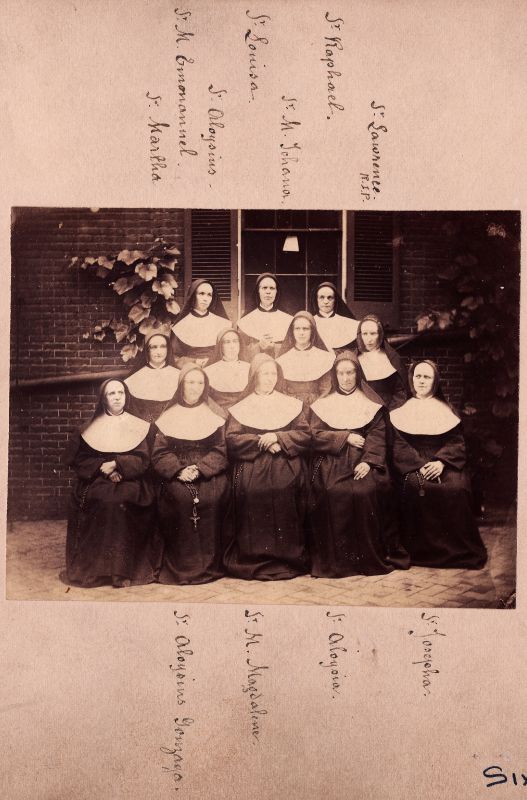
Sixth Street Early Sisters, 1870
Courtesy of the Sisters of Notre Dame de Namur
Ohio Province Archivist
Photo ID 2016-9299
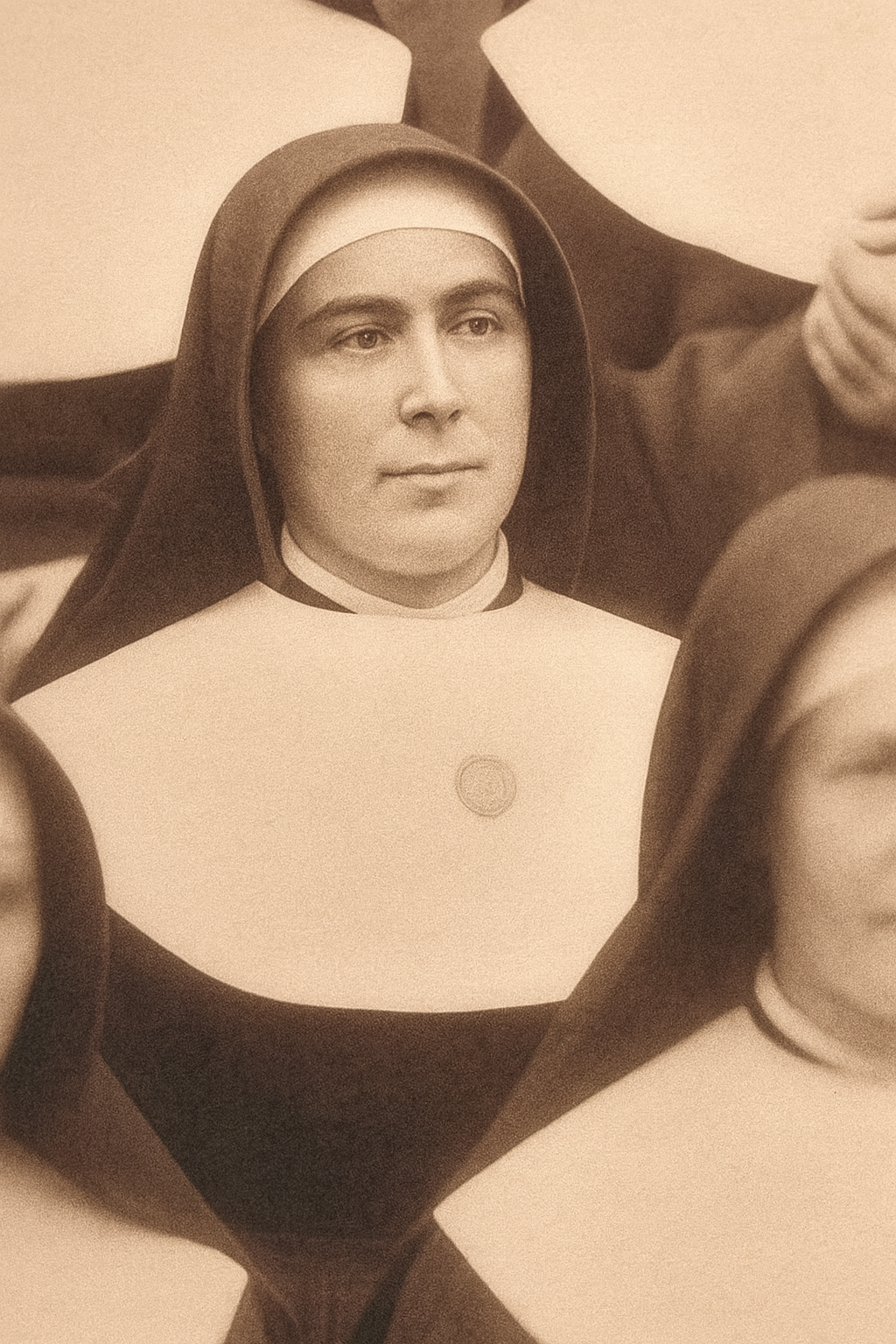
Sister Aloysius (Josephine) Dorman
From photo on the left
Second row, second from the left
Photo enhanced

Sister Aloysius was born in Washington, D.C., on August 2, 1835, to Albert and Adelaide Dorman, both of whom had emigrated from France. At nineteen, she entered the postulancy of the Sisters of Notre Dame de Namur at the Sixth Street Convent in Cincinnati. She professed her perpetual vows in 1861, beginning a lifetime of service marked by music, teaching, and devotion.

Her ministry carried her across several communities. She spent twenty‑five years at the Sixth Street Academy in Cincinnati, seventeen years at the Notre Dame Academy in Philadelphia’s Rittenhouse Square, twelve years in Dayton, and shorter periods in Columbus, Hamilton, and Summit, Ohio. Wherever she went, she taught music and orchestration, publishing hymns and songs for the schools she served. These works—now recognized as the American hymns attributed to “S. N. D.”—became part of the spiritual soundtrack of countless classrooms.

What stands out most in the accounts of her life is her spirited personality. She was known for her lively disposition and her ability to charm those around her. One vivid moment from her final year captures this beautifully. In late March of 1913, she conducted an orchestra of many instruments, singing a gypsy song while accompanying herself on the tambourine. She danced with such youthful agility that observers could hardly believe she was nearly eighty years old.

The very next day, however, she fell ill. For two weeks she continued to attend Mass and receive Holy Communion, but eventually she had to confine herself to her small room above the sacristy. There, after a long life of service, she quietly departed on April 1, 1913. She was laid to rest in the Notre Dame Cemetery in Hamilton, Ohio.

Much of what we know about Sister Aloysius today comes from the careful research of Sister Kim Dalgarn, SNDdeN, archivist in Cincinnati, and from a 1989 letter written to Peter Meggison by Sister Agnes Immaculata Guswiler, the first archivist in Cincinnati. Their work, along with excerpts from the Hamilton Annals, preserves the details of Sister Aloysius’s life and confirms her as the composer of the American hymns and songs long attributed to her initials.

As I learned more about her, I found myself reflecting on how easily figures like Sister Aloysius slip into the background of history. It was customary throughout the entire 19th and early 20th century for religious authors, artists, and composers to remain anonymous, giving only the name of their religious congregations for their published works. Knowing this helped me understand why her contributions were hidden for so long—and why uncovering them feels so meaningful.

Before Peter Meggison mentioned her name, I had never wondered who composed the hymns I’d heard so many times. Her story reminded me that some of the most enduring influences come from people who never sought recognition at all. In discovering her life, I feel as though I’ve uncovered a quiet but beautiful thread woven through American musical and spiritual history, one that deserves to be remembered and celebrated.

The hymn books listed below, compiled by the Sisters of Notre Dame de Namur between 1871 and 1883, constitute a representative sample of a larger body of devotional music associated with the congregation. These volumes document the circulation, revision, and reuse of hymn texts across multiple publications and successive editions, rather than preserving a comprehensive or fixed corpus. The accompanying alphabetized catalog identifies hymns attributed to Sister Aloysius Dorman, S.N.D., with cross‑references to all presently known hymnals and corresponding publication years in which each text appears. Where available, individual hymn entries include links to related narrative essays that document the hymn’s history, variants, and devotional use. This catalog remains provisional and open to expansion as additional hymn texts, variant titles, and source materials are identified.

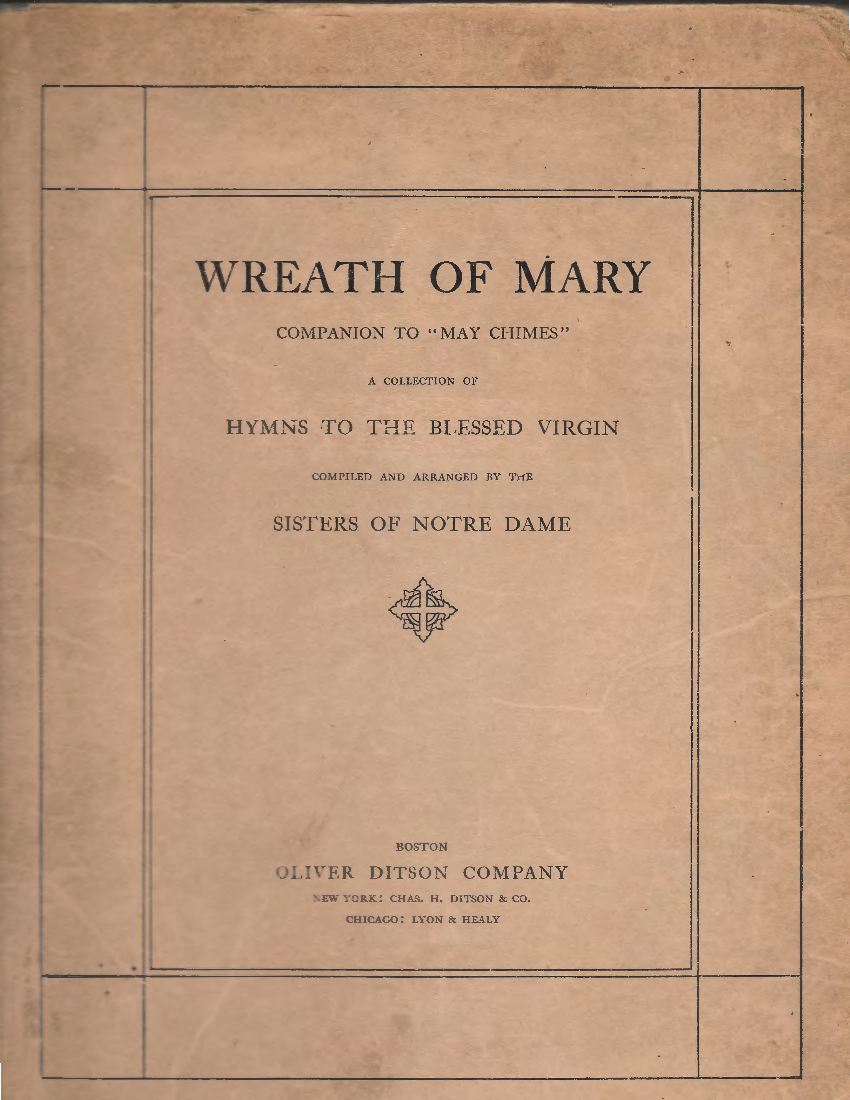
Wreath of Mary, 1883
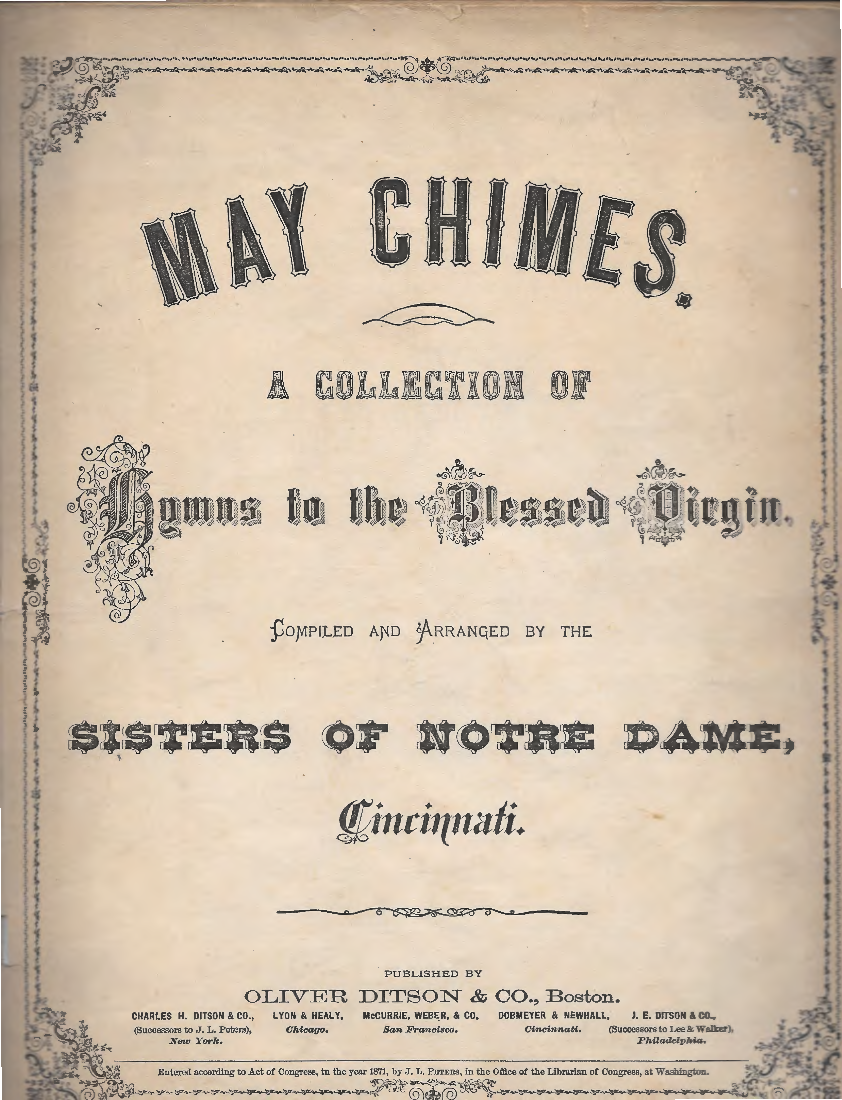
May Chimes, 1871
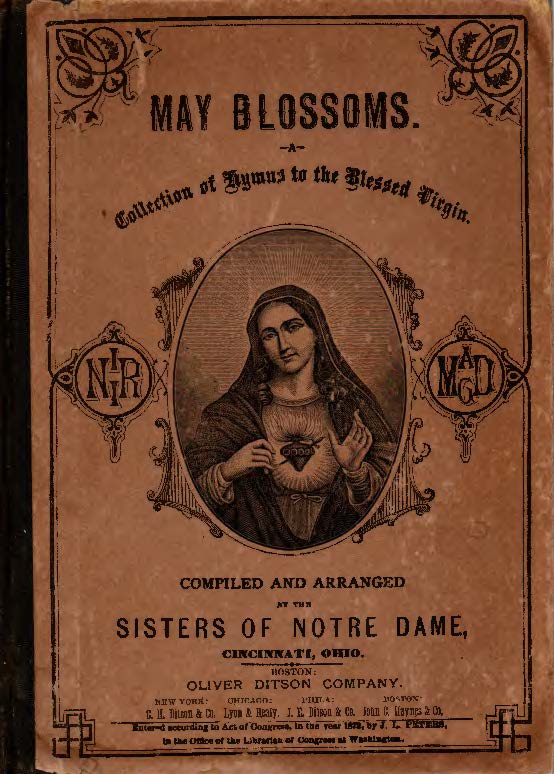
May Blossoms, 1872
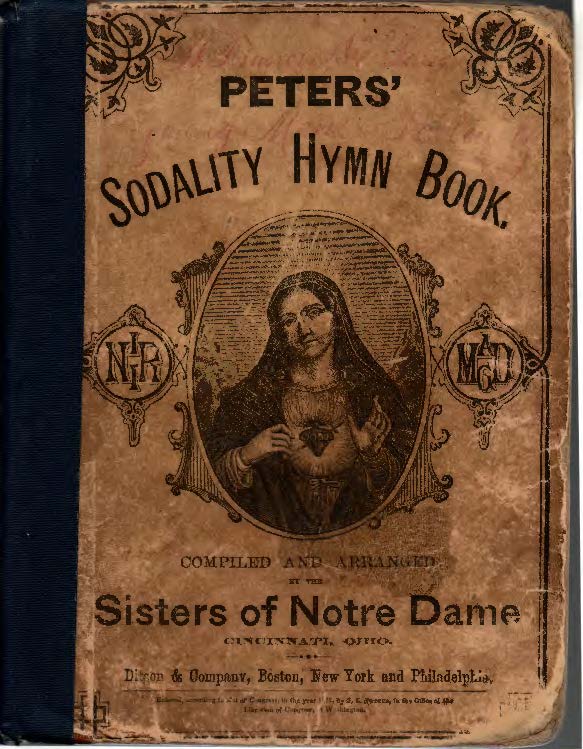
Peters Sodality Hymn Book, 1872

Complete Alphabetized Catalog of Hymns by Sister Aloysius Dorman, S.N.D.

With cross‑references to all known hymnals and publication years

(Catalog remains open for expansion as additional hymns are identified.)

Ah, Who Is She That Mounts to Heaven (also printed as Assumption Hymn)

  • Wreath of Mary (1883)
  • Sunday School Hymn Book (1887, 1907, 1935)

At Last, Thou Art Come, Little Savior

  • Wreath of Mary (1883)

Ave Maria, Bright and Pure (also printed as Ora Pro Mea)

  • May Chimes (1871)
  • May Blossoms (1872)
  • Peters’ Sodality Hymn Book (1872, 1914)
  • Crown Hymnal (1913)
  • St. Basil’s Hymnal (1918, 1925)
  • St. Joseph’s Hymnal (1930)

Great St. Joseph! Thron’d in Glory (also printed as St. Joseph)

  • Wreath of Mary (1883)
  • St. Basil’s Hymnal (1897, 1918)

Hail Virgin, spotless Mother!

  • May Chimes (1871)
  • May Blossoms (1872)

Heart of Mary, Pure and Fair (also printed as O Heart of Mary, Pure and Fair)

  • May Chimes (1871)
  • May Blossoms (1872)

Heavenly Desires (Oh, When Shall We With Angels Bright)

  • May Chimes (1871)
  • May Blossoms (1872)
  • Peters’ Sodality Hymn Book (1872, 1914)
  • Sunday School Hymn Book (1887, 1907, 1935)
  • St. Basil’s Hymnal (1918, 1925)

How Pure, How Frail, and White (also printed as The Annunciation)

  • May Chimes (1871)
  • May Blossoms (1872)
  • Peters’ Sodality Hymn Book (1872, 1914)
  • Crown Hymnal (1913)
  • St. Basil’s Hymnal (1897, 1918)
  • St. Joseph’s Hymnal (1930) 

I Am My Love’s and He Is Mine (also printed as I Am My Lord’s and He Is Mine)

  • May Chimes (1871)
  • May Blossoms (1872)
  • Sunday School Hymn Book (1887, 1907, 1935)
  • St. Basil’s Hymnal (1891, 1897, 1906)

Mary’s Titles ( also printed as Thro’ the world Thy Children Raise)

  • May Chimes (1871)
  • May Blossoms (1872)
  • St. Basil’s Hymnal (1906)

Mother Dearest, Mother Fairest (also printed as Our Lady of Help)

  • Wreath of Mary (1883)
  • Sunday School Hymn Book (1887, 1907, 1935)
  • Basil’s Hymnal (1888 through 1925)

Mystery of Love, To Thee We Turn

  • May Chimes (1871)
  • May Blossoms (1872)

Oh! Beautiful Thou art

  • May Chimes (1871)
  • May Blossoms (1872) 

O List, My Loved Angel, Assent to My Vow (also printed as My Angel)

  • May Chimes (1871)
  • May Blossoms (1872)

O Mournful Mother, Who Didst Stand (also printed as Help of Christians)

  • May Chimes (1871)
  • May Blossoms (1872)

O Mother Loved, Our Sweet Delight

  • May Chimes (1871)
  • May Blossoms (1872)

Ora Pro Mea (see Ave Maria, Bright and Pure)

Our Lady of the Sacred Heart (To Thee Sweet Mother, Heav’nly Queen)

  • May Chimes (1871)
  • May Blossoms (1872)

Our Lady of the Sacred Heart (Sweet Lady of the Sacred Heart)

  • May Blossoms (1872)
  • Peters Sodality Hymn Book (1872, 1914)

Rose of the Cross (Rose of the Cross, thou mystic flower!)

  • May Chimes (1871)
  • May Blossoms (1872)
  • Sunday School Hymn Book (1887,1907, 1935)
  • Basil’s Hymnal (1918, 1925)

Soft Breaks the Morn on Zion’s Hill (also printed as Presentation)

  • Wreath of Mary (1883)

Sorrows of Mary (Vast as ocean’s briny water, Mighty as it’s surging tide)

  • Wreath of Mary (1883)

A special thank you to Peter Meggison producer of The Devotional Hymns Project for allowing me to link to recordings of some of the hymns listed above.

album-art

00:00