Interest Grows in AI Tools for “A Parish Inheritance”

Growing interest among Catholic musicians in the AI-assisted hymn analysis process originally featured in A Parish Inheritance: A Hymnological Study of St. Mary’s Parish has led to the creation of a centralized collection of resources. To support this expanding community of practice, all of the foundational documents, templates, examples, and AI workflow instructions have now been gathered into one convenient online location.

Whether you are seeking to evaluate your parish’s current repertoire, better understand the Church’s vision for sacred music, or explore the theological foundations of Catholic hymnody, these resources provide a structured framework for study, formation, and discernment.

A word of encouragement: Before diving into the AI tools, take time to read the foundational documents slowly and carefully. The goal of this project is not simply to classify hymns, but to foster a deeper understanding of Catholic hymnody, sacred music, and the Church’s liturgical life. A thoughtful reading of these documents will provide the context needed to use the analysis process wisely and fruitfully.

How These Resources Work Together

The materials below are designed to function as a unified framework. These are the foundational documents needed to analyze hymn texts. (click on the documents to download):

Taken together, these resources form a complete toolkit for evaluating hymn texts through the lens of Catholic doctrine, liturgical principles, and pastoral sensitivity.

Getting Started with AI-Assisted Hymn Analysis

The AI Analysis Guide provides a standardized workflow for using AI as a research assistant when evaluating hymn texts. The goal is not to replace human discernment, but to help pastors, musicians, and parish leaders apply a consistent theological and liturgical framework across large hymn collections.

Recommended Workflow

  1. Download and upload the following documents into your AI session:
    • What Is a Catholic Hymn?
    • A Pastoral Look at the Hymns We Sing: Past and Present
    • Appendix D: Hymn Analysis Template
    • Appendix E: Sample Hymn Analyses
  1. Use the priming instructions provided in the AI Analysis Guide for Liturgical Hymnody so the AI understands the analytical framework established by A Parish Inheritance.
  2. Evaluate one hymn at a time using the methodology outlined in the guide.
  3. Review the analysis carefully and use it as the basis for informed discussion and shared discernment.
  4. Save the completed analysis in a Word document or note-taking application for future reference. Building a library of completed hymn evaluations reduces duplication of effort, provides consistency over time, and creates a useful resource for pastors, musicians, and parish leaders.

Tips for Analyzing Hymns with AI

To obtain the most accurate and consistent results, keep the following limitations and best practices in mind:

  • Build and Maintain the Framework: The effectiveness of the process depends upon understanding the theological, liturgical, and pastoral principles that guide the framework. When starting a new AI session, upload the foundational documents and use the instructions provided in the AI Analysis Guide for Liturgical Hymnody. These resources establish the standards by which hymns are evaluated and should be used as provided. Modifying the framework to obtain a preferred outcome may compromise the integrity of the analysis.
  • Analyze One Hymn at a Time: For the most reliable results, evaluate only one hymn per analysis. While AI systems can process large amounts of information, analytical precision tends to decline when multiple hymns or excessive amounts of text are introduced at once. Likewise, provide hymn lyrics in plain text whenever possible. Although AI can sometimes extract lyrics from scanned musical scores, transcription errors may affect the quality and consistency of the analysis.
  • Refresh the Conversation Periodically: As conversations become longer, AI models can gradually lose sight of their original instructions and begin to drift from the analytical framework established by the foundational documents. In my own testing, I have generally been able to analyze three to four hymns individually within the same AI session with consistent results. Beyond that point, I have occasionally observed a decline in adherence to the framework. For this reason, I recommend starting a fresh session after every four or five hymn analyses, re-uploading the foundational documents, and continuing from there. As AI technology continues to evolve, these limitations may become less significant. The recommendations above reflect current experience and are intended to promote consistency and accuracy within the A Parish Inheritance framework.
  • Remember That AI Is a Research Assistant:
    Approach the process as a teacher mentoring an apprentice or a professor directing a research assistant. AI can help identify patterns, organize information, and apply established criteria, but theological and pastoral judgment remain the responsibility of the user. The goal is not to outsource discernment to AI, but to support informed discussion and shared discernment among pastors, musicians, parish leaders, and interested parishioners.

A Tool for Formation, Not Judgment

These resources were developed as tools for formation and discernment. Their purpose is not to criticize beloved hymns, dismiss parish traditions, or pass judgment on the faith of those who cherish them. Rather, they are intended to help pastors, musicians, parish leaders, and interested parishioners engage in thoughtful conversation about how the Church prays, sings, and expresses her faith through sacred music.

The goal is not correction, but deeper understanding; not division, but shared formation; and ultimately, a richer participation in the Church’s liturgical and devotional life.


Nearer My God To Thee

Introduction: A Shared Anthem, A Distinct Devotion

For generations of American Christians, Sarah F. Adams’ 1841 text and Lowell Mason’s 1856 melody, Bethany, have served as the quintessential anthem of Christian hope, mortality, and final rest. While universally recognized as a staple of Protestant hymnody, Nearer, My God, To Thee holds a fascinating, deeply localized, and often overlooked history within the Roman Catholic Church in the United States. Far from being a simple borrowing of Protestant culture, the hymn underwent a profound theological inculturation during the late 19th and early 20th centuries, finding a home in major Catholic hymnals, parish obituaries, and the private devotional lives of the faithful.

The Sacred Heart Verses: An Anonymous Inculturation (1868–1935)

As waves of European Catholic immigrants established parishes across the United States in the mid-to-late 19th century, publishers sought to provide English-language hymnody that resonated with the American context while remaining fiercely protective of Catholic doctrine. The historical cornerstone of this movement was Peter F. Cunningham’s The Hymn-Book.

While an 1868 edition explicitly links the text to prayers for Mass and the anonymous Sacred Heart verses, an extraordinary archival discovery from the May 31, 1856, issue of The Boston Pilot page 2, right-hand column, reveals that this publication was already a legendary staple of American Catholic life long before the dawn of the American Civil War. The 1856 advertisement reveals that The Hymn Book had already reached its “Seventh Edition” by the spring of that year, selling for a mere 6 cents a copy (or 50 cents per dozen) and boasting that it comprised “all the best and most popular Catholic Hymns as now used all over the country, with the Approbation of our Right Rev Bishop.” (Click on any image to enlarge)

The Boston Pilot Vol. 19 - May 31, 1856

By the time later publisher catalogs advertised that the text had reached its “180th thousand” print run, it had achieved a staggering saturation of the American Catholic market. Because it was priced for the working class, immigrant families carried it in their pockets to daily Mass, parish missions, and family devotions.

The 1856 Boston Pilot clipping, however, introduces a fascinating historical and musicological puzzle. Lowell Mason did not compose Bethany—the melody universally associated with Nearer, My God, To Thee—until 1856. This timeline creates two compelling possibilities for how the hymn evolved within the Catholic consciousness:

  • The Evolution of Melody: If the Sacred Heart verses were already nestled inside the 1856 Seventh Edition, they were initially sung to an older, lost traditional melody, only marrying Mason’s famous Bethany tune later when it swept the nation.
  • A Living, Growing Compilation: Alternatively, The Hymn Book was an evolving text. Having established itself as a national bestseller by 1856, later editions (such as the 1868 printing) actively absorbed and baptized Nearer, My God, To Thee with the anonymous Sacred Heart verses once Mason’s tune became a cultural phenomenon.

In either scenario, this staggering print volume completely recontextualizes the hymn’s history. It proves that for a vast portion of the American Catholic faithful in the late 19th century, the traditional Protestant imagery of Jacob’s ladder was thoroughly supplanted. For an entire generation of believers, the familiar melody did not conjure images of a stony pillow, but rather served as a direct, intimate, and widely shared prayer of reparation to the Pierced Heart of Jesus.

While the identity of the poet who adapted these verses remains shrouded in historical anonymity, the publishing ecosystem of Peter F. Cunningham strongly suggests a monastic origin. Cunningham frequently collaborated with the Religious of the Sacred Heart of Jesus (‘The Ladies of the Sacred Heart’) to translate and compose English devotional materials. It is highly likely that a sister of this order, operating under the traditional veil of religious humility, penned these verses. In doing so, she chose to leave her own name forgotten, ensuring that the listener’s focus remained entirely fixed on the wounded Heart of Christ.

By supplanting the original lyrics—which draw heavily on the Old Testament imagery of Jacob’s dream at Bethel—with verses centered on the pierced Heart of Christ, this anonymous Catholic author transformed a hymn of general providence into an intimate, Christocentric prayer of reparation. For nearly seventy years, this version flourished across a wide spectrum of Catholic instructional and devotional materials:

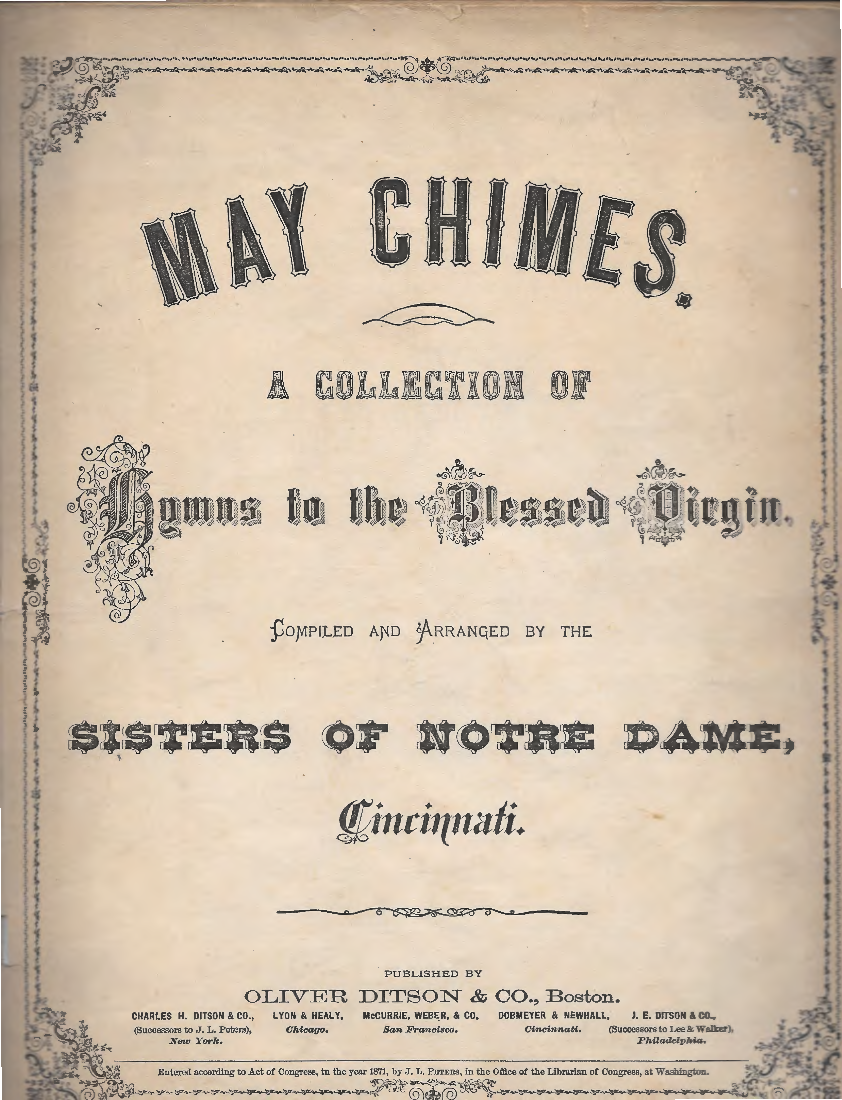
  • It was curated by religious orders for the formation of youth, as seen in the Sisters of Notre Dame’s Sunday School Hymn Book (1887–1935) and the Basilian Fathers’ prominent St. Basil’s Hymnal (1888–1918).
  • It found a home in standard parish collections across major immigrant hubs, including Laudis Corona (1880), Father A. Police’s Parochial Hymn Book (1897), and Francis J. Butler’s The Holy Family Hymn Book (1904).

Interestingly, its inclusion was not always without pastoral reservation. In the 1908 collection Hymns for the Ecclesiastical Year, compiler Alphonsus Dress appended a strict pedagogical note: the hymn was to be sung “only at Mission for Non-Catholics” (a restriction shared with John Henry Newman’s Lead, Kindly Light). This reveals an early liturgical tension, showcasing how some clergy viewed the melody as a pastoral bridge for converts, rather than standard fare for the high Latin liturgy. By 1935, as the Church in America consolidated its identity and moved toward stricter liturgical standardization, the Sacred Heart verses faded from print.

Pre-Vatican II Funerary Practice: A Hymn for the Requiem

Despite its eventual disappearance from standard hymnals, historical obituaries demonstrate that Nearer, My God, To Thee remained deeply embedded in the lived experience of Catholic grief and hope during the first half of the 20th century. It served as a powerful emotional bookend to the rigorous, objective ritual of the Latin Requiem Mass.

Archival accounts suggest a flexible pastoral application of the hymn within the funeral liturgy, echoing alongside traditional Latin chants like the Miserere and Pie Jesu:

  • The Processional: In 1932, at the funeral of Sister Mary Rose (Alvina Woisard) in Connecticut, the hymn was utilized to accompany the solemn entry of the casket into the church. (The Catholic Transcript, Thursday 3-24-1932, pg.7)
  • The Recessional: Conversely, the 1921 obituary of Mary Gertrude Drumright in Oklahoma notes the hymn’s execution at the conclusion of the Mass as a recessional.
  • The Graveside Committal: For many families, the hymn accompanied the deceased to their final resting place. Records for Blazius Brzozowski (1931) and Daniel Daley Jr. (1936) indicate that Nearer, My God, To Thee—frequently paired with other devotional hymns like Sweet Name Which Makes the Dying Live—was sung at the graveside, offering comfort in the open air where the strictures of church rubrics were relaxed.

Because these accounts highlight a diverse cross-section of the faithful—ranging from a religious sister to prominent citizens—it is clear that the hymn was a beloved staple across American Catholic parishes during the pre-Vatican II era.

Musicological Evidence: A Survey of the Catholic Scores

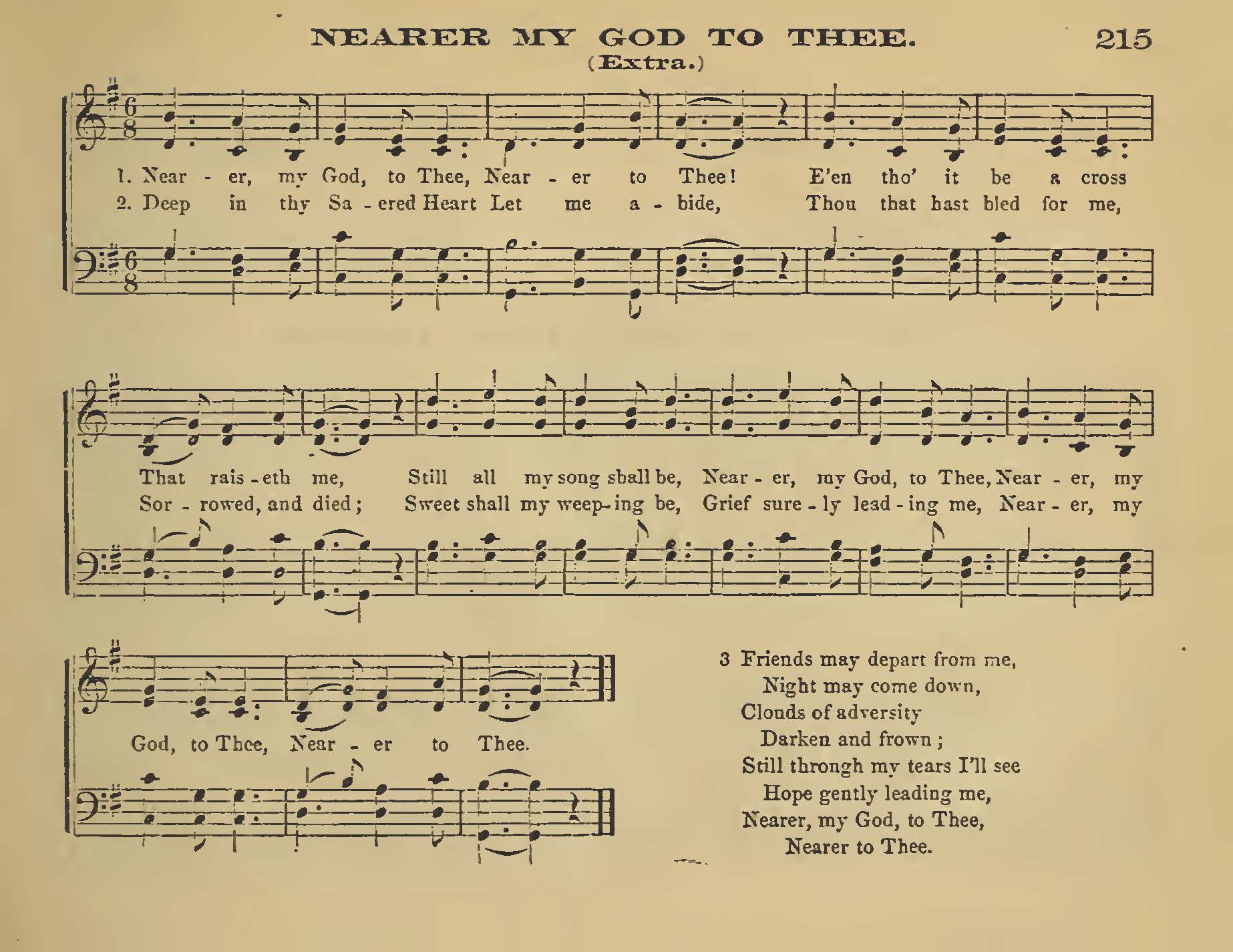
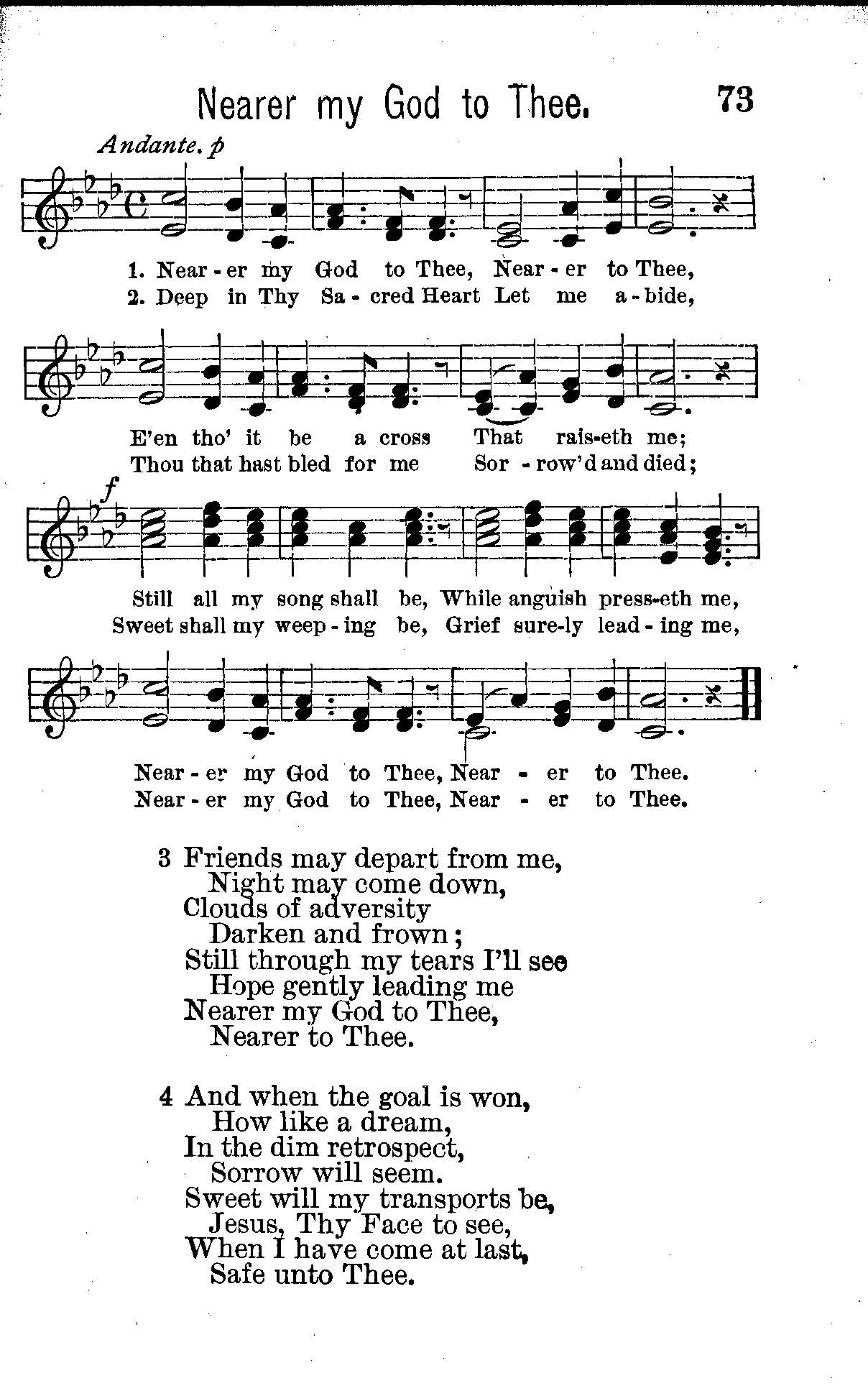
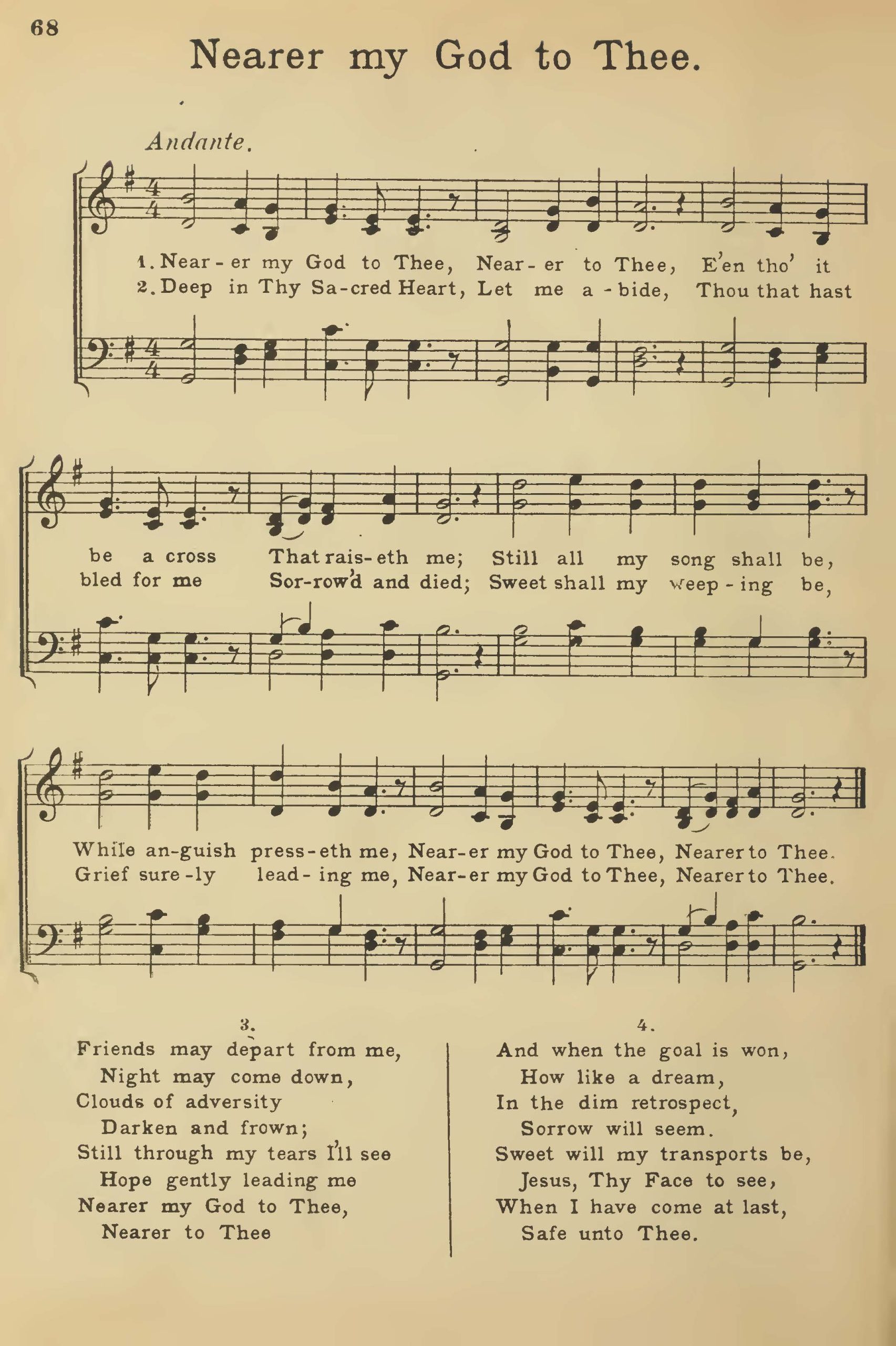
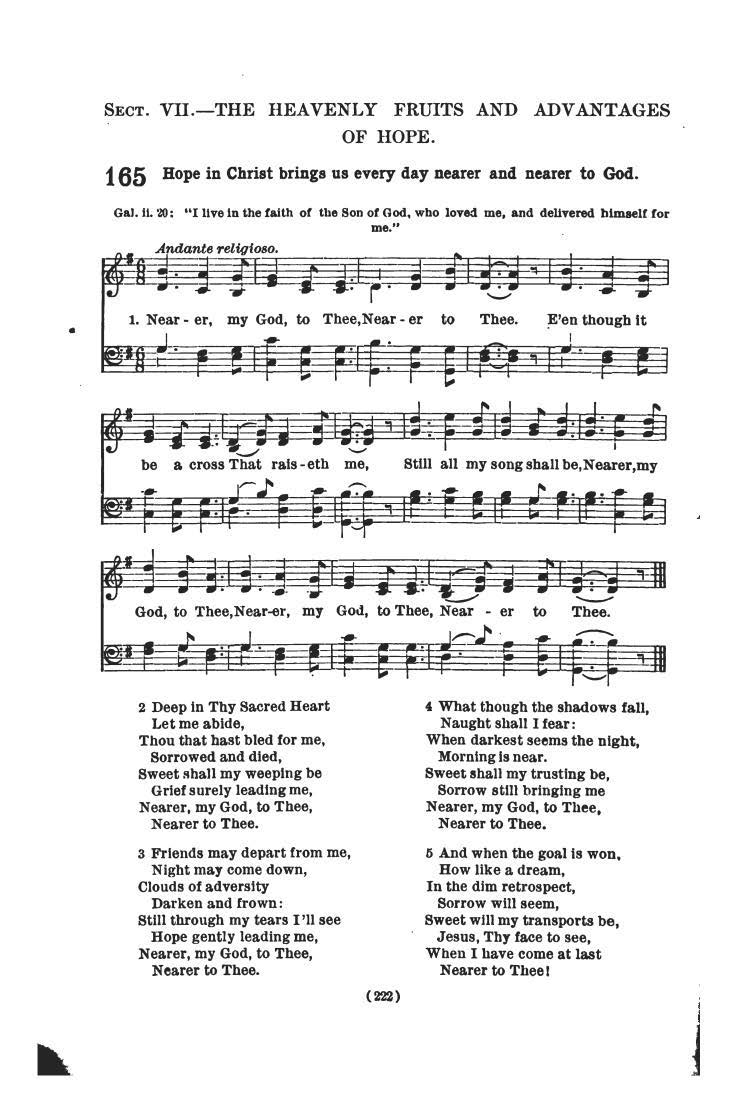
While historical records tell us these hymnals existed, the surviving musical scores provide concrete evidence of how the text was preserved, altered, and sung across different generations of Catholic life. A close textual analysis of the scores from Laudis Corona, the Sunday School Hymn Book, the Parochial Hymn Book, and St. Basil’s Hymnal reveals the consistent retention of the Sacred Heart verses alongside evolving musical arrangements.

1. Laudis Corona (1880/1885)

The score from Laudis Corona is a critical piece of evidence because it demonstrates that by 1880, the Sacred Heart verses were explicitly standardized into a five-stanza structure. The score sets the text to a standard melodic frame, but the poetry immediately shifts focus away from Bethel’s wilderness to the Pierced Heart:

“Deep in Thy Sacred Heart / Let me abide, / Thou that hast bled for me, / Sorrowed, and died…”

This score is crucial to the narrative because it proves that within twelve years of Cunningham’s first publication, the text had been successfully picked up by East Coast compilers and distributed nationally by major houses like Sadlier.

Laudis Corona, 1880 - page 1
Laudis Corona, 1880 - page 2

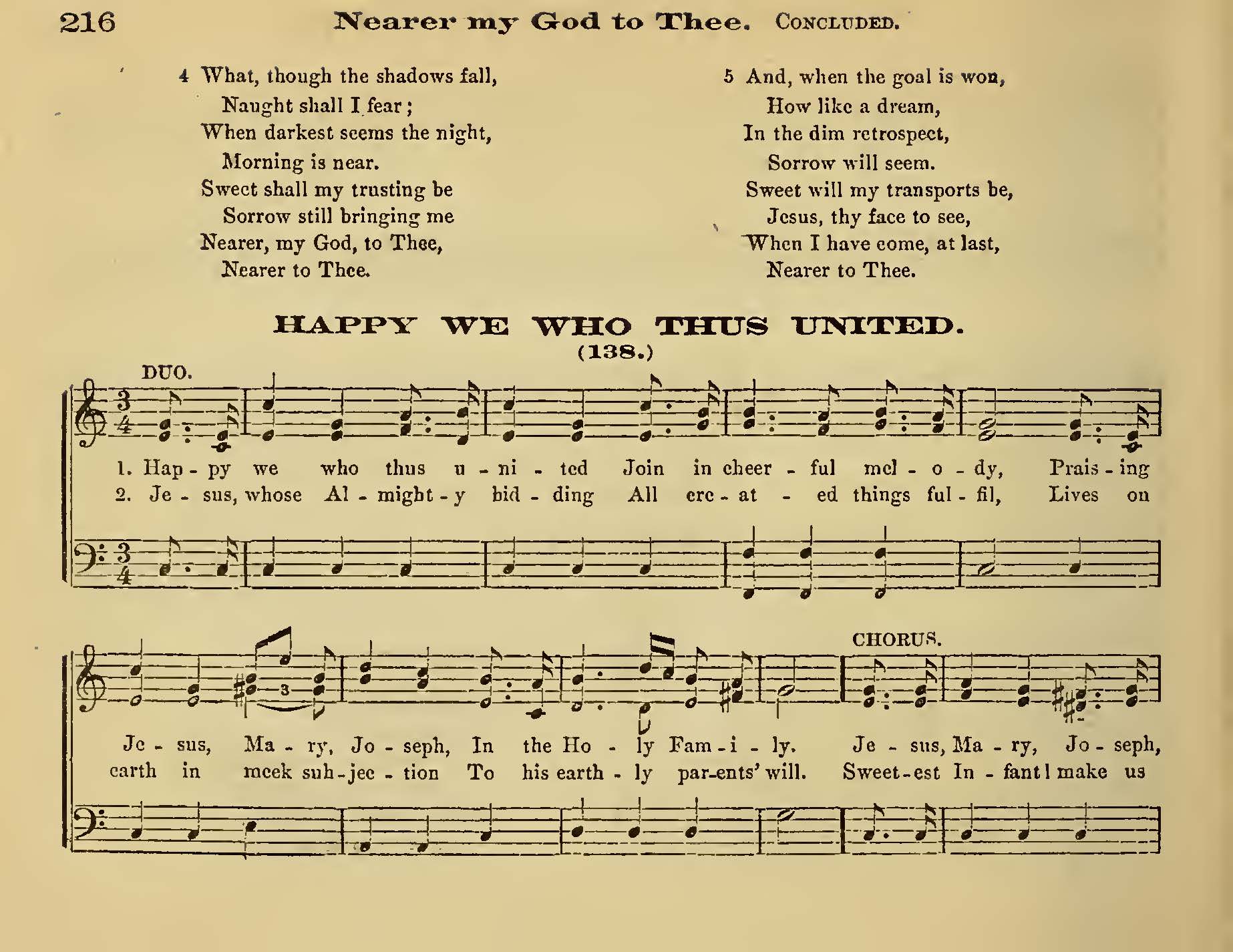
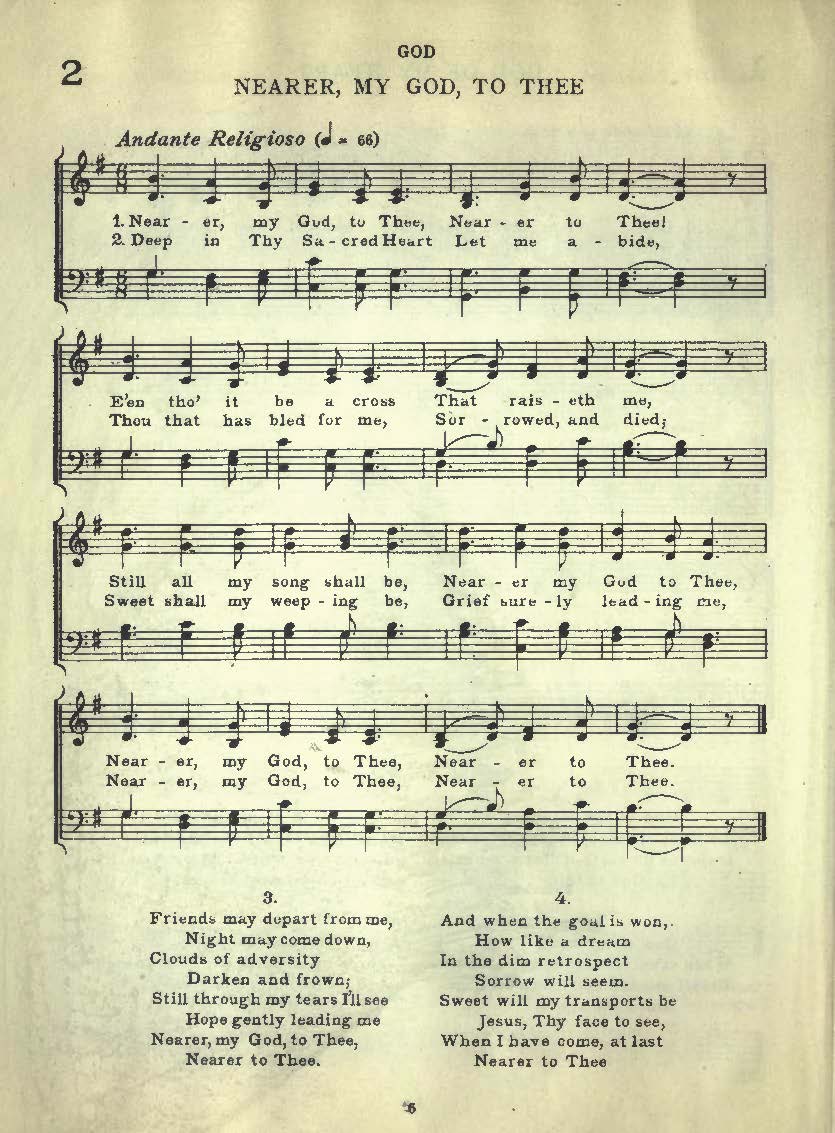
2. Sunday School Hymn Book (1887–1935)

Compiled by the Sisters of Notre Dame, the score in this volume features simpler, child-friendly voicing meant for pedagogical use. The presence of Nearer, My God, To Thee in this specific collection indicates that the Sacred Heart version was not considered adult-only devotional material. Rather, the music score shows that the Sisters were actively using this melody and its Christocentric words to catechize young children, embedding the devotion to the Sacred Heart into their spiritual muscle memory from a young age.

Sunday School Hymn Book, 1887
Sunday School Hymn Book, 1935

3. The Parochial Hymn Book (1897)

Father A. Police’s Parochial Hymn Book is famous for its transatlantic scope, serving parishes in New York, London, and Dublin. The musical score in this volume represents a higher level of liturgical or choral sophistication. Incorporating this score demonstrates that the Sacred Heart verses were not just an American anomaly; the music traveled the English-speaking world, offering a uniform, globalized Catholic alternative to the Protestant original text.

The Parochial Hymn Book, 1897

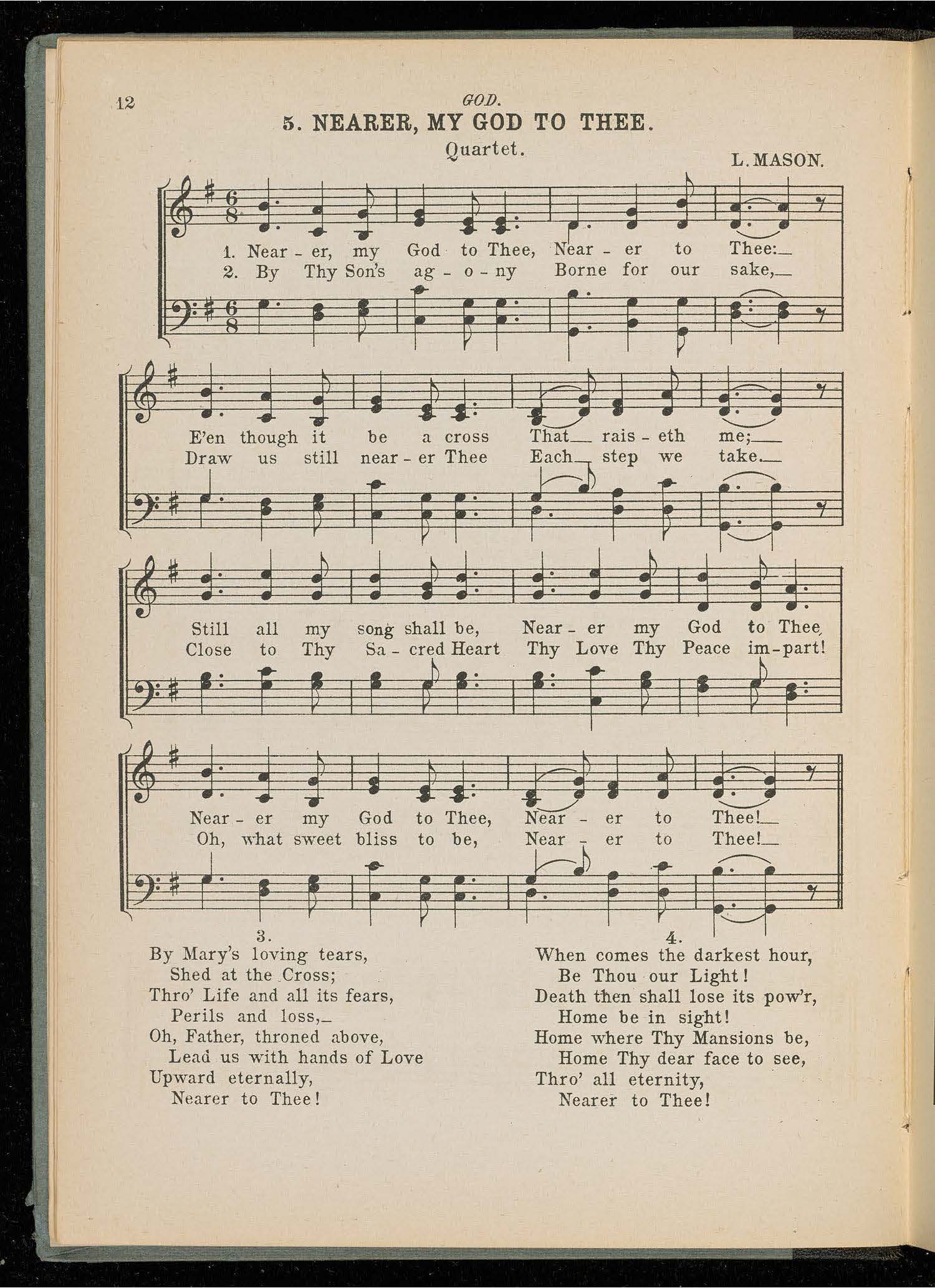
4. St. Basil’s Hymnal (1888–1918)

As perhaps the most widely used and influential American Catholic hymnal of its era, the score from St. Basil’s represents the peak of the hymn’s mainstream Catholic usage. Set to the familiar four-part harmony of Lowell Mason’s Bethany, the St. Basil’s score acts as the definitive musical snapshot of this tradition before it began to fade from twentieth-century prints after 1925.

St. Basil's Hymnal, 1918

5. Other Hymnals

Beyond the widespread reach of the St. Basil’s Hymnal, further historical and musicological evidence of these unique Catholic text variations is preserved across several notable late-nineteenth and early-twentieth-century collections:

Hymns with Tunes (compiled by Rev. Edmund G. Hurley, 1889)

The Holy Family Hymn Book (compiled by Francis J. Butler, 1904)

The Youth’s Manual (published by Thomas J. Flynn & Co., 1908)

Additionally, a significant textual lineage is found in the publications of The Bergé Music Company, compiled under the direction of Louis Bergé. These volumes include:

The Book of Gems (1904)

New Catholic Hymn Book (1906)

Young Peoples Catholic Hymn Book (1911)

The inclusion of the Bergé collections is particularly vital to illuminating what was lost in the later push for uniformity. These volumes do not merely alter a few words; they contain a distinctive Marian stanza of verses. Rather than maintaining a purely sentimental or generalized narrative, editors like Bergé deliberately introduced explicitly Marian imagery. This served to deeply anchor the hymns within the liturgical, devotional, and theological culture of the Catholic faith, proving that these revisions were treated as intentional pieces of sacred art.

The list above does not represent an exhaustive search of my entire hymnal collection for every occurrence of “Nearer, My God, to Thee,” these specific volumes offer definitive evidence of a rich, intentional tradition of Catholic textual adaptation.

Berges Book of Gems, 1904

Rhythmic Variance and the Scottish Roots of Bethany

Beyond textual variations, surviving Catholic scores reveal considerable flexibility in how compilers presented Lowell Mason’s Bethany. Collections such as Laudis Corona and St. Basil’s Hymnal alternate between 6/8 and 4/4 meter. The former preserves a gentler, folk-like character suited to devotional and educational settings, while the latter transforms the melody into a more stately chorale appropriate for funerals and congregational worship.

The melody itself may have deeper roots than Mason’s 1856 composition. Hymnologists have noted similarities between Bethany and the traditional Scottish air The Auld House, suggesting that Mason may have drawn upon older folk traditions when shaping the tune. Whether consciously or not, the resulting melody represented a remarkable cultural journey. By pairing it with the anonymous Sacred Heart verses, Catholic editors effectively baptized a tune shaped by Scottish folk music and American Protestant hymnody into a distinctly Catholic expression of devotion and reparation.

Lyrical Analysis: The Total “Baptism” of a Text

When we look at the exact verses preserved across Laudis Corona, St. Basil’s, and the Sunday School Hymn Book, we see a highly unified, intentional effort to rewrite the hymn’s theology from scratch. While the opening stanza retains Sarah Adams’ universal cry of a soul longing for God through suffering, the remaining four stanzas are a total departure.

Here is how the anonymous Catholic author masterfully transformed the text:

Stanza 1: The Shared Threshold

Nearer, my God, to Thee, / Nearer to Thee! / E’en tho’ it be a cross / That raiseth me…

The Catholic version intentionally keeps this first stanza intact. The imagery of the “cross” raising the believer serves as the perfect theological bridge. While Adams originally used the cross metaphorically, for a Catholic reader, it immediately anchors the mind to the literal Crucifixion and the physical Holy Sacrifice of the Mass.

Stanza 2: Entering the Pierced Heart

Deep in thy Sacred Heart / Let me abide, / Thou that hast bled for me, / Sorrowed, and died…

Here, the Protestant narrative is completely discarded. In Adams’ original second stanza, she writes about a wanderer where “the sun gone down, darkness be over me, my rest a stone.” The Catholic version brilliantly shifts the “resting place” from a cold stone in the wilderness to the literal Sacred Heart of Jesus. The emphasis turns immediately to Christ’s Passion (“Thou that hast bled for me”), transforming a song about a lonely wanderer into an act of deep, intimate reparation.

Stanza 3 & 4: Transforming Grief into Hope

(Stanza 3) Still through my tears I’ll see / Hope gently leading me… (Stanza 4) When darkest seems the night, / Morning is near. / Sweet shall my trusting be…

Where the original Protestant text spends its middle stanzas detailing Jacob’s dream of a ladder with angels beckoning him, the Catholic verses pivot to an interior, pastoral psychology of grief. It addresses the real-world trials of the immigrant church—abandonment by friends, clouds of adversity, and dark nights of the soul—and re-frames sorrow not as a punishment, but as a grace-filled vehicle (“Sorrow still bringing me / Nearer to Thee”). This explains why the hymn became an absolute staple at pre-Vatican II Catholic gravesides; it met grieving families exactly where they were.

Stanza 5: The Beatific Vision

And, when the goal is won… / Sweet will my transports be, / Jesus, thy face to see, / When I have come, at last, / Nearer to Thee.

The hymn closes with a breathtakingly distinct Catholic eschatology. While Adams’ original final stanza imagines flying upward through the sky, forgetting the sun, moon, and stars, the Catholic lyricist keeps the focus entirely Christocentric. The ultimate goal of the soul is not just an upward escape into the cosmos, but the Beatific Vision—the ecstatic joy of looking directly upon the face of Jesus (“Jesus, thy face to see”).

The Modern Paradigm: Ecumenical Revival and Liturgical Planning

Following the liturgical reforms of the Second Vatican Council, which fully embraced vernacular hymnody, Nearer, My God, To Thee experienced a significant resurrection within Catholic spaces. However, this modern revival came with a twist: the historic Sacred Heart verses had completely faded from the collective memory of the faithful. In their place, the original Protestant text by Sarah F. Adams returned, embraced for its raw, scriptural evocative power.

Today, a survey of modern Catholic parish funeral music guides—stretching from St. Joseph in Libertyville, Illinois to St. Stanislaus Kostka, in Chicago,—reveals that the hymn is frequently suggested as an option for the Liturgy of Christian Burial. It is highly regarded by contemporary pastoral musicians for several reasons:

  1. Ecumenical Pastoral Care: In an era where Catholic funerals are frequently attended by non-Catholic family members and friends, the hymn provides a comforting, universally recognized touchstone of shared Christian hope.
  2. Theological Alignment with Resurrection: The original text’s trajectory—moving from the darkness of a stony pillow to an upward journey of praise (“Cleaving the sky, sun, moon, and stars forgot”)—complements the modern Catholic funeral liturgy’s emphasis on the Paschal Mystery and the soul’s journey to the heavenly Jerusalem.

Reflection

Silent Night and Nearer, My God, to Thee are historical parallels.

The story of Nearer, My God, to Thee is not unique. Another beloved hymn, Silent Night, followed a remarkably similar path in American Catholic life. Both hymns circulated in distinctly Catholic forms that reshaped popular texts inherited from outside the Catholic tradition. These adaptations were not acts of hostility toward their sources, but expressions of a conviction that even the most beloved hymns should proclaim the fullness of Catholic faith.

The parallels run deeper than editorial revision. Both hymns begin in darkness and suffering before leading the soul toward divine light. Silent Night transforms a cold and silent world through the dawn of redeeming grace. Nearer, My God, to Thee transforms loneliness, sorrow, and death into a pathway toward heaven. Together, they embody a profoundly Christian insight: God often reveals Himself most clearly amid grief, longing, and sacrifice.

Catechesis Through Melody

Earlier Catholic editors understood hymnody as catechesis through melody. Sacred music was not simply intended to express faith; it was intended to form it. Through the hymns sung week after week, generations of Catholics learned the mysteries of the Trinity, the Incarnation, the Sacred Heart, and the Real Presence as surely as they learned them from sermons and catechisms.

The standardization of American hymnals in the twentieth century undoubtedly fostered greater unity and familiarity. Yet it also coincided with a shift in emphasis. Congregational song moved from a predominantly theocentric and Eucharistic expression of worship toward a more personal and experiential language of faith, one that often emphasized the believer’s journey more than the mysteries celebrated upon the altar.

If the life of a parish flows from its worship, then the songs it sings matter profoundly. Hymnody is one of the Church’s most enduring teachers, shaping what believers come to love, remember, and believe. The forgotten Catholic verses of Nearer, My God, to Thee and Silent Night therefore represent more than a historical curiosity. They remind us of a time when sacred music was expected not merely to inspire, but to direct hearts upward—away from the self and toward the living God.

Unlocking a Lost Tradition: A Four-Year Survey of Sacred Heart Hymnody

Introduction

Over the last four years, I have surveyed hymns to the Sacred Heart of Jesus from my collection of Catholic hymnals. I have decided to present some of the findings of that research in this preliminary analysis. This study draws on a robust and expanding dataset that represents the culmination of this long-term archival research and recovery.

Drawn from a wide range of English-language Catholic hymnals spanning the 19th and early 20th centuries, this study maps the historical footprint of a defining Catholic devotion. While approximately forty additional hymnals remain to be integrated into the final index, the present dataset contains exactly 1,392 occurrences across 161 unique historic hymnals. It yields clear, undeniable patterns in devotional emphasis, textual theology, musical style, and repertoire stability.

Scope of the Current Index and Horizons for Future Expansion

While the current iteration of Sacred Heart Hymnody represents a robust foundational dataset, it is bounded strictly by the content of bound, English-language parish hymnals. It does not yet reflect the full breadth of ephemeral or localized devotional music from the era. To preserve a clear horizon for future expansion, it is important to note what remains outside the current index.

A substantial secondary collection of historical source materials is currently slated for future integration. This includes individual published sheet music pieces and pamphlets/booklets specifically printed for Sacred Heart devotions. Furthermore, the dataset will be expanded internationally to include transpacific traditions, beginning with multiple editions of The Australian Catholic Hymn Book spanning 1884 through 1916.

Finally, future phases of this recovery project will systematically index vital Catholic musical periodicals and institutional collections, including:

  • The Catholic Choirmaster (1915–1923)
  • The Caecilia Magazine (1927–1965)
  • The Messenger of the Sacred Heart periodical (1880–1908)
  • A rare, localized collection of hymns and motets Used by the Pupils of the Sisters of the Sacred Heart, documenting historic devotional footprints in Paris, France, and Roehampton, England (1865–1908).

Incorporating these ephemeral, periodical, and international resources will ultimately transform this survey from a study of mainstream hymnal publishing into an exhaustive, definitive global atlas of Sacred Heart hymnody.

A Note on Methodology: Occurrences vs. Usage

It is vital to clarify a critical distinction regarding the nature of this dataset: this survey documents the occurrence of hymn texts within published hymnals, not their actual parish usage. The data tracks editorial choice, publisher distribution, and repertoire availability across 161 historic volumes; it does not provide historical records of how frequently these hymns were actively performed or selected by local parish musicians.

While one might reasonably infer that a hymn printed 106 times across multiple decades enjoyed widespread popularity, these numbers strictly quantify a hymn’s systemic presence in the Catholic publishing market. Acknowledging this boundary preserves the academic integrity of the survey, shifting our focus to how a stable devotional repertoire was curated and made available to the faithful, rather than attempting to measure the unrecorded weekly choices of historic choir directors.

Far from offering a static spreadsheet of titles, this survey exposes a living tradition. The data charts the physical, transatlantic migration of the devotion from European centers to American metropolitan hubs, uncovers the clever corporate strategies of historic music publishers, and traces how immigrant communities preserved their native cultural voices in the parish pew.

Ultimately, the goal of this analysis is twofold: first, to decode a historically fragmented publishing record by identifying the core, prominent hymns that sustained generations of Catholics ; and second, to provide immediate, practical recommendations for parishes seeking to ground modern liturgies, Holy Hours, and national consecrations in a deeply rooted, historically proven pastoral legacy.

1. Historical & Analytical Findings

The dataset spans from 1807 to 1966, with a massive concentration between approximately 1890 and 1935 (median date: 1913). This period corresponds closely with the height of Sacred Heart devotion in Catholic life, particularly following the spread of the devotion after the revelations to St. Margaret Mary Alacoque and its formal encouragement by the Holy See in the 18th and 19th centuries.

A decade-by-decade breakdown of the data reveals that publishing activity swelled significantly in the 1880s (147 entries) and 1890s (185 entries), remaining incredibly strong through the turn of the century (195 entries in the 1900s). The absolute historical peak of publishing occurred during the 1920s, which yielded an astonishing 237 unique entries. The clustering of hymnody in this period suggests that Sacred Heart devotion was not merely theological but deeply embedded in parish practice, devotional societies, and popular hymnody. The sharp decline in representation after the mid-20th century likely reflects broader shifts in liturgical and devotional priorities rather than a loss of theological importance.

The Transatlantic Migration of Tradition

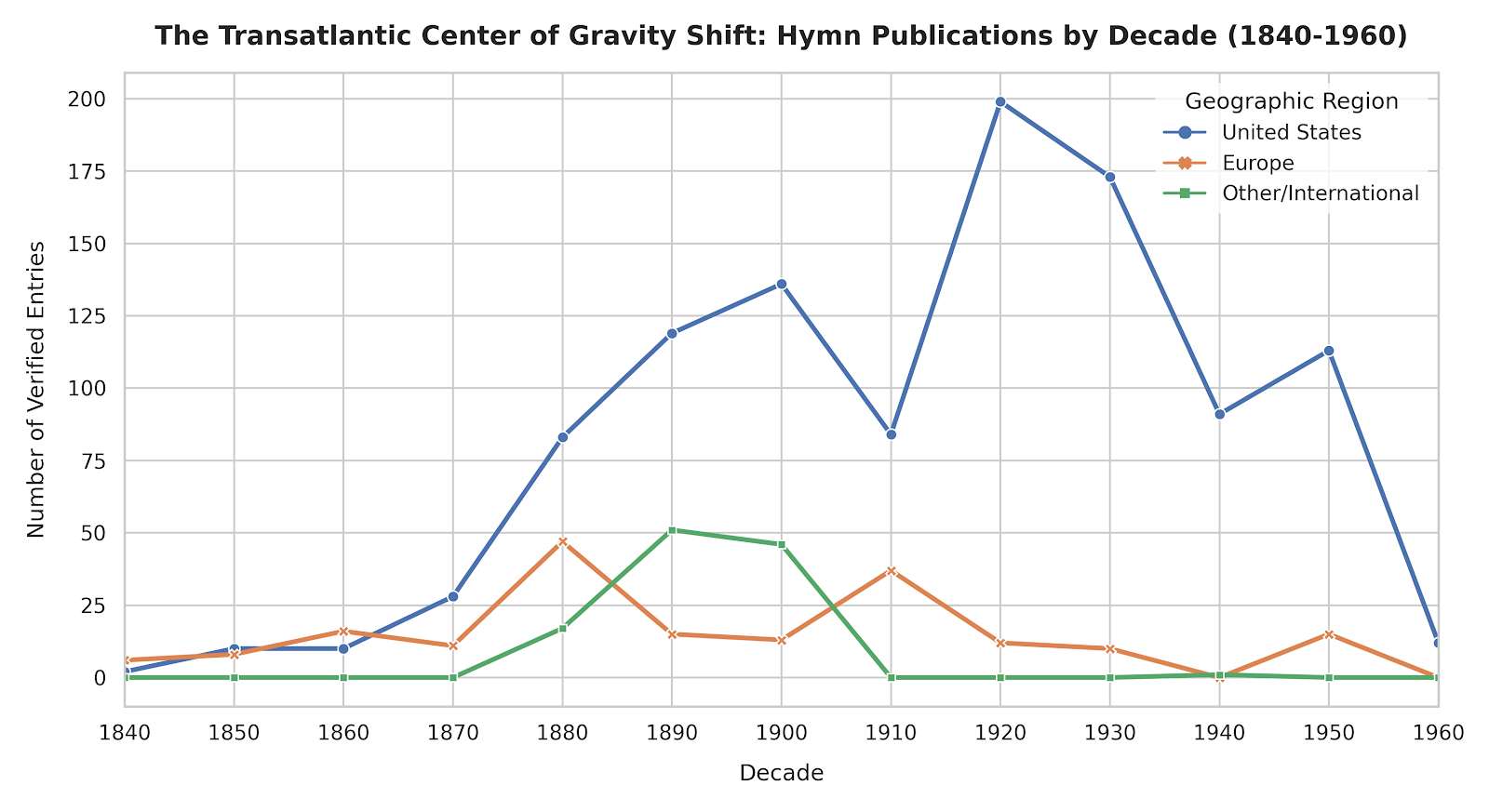
The dataset simultaneously tracks a literal “migration” of Catholic tradition. In the mid-19th century, the musical repertoire was heavily anchored in European hubs like London (129 entries) and Dublin (24 entries). However, by the 1920s, the “center of gravity” shifted dramatically to the United States. This era saw an explosion of publishing activity dominated by massive metropolitan hubs like New York (371 entries) and Boston (272 entries), rapidly scaling up production to serve growing immigrant populations.

Hymn Publications by Decade (1840-1960)

This visualization above, captures the precise rise and fall of the publishing eras. You can visually track how the American publishers began aggressively scaling up right around the 1880s, hitting that dramatic historical peak in the 1920s before dropping off in the mid-20th century.

Graphic Distribution of Hymn Publication Locations

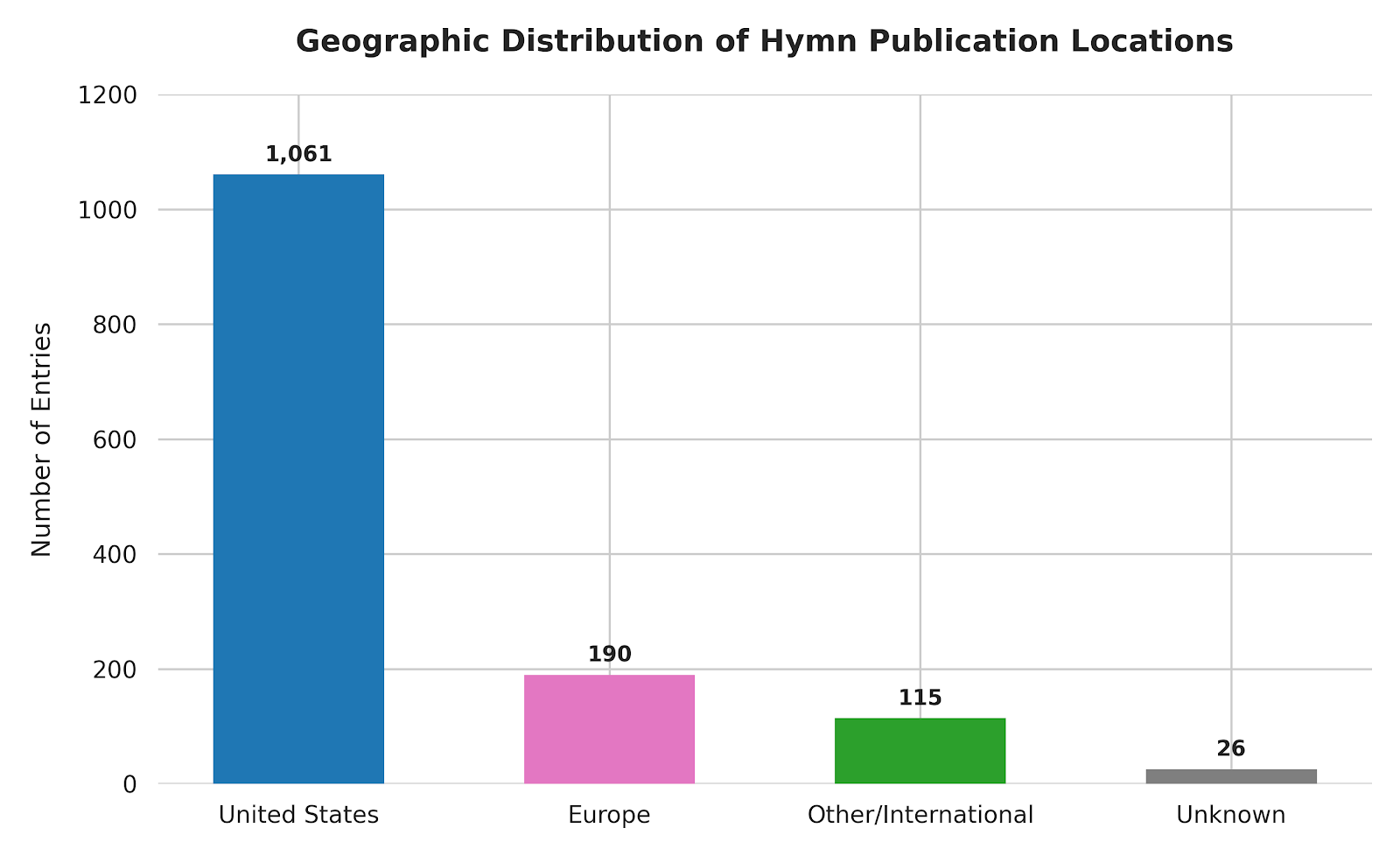
The chart above displays consolidated publication locations grouped into their true regional baselines, showcasing the clear dominance of the American market.

2. Repertoire Stability and Core Hymns

A striking feature of the dataset is the emergence of a relatively small group of highly recurrent hymns, suggesting a stable “core repertoire” used across multiple hymnals and generations.

Most frequently occurring hymns include:

  • To Jesus’ Heart All Burning (93 named occurrences; 106 first-line matches)
  • Hear the Heart of Jesus Pleading (20 occurrences)
  • Sweet Heart of Jesus [Fount/Source] of Love and Mercy (20 occurrences)
  • Sacred Heart in Accents Burning (19 occurrences)
  • To Christ the Prince of Peace (18 occurrences)
  • O Sacred Heart, O Love Divine (18 occurrences)
  • O Sacred Heart, Our [Home/Hope] lies deep in Thee (16 occurrences)
  • O Cor Amoris Victima (21 occurrences)
  • Cor Dulce, Cor Amabile (7 occurrences)

This repetition across sources highlights a stable devotional core, yet it simultaneously uncovers a “nomenclature trap” for modern researchers. Dominant historic publishers frequently assigned custom titles (such as Cor Amoris or Praise to the Sacred Heart) to the exact same text. For example, while To Jesus’ Heart All Burning is explicitly titled as such 93 times, a text-match search of its opening first line (“To Jesus’ Heart all burning with fervent love for men”) reveals 106 separate occurrences. By tracking these variations down to their unique first lines, this survey unifies what otherwise appears to be a fragmented tradition.

The Latin selections featured above are highly representative of the broader historical repertoire. By pairing O Cor Amoris—one of the most widely distributed texts in the national survey—with the beautifully accessible Cor Dulce, Cor Amabile, these pieces collectively capture both the widespread institutional footprint and the practical, lived choral traditions of the era.

Note on Methodology: The number of occurrences shown above reflects the text’s frequency across the nation and is not an evaluation of the regional melodies. While a single text often wandered between various regional settings and musical compositions, these figures strictly document the historical distribution of the metrical verse itself. As a point of data limitation, these metrics quantify the historical presence of hymns within printed hymnals rather than documenting daily parish usage frequencies.

3. Theological Themes in the Texts

The textual incipits and titles reveal a consistent theological framework centered on several key motifs:

3a. Affective Devotion

Many hymns emphasize emotional intimacy with Christ:

  • “Sweet Heart of Jesus, fount [or source] of love and mercy”
  • “I dwell a captive in this Heart”

This reflects the affective spirituality characteristic of Sacred Heart devotion, focusing on love, consolation, and personal union with Christ.

3b. Reparation and Consolation

Texts frequently present the Heart of Jesus as wounded by human sin and in need of consolation:

  • “Hear the Heart of Jesus pleading”

This aligns with the theology of reparation, central to Sacred Heart devotion.

3c. Eucharistic and Liturgical Resonance

Some hymns connect the Sacred Heart with Eucharistic imagery and perpetual adoration:

  • “Upon the altar night and day”

This reinforces the integration of Sacred Heart devotion with the liturgical life of the Church.

3d. Kingship and Sovereignty

Certain texts emphasize Christ’s kingship and authority:

  • “To Christ the Prince of Peace”

This theme provides a natural bridge to national consecration contexts.

3e. Latin Hymnody and Devotional Context

The dataset maintains a vital link to the universal language of the Church, featuring a robust tradition of Latin hymnody. Rather than existing as isolated relics, these texts frequently reappeared in creative variations across the centuries, serving as stable pillars of doctrinal clarity:

  • Cor Jesu / Cor Jesu Variants: (46 combined occurrences; 12 as an exact standalone Cor Jesu)
  • Cor arca legem continens: (9 occurrences)
  • Cor dulce cor amabile: (7 occurrences)
  • Cor Jesu cor purissimum: (5 occurrences)
  • Summi Parentis Filio: (5 occurrences)

3f. Inculturated Devotion and the “Native Voice”

While the dataset primarily highlights English and Latin traditions, it simultaneously uncovers how deeply embedded and adaptable this devotion was across cultural lines. The archival record reveals the “Native Voice” of immigrant communities—particularly within the German-American settlements of the Great Lakes region.

The inclusion of historic German titles such as “Dem Herzen Jesu singe” (sung to the same architectural structure as To Jesus’ Heart All Burning) demonstrates that as immigrant populations migrated, they did not abandon their heritage. Instead, they utilized their native tongue to weave familiar European devotional expressions into the emerging American parish landscape.

This inculturation was heavily championed by local hierarchy; most notably, Bishop Joseph Schrembs (the first Bishop of Toledo and later Archbishop of Cleveland) appears 11 times in the dataset as a composer. His pastoral work focused heavily on providing accessible musical settings that allowed German-American congregations to sing in unison, bridging their European devotional inheritance with their new American parish life.

4. Musical Characteristics and Publisher Dynamics

The musical landscape of the dataset reflects a transition from traditional European part-singing to highly accessible, community-focused parish hymnody. Rather than being dictated by a single aesthetic standard, the musical characteristics were heavily driven by the commercial and pastoral strategies of dominant historic publishers.

4a. Publisher Footprints and Corporate Strategy

The sheer volume of entries in the dataset underscores the immense influence of a handful of publishing houses in defining the soundscape of American Catholic devotion. Foremost among these are McLaughlin & Reilly Co. (122 total entries) and J. Fischer & Bro., whose massive catalog contributes 119 total entries (including 85 unique titles) to this study.

Publishers like Fischer and McLaughlin & Reilly did not merely print music; they actively curated the tradition. By commissioning prolific lyricists like Eleanor C. Donnelly (who leads the dataset with 57 authored entries) and frequently re-titling existing melodies (the “nomenclature trap” outlined in Section 2), they successfully established brand dominance and ensured their hymnals became indispensable staples of parish choir lofts across the United States.

4b. Melody, Repertoire, and Community Accessibility

Musically, the repertoire prioritizes melodic familiarity and ease of congregational participation. A significant portion of the English-language entries utilizes melodies widely familiar to a community—serving as a true “Common Meter” of the people that bypassed complex musical notation in favor of immediate utility.

This focus on accessibility explains the massive longevity of core hymns like To Jesus’ Heart All Burning (106 first-line occurrences). Its structural rhythm perfectly aligned with the predictable pulse required for large, untrained assemblies to sing in unison, ensuring the devotion could easily migrate from formal choral performance to spontaneous parish prayer.

5. Implications for Contemporary Parish Use

The historical data strongly refutes the modern assumption that suitable Sacred Heart hymnody is scarce or inaccessible. Instead of looking for entirely new compositions, parishes preparing for devotional milestones can draw from a deeply rooted, historically proven repertoire that is both theologically rich and pastorally accessible.

Recommended Core Hymns & Liturgical Placement

The following hymns are highly recommended due to their high historical frequency, theological clarity, and capacity for congregational singing:

  • Entrance or Exposition: O Sacred Heart, O Love Divine
  • During Adoration: To Jesus’ Heart All Burning or Sweet Heart of Jesus [Fount/Source]
  • Act of Consecration: To Christ the Prince of Peace (ideal for themes of Kingship and sovereignty)
  • Reposition or Closing: Hear the Heart of Jesus Pleading

Choral Note: For parish choirs capable of polyphony, the underlying themes of adoration, love, and reparation highlighted throughout this survey align perfectly with standard historical Sacred Heart motets. Utilizing these core congregational hymns alongside traditional polyphonic settings allows a choir to elevate the liturgy while maintaining an unbroken, accessible musical dialogue with the pews.

Pastoral Application

The most fruitful approach for contemporary renewal is not the creation of new materials, but the deliberate recovery of this inherited tradition. These hymns do not just provide an enduring vocabulary for divine love, reparation, and the kingship of Christ—they connect modern worshipers to a musical legacy that has successfully sustained parish devotion for generations. By restoring these core hymns to the standard parish repertoire, local leadership can ground modern devotions in a stable, accessible, and historically rich tradition.

Conclusion

Even in its preliminary state, this survey reveals a coherent and deeply rooted tradition of Sacred Heart hymnody, characterized by theological unity, musical adaptability, and remarkable consistency across time. The evidence suggests that parishes preparing for a national consecration would benefit most not from novelty, but from a deliberate retrieval of this tradition.

Readers interested in exploring this repertoire further or incorporating it into parish life are encouraged to consult two complementary resources: the Devotional Hymns Project, which provides curated access to historic Catholic hymn texts and recordings, and the Sacred Music Library, a broader repository of liturgical and devotional music, especially “A Catholic Book of Hymns”. Together, these platforms offer practical tools for clergy, musicians, and scholars seeking to engage more deeply with the living tradition of Sacred Heart hymnody.

As additional hymnals are incorporated into the dataset, it is highly likely that these patterns will be further reinforced rather than overturned, continually strengthening the case for a historically grounded, pastorally rich response.

The Living Repertoire – Devotional Recordings from St. Mary’s (Akron, Ohio)

As definitive proof of the enduring longevity and pastoral utility of this core repertoire, this survey concludes with a historic archival audio collection from St. Mary’s Church in Akron, Ohio. Recorded during a special parish devotion in honor of the Sacred Heart of Jesus in June 1982, these live selections demonstrate how the exact hymns curated by 19th- and early 20th-century publishers continued to shape the organic devotional life of mid-western American parishes generations later.

Featured prominently in this audio collection is O Sacred Heart, O Love Divine (the parish Hymn of the Month), alongside live parish recordings of the survey’s most historically frequent selections, including the definitive “To Jesus’ Heart All Burning,” the Eucharistic-centered “Peace Be Still, Our God is Dwelling” (first published in 1891), and the devotional act of thanksgiving, “Heart of Jesus, We Are Grateful.”

album-art

00:00

The Music of Sister Mary Editha, B.V.M.

Courtesy of the
Sisters of Charity of the
Blessed Virgin Mary

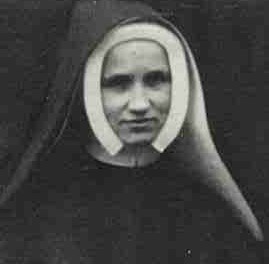
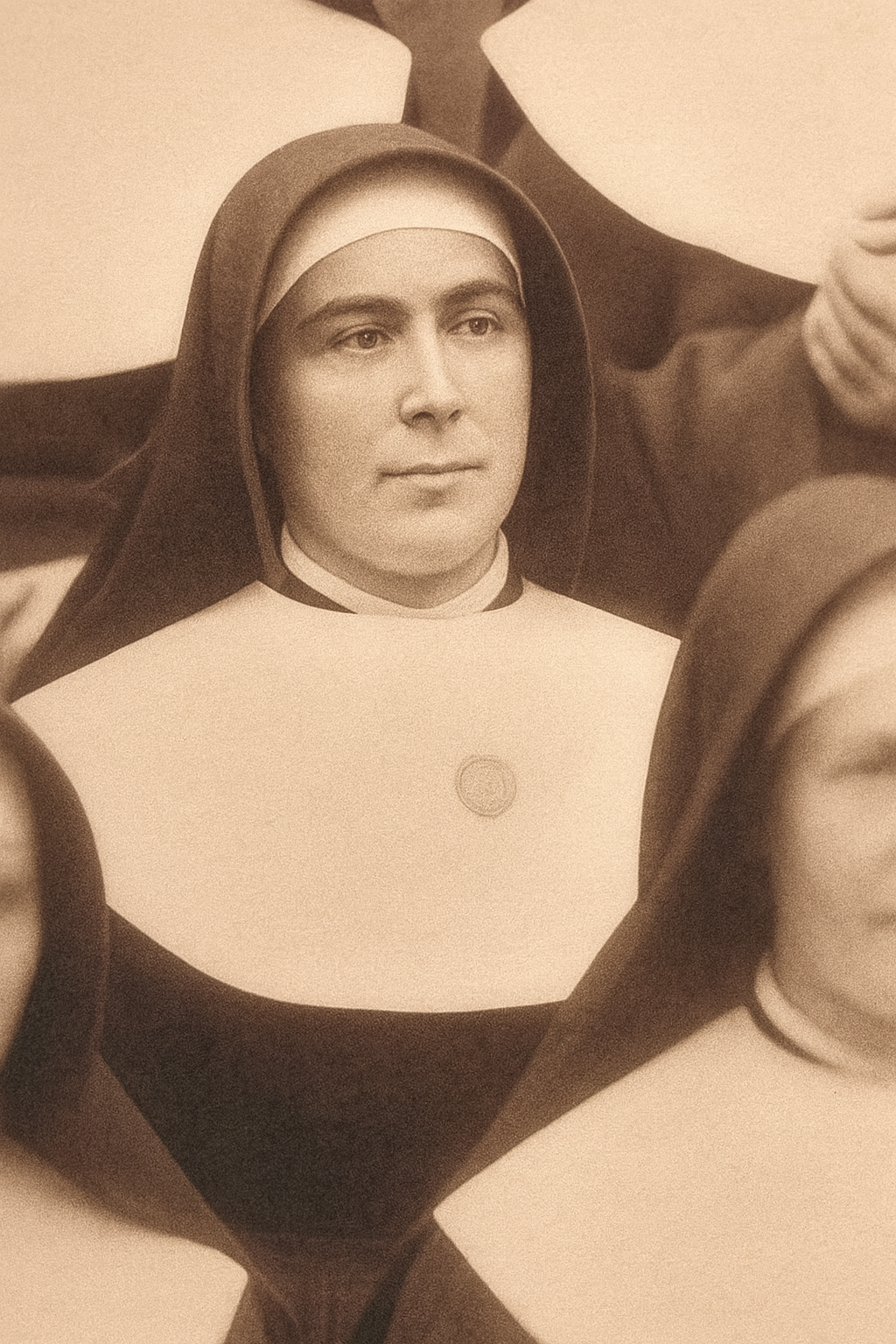
Though her musical legacy spans decades, the portrait above is the only photograph the Sisters of Charity of the Blessed Virgin Mary possess of Sister Mary Editha Flannagan, B.V.M. (1858–1939) Yet, while her visual record is sparse, her extraordinary contributions to Catholic music speak volumes.

Digital enhancement (2026)
Colorized digital reconstruction (2026)

Biography of Sister Mary Editha Flannagan, B.V.M.

Sister Mary Editha was born on August 9, 1858, in Haverhill, Massachusetts and baptized Mary Elizabeth. At an early age she came with her parents John and Honora (née Carey) Flannagan to Iowa City, Iowa where she received her musical education. She entered the Sisters of Charity of the Blessed Virgin Mary (BVMs) from Iowa City on October 29, 1872, at the young age of fourteen. She was received on September 19, 1873, and was given the religious name Editha.

She should have been received in February or March of 1873, but this was delayed until after her 15th birthday. She made her first vows on July 27, 1876, and renewed these vows every year until December 31, 1914, when she was among the first group of BVMs to make perpetual vows after the congregation received papal permission for perpetual vows.

Her brother, John Thomas Aloysius Flannagan (1860-1926), would become a priest and later a monsignor, and the bond between the two would remain one of the defining relationships of her life. Father Flannagan served as the second president of St. Ambrose College in Davenport, Iowa from 1891 to 1906.

For thirty-eight years, Sister Mary Editha served at Immaculate Conception Academy in Davenport, Iowa, as both music teacher and superior. She also served for six years as Superior at Holy Angels High School in Milwaukee, Wisconsin although archive records are unclear as to the exact dates.

In 1915, she entered the highest levels of congregational leadership as a Councilor, and in 1926 she became Provincial, a role she held until 1935. Remarkably, even while carrying on the responsibilities of Provincial, she returned to teaching music at Immaculate Conception Academy, demonstrating her unwavering devotion to the artistic and spiritual formation of her students.

Selected Compositions

Across her long career, Sister Mary Editha produced an extraordinary body of music, much of it written for the voices and instruments available in B.V.M. schools and convents. Her compositions reveal both her technical skill and her deep devotion to the Church’s musical tradition. Among her known works are:

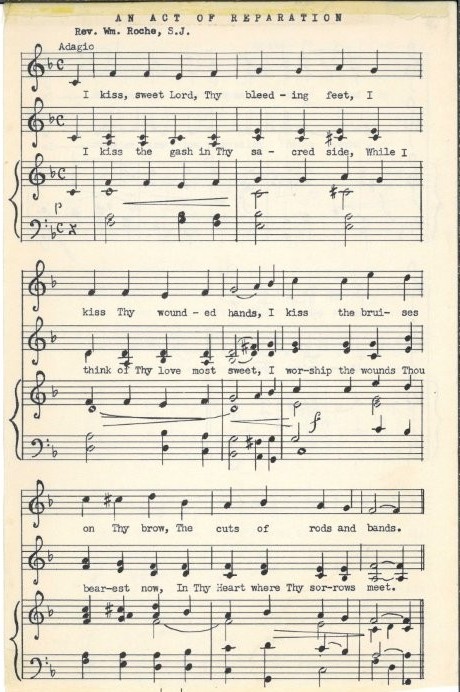
An Act of Reparation — a devotional piece set to words by Father William Roche, S.J., (1856-1945) reflecting her sensitivity to penitential and prayerful themes. (Click on any image to enlarge)

Courtesy of the
Sisters of Charity of the
Blessed Virgin Mary

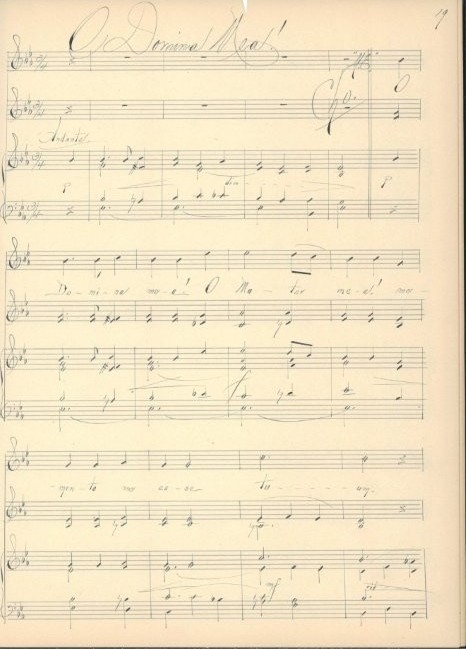
O Domina Mea — written for three equal voices and organ. This composition has color and a structural design which indicates skill and musicianship. This musical composition was later published by McLaughlin and Reilly Co., 1934.

Courtesy of the
Sisters of Charity of the
Blessed Virgin Mary

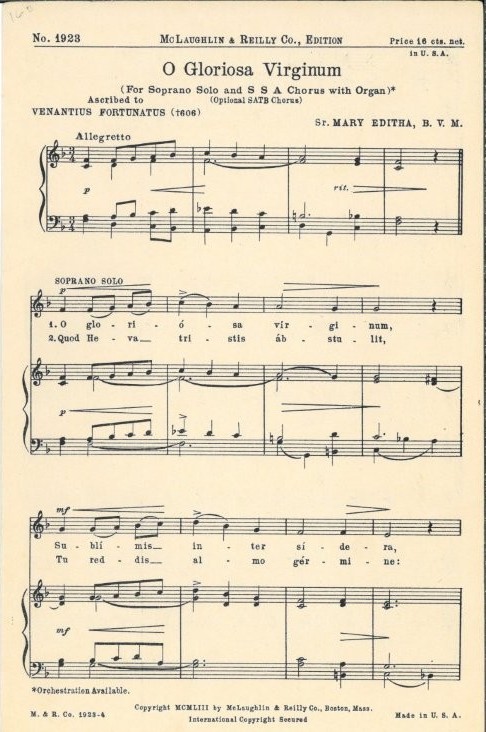
O Gloriosa Virginum — a setting for soprano solo and SSA chorus, with text attributed to Venantius Fortunatus, linking her work to one of the great hymnographers of the early Church.

Courtesy of the
Sisters of Charity of the
Blessed Virgin Mary

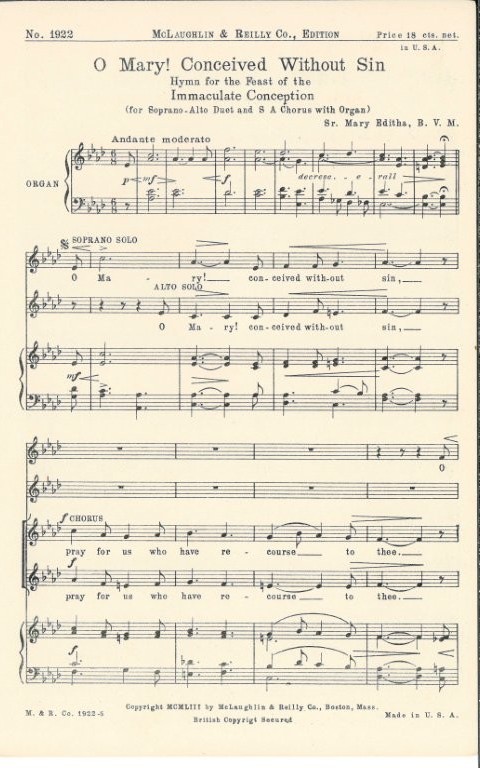
O Mary! Conceived Without Sin — a hymn for the Feast of the Immaculate Conception, arranged for soprano–alto duet, SA chorus, and organ, demonstrating her ability to write for layered treble textures.

Courtesy of the
Sisters of Charity of the
Blessed Virgin Mary

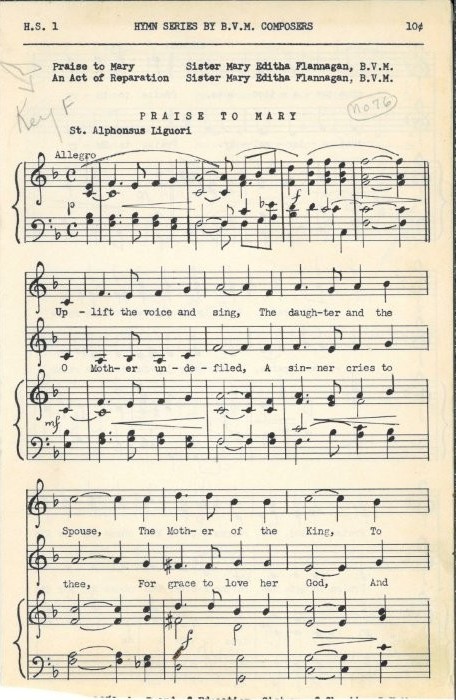
Praise to Mary — set to words by St. Alphonsus Liguori for three treble voices and piano; this hymn earned her fourth prize in the national contest sponsored by Miraculous Medal Magazine in 1932.

Courtesy of the
Sisters of Charity of the
Blessed Virgin Mary

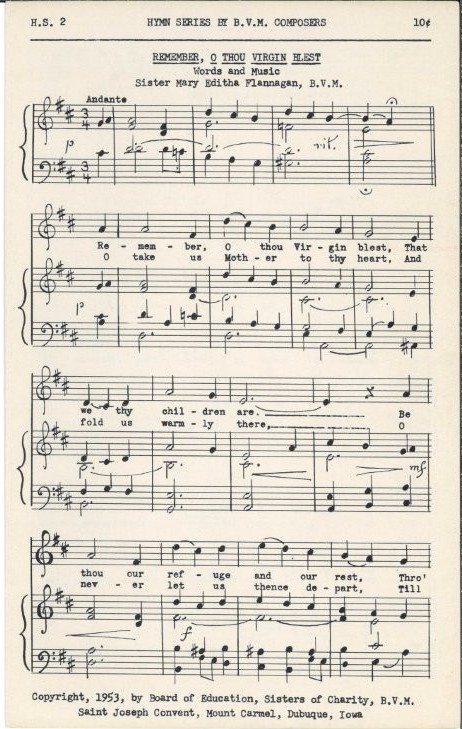
Remember, O Thou Virgin Blest — both words and music by Sister Mary Editha, composed for two treble voices and piano, showing her capacity to craft complete devotional works from text to melody.

Courtesy of the
Sisters of Charity of the
Blessed Virgin Mary

Her talent received national recognition in 1932, when she won fourth prize in a hymn-writing contest sponsored by Miraculous Medal Magazine for her hymn Praise to Mary. The piece was published in the magazine’s November issue, bringing her work to a broad devotional readership.

Many of her hymns and choral works were performed publicly, especially at diocesan music festivals. Her compositions appeared on programs at St. Ambrose Hall in Davenport, in Chicago, and at other regional gatherings where Catholic school choirs showcased their finest work. One of the most striking tributes to her influence came in 1935, when her musical setting of the Christmas carol Awake! Awake! Behold the Morn (with text by Agnes V. Flannery) was performed by 950 high school students at Immaculata High School in Chicago during the school’s Christmas program. Below are manuscripts of the choral piece. (Click on any image to enlarge)

Courtesy of the
Sisters of Charity of the
Blessed Virgin Mary
Page 1
Courtesy of the
Sisters of Charity of the
Blessed Virgin Mary
Page 2
Courtesy of the
Sisters of Charity of the
Blessed Virgin Mary
Page 3

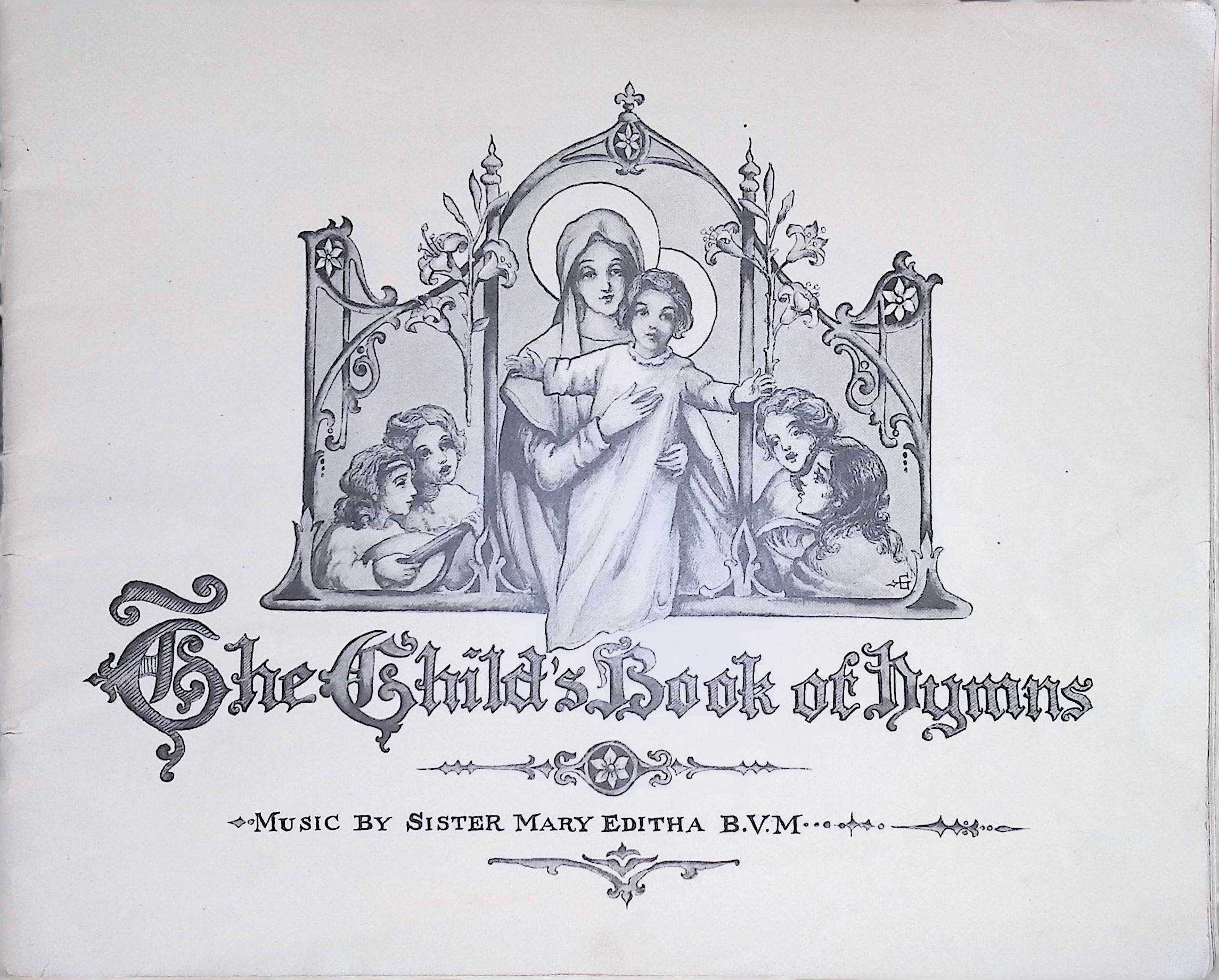
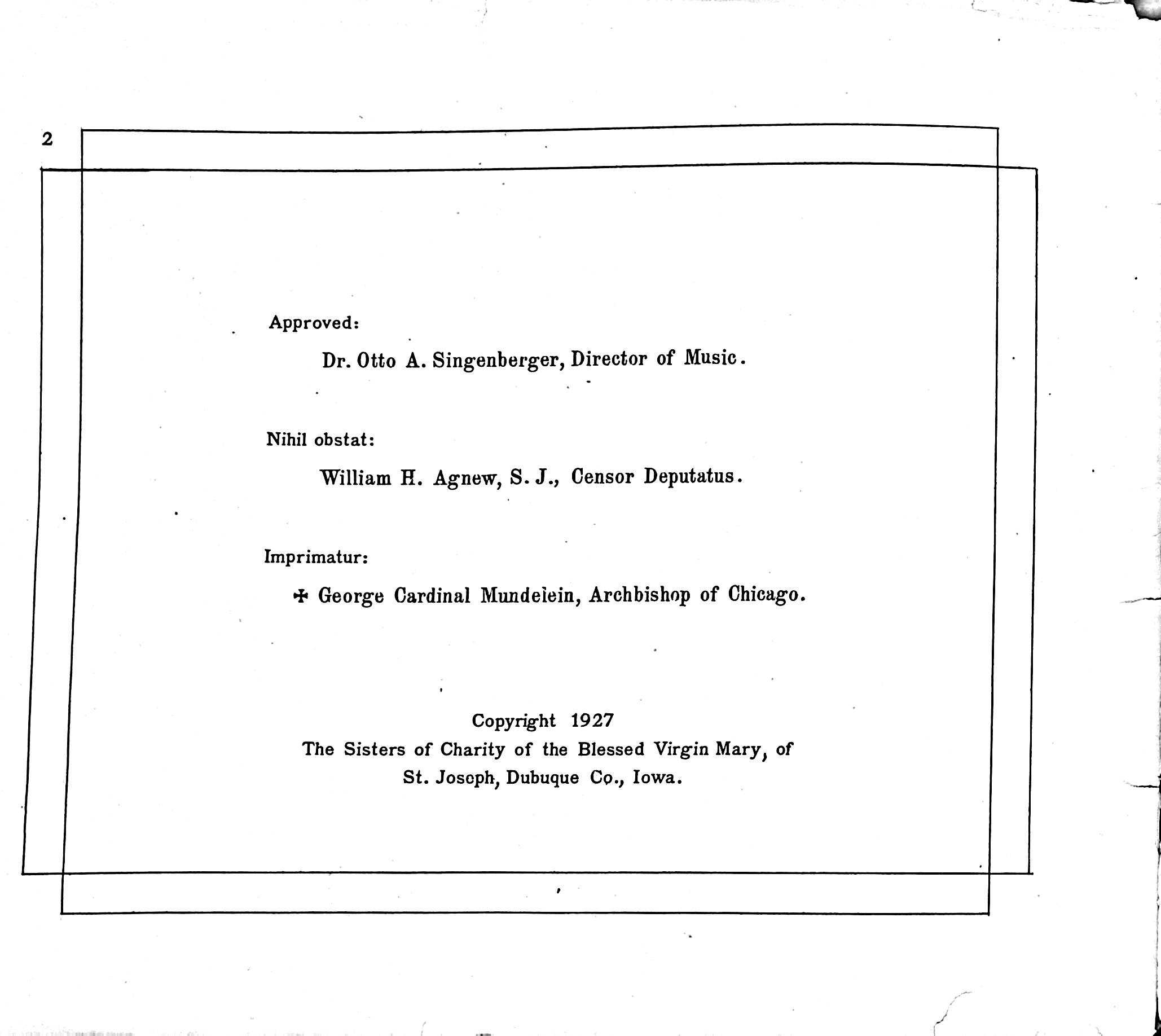
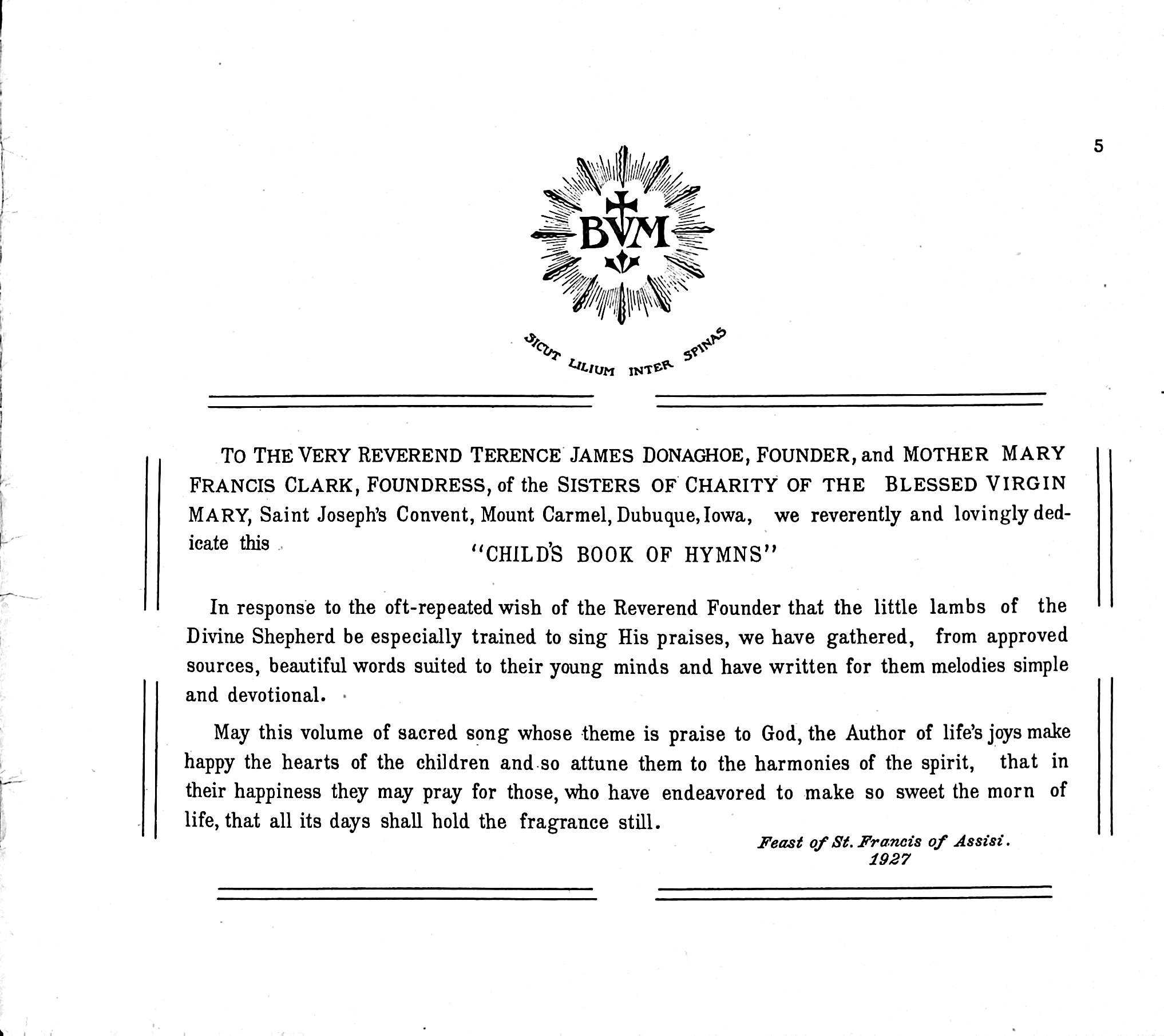
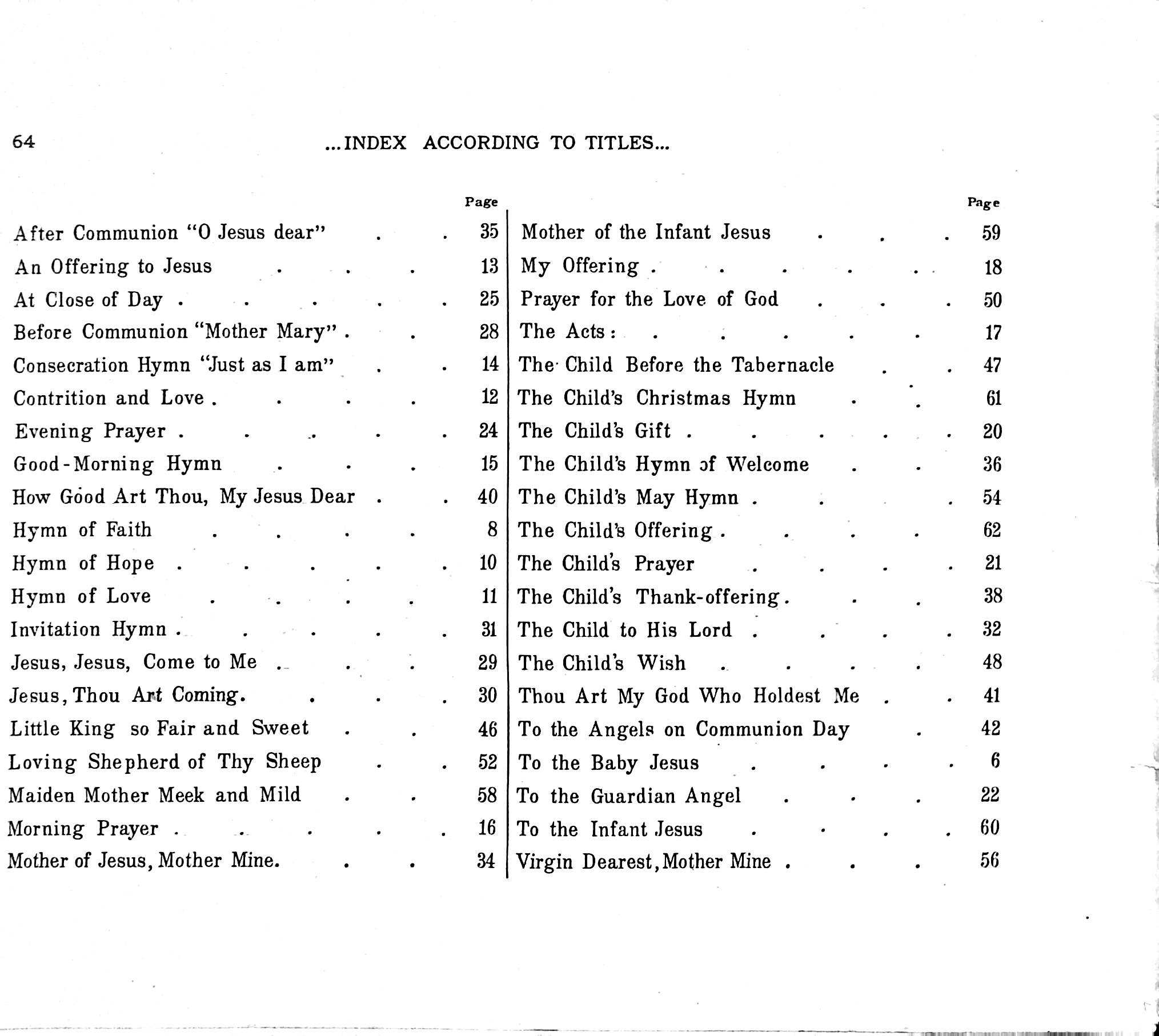
Despite her accomplishments, Sister Editha remained a lifelong student of her craft. In the early 1920s, during the beginning days of Immaculata, she traveled to Chicago to study harmony and counterpoint with John Singenberger, the noted composer and music director at Mundelein Seminary. Sister Editha had in mind the publication of several works—a goal she realized over the course of the decade, culminating in her 1927 collection, Child’s Book of Hymns. While community memory later associated her Chicago trip with the 1927 publication year, the study itself took place just before Singenberger’s death in 1924. This published volume beautifully reflects her deep belief in the formative power of music for young hearts and minds, cementing her contribution to children’s religious education.

The Child's Book of Hymns, 1927
Preface
The Child's Book of Hymns, 1927
Page 1
The Child's Book of Hymns, 1927
Page 2

Personal Character and Daily Life

Though Sister Mary Editha was often remembered as a stern and formidable presence, those who knew her well spoke just as readily of her deep kindness. Stories circulated within the community about her quiet generosity toward anyone in need, gestures offered without fanfare and often without witnesses. Her outward seriousness concealed a heart that responded instinctively to suffering.

In appearance, she was short and a little stout, but her physical stature was overshadowed by a personality that, as one sister put it, seemed to be bursting out all over. Determination was one of her defining traits. When she set her mind to a task, she pursued it with unwavering focus — and often, she achieved exactly what she intended.

The great love of her life was her brother, Msgr. John Flannagan, whose death left a lasting wound. Soon after she had celebrated her golden jubilee, her brother, Monsignor John Flannagan died. She mourned him for many years, carrying his memory with her in prayer and in the quiet spaces of her day. Yet grief never diminished her dedication to her work. She poured herself into her music, spending hour upon hour composing, revising, and practicing.

Her practice instrument was often a small pump organ, notorious among the sisters for its harsh, wheezing tone. But even that was nothing compared to her singing voice, which — as Sister Mary Blandina recalled with affectionate humor — was not her strongest gift. She sang everything she wrote, testing each line aloud, shaping melodies through sheer persistence rather than vocal beauty. And when a piece was finally ready, when it was performed for her review by students or fellow sisters, she must have felt a profound satisfaction: the knowledge that the music had traveled from her heart, through her pen, into the voices of others.

Quite early in the “beginning” days of Immaculata, Sister Mary Editha decided to come there to do some harmony and counterpoint study with Mr. Singenberger, who at that time was in charge of music at Mundelein Seminary. She had in mind publication of several works; and the community now has the result of this endeavor. As far as Sister’s music went, I don’t think there was much change from her original writings as she was a woman of very definite ideas. We all knew this and dare not change one tiny bit because she would recognize it.

An illustration of this took place one evening as we were going over some things for Sunday’s Mass. Sister M. Consuelo (Gladys) Ramaley thought that a certain change in wording would be a better expression of a thought and Sister M. Emilita answered her, “Do you want Sister M. Editha to stand up in chapel and exclaim, “O, my God!!”

And who had a better right to express her feelings thus that the composer of such beautiful hymns as “O Glorioso Virginum” ,”Remember O Thou Virgin Blest” or “O Domina Mea” sung as solos by Sister Mary Consuelo or Sister Mary Jeanine Mulumby at that time. One happy memory of mine is of singing with Sister Mary Emilita in a duet, the lovely hymn, “0 Jesus, Dearest Lord”.

These recollections, preserved by Sister Mary Blandina Mosgrove, B.V.M., offer a rare glimpse into the human side of Sister Mary Editha — the determined teacher, the grieving sister, the tireless composer, and the woman whose life was shaped by both discipline and devotion.

Final Years and Failing Sight

In her later years, however, she faced a trial that struck at the very heart of her vocation. Cataracts slowly robbed her of her sight, forcing her—most reluctantly—to set aside the work she cherished. Even as her vision dimmed, she continued to write, holding her pen to the music pad until the moment complete darkness made further work impossible. Her faith during this period was described as almost superhuman. She prayed fervently for the restoration of her sight, yet always with a spirit of resignation to God’s will, accepting whatever path lay before her.

Daily life became increasingly difficult. When the bells rang for community exercises, the sisters would see her groping her way up the front stairs or leaning on the arm of a devoted young Sister who guided her with quiet fidelity.

An operation eventually offered hope of relief. Though the procedure was successful, the shock proved too great for her aging body. She slipped gradually into a coma, and death came gently in 1939, closing the life of a woman whose music had shaped generations.

Sister Mary Editha Flannagan’s legacy endures in the hymns she wrote, the students she taught, the schools she guided, and the community she served with unwavering devotion. Her life was a testament to faith, perseverance, and the belief that music—born of the heart and offered to God—can shape souls and communities for generations.

Reflection

Except for the hymn collection “The Child’s Book of Hymns”, I knew very little about Sister Mary Editha, save a few tidbits of information extracted from the Preface of hymn collection and extracts from the 1934 edition of Ceacilia Magazine which featured one of her hymns “O Gloriosa Virginum.”

My connection to “The Child’s Book of Hymns” was a personal one. There is a hymn in this collection that I learned when I made my First Communion, “Jesus, Thou Art Coming,” although it is a different melody from the one I learned.

So, about three years ago in October, I reached out the archivist of the BVM Congregation, which is located in Dubuque, Iowa. I explained that each month I do a short write-up on a Catholic hymn, the author and the composer. I sent her a link to my website where I recently completed a tribute to Sister Mary Alexis Donnelly, R.S.M., and her contributions to Catholic music.

“I would like to do a write-up on the hymn “Jesus, Thou Art Coming” and Sister Mary Editha B.V.M., and her contributions to Catholic music, I do not profit monetarily from these write-ups but spiritually I’m sure I do. If there is any information you can share with me about Sister Mary Editha, such as when she joined the Sisters of Charity, when she was born, when she died; are there any photographs of her, is there anyone still living who knew her,  I would be most grateful for any help.

Later in the month, I received an email from the archivist with information about Sister Editha. A photograph, the only one known to exist, and a pdf containing information about her life and service. This is were I learned of Sister Editha’s last name – Flannagan. So, I turned to Google and did a search and stumbled upon a BVM Newsletter that was published in the Fall of 2020.

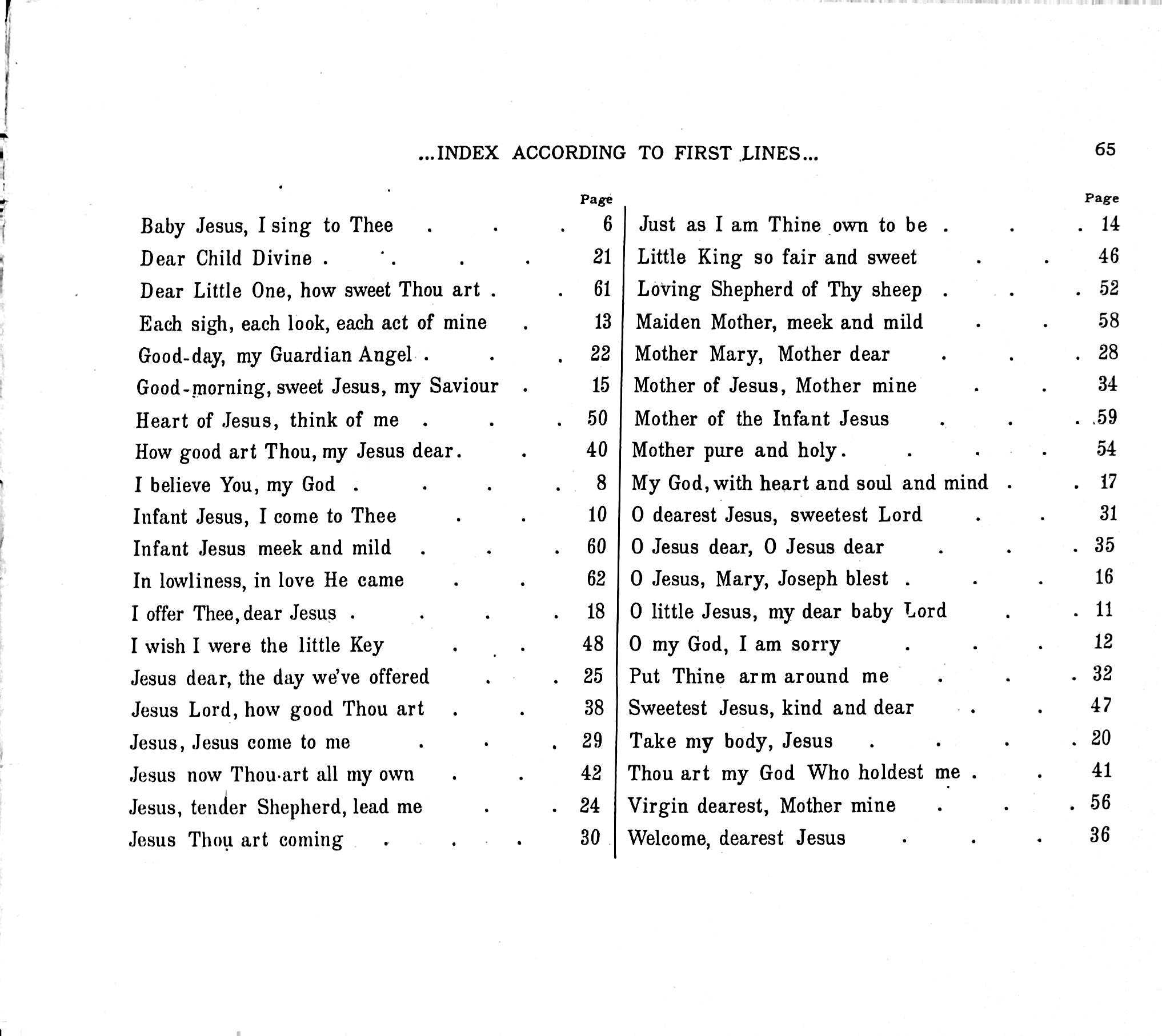
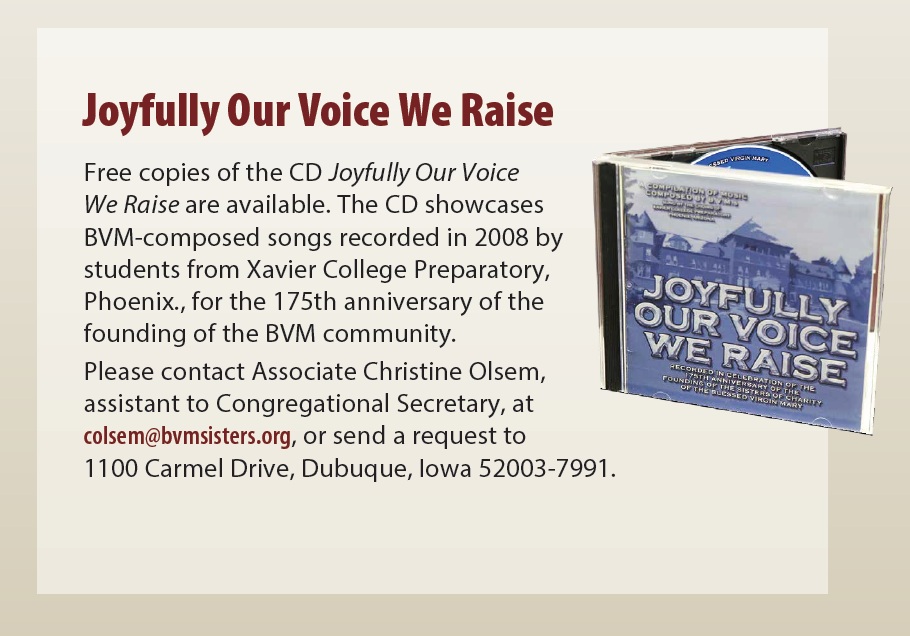
Within it was an announcement for a CD, ‘Joyfully Our Voice We Raise,’ which was a compilation of music composed by B.V.M.s. It was released in time for the 175th anniversary of the founding of the Sisters of Charity of the Blessed Virgin Mary. The CD showcased BVM-composed songs recorded in 2008 by students from Xavier College Preparatory, Phoenix, Arizona.

Joyfully Our Voice We Raise CD

So, I immediately requested a copy. Not long after, a package arrived in the mail containing a small pamphlet—a lyrics booklet prepared to accompany the ‘Joyfully Our Voice We Raise’ CD. It contained the lyrics for 27 hymns by various B.V.M. Sisters, seven of which were composed by Sister Editha. To a researcher like me, this was a gold mine. I once again reached out to the BVM archivist to inquire if any of Sister Editha’s sheet music was available, specifically the titles featured on the CD. While copies existed, they were housed in a separate facility and would take some time to retrieve. After submitting the formal request forms for the specific titles and obtaining permission to use the CD recordings, I received official approval in February 2026.

Around that same time, I was heavily involved in writing “A Parish Inheritance – A Hymnological Study of St. Mary’s Parish.” Anyway, things have settled down now and I am able to turn my attention once again to Sister Editha.

I initially planned to center this piece on ‘O Domina Mea,’ having found a copy of the score in the Caecilia Magazine referenced earlier. Then, considering this feature would publish in June—a month the Catholic Church dedicates to the Sacred Heart—I thought of showcasing a Sacred Heart hymn Sister Editha composed titled ‘O Heart of Jesus.’ Ultimately, however, my memory pulled me back to my original inspiration: ‘Jesus, Thou Art Coming.’

In truth, Sister Editha’s contributions are far too vast to limit to a single song; selecting just one would not tell the whole story. Therefore, this feature is dedicated to the broader musical legacy of Sister Mary Editha Flannagan, B.V.M., made possible by the generous permission of the Sisters of Charity of the Blessed Virgin Mary to share both her original manuscripts and the recordings of her compositions.

It is my sincere hope that this story serves to raise awareness of Sister Editha’s extraordinary talent, and safeguards the memory of all the religious sisters whose musical gifts might otherwise be forgotten.

Unlike the computer-generated files typically featured on this site, the following audio tracks are actual recordings performed by the student choirs of Xavier College Preparatory in Phoenix, Arizona. They are presented here with the generous and exclusive permission of the Sisters of Charity of the Blessed Virgin Mary. Because these historical compositions and recordings are tightly protected by congregational archives, music directors or ensembles interested in utilizing these hymns or scores for their own liturgies are advised to contact the author for guidance on proper permissions and archival requests. Selected performances or community recordings shared with the author may be featured in the ‘What’s New’ section of the website.

album-art

00:00

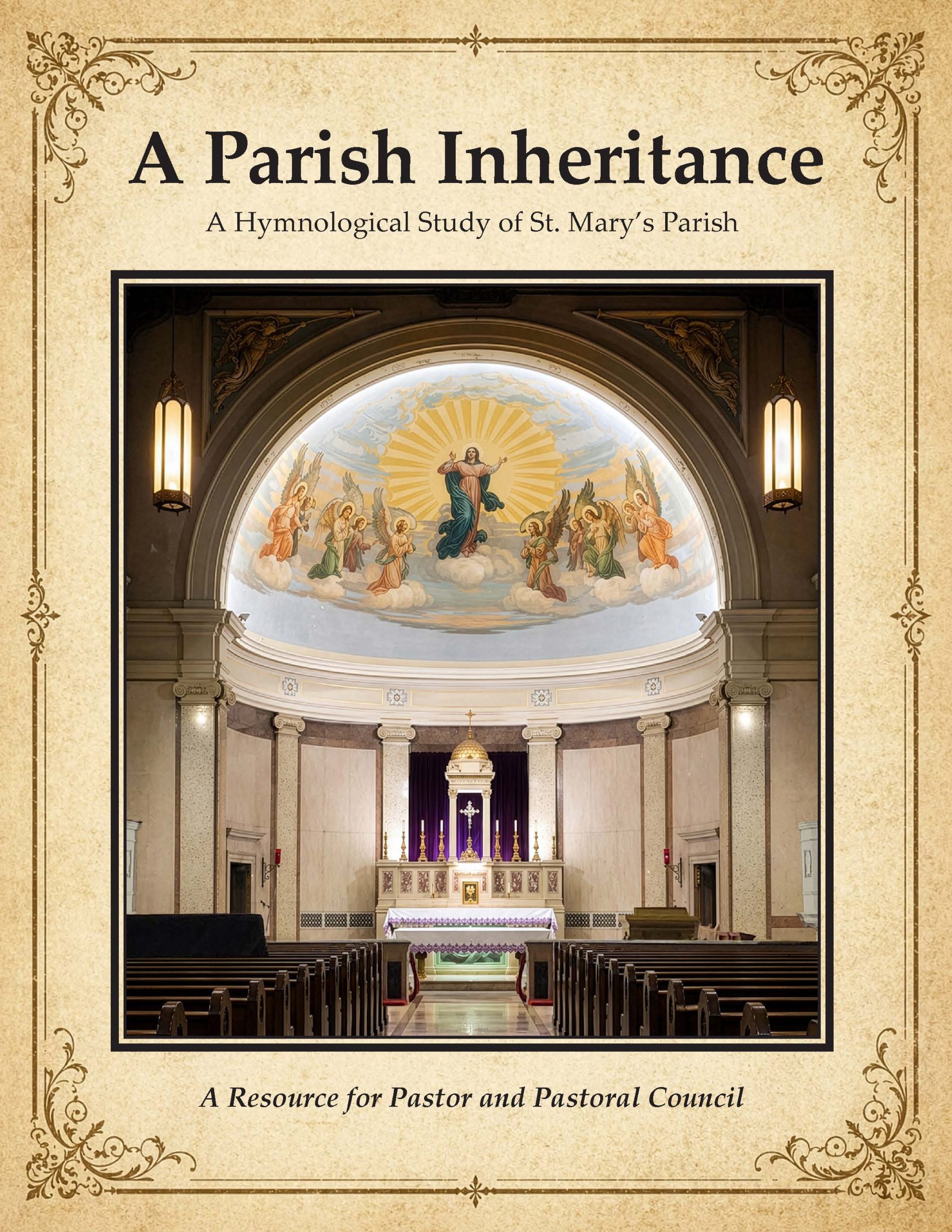
A Parish Inheritance: A Hymnological Study of St. Mary’s Parish

I’ve added a new major resource to the site: A Parish Inheritance: A Hymnological Study of St. Mary’s Parish. This curated packet grew out of a simple but searching question: “What happened to the hymns we once sang at St. Mary’s?” It traces how a deeply Catholic, Eucharistic, and Marian repertoire shaped parish life over decades—and how that musical memory can quietly fade when its carriers are no longer at the organ bench or in the choir loft.

The study brings together doctrinal grounding, pastoral reflection, and practical tools for pastors, musicians, and parish leaders who want to choose hymns “in a spirit of service to the Church’s liturgical prayer and to those entrusted with its care.” As the cover letter notes, “They are offered not to provoke change, but to deepen understanding—so that any future decisions, whenever they are made, may be shaped by reverence, clarity, and care for the unity of worship.

You’ll find a doctrinal definition of a Catholic hymn, a pastoral narrative of St. Mary’s musical journey, and appendices on chant, hymn categories, sample analyses, and bulletin-ready formation pieces. My hope is that this work will help other parishes listen more closely to how the Church herself prays—and to the musical inheritance already entrusted to them. (Click on any image to enlarge)

A Parish Inheritance — Quick Overview

  • What Is a Catholic Hymn? — A doctrinal foundation for parish musicians
  • A Pastoral Look at the Hymns We Sing — St. Mary’s musical story, past & present
  • Appendix A — Chant, antiphons, and the Church’s musical structure
  • Appendix B — Hymn categories (C1–C4) for parish discernment
  • Appendix C — A meditation on the posture of sung prayer
  • Appendix D — Hymn analysis template for parish use
  • Appendix E — Sample hymn evaluations
  • Supplemental resources for pastors, musicians, and parish formation
A Parish Inheritance The visual doorway into the full hymnological study.
A Parish Inheritance
The visual doorway into the full hymnological study.
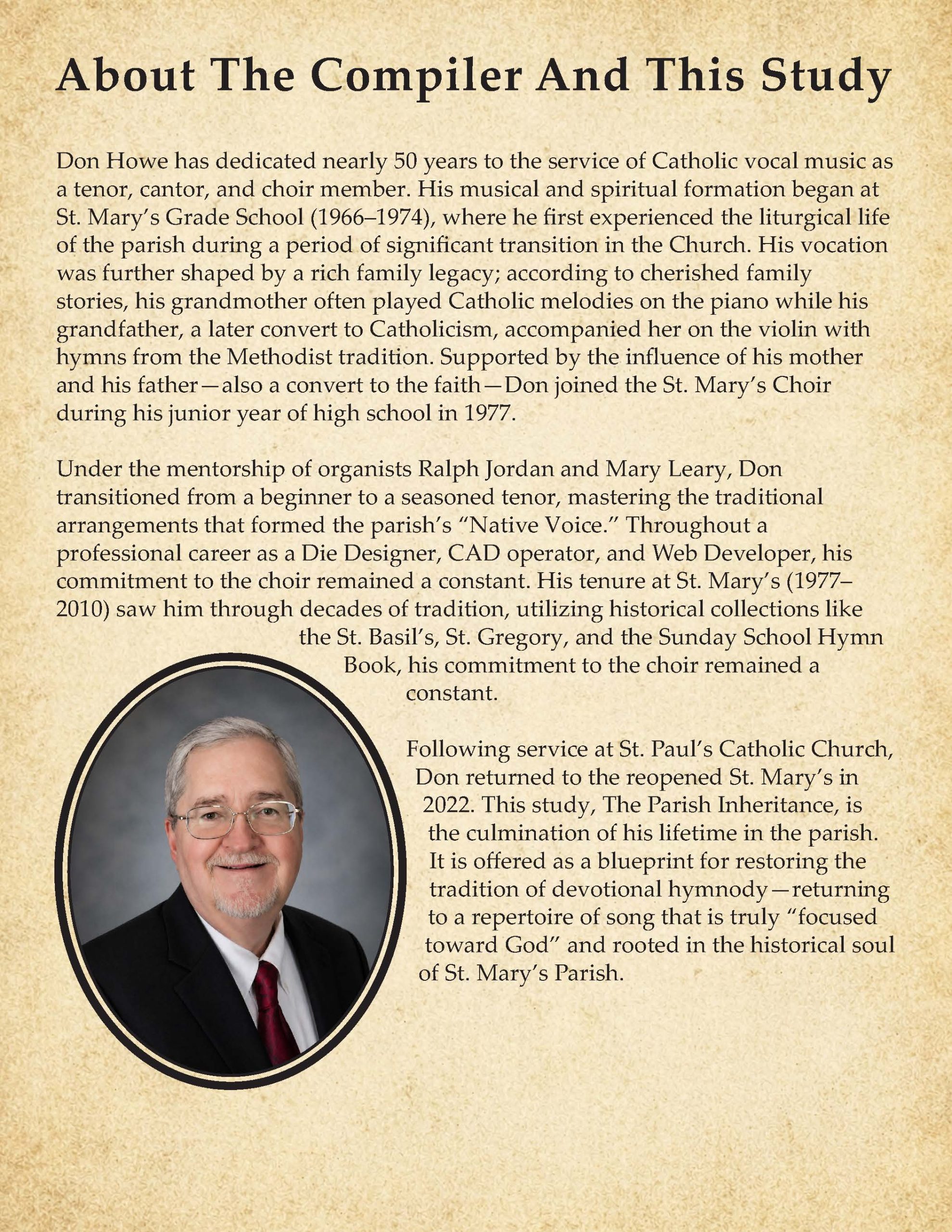
About the Author A brief introduction to the author’s fifty years of choral service.
About the Author
A brief introduction to the author’s fifty years of choral service.

Download A Parish Inheritance – A Hymnolocigal Study of St Marys Parish

This edition includes the complete study exactly as presented in the printed packet, along with the author’s biographical note on the back cover.

The Mystagogy of Little White Guest

Little White Guest

I. The Archeology of a Melody: Uncovering the Authors

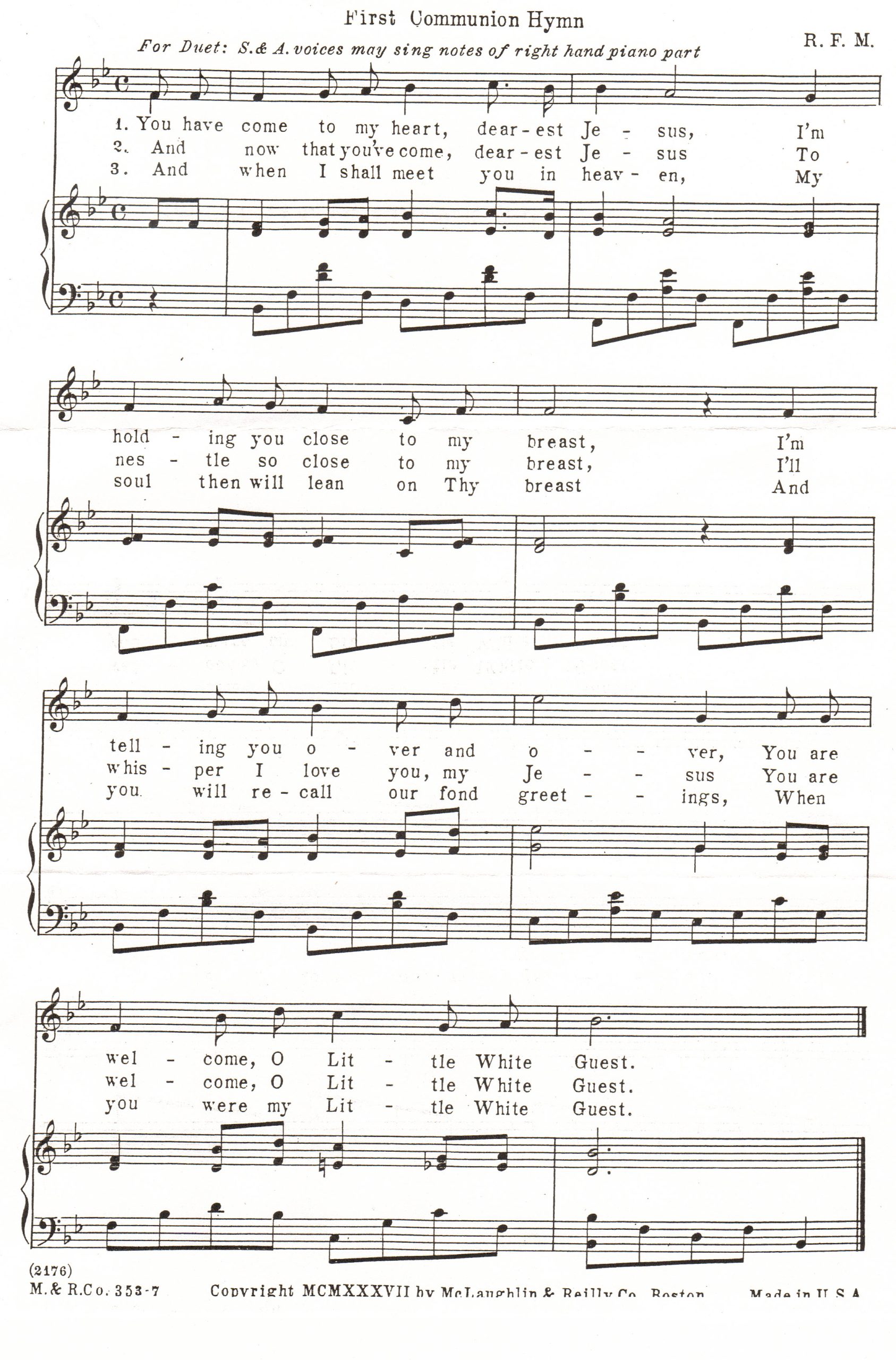
The history of this First Communion hymn begins not with a single name, but with a puzzle of initials. For decades, the melody published in 1937 by McLaughlin & Reilly Co. was attributed simply to “R.F.M.” Through meticulous research into the 1907 Musical Times and the 1937 Catalog of Copyright Entries, the identity of this composer finally emerges as Richard Frank Martin Akerman (1871–1938). Akerman was a figure of significant liturgical stature: one of the earliest students at the Royal College of Music and an assistant at St. George’s Chapel, Windsor. His background in Anglican vocal church music and his role at Eton College suggest a composer who understood the power of disciplined, beautiful melody.

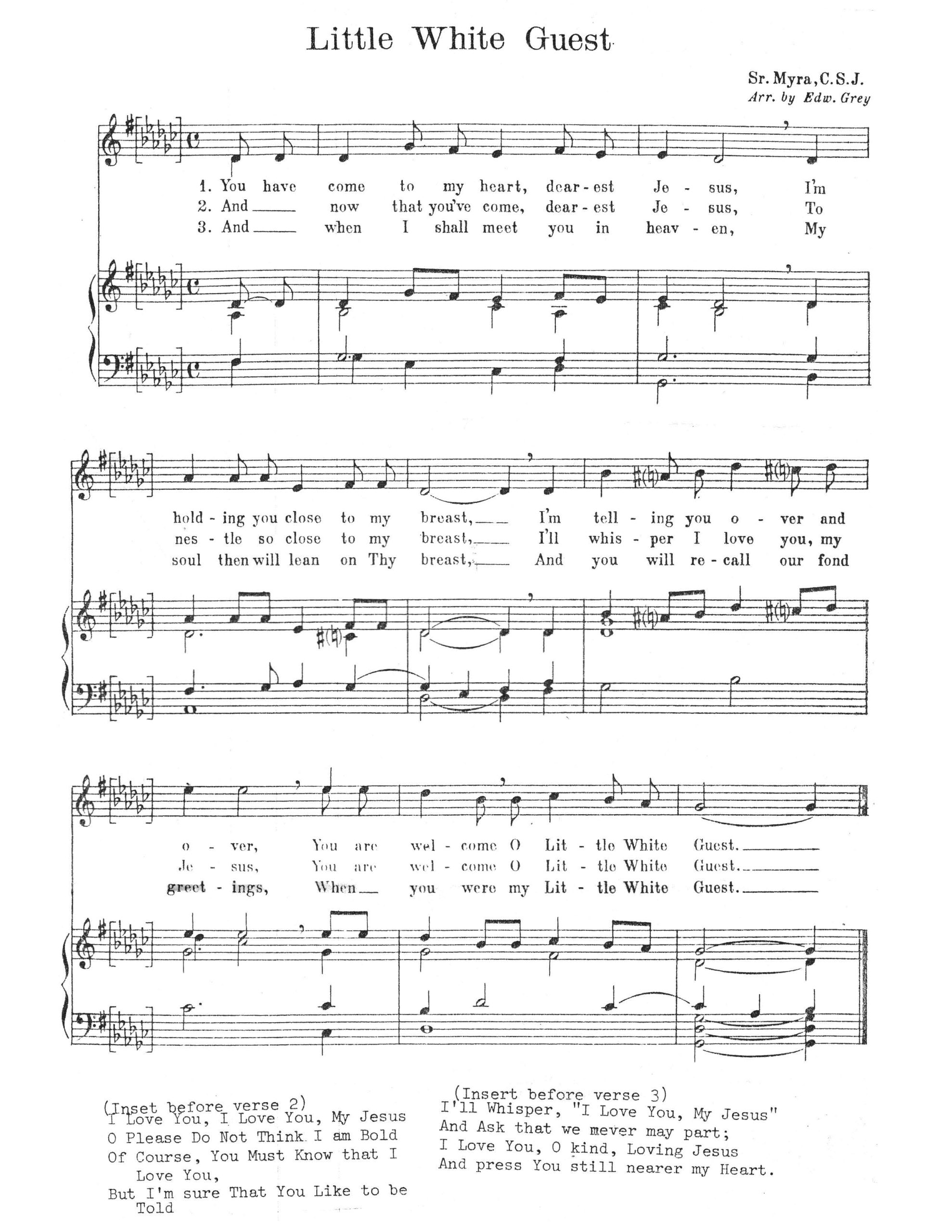
Parallel to this English tradition is a second melody published in 1958 by Sr. Myra, C.S.J. (Margaret Mary Farrell). A dedicated music educator at Regis College (Weston, Massachusetts)  and Mount Saint Joseph Academy (Brighton/Boston Massachusetts), her version—arranged by “Edward Grey” (a pseudonym for Fr. Joseph Portelance)—carried the hymn into the mid-century American parish. While much of Sr. Myra’s work was tragically lost to history after her death, her contribution to this hymn survives as a testament to the musical life of the teaching sisters.

The 1937 melody by Richard Frank Martin Akerman. Note the traditional arrangement characteristic of the Royal College of Music influence.
The 1958 setting by Sr. Myra, C.S.J., which became a staple in mid-century American parochial schools.  Courtesy of The Devotional Hymns Project
The 1958 setting by Sr. Myra, C.S.J., which became a staple in mid-century American parochial schools.
Courtesy of The Devotional Hymns Project

The enduring significance of this hymn is perhaps best evidenced by its persistent life outside the choir loft. Decades after its mid-century peak, Little White Guest remains a staple of the devotional landscape, with its accompanying prayer cards still widely available through major religious retailers like the EWTN Religious Catalogue and Catholic Supply. These cards, often featuring the classic Fratelli Bonella artwork of the Christ Child, continue to be sold in the thousands for First Communion ceremonies and parish distribute. This ongoing commercial and devotional presence suggests that the hymn is not merely a museum piece of “old-fashioned” sentimentality, but a living “souvenir of faith” that continues to provide a tangible, prayerful anchor for new generations. 

Online forums and social media are filled with testimonials from individuals who, decades after their own First Communion, still recite the verses from memory after receiving the Eucharist. This persistent popularity suggests that the hymn serves as a “living bridge,” connecting the structured sacramental preparation of the past with the personal, interior prayer life of the present.

Little White Guest

You have come to my heart, dearest Jesus,
I’m holding you close to my breast,
I’m telling you over and over,
You are welcome, O Little White Guest.

I Love you, I Love you, My Jesus,
Please do not think I am bold
Of course, you must know that I Love You,
But I am sure that You like to be told.

And now that you’ve come, dearest Jesus
To nestle so close to my breast,
I’ll whisper “I love you, my Jesus”
You are welcome, O Little White Guest.

I’ll Whisper, “I Love You, My Jesus”
And ask that we never may part;
I Love You, O kind, Loving Jesus
And press You still nearer my Heart.

And when I shall meet you in heaven,
My soul then will lean on Thy breast
And you will recall our fond greetings,
When you were my Little White Guest.

Prayer Card - Courtesy of The Devotional Hymns Project

II. The Interior Garden: A Theology of Childhood

To the modern critic, the lyrics of  Little White Guest are sometimes labeled as “sentimental.” However, this critique overlooks the hymn’s profound pedagogical and mystagogical purpose. In the era of the Baltimore Catechism, children were not just taught information about the Eucharist; they were given a structure for an interior life.

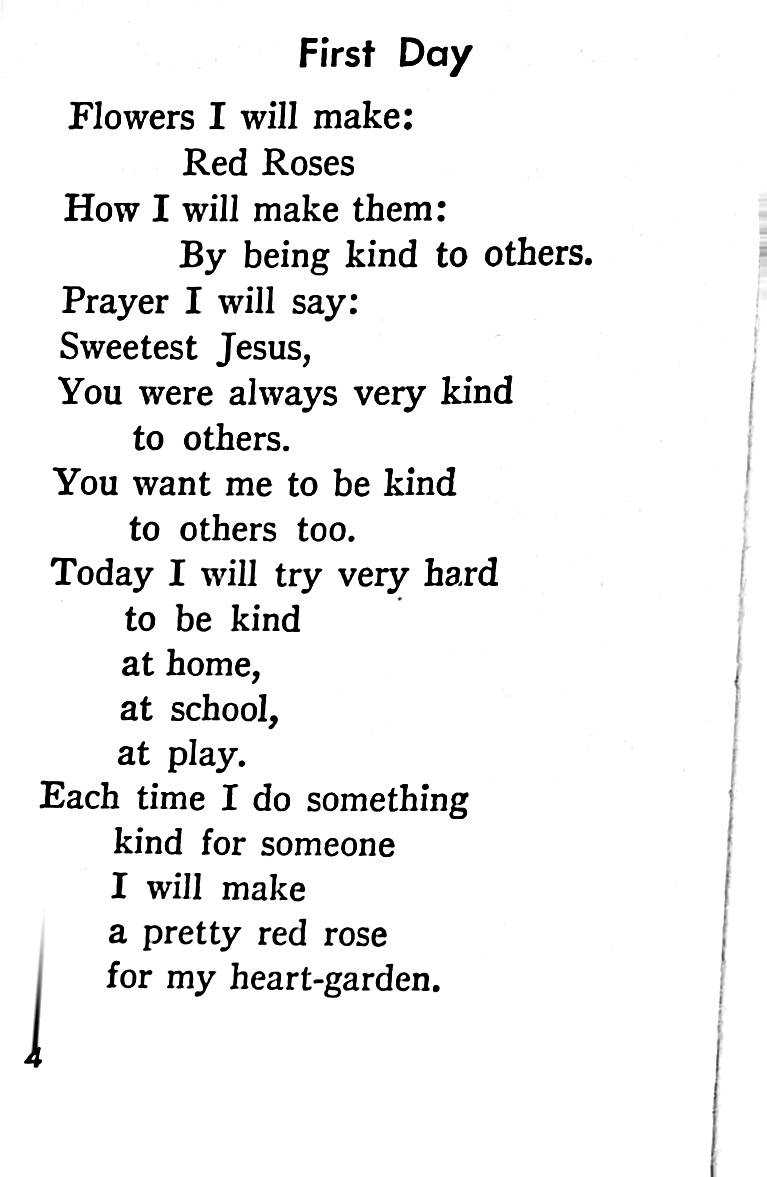
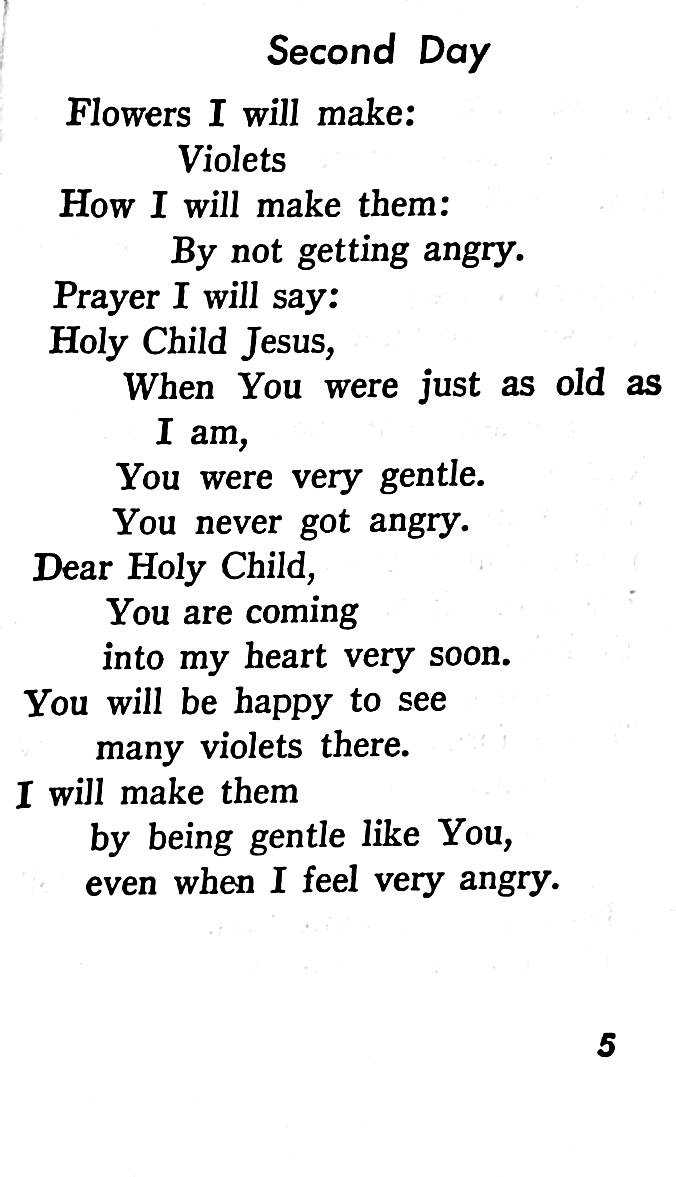
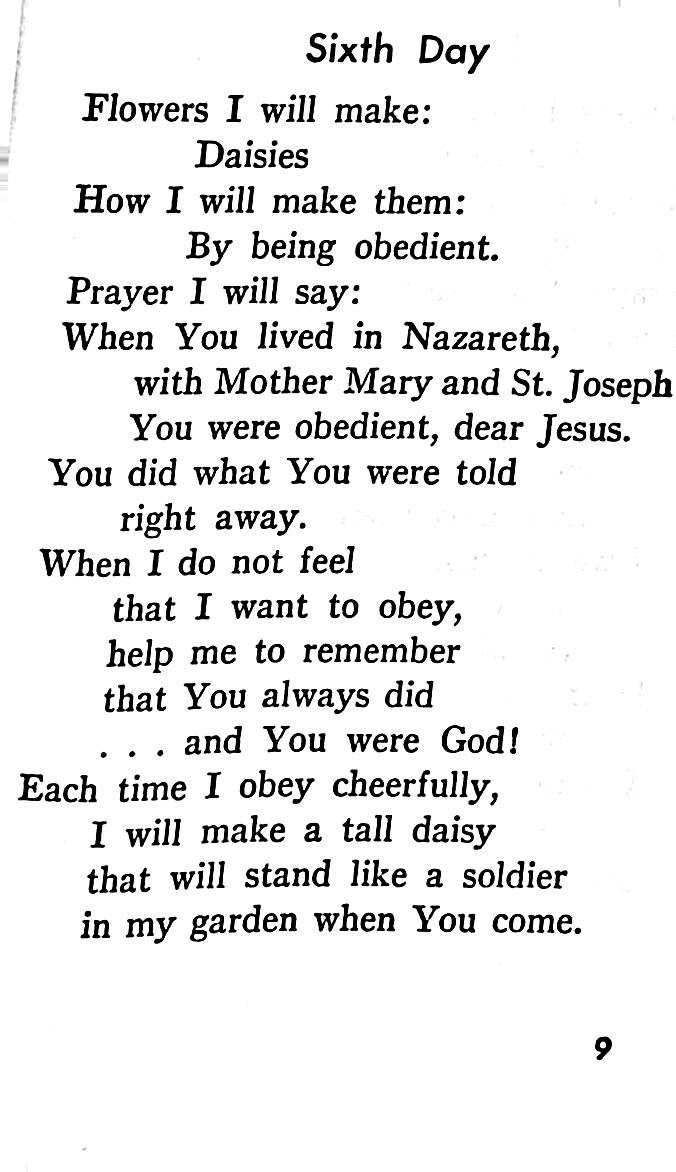
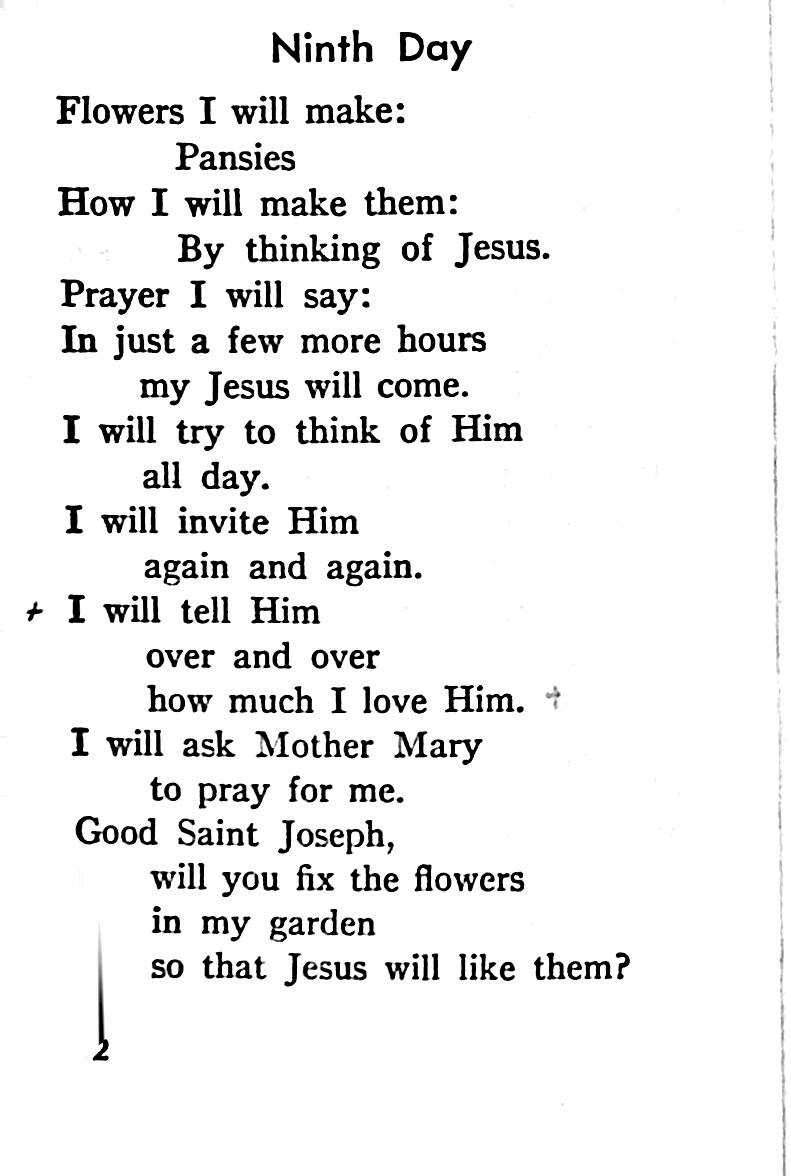
This is best exemplified by the Heart-Garden Novena that accompanied the hymn. The preparation was a nine-day labor of active virtue. Each virtue was represented by a specific bloom:

  • Red Roses for kindness to others.
  • Violets for the discipline of patience.
  • Daisies for the virtue of obedience.
  • Pansies for the constant thought of Jesus.

In this context, the Little White Guest is not a diminutive title, but an Incarnational one. By framing the Eucharist as a “Guest,” the hymn teaches the logic of hospitality. The child learns that their soul is a home that must be swept, decorated, and made ready for a Royal Visitor. In this way, the hymn is valuable within its proper theological and liturgical limits. It meets the child where they are

The choice of the word ‘Guest’ is not merely a charming sentiment for children; it is a profound echo of the Church’s high liturgy. In the Veni Sancte Spiritus—the ancient ‘Golden Sequence’ of Pentecost—the Holy Spirit is addressed as Dulcis Hospes Animae, or the ‘Sweet Guest of the Soul.’ By using this language, Little White Guest performs a vital mystagogical service, translating the abstract mystery of the Divine Indwelling into the accessible ‘logic of hospitality.’ It teaches the young communicant that the soul is not an empty space, but a sanctuary prepared for a Royal Visitor. This framework transforms the act of receiving the Eucharist into a personal encounter, grounding the ‘warm’ devotional experience in the ‘high’ theological reality of the Roman Missal.

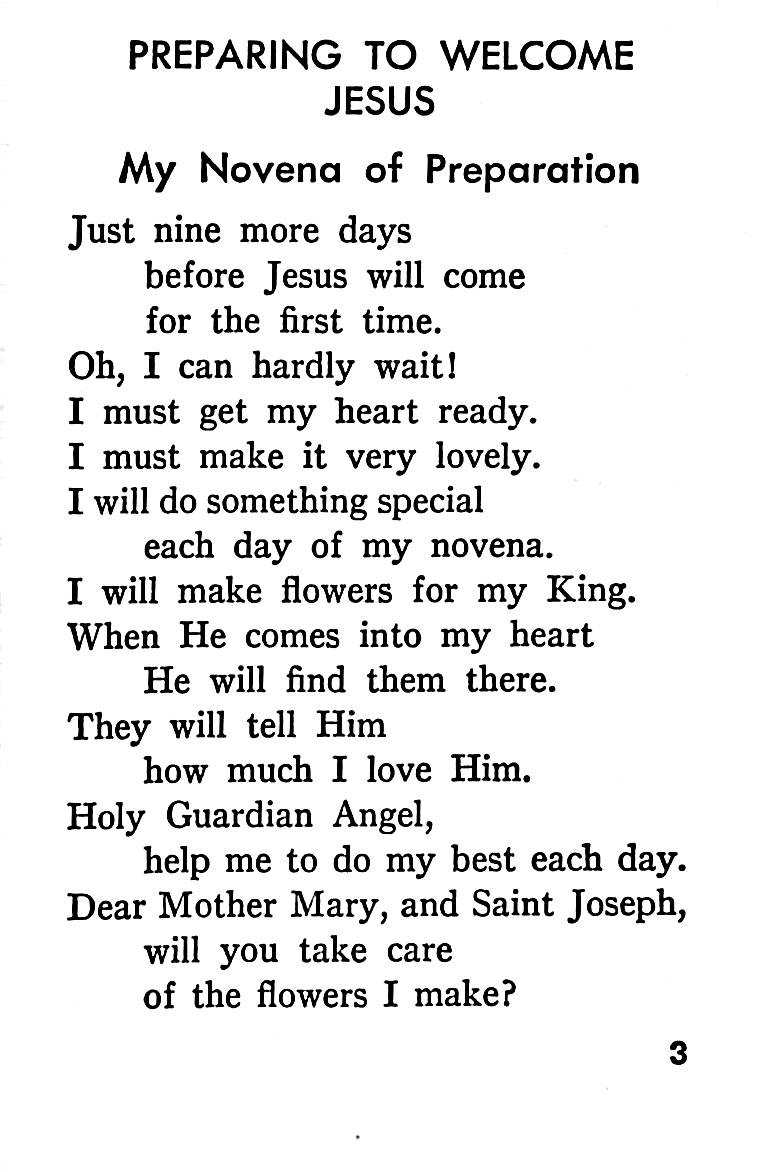
The following excerpts are taken from a First Communion preparation text “Preparing to Welcome Jesus” used during the catechetical period of the author. They illustrate a structured approach to forming the interior life of the child through symbolic and devotional language, often described as the “heart-garden”.

Preparing to Welcome Jesus (1952)
Fr. George M. Dennerle & Sr. Mary Magdela, S.N.D.

The following booklet, originally published in 1952 by The Bruce Publishing Company of Milwaukee, is provided here as a historical devotional resource associated with First Holy Communion preparation in the mid-twentieth century. Its language and spiritual approach reflect a particular moment in Catholic catechetical practice—marked by affective devotion, child-centered piety, and an emphasis on personal intimacy with Our Lord in the Eucharist.

This document is presented not as a normative model of Catholic hymnody or Eucharistic theology, but as a representative artifact of a widely shared devotional culture. Its inclusion is intended to assist readers in understanding the pastoral and imaginative framework that shaped the religious experience of many Catholics in the context of First Communion. This booklet is believed to be in the public domain; if a valid copyright claim exists, it will be removed upon request.

Preparing to Welcome Jesus – First Communion (PDF)

III. The Great Gap: Formation vs. Information

Within the framework of this study, Little White Guest is best understood as a devotional hymn. In this classification, such hymns are recognized for expressing a personal and affective response to the reception of Christ, while not necessarily articulating the fullness of Eucharistic doctrine,  particularly with regard to the objective reality of Christ’s presence in the sacrament. This distinction is important. The hymn does not serve as a primary expression of the Church’s liturgical voice, but accompanies it, giving the communicant—especially the child—a language of love in response to a mystery already received.

Examining this hymn today reveals a significant shortcoming in modern catechesis. When we were taught by religious sisters using the Baltimore Catechism, we were given a “musical spine” for our faith. The sisters lived a life centered on the Eucharist, and they passed that interiority down to us through these simple devotions.

Today, many lay teachers—often through no fault of their own—have had less exposure to this kind of liturgical and devotional formation. Modern pedagogy often emphasizes the “communal meal” or the “gathering,” but it can neglect the interior silence and the personal conversation with Christ. Without the structured “small steps” of the Heart-Garden, children may learn about the sacrament without learning how to love the Person within it.

IV. The Classical Restoration: Chesterton and the Future

There is a growing movement today to recover this lost inheritance. Schools like the Chesterton Academy network are returning to a classical model of Catholic education, emphasizing the integration of faith, reason, and beauty.

While these modern classical schools rightly focus on the “high” traditions of Gregorian chant, there remains a vital place for the “warm” traditions of the devotional hymn. The Chestertonian spirit—one of “Catholic joy” and common sense—aligns perfectly with the Little White Guest. By reintroducing these hymns, we bridge the gap between a rigorous mind and a tender heart. We offer children more than just facts; we offer them the “whisper” of a post-Communion heart that says, “I love You, my Jesus.”

V. Conclusion: Seeing What I See

When I invite readers to review these verses, I am inviting them to look past the notes and see the spiritual landscape they create. This hymn was once a staple of the Choir Loft radio broadcasts in 1937, and for over thirty years, it has echoed in my own experience in the choir at St. Mary’s in Akron, Ohio. It is more than a song; it is the final result of a soul prepared.

As I reflect on the journey of the Little White Guest, I am reminded of the words that conclude the nine-day journey of preparation:

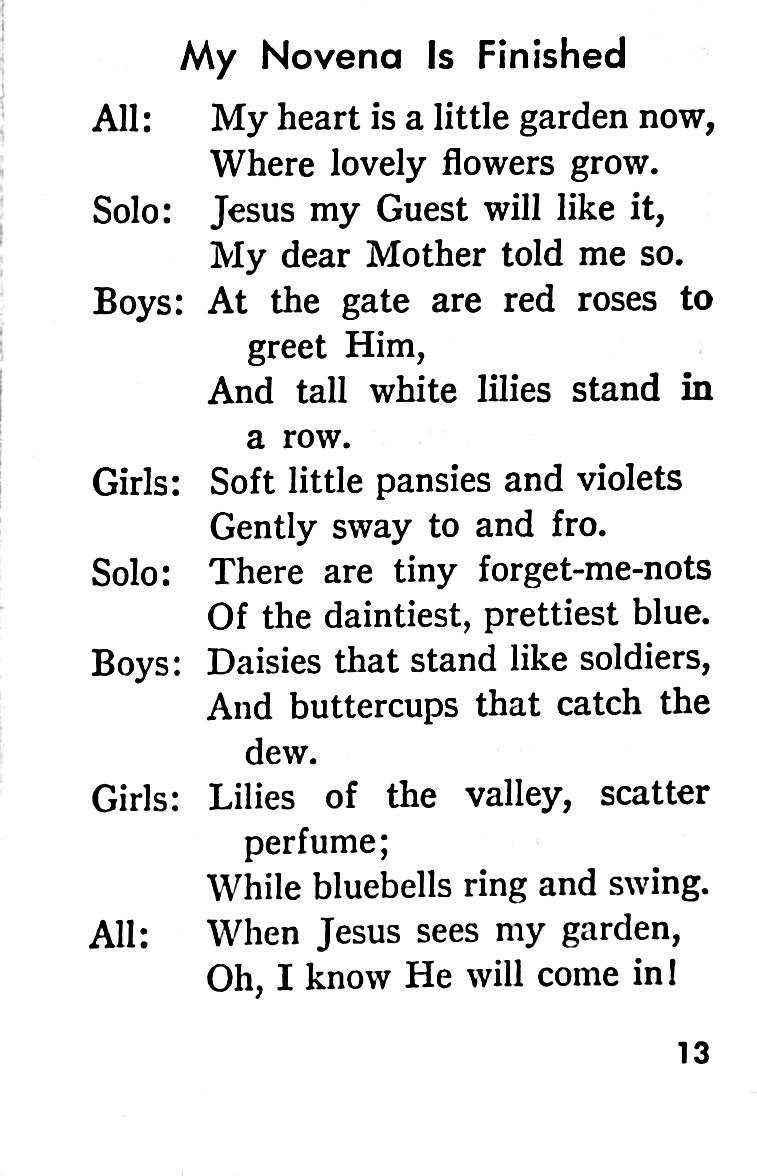
“Now my Novena is finished, and my heart is a little garden where lovely flowers grow. Jesus my Guest will like it, my dear Mother Mary told me so. When Jesus sees my garden, oh, I know He will come in! I’ll whisper, I Love You, I Love You, My Jesus. He is coming in this morning, to be my Little White Guest.” This beautiful hymn says it all.

A special thank you to Peter Meggison, producer of The Devotional Hymns Project for allowing me to link to his recordings of Little White Guest. I particularly wish to highlight the beautiful selections he produced at St. Paul Church in Harvard Square, Cambridge, Massachusetts. On June 28, 2013, vocalists Lisa Correnti and Sarah Mitchell performed the melody by Sr. Myra, C.S.J., under the direction of organist John Robinson, who served as music director of both the church and the renowned St. Paul Choir School.

The collaboration continued in August 2014, when additional selections were recorded at the same location by John Robinson with vocalists Clare McNamara and Camila Parias. Their performance of the melody by Richard Frank Martin Akerman further honors the tradition of exceptional sacred music associated with this distinguished institution.

album-art

00:00

Easter at St. Mary’s: A Tribute to the Choir

A Sister’s Question and the Rediscovery of a Lost Easter Sound

In the days leading up to this project, my sister wrote to me searching for a recording of Terra Tremuit, the Easter alleluia we grew up singing at St. Mary’s. She had found versions online, but none carried the sound or spirit she remembered. Her message stirred something in me — the same longing for a music we once knew so well, a music that seemed to have slipped beyond reach. In replying to her, I unearthed an old cassette from Easter Morning, 1991, and began the careful work of digitizing it. What started as a simple attempt to help my sister hear a beloved melody again became the doorway into this entire tribute: a return to the voices, memories, and grace of St. Mary’s Choir at Easter.

Easter at St. Mary’s in Akron was never simply a date on the calendar. It was the summit of the parish’s musical and spiritual life, the moment when the choir’s year‑long devotion blossomed into something luminous. Long before the first bells rang or the first alleluia was sung, the choir loft was already alive with quiet purpose. Rehearsals took on a different tone in those weeks—gentler, more focused, as though everyone sensed that what we were preparing was not merely music, but an offering.

Holy Week always marked a turning. Palm Sunday carried its own solemnity, but it was the Triduum that shaped the choir’s deepest work. On Holy Thursday, the music softened into contemplation; on Good Friday, it nearly disappeared into silence. And then came the long, breath‑held waiting before the Vigil, when the church sat in darkness and the choir waited with it, ready to give voice to the first light of the Resurrection.

Every other year, when the Easter Vigil in the Ordinary Form—the Novus Ordo—was celebrated in Latin, St. Mary’s felt like a doorway into the Church’s deep memory. The darkness, the fire, the Exsultet, the slow return of light—these were not performances. They were encounters. Even within the reformed liturgy, the choir’s Latin Ordinary gave the Vigil its solemn backbone, and when the Gloria finally burst forth—bells ringing, lights blazing, organ swelling—it felt as though the entire parish rose with Christ from the tomb.

Easter Morning Traditions and the Music of 1991

Easter morning had its own radiance. Where the Vigil was ancient and solemn, Easter morning was bright and full‑voiced. Parishioners arrived early, not out of obligation but out of desire, knowing that the choir would offer a half‑hour of sacred music before Mass. These preludes became a cherished tradition, a kind of musical procession leading the parish into the joy of the Resurrection.

One Easter in particular—1991—captures the spirit of those years with remarkable clarity. The program from that morning Mass, celebrated by Father Raymond Smith, reveals a choir unafraid to draw from every era of sacred music so long as it lifted hearts toward God. The prelude began with The Dawn Was Purpling O’er the Sky from the 1918 St. Basil’s Hymnal, a gentle rising of light. From there, the choir moved through The Holy City, Lani Smith’s Christ Is Risen with its echo of Handel’s Hallelujah Chorus, the cheerful Let the Bells of Easter Ring, and the sturdy hymn King All‑Glorious. It was a tapestry of devotion—old, new, solemn, joyful—woven together with the unmistakable sound of St. Mary’s.

The Mass itself reflected the parish’s unique musical identity. The Entrance Hymn, Christ the Lord Is Risen Today, was sung to the tune Victimae Paschali, linking familiar English words with the ancient Easter sequence. The Ordinary was taken entirely from John Wiegand’s 1922 Mass in Honor of the Immaculate Conception, a setting that had become part of St. Mary’s musical DNA. The Sprinkling Rite featured Kempter’s Vidi Aquam, flowing and prayerful, and the Offertory—Wiegand’s Terra Tremuit—brought a solemn triumph to the liturgy. Communion carried its own tenderness: Let the Holy Anthem Rise, followed by Anthony Werner’s 1895 Regina Coeli, first sung and then played as an organ meditation. The closing hymns—Jesus Christ Is Risen Today and Christ Is Risen from the 1907 Sunday School Hymn Book—sent the parish forth in full Easter joy.

What made the St. Mary’s Choir remarkable was never perfection. It was devotion. We were teachers, retirees, students, parents, and parishioners who loved our church. We gave up evenings, weekends, and holidays because we believed the liturgy deserved our best. And somehow, through grace and perseverance, our best was enough. Easter revealed that truth more clearly than any other time of year. The music was never about performance. It was about faith—lived, sung, and shared.

Preserving the Recordings — A Fragile Ribbon of Sound

Some of these moments were preserved on a simple cassette tape, recorded live from the organ bench at the main console in the body of the church during that 1991 Easter morning. The recordings were rescued from that fragile ribbon of sound—nearly thirty years old—where time had left its mark: a soft hiss here, a faint rumble there, the unmistakable acoustics of a living church. After gentle restoration, the music remains exactly what it was: the honest, unpolished, heartfelt voice of a parish choir singing the Resurrection. These recordings are not studio‑quality, but they are authentic—the real sound of St. Mary’s, carried across decades.

Easter at St. Mary’s stands as one of the parish’s greatest gifts. It showed what a choir can be when it sings not for applause but for the glory of God. It showed what a parish can be when tradition and renewal walk hand in hand. And it showed what sacred music can accomplish when offered with humility and love. The St. Mary’s Choir carried that legacy for decades. And though the voices have changed and the years have passed, the memory of those Easter mornings—filled with light, filled with song, filled with faith—remains a treasure worth preserving.

As I listen to these recordings now, after nearly fifty years in the loft, I am deeply aware that I am the last of the St. Mary’s Choir. So many of the voices you hear—faithful friends, mentors, companions in song—have gone on to their final reward. Yet in these fragile, time‑worn tapes, they live again. Their harmonies rise, their devotion lingers, and the love they poured into the liturgy still shines through the imperfections of an old cassette. It does my heart good to hear them, my choir family, singing as they once did on Easter morning. I offer this short tribute to their memory, with gratitude for the years we shared and the music that continues to echo in my soul.

St. Mary’s Choir/ Easter Sunday Morning 10a.m. Mass with Easter Music Program 1991. Celebrant was Father Raymond Smith; Organist Ralph Jordan.

Easter Music Program Before Mass
1. Organ Prelude – The Dawn Was Purpling O’er The Sky – St. Basil’s Hymnal 1918
2. The Holy City – F. E. Weatherly/Stephen Adams/ Arr. by Harold DeCou, 1972
3. Christ Is Risen – L. O. Emerson/ Arr. Lani Smith/ Incorporates Handel’s Hallelujah Chorus, 1990
4. Let The Bells of Easter Ring – Nancy Price/Don Besig, 1990
5. King All-Glorious – Charles Wesley/ George M. Vail, 1928

Entrance Hymn – Christ, the Lord, Is Risen Today (Missalette) Tune: Victimae Paschali
KyrieMass in Honor of the Immaculate Conception of the Blessed Virgin Mary/ John Wiegand, 1922
Gloria – Mass in Honor of the Immaculate Conception of the Blessed Virgin Mary/ John Wiegand, 1922
Responsorial Psalms – This is the day the Lord has made; Let us rejoice and be glad.
Gospel Alleluia Three times and Verse
Sprinkling RiteVidi Aquam – Carl Kempter/ Arr. by B. Hamma, 1893
Offertory for EasterTerra Tremuit – John Wiegand, 1914
Sanctus – Mass in Honor of the Immaculate Conception of the Blessed Virgin Mary/ John Wiegand, 1922
Pater Noster w/organ
Agnus Dei – Mass in Honor of the Immaculate Conception of the Blessed Virgin Mary/ John Wiegand, 1922
Communion Hymn – Let the Holy Anthem Rise (Missalette) Tune: Traditional
Communion HymnRegina Coeli – Anthony Werner, 1885
Communion Meditation – Regina Ceoli Organ only
Closing Hymn – Jesus Christ is Risen Today (Missalette) Tune: Easter Hymn
Second Closing HymnChrist Is Risen – Sunday School Hymn Book, 1907
Organ Postlude

About These Recordings

The recordings featured below, were digitized from an aging cassette tape that captured the Easter Sunday Morning Mass at St. Mary’s in 1991. Due to the limitations of the original medium and the passage of time, the audio quality reflects the natural imperfections of live parish recordings. Basic restoration techniques were applied to reduce tape hiss and environmental noise, but the goal was preservation rather than perfection. What remains is an authentic historical document of the choir’s sound and the parish’s musical life.

album-art

00:00

Catholic Hymnody, Authority, and Modern Hymnals

Context and Purpose

Catholic hymnody has always existed under the authority of the Church, yet the way that authority is exercised has changed significantly in the modern era. This article examines why Catholic bishops no longer formally approve hymnody through imprimaturs, how hymn evaluation now functions within the Church, and how modern Catholic hymnals measure up when judged against the Church’s own doctrinal and liturgical standards. Drawing on historical practice, the USCCB’s Catholic Hymnody at the Service of the Church (2020), and What Is a Catholic Hymn?, this study seeks not to be polemical, but ecclesial: to clarify what the Church means by Catholic hymnody and how that meaning is applied today.

1. Why Imprimaturs for Hymnals Disappeared in the U.S.

Historically (pre‑1960s), Catholic hymnals commonly carried imprimaturs. Hymns were treated as catechetical and doctrinal texts, and bishops exercised direct oversight.

After Vatican II, imprimaturs for hymnals faded gradually (roughly 1968–1980)—not by formal abolition, but by a shift in priorities:

  • Episcopal authority focused increasingly on official liturgical texts (Missal, Lectionary, sacraments).
  • Hymns came to be viewed as pastoral or devotional aids, not juridically regulated texts.
  • The explosion of vernacular, ecumenical, and rapidly revised repertoire made exhaustive review impractical.

Importantly, the Church never declared hymn approval unnecessary in principle. Instead, oversight shifted from formal pre‑approval to discernment, formation, and responsibility at lower levels (publishers, pastors, musicians).

2. Criteria for Evaluating Hymns Using the Church’s Own Language

From Sacrosanctum Concilium, Musicam Sacram, the GIRM, the Catechism, and the USCCB (2020), a coherent set of criteria emerged. These were synthesized into four lenses:

Doctrinal Integrity

Hymns must clearly express Catholic doctrine (Trinity, Christology, Eucharist, salvation) without ambiguity. Vague or contradictory theology is not acceptable simply because it is popular or emotive.

Liturgical Function

Hymns must serve the ritual action of the Mass, not merely provide religious sentiment. A hymn can be orthodox yet still liturgically unsuitable if it does not correspond to the rite (Entrance, Offertory, Communion).

Ecclesial Voice

Catholic hymnody should sound like the Church praying as Church, not primarily individuals expressing personal experience. Preference is given to scriptural, liturgical, and traditional sources.

Pastoral Effectiveness

Hymns should be singable, prayerful, and oriented toward reverence—not performance or entertainment.

The USCCB document presents these as guidelines and cautions, not binding judgments.

3. “What Is a Catholic Hymn?” — A Stronger, Definitional Synthesis

What Is a Catholic Hymn? was shown to be fully consistent with the USCCB document but stronger and more precise in its conclusions.

Key contributions of What Is a Catholic Hymn?:

  • It offers a definition, not just an evaluation aid.
  • It states that hymns which obscure doctrine or fail liturgical purpose are unsuitable for Mass, not merely “concerning.”
  • It insists that a Catholic hymn exists under ecclesial authority and permission, even if not through a traditional imprimatur.
  • It integrates doctrine, liturgy, history, and authority into a single coherent standard.

In short:

  • USCCB (2020) asks: What problems should we watch for?
  • What Is a Catholic Hymn? asks: What does the Church mean by Catholic hymnody at all?

They are complementary, not contradictory.

4. Testing Modern Hymnals Against Both Documents

Several widely used U.S. hymnals were evaluated using both standards.

Hymnals Tested[1]

Gather (GIA)

Glory & Praise (OCP)

Breaking Bread (OCP)

St. Michael Hymnal (St. Boniface Roman Catholic Church)

Adoremus Hymnal (Ignatius Press)

A Catholic Book of Hymns (Sacred Music Library)

Results

According to the USCCB (2020):

  • Most modern hymnals contain a mixture of acceptable and problematic texts.
  • They require careful discernment, not wholesale rejection.

According to What Is a Catholic Hymn?:

  • Gather, Glory & Praise, and Breaking Bread fail definitionally as Catholic hymnals, even if they include individual acceptable hymns. They lack consistent doctrinal clarity, liturgical function, and ecclesial voice.
  • St. Michael Hymnal substantially conforms, showing intentional Catholic coherence.
  • Adoremus Hymnal and A Catholic Book of Hymns clearly and fully conform, embodying Catholic doctrine, liturgical theology, and ecclesial intent.

This demonstrates that the stronger definition is not impractical—it is already being met by certain publishers.

5. Core Insight of the Study

The central conclusion is this:

The decline of imprimaturs did not alter the Church’s standards for hymnody, but it shifted how responsibility for applying those standards is exercised.

  • The USCCB document preserves doctrinal vigilance but avoids juridical enforcement.
  • What Is a Catholic Hymn? restores clarity by naming what Catholic hymnody is, not merely what it should avoid.
  • Modern hymnals vary widely, not because Catholic standards are unclear, but because they are applied inconsistently.
  • Two modern hymnals (Adoremus and A Catholic Book of Hymns) demonstrate that coherent, doctrinally strong, liturgically faithful Catholic hymnody is fully achievable today.
[1] Note on Sources:
The hymnals discussed in this document are commercially published and widely used in U.S. parishes. Their contents—hymn texts, indices, and liturgical assignments—are publicly available through publisher materials and independent hymn indices, allowing evaluation based on the texts themselves and the Church’s own liturgical and doctrinal standards.

Discovering the Legacy of Sister Aloysius Dorman

Sister Aloysius Dorman (1835–1913) was a 19th‑century Catholic hymn composer whose music quietly shaped American devotional life. Her initials—S. N. D.—appear above the texts of many hymns found in older Catholic hymnals, yet the woman behind those letters has remained largely unknown. Through archival research and historical sources, this article traces the life, ministry, and hymnody of Sister Aloysius Dorman of the Sisters of Notre Dame de Namur, revealing the legacy of a gifted composer whose work accompanied generations of Catholic prayer while her name faded into anonymity. (Click on any image to enlarge)
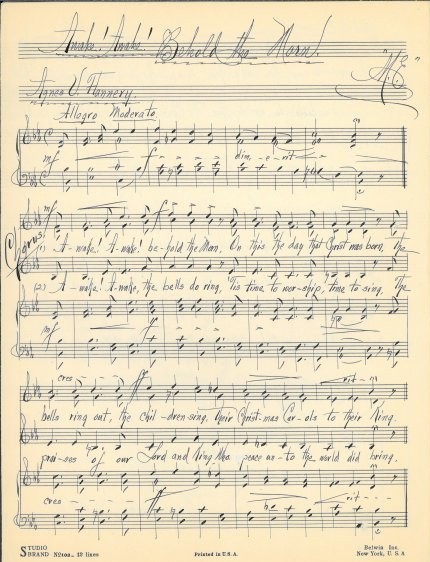
Sixth Street Early Sisters, 1870
Courtesy of the Sisters of Notre Dame de Namur
Ohio Province Archivist
Photo ID 2016-9299
Sister Aloysius (Josephine) Dorman
From photo on the left
Second row, second from the left
Photo enhanced

Sister Aloysius was born in Washington, D.C., on August 2, 1835, to Albert and Adelaide Dorman, both of whom had emigrated from France. At nineteen, she entered the postulancy of the Sisters of Notre Dame de Namur at the Sixth Street Convent in Cincinnati. She professed her perpetual vows in 1861, beginning a lifetime of service marked by music, teaching, and devotion.

Her ministry carried her across several communities. She spent twenty‑five years at the Sixth Street Academy in Cincinnati, seventeen years at the Notre Dame Academy in Philadelphia’s Rittenhouse Square, twelve years in Dayton, and shorter periods in Columbus, Hamilton, and Summit, Ohio. Wherever she went, she taught music and orchestration, publishing hymns and songs for the schools she served. These works—now recognized as the American hymns attributed to “S. N. D.”—became part of the spiritual soundtrack of countless classrooms.

What stands out most in the accounts of her life is her spirited personality. She was known for her lively disposition and her ability to charm those around her. One vivid moment from her final year captures this beautifully. In late March of 1913, she conducted an orchestra of many instruments, singing a gypsy song while accompanying herself on the tambourine. She danced with such youthful agility that observers could hardly believe she was nearly eighty years old.

The very next day, however, she fell ill. For two weeks she continued to attend Mass and receive Holy Communion, but eventually she had to confine herself to her small room above the sacristy. There, after a long life of service, she quietly departed on April 1, 1913. She was laid to rest in the Notre Dame Cemetery in Hamilton, Ohio.

Much of what we know about Sister Aloysius today comes from the careful research of Sister Kim Dalgarn, SNDdeN, archivist in Cincinnati, and from a 1989 letter written to Peter Meggison by Sister Agnes Immaculata Guswiler, the first archivist in Cincinnati. Their work, along with excerpts from the Hamilton Annals, preserves the details of Sister Aloysius’s life and confirms her as the composer of the American hymns and songs long attributed to her initials.

As I learned more about her, I found myself reflecting on how easily figures like Sister Aloysius slip into the background of history. It was customary throughout the entire 19th and early 20th century for religious authors, artists, and composers to remain anonymous, giving only the name of their religious congregations for their published works. Knowing this helped me understand why her contributions were hidden for so long—and why uncovering them feels so meaningful.

Before Peter Meggison mentioned her name, I had never wondered who composed the hymns I’d heard so many times. Her story reminded me that some of the most enduring influences come from people who never sought recognition at all. In discovering her life, I feel as though I’ve uncovered a quiet but beautiful thread woven through American musical and spiritual history, one that deserves to be remembered and celebrated.

The hymn books listed below, compiled by the Sisters of Notre Dame de Namur between 1871 and 1883, constitute a representative sample of a larger body of devotional music associated with the congregation. These volumes document the circulation, revision, and reuse of hymn texts across multiple publications and successive editions, rather than preserving a comprehensive or fixed corpus. The accompanying alphabetized catalog identifies hymns attributed to Sister Aloysius Dorman, S.N.D., with cross‑references to all presently known hymnals and corresponding publication years in which each text appears. Where available, individual hymn entries include links to related narrative essays that document the hymn’s history, variants, and devotional use. This catalog remains provisional and open to expansion as additional hymn texts, variant titles, and source materials are identified.

Wreath of Mary, 1883
May Chimes, 1871
May Blossoms, 1872
Peters Sodality Hymn Book, 1872

Complete Alphabetized Catalog of Hymns by Sister Aloysius Dorman, S.N.D.

With cross‑references to all known hymnals and publication years

(Catalog remains open for expansion as additional hymns are identified.)

Ah, Who Is She That Mounts to Heaven (also printed as Assumption Hymn)

  • Wreath of Mary (1883)
  • Sunday School Hymn Book (1887, 1907, 1935)

At Last, Thou Art Come, Little Savior

  • Wreath of Mary (1883)

Ave Maria, Bright and Pure (also printed as Ora Pro Mea)

  • May Chimes (1871)
  • May Blossoms (1872)
  • Peters’ Sodality Hymn Book (1872, 1914)
  • Crown Hymnal (1913)
  • St. Basil’s Hymnal (1918, 1925)
  • St. Joseph’s Hymnal (1930)

Great St. Joseph! Thron’d in Glory (also printed as St. Joseph)

  • Wreath of Mary (1883)
  • St. Basil’s Hymnal (1897, 1918)

Hail Virgin, spotless Mother!

  • May Chimes (1871)
  • May Blossoms (1872)

Heart of Mary, Pure and Fair (also printed as O Heart of Mary, Pure and Fair)

  • May Chimes (1871)
  • May Blossoms (1872)

Heavenly Desires (Oh, When Shall We With Angels Bright)

  • May Chimes (1871)
  • May Blossoms (1872)
  • Peters’ Sodality Hymn Book (1872, 1914)
  • Sunday School Hymn Book (1887, 1907, 1935)
  • St. Basil’s Hymnal (1918, 1925)

How Pure, How Frail, and White (also printed as The Annunciation)

  • May Chimes (1871)
  • May Blossoms (1872)
  • Peters’ Sodality Hymn Book (1872, 1914)
  • Crown Hymnal (1913)
  • St. Basil’s Hymnal (1897, 1918)
  • St. Joseph’s Hymnal (1930) 

I Am My Love’s and He Is Mine (also printed as I Am My Lord’s and He Is Mine)

  • May Chimes (1871)
  • May Blossoms (1872)
  • Sunday School Hymn Book (1887, 1907, 1935)
  • St. Basil’s Hymnal (1891, 1897, 1906)

Mary’s Titles ( also printed as Thro’ the world Thy Children Raise)

  • May Chimes (1871)
  • May Blossoms (1872)
  • St. Basil’s Hymnal (1906)

Mother Dearest, Mother Fairest (also printed as Our Lady of Help)

  • Wreath of Mary (1883)
  • Sunday School Hymn Book (1887, 1907, 1935)
  • Basil’s Hymnal (1888 through 1925)

Mystery of Love, To Thee We Turn

  • May Chimes (1871)
  • May Blossoms (1872)

Oh! Beautiful Thou art

  • May Chimes (1871)
  • May Blossoms (1872) 

O List, My Loved Angel, Assent to My Vow (also printed as My Angel)

  • May Chimes (1871)
  • May Blossoms (1872)

O Mournful Mother, Who Didst Stand (also printed as Help of Christians)

  • May Chimes (1871)
  • May Blossoms (1872)

O Mother Loved, Our Sweet Delight

  • May Chimes (1871)
  • May Blossoms (1872)

Ora Pro Mea (see Ave Maria, Bright and Pure)

Our Lady of the Sacred Heart (To Thee Sweet Mother, Heav’nly Queen)

  • May Chimes (1871)
  • May Blossoms (1872)

Our Lady of the Sacred Heart (Sweet Lady of the Sacred Heart)

  • May Blossoms (1872)
  • Peters Sodality Hymn Book (1872, 1914)

Rose of the Cross (Rose of the Cross, thou mystic flower!)

  • May Chimes (1871)
  • May Blossoms (1872)
  • Sunday School Hymn Book (1887,1907, 1935)
  • Basil’s Hymnal (1918, 1925)

Soft Breaks the Morn on Zion’s Hill (also printed as Presentation)

  • Wreath of Mary (1883)

Sorrows of Mary (Vast as ocean’s briny water, Mighty as it’s surging tide)

  • Wreath of Mary (1883)

A special thank you to Peter Meggison producer of The Devotional Hymns Project for allowing me to link to recordings of some of the hymns listed above.

album-art

00:00

A Pastoral Look at the Hymns We Sing: Past & Present — The Parish Hymnody Study

PREFACE

This study began with a simple question: What happened to the hymns we once sang at St. Mary’s?

Behind that question lies a deeper story — a story of memory, devotion, and the quiet ways a parish’s musical identity can change over time. This work does not seek to judge or to criticize. Its purpose is pastoral: to understand, to remember, and to honor the musical tradition that shaped generations of parishioners.

For nearly three decades, St. Mary’s sang from a repertoire that was deeply Catholic, profoundly Eucharistic, and richly Marian. These hymns were not merely selections on a page; they were the parish’s devotional heartbeat. When the organists who carried this tradition in their hands and memory was no longer present, the tradition itself began to fade. New hymnals brought new music, and slowly, almost imperceptibly, the parish’s musical voice changed.

This study traces that journey — from the hymns we all shared, to the hymns we lost, to the hymns that arrived later. It is a pastoral look at the hymns we sing, and the hymns we no longer sing, and what that means for the life of a parish.

Companion Document

This study is grounded in the definition of a Catholic hymn presented in the companion document, What Is a Catholic Hymn? which outlines the doctrinal principles used throughout this reflection.

INTRODUCTION

Every parish has a musical memory. Some of it is written in hymnals, but most of it lives in the people — in the voices that rise together Sunday after Sunday, in the melodies that echo through the church long after Mass has ended, in the hymns that accompany baptisms, funerals, weddings, and feast days.

Many pastors assume that the musicians they hire are already familiar with the Church’s documents on sacred music and will naturally choose hymns that reflect those teachings. Musicians, for their part, often assume that if a hymn appears in a widely used missalette—or in the liturgy aid that accompanies it—it must be fully suitable for the Sacred Liturgy.

These resources, however, do not distinguish between Catholic, Protestant, or theologically ambiguous hymns. In this gap of assumptions, hymns with unclear or incomplete theology—such as Ashes—continue to be used simply because they are familiar or long associated with a season. The solution is not more documents, but formation: a shared process in which pastors and musicians learn together how to evaluate hymn texts, understand the Church’s vision for sacred music, and make choices that reflect the faith we celebrate. When clergy and musicians grow in this understanding side by side, the parish’s sung prayer becomes clearer, stronger, and more deeply rooted in the Church’s tradition.

In many parishes, there are also faithful individuals who quietly carry the parish’s musical memory and can help bridge the gap between pastor and musician. These parishioners—often long‑time choir members, organists, or those formed by the parish’s devotional life—can offer gentle guidance, historical insight, and practical support.

Their presence is a gift. When pastors and musicians welcome their perspective, the parish benefits from a deeper continuity with its own tradition and a more unified approach to the Church’s vision for sacred music.

St. Mary’s musical memory is unusually rich. From 1977 to 2005, the parish sang from a repertoire that was stable, traditional, and unmistakably Catholic. The J.S. Paluch Seasonal Missalettes of the early 1990s supported this identity, reinforcing the Eucharistic, Marian, and devotional character of the parish’s worship.

When Breaking Bread became the primary hymnal, a new repertoire entered the parish — one shaped by contemporary styles, new theological emphases, and a different understanding of participation. Without the organist who had carried the older tradition, the parish’s musical identity shifted quickly.

This study tells that story in three pastoral narratives.

How the Research Was Conducted

A Pastoral Explanation for Parish Musicians and Parish Leaders

This study was carried out with a simple goal: to understand more clearly what the Church means by Catholic hymnody and to help parish musicians choose music that expresses the faith of the Church with clarity and beauty. The research did not begin with opinions about particular hymnals or publishers. Instead, it began with the Church’s own teaching.

1. Beginning with the Church’s Documents

The foundation of this work comes from the Church herself. The Catechism of the Catholic Church, the General Instruction of the Roman Missal, and the USCCB’s 2020 document Catholic Hymnody at the Service of the Church provided the core principles. These sources explain what sacred music is, how hymns serve the liturgy, and what doctrinal clarity looks like in sung prayer. Additional guidance came from Sacrosanctum Concilium, Musicam Sacram, Tra le Sollecitudini, and the Roman Missal. These documents shaped the criteria used throughout the study.

2. Examining Hymn Lists with Pastoral Sensitivity

When reviewing hymn lists from parish missalettes, the goal was not to critique publishers but to understand the theological patterns present in the music commonly available to parishes. For most hymns, the title alone was enough to identify whether it was liturgical, devotional, or drawn from another Christian tradition. Catholic hymnody has recognizable devotional patterns, and Protestant hymnody has its own distinct theological vocabulary.

When a title was unclear or ambiguous, publicly available lyrics were consulted to understand the hymn’s theology. Only lyrics that were legally accessible online were used. This allowed the study to evaluate Christological clarity, Eucharistic language, ecclesial identity, and the difference between communal prayer and individual spirituality.

3. Respecting Copyright and Using Only Public Sources

No copyrighted hymn texts were reproduced or stored. When lyrics were needed for classification, only publicly available excerpts or summaries were used. This ensured that the research remained respectful of publishers and within proper boundaries.

4. Recognizing the Value of Parish Tradition

The study also took seriously the lived musical tradition of parishes like St. Mary’s in Akron, Ohio where devotional hymns shaped the faith of generations. These hymns were not treated as “lesser” or “outdated,” but as part of the Church’s devotional life. The research honored these traditions while also distinguishing between devotional hymnody and the liturgical texts of the Mass.
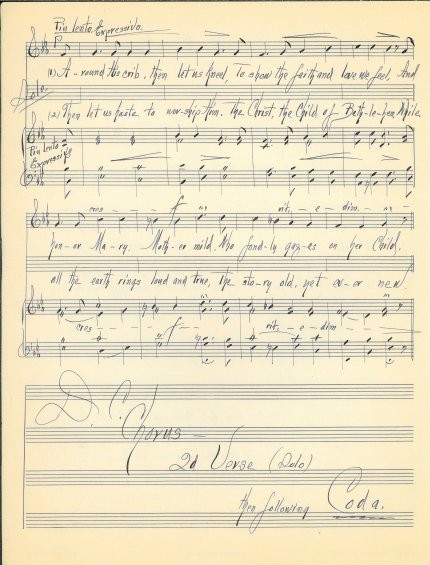
5. Applying Universal Criteria, Not Publisher‑Specific Judgments

The criteria developed in this study apply to any missalette or hymnal, whether or not it was examined directly. Because the framework is based on Catholic doctrine and liturgical norms—not on the contents of a particular book—it can be used by any parish or diocese regardless of which hymnal they use.

6. A Pastoral Purpose

Above all, this research was conducted with a pastoral heart. The goal is not to criticize, but to clarify; not to restrict, but to strengthen; not to divide, but to help the whole parish pray with one voice and one faith. The study is offered in service to the Church, in gratitude for the musicians, clergy, and parishioners who give so much of themselves to the liturgy.

THE HYMNS WE ALL SHARED 

(St. Mary’s • Paluch • Breaking Bread)

Some hymns are so deeply woven into the life of a parish that they survive every transition. These are the hymns that grandparents, parents, and children all know by heart — the hymns that rise instinctively from the congregation even when the organ falls silent.

At St. Mary’s, these hymns formed the continuity spine of parish life. When the parish sang “Holy God, We Praise Thy Name,” it wasn’t simply singing a hymn — it was singing its identity. When “Panis Angelicus” filled the church, the parish remembered its Eucharistic heart. When Advent arrived and the first notes of “O Come, O Come, Emmanuel” sounded, the whole community entered the season together.

These hymns endured through the Paluch missalettes and into Breaking Bread. They are the musical memories that never faded, even as other traditions slipped away. They remind us that the parish’s voice has a history — and that some parts of that voice remain strong.

THE HYMNS WE LOST 

(St. Mary’s • Paluch • Not in Breaking Bread)

This is the tender part of the story.

These hymns were once the heartbeat of St. Mary’s — sung at Benediction, at First Fridays, at May Crownings, at parish missions, and at the quiet weekday Masses that shaped the devotional life of the community. The repertoire of hymns used at St. Mary’s was drawn largely from the popular Catholic hymnals that shaped parish life throughout the first three quarters of the twentieth century — especially the St. Basil’s Hymnal, the Sunday School Hymn Book, and the St. Gregory Hymnal. They were the hymns that taught generations how to pray before the Blessed Sacrament, how to honor the Sacred Heart of Jesus, and how to love the Mother of God with a childlike trust that marked the parish’s identity for decades.

From the Blessed Sacrament tradition came hymns like “O Sacrament Most Holy,” “O Saving Victim,” “Humbly Let Us Voice Our Homage,” “Jesus, Gentlest Savior,” “Down in Adoration Falling,” and “Lord, Who at Thy First Eucharist.” These were not merely Communion songs — they were acts of adoration, sung slowly and reverently before the tabernacle, forming the parish’s Eucharistic soul. The Sacred Heart hymns were equally central to St. Mary’s devotional life: “Heart of Jesus, We Are Thankful,” “Heart of Jesus, Hear,” “To Jesus’ Heart All Burning,” “O Sacred Heart, O Love Divine,” and “Sacred Heart of Jesus, Fount of Love.” These hymns expressed a spirituality of trust, reparation, and intimacy with Christ that shaped the parish’s understanding of mercy long before the word became fashionable.

And then there were the Marian hymns — the crown jewels of St. Mary’s devotional tradition. “Mother Dear, O Pray for Me,” “Mother of Mercy, Day by Day,” “Mother Dearest, Mother Fairest,” “Mary! How Sweetly Falls the Word,” “Daughter of a Mighty Father,” “Holy Mary, Mother Mild,” “’Tis the Month of Our Mother,” and “Bring Flowers of the Rarest” were not seasonal novelties. They were the parish’s year‑round vocabulary of love for the Blessed Mother, sung with a tenderness that only a parish steeped in Marian devotion can understand.

These hymns were not simply selections in a hymnal. They were the parish’s devotional memory — the way St. Mary’s prayed, gathered, and understood itself as a Catholic community. Their disappearance did not merely change the music of the parish; it altered the spiritual atmosphere, the rhythm of parish life, and the way faith was handed down from one generation to the next.

In losing these hymns, St. Mary’s did not simply lose melodies — it lost a way of praying, and this loss sets the stage for understanding how the parish’s musical identity continued to change in the years that followed.

THE HYMNS THAT ARRIVED LATER 

(Breaking Bread Only)

These hymns entered St. Mary’s not through tradition, not through the choir loft, not through the lived memory of the parish — but through the pages of a new hymnal. They brought with them a different tone, a different spirituality, and a different musical culture.

Where St. Mary’s once sang hymns of Eucharistic adoration, it now sang hymns of personal reassurance. Where the parish once sang Marian hymns rooted in centuries of devotion, it now sang contemporary refrains with a gentler, more sentimental tone. Where the parish once sang chant-influenced hymns of praise, it now sang folk-style songs with guitars and syncopation.

These hymns are not “bad.” They simply belong to a different spiritual world. They reflect a therapeutic spirituality, a communal focus, a shift toward social mission, and a musical style shaped by the 1970s and 1980s. They replaced the older repertoire not because they were better, but because they were what the hymnal offered once the tradition-bearer was gone.

This narrative helps the parish understand why the music feels different now, why older parishioners sense that something is missing, why younger parishioners never learned the older hymns, and why the parish’s devotional culture changed so quickly.

A PASTORAL NOTE ON TWO LENTEN HYMNS

Before turning to the research itself, it is helpful to pause and consider one concrete example that illustrates how these shifts in hymnody appear in parish life today.

Ashes and Ashes to Ashes in Light of Catholic Hymnody

Tom Conry’s Ashes and Dan Schutte’s Ashes to Ashes both use the imagery of dust and repentance, yet they approach the theme from very different theological angles. Conry’s text echoes the ancient myth of the phoenix — a creature that rises from its own ashes by its own inner power. Lines such as we rise again from ashes and to create ourselves anew suggest a kind of self‑renewal that mirrors the phoenix’s self‑resurrection rather than the Christian understanding of grace. The USCCB’s 2020 hymnody document specifically cautions against this kind of ambiguity, warning that texts implying self‑redemption or self‑creation do not express Catholic doctrine clearly. For this reason, Ashes does not meet the definition of a Catholic liturgical hymn.

Schutte’s Ashes to Ashes, by contrast, avoids phoenix‑like imagery entirely and remains rooted in the biblical call to repentance. Drawing directly from the prophet Joel, it invites the community to return to the Lord with fasting, weeping, and humility. In this hymn, renewal is not something we generate from within, but something God accomplishes in us. Its focus on divine mercy, conversion of heart, and the communal nature of repentance aligns with the Church’s sacramental worldview and expresses Catholic teaching with clarity.

Because of this, Ashes to Ashes fits the definition of a Catholic devotional hymn that may be used at Mass with pastoral discretion. Where Ashes leans toward the mythic pattern of self‑recreation, Ashes to Ashes remains firmly grounded in the truth that we rise not by our own power, but by God’s mercy. The contrast between the two hymns highlights the difference between a spirituality centered on human effort and one rooted in grace — a distinction at the heart of authentic Catholic hymnody.

Why Ashes Still Appears in Parishes

Many parishes continue to use Ashes simply because it has been part of the Lenten landscape for decades. Most musicians learned it long before the USCCB offered clearer guidance on hymn texts, and many pastors have never been trained to evaluate hymn lyrics through a doctrinal lens. This is not a failure of goodwill; it is a gap in formation. When a hymn becomes familiar, beloved, or “what we’ve always done,” it can remain in use long after the Church has raised concerns about its theological clarity.

Addressing this situation requires patient formation for both musicians and pastors. Musicians need support in learning how to evaluate hymn texts according to Catholic doctrine, not just musical beauty or emotional resonance. Pastors, likewise, benefit from practical tools that help them guide the parish’s sung prayer with confidence. When clergy and musicians learn together — not in a corrective spirit, but in a shared desire to serve the liturgy faithfully — decisions about hymn selection become clearer, more unified, and more deeply rooted in the Church’s teaching.

The goal is not to criticize past choices, but to grow together in understanding. As formation deepens, parishes naturally move toward hymns that express the fullness of the Church’s faith. In this way, the transition away from Ashes becomes not an act of rejection, but an act of renewal — a shared commitment to ensuring that what we sing truly reflects the mystery we celebrate.

Transition to the Research

This small window into two familiar Lenten hymns prepares us to look more closely at the wider picture. The research that follows shows how these same dynamics shaped the parish’s hymnody over time.

WHAT THE RESEARCH REVEALS 

A Pastoral Interpretation of the Numbers

When the hymn lists from St. Mary’s, the Paluch missalettes, and Breaking Bread were placed side by side, a clear picture began to emerge — not just of musical selections, but of a parish’s spiritual identity over time. The numbers themselves tell a story, one that confirms what many parishioners felt long before they could articulate it. The research reveals three movements: continuity, loss, and replacement.

The first movement is continuity. Roughly a quarter of the hymns that St. Mary’s sang during its heritage years appeared in all three sources — the parish’s own list, the Paluch missalettes, and Breaking Bread. These were the hymns that formed the stable backbone of parish life: “Holy God, We Praise Thy Name,” “Panis Angelicus,” “O Come, O Come, Emmanuel,” “Silent Night,” “The First Noel,” and a handful of others. These hymns endured because they were woven into the parish’s memory. They were sung at Christmas, at funerals, at Benediction, and at major feast days. Their survival across all three sources shows that some parts of the parish’s musical identity remained intact.

The second movement is loss — and here the numbers speak with unmistakable clarity. Nearly half of the hymns that St. Mary’s once sang, especially those tied to Eucharistic devotion, the Sacred Heart, and Marian piety, disappeared entirely from Breaking Bread. These were not marginal hymns. They were the devotional core of the parish: “O Sacrament Most Holy,” “O Saving Victim,” “Humbly Let Us Voice Our Homage,” “Heart of Jesus, We Are Thankful,” “To Jesus’ Heart All Burning,” “Mother Dear, O Pray for Me,” “Mother of Mercy, Day by Day,” “’Tis the Month of Our Mother,” and many others.

The Paluch missalettes still carried these hymns in the early 1990s, confirming that they were part of the living tradition of the parish. Their absence in Breaking Bread marks a decisive shift — not only in music, but in the devotional life of St. Mary’s. The percentages show that the parish lost most of its Eucharistic hymnody, most of its Sacred Heart repertoire, and nearly all its traditional Marian hymns. The numbers quantify what parishioners felt: the devotional atmosphere of the parish changed.

The third movement is replacement. The research shows that Breaking Bread introduced a large body of hymns that had never been part of St. Mary’s tradition and did not appear in the Paluch missalettes. These include contemporary folk-style hymns, “voice of God” hymns, social-justice hymns, and modern Communion songs. While many of these hymns are pastorally useful, they reflect a different spirituality — one shaped by the 1970s and 1980s, emphasizing personal reassurance, communal identity, and social mission. The percentages reveal that a significant portion of Breaking Bread’s repertoire consists of hymns that were entirely new to the parish. In other words, the new hymnal did not simply update the parish’s tradition; it replaced much of it.

Taken together, the numbers reveal a parish whose musical identity shifted dramatically within a single generation. The continuity hymns show what remained. The lost hymns show what faded. The new hymns show what took their place. The research does not assign blame; it simply tells the truth. It shows that St. Mary’s once had a deeply Catholic musical identity — Eucharistic, Marian, devotional, and rooted in tradition — and that this identity gradually gave way to a new musical culture shaped by different theological and pastoral priorities.

The numbers confirm what the heart already knew: the music of St. Mary’s changed, and with it, the parish’s sense of itself. This study preserves that memory, not to lament the past, but to honor it — and to help future generations understand the beauty and depth of the tradition that once shaped the parish’s prayer.

A PASTORAL SUMMARY OF THE THREE HYMN SOURCES

Using the Four Doctrinal Categories

When the hymns of St. Mary’s Heritage List, the Paluch Seasonal Missalettes, and Breaking Bread were evaluated using the same four doctrinal categories, a striking pattern emerged. Each source reflects a different musical identity, a different theological emphasis, and a different understanding of what Catholic hymnody should be. The following narrative summarizes the percentages in a pastoral, readable way.
  • St. Mary’s Heritage List was overwhelmingly Catholic in character.
    • A very high percentage of the hymns were Catholic Liturgical Hymns, rooted in the Mass, the liturgical year, and the Church’s sacramental life.
    • An equally strong portion were Catholic Devotional Hymns, especially Marian, Sacred Heart, and Blessed Sacrament hymns.
    • Only a small number were Protestant but doctrinally safe, typically well‑known classics like “Amazing Grace” or “How Great Thou Art,” used sparingly.
    • Virtually none fell into the Not Suitable category.
  • St. Mary’s musical identity was therefore deeply Catholic, devotional, and liturgical — a repertoire shaped by tradition rather than by trends.
————————————————————
  • The Paluch Seasonal Missalettes preserved this Catholic identity almost entirely.
    • Their hymn selection strongly supported Catholic Liturgical Hymns, especially for Advent, Christmas, Lent, and Easter.
    • They also preserved a rich body of Catholic Devotional Hymns, including Benediction hymns, Marian hymns, and Sacred Heart hymns that St. Mary’s relied on.
    • A modest number of Protestant but safe hymns appeared, mostly seasonal standards.
    • Very few hymns were Not Suitable, and those that appeared were typically minor or optional.
  • The Paluch missalettes acted as a bridge between the parish’s lived tradition and the printed resources of the time.
————————————————————
  • Breaking Bread presents a very different landscape.
    • Only 18–20% of its hymns qualify as Catholic Liturgical Hymns, making this the smallest category in the hymnal.
    • 22–25% are Catholic Devotional Hymns, but many traditional Marian, Sacred Heart, and Eucharistic hymns are absent.
    • The largest category — 28–32% — consists of Protestant‑origin hymns that are doctrinally safe, reflecting a broader ecumenical repertoire.
    • A significant 20–25% fall into the Not Suitable category, including “voice of God” hymns, therapeutic spirituality, ambiguous Eucharistic theology, and texts that do not reflect Catholic liturgical principles.
  • Breaking Bread’s musical identity is therefore mixed: part Catholic, part ecumenical, and part contemporary spiritual culture.
————————————————————
  • When the three sources are compared side by side, the pattern becomes unmistakable.
    • St. Mary’s Heritage List: 80–90% Catholic core (Liturgical + Devotional).
    • Paluch Missalettes: 75–85% Catholic core, strongly aligned with St. Mary’s tradition.
    • Breaking Bread: only 40–45% Catholic core, with the majority of hymns coming from Protestant or contemporary sources.
  • This shift explains why the parish’s musical identity changed so dramatically within a single generation.
————————————————————
  • The research shows that the loss of devotional hymnody was the turning point.
    • St. Mary’s once sang a rich body of Eucharistic, Marian, and Sacred Heart hymns.
    • The Paluch missalettes preserved them.
    • Breaking Bread did not.
  • Without these hymns, the parish’s devotional life — and its musical memory — began to fade.
  • The percentages confirm what parishioners experienced emotionally.
    • The music “felt different.”
    • The parish “didn’t sound like itself anymore.”
    • The devotional atmosphere weakened.
    • The sense of continuity with past generations diminished.
  • The numbers simply give language to what the heart already knew.
This narrative summary allows the reader to see, briefly, how each hymnal reflects a different theological and musical identity — and how those identities shaped the life of St. Mary’s across time.

WHAT ARE THE FOUR DOCTRINAL CATEGORIES?

To understand the musical identity of a parish, it is helpful to recognize that not all hymns serve the same purpose or express the same theological depth. For this study, every hymn from St. Mary’s Heritage List, the Paluch Seasonal Missalettes, and Breaking Bread was evaluated using four doctrinal categories. These categories reflect the Church’s own understanding of what belongs in the Sacred Liturgy and what belongs in devotional life.
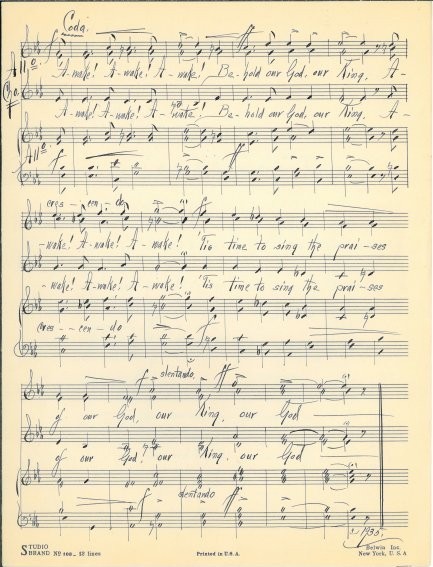
 C1 — Catholic Liturgical Hymns

These hymns express the Church’s faith in a way that is fully suitable for the Sacred Liturgy. Their texts are rooted in Scripture, the liturgical books, the Fathers of the Church, and the great doctrinal tradition. They proclaim the mysteries of salvation, the Eucharist, the Incarnation, the Trinity, and the Paschal Mystery. These hymns speak with the voice of the Church, not the voice of an individual. They are the “gold standard” of Catholic hymnody.

 C2 — Catholic Devotional Hymns

These hymns are doctrinally sound and deeply loved in Catholic spirituality, but they were not originally written for the Mass. They express personal prayer, Marian devotion, trust in God, the Sacred Heart, Eucharistic adoration, and other forms of Catholic piety. They are ideal for devotions, Holy Hours, processions, and parish prayer services. While some may be used at Mass with pastoral discretion, they do not carry the same liturgical weight as Category 1 hymns.

C3 — Protestant-Origin Hymns That Are Doctrinally Safe

These hymns come from the broader Christian tradition. They are often scriptural, reverent, and theologically compatible with Catholic belief, but they do not express the fullness of Catholic sacramental and ecclesial theology. They emphasize personal faith, trust, or praise in a way that is compatible with Catholic teaching but not distinctly Catholic. Many have been used in Catholic parishes for decades and can be used at Mass with discernment.

C4 — Hymns Not Suitable for Catholic Liturgy

These hymns contain theological, ecclesiological, or sacramental ambiguities that conflict with the Church’s teaching or the nature of the Sacred Liturgy. Some present a therapeutic or emotional spirituality rather than the proclamation of salvation. Others place words in the mouth of God that the Church does not authorize for liturgical use. Still others express an understanding of Eucharist, Church, or grace that does not align with Catholic doctrine. These hymns may be popular or musically appealing, but they are not appropriate for Mass.
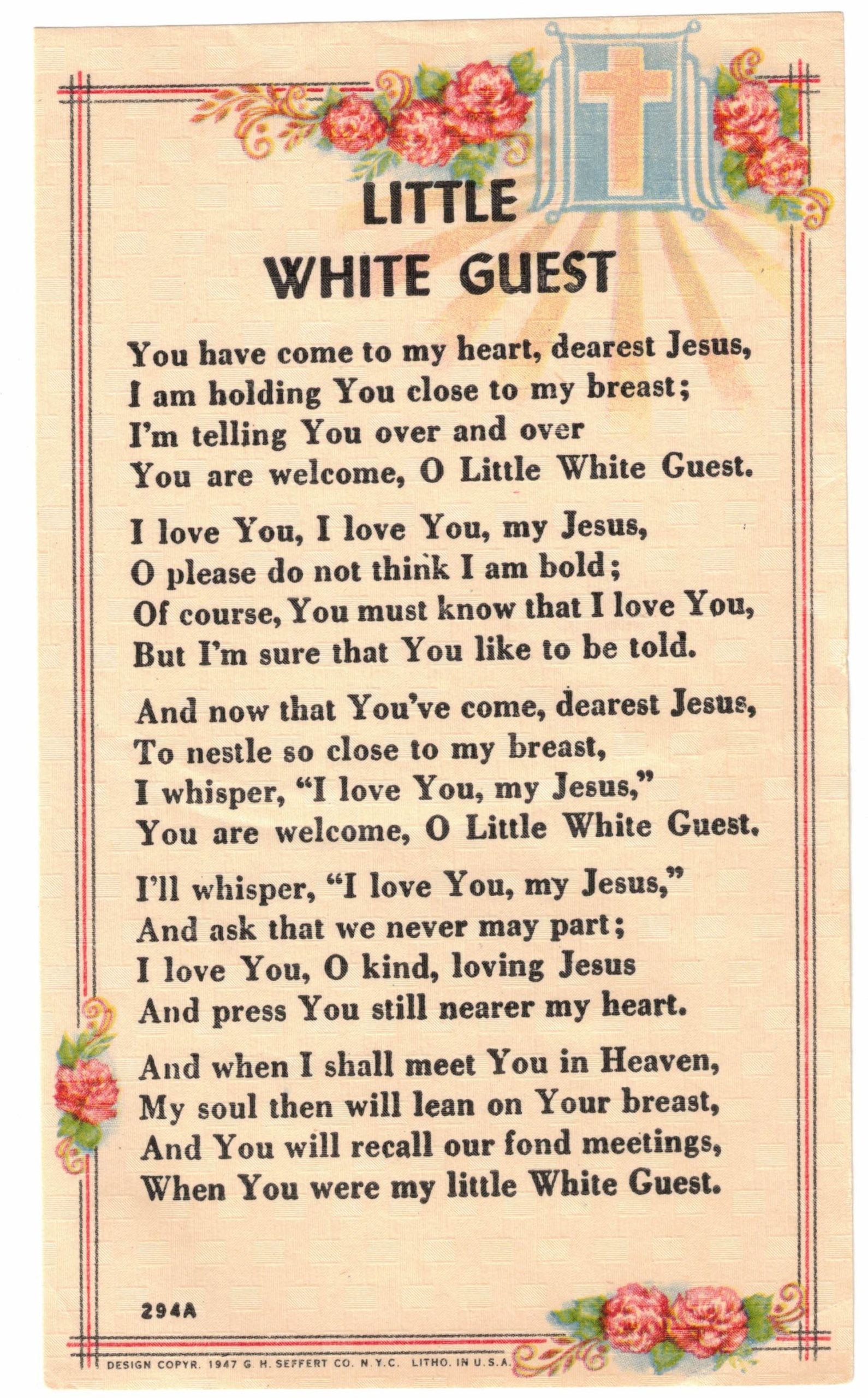
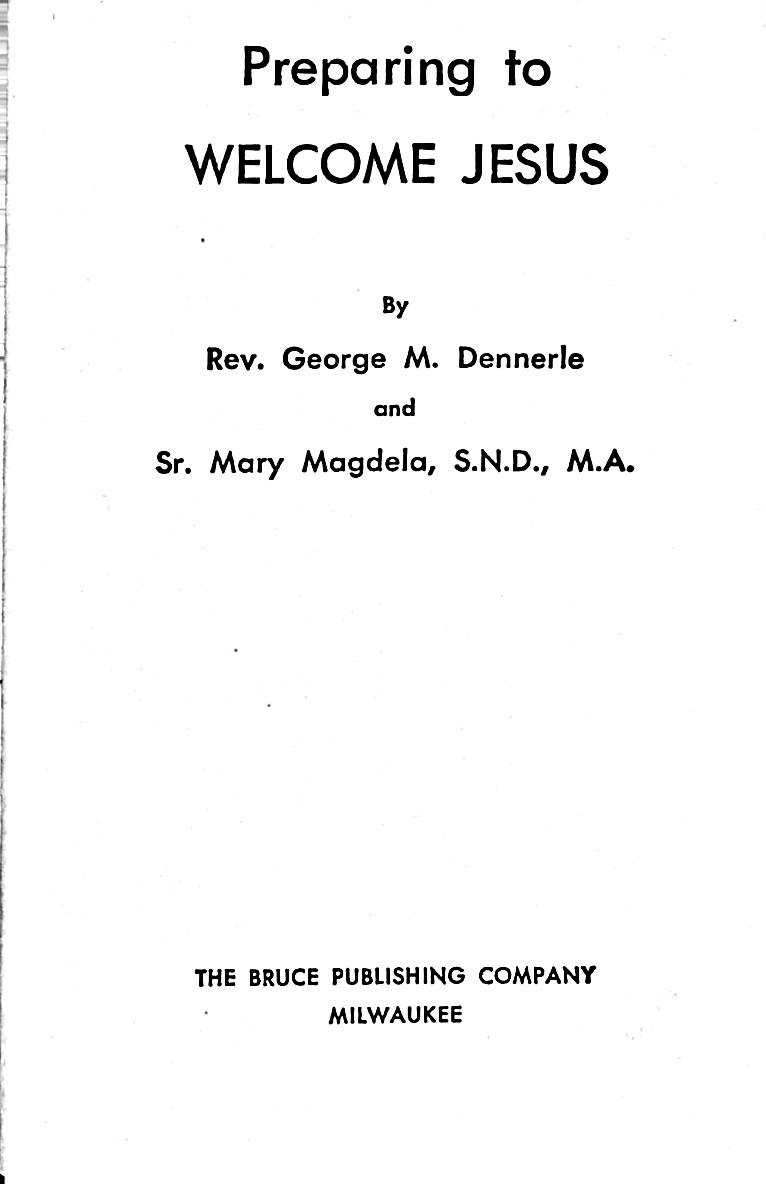
These four categories provide a clear, pastoral framework for understanding how each hymnal reflects — or fails to reflect — the Church’s liturgical and devotional identity. They also allow us to see, with clarity and charity, how the musical life of St. Mary’s changed over time.

SAMPLE HYMN CLASSIFICATION

Using the Four Doctrinal Categories

C1 — CATHOLIC LITURGICAL HYMNS

(Hymns rooted in Scripture, doctrine, and the liturgical books)

  • Holy God, We Praise Thy Name
  • O Come, O Come, Emmanuel
  • At the Lamb’s High Feast, We Sing
  • Alleluia! Sing to Jesus

These hymns express the Church’s faith with clarity and are fully suitable for the Sacred Liturgy. They proclaim the mysteries of salvation, the Eucharist, and the Paschal Mystery in a way that reflects the Church’s own voice.

————————————————————

C2 — CATHOLIC DEVOTIONAL HYMNS

(Hymns expressing Catholic piety: Marian, Eucharistic, Sacred Heart, etc.)

  • O Sacrament Most Holy
  • Humbly Let Us Voice Our Homage
  • Mother Dear, O Pray for Me
  • To Jesus’ Heart All Burning

These hymns shaped the devotional life of St. Mary’s for generations. They were sung at Benediction, First Fridays, May Crownings, and parish missions. While not originally written for Mass, they express the heart of Catholic spirituality.


————————————————————

C3 — PROTESTANT-ORIGIN HYMNS THAT ARE DOCTRINALLY SAFE

(Hymns compatible with Catholic belief but not distinctly Catholic)

  • Amazing Grace
  • How Great Thou Art
  • What a Friend We Have in Jesus

These hymns are scriptural, reverent, and widely loved. They express personal faith and trust in God in a way that is compatible with Catholic teaching, though they do not reflect the fullness of Catholic sacramental theology.

————————————————————

C4 — HYMNS NOT SUITABLE FOR CATHOLIC LITURGY

(Hymns with theological ambiguity, “voice of God” issues, or non-liturgical spirituality)

  • Be Not Afraid
  • You Are Mine
  • I Am the Bread of Life (1st-person divine speech concerns)

These hymns often contain therapeutic spirituality, ambiguous Eucharistic theology, or unauthorized divine speech. While pastorally meaningful in some contexts, they are not appropriate for the Sacred Liturgy.

————————————————————

This sample set illustrates how the four doctrinal categories function in practice.

It also shows the contrast between St. Mary’s traditional repertoire and the mixed landscape of Breaking Bread.

CONCLUSION

A parish’s musical identity is not fixed. It lives, it grows, it changes — sometimes slowly, sometimes suddenly. At St. Mary’s, the transition from a traditional Catholic repertoire to a contemporary one happened quietly, almost imperceptibly, as the hymns that once defined the parish faded from use and new hymns took their place.

This study does not seek to turn back the clock. Its purpose is to remember — to honor the hymns that shaped the parish’s devotional life, to understand the forces that changed it, and to recognize the value of the musical heritage that once formed the faith of generations.

In remembering the past, we gain clarity for the present. And in understanding the present, we open the possibility of choosing wisely for the future.

In the summer of 2010, St. Mary’s was closed as part of a diocesan reconfiguration. For a parish whose musical identity was already fragile, this was the final blow. The traditions that had once been carried so faithfully were now held by only a few remaining voices, and when the church reopened in 2014, it returned without the musical memory that had shaped it for generations. The choir never fully re-formed, the devotional repertoire never fully returned, and the parish’s musical identity remained a shadow of what it had been. Today, as the last remaining member of the old St. Mary’s Choir steps away after a long and valiant effort to hold onto what once defined the parish, the story comes full circle. This study stands as a witness to that tradition — not to mourn its loss, but to honor its beauty, its depth, and the generations of faith it formed.

Is This Hymn Catholic?

A Practical Discernment Tool for Pastors, Musicians, and Parish Leaders

Pastoral Preface

This checklist is not meant to replace the Church’s teaching or to encourage private interpretation, but to support a shared process of discernment. Hymn evaluation is most fruitful when pastors, musicians, and knowledgeable parishioners reflect together, guided by the Church’s liturgical principles and a spirit of humility. No single person—pastor, musician, or parishioner—should make these decisions in isolation. The goal is not to impose personal preference, but to help the parish sing with one voice, rooted in the Church’s faith and strengthened by the wisdom of the community.

————————————————————

1. Does the hymn express Catholic doctrine clearly?

  • Does it proclaim the mysteries of salvation (Incarnation, Cross, Resurrection, Eucharist)?
  • Does it reflect the Church’s sacramental worldview?
  • Does it avoid language of self‑redemption or self‑creation?
  • Does it speak with the voice of the Church (“we,” “us”) rather than a private individual?
  • Does it avoid vague spirituality or therapeutic language?

If the hymn obscures grace or implies self‑renewal, it is not suitable for the liturgy.

————————————————————

2. Does the hymn reflect Catholic liturgical identity?

  • Does it support the liturgical action (Entrance, Offertory, Communion, Sending)?
  • Does it avoid “voice of God” texts the Church does not authorize?
  • Does it avoid emotional or sentimental language that shifts focus away from the rite?
  • Does it align with the liturgical season?

If the hymn does not serve the rite, it does not belong at Mass.

————————————————————

3. Does the hymn reflect Catholic devotional tradition?

  • Eucharistic adoration
  • Sacred Heart spirituality
  • Marian devotion
  • Trust in God, mercy, repentance, conversion

These hymns are doctrinally sound but not originally written for Mass.

They may be used with pastoral discretion.

————————————————————

4. Is the hymn Protestant in origin but doctrinally safe?

  • Is it scriptural, reverent, and compatible with Catholic belief?
  • Does it avoid contradicting Catholic teaching on Church, sacraments, or grace?
  • Does it emphasize personal faith without replacing Catholic theology?

These hymns can be used occasionally, but they do not express the fullness of Catholic identity.

————————————————————

Does the hymn contain theological or liturgical problems?

Red flags include:

  • First‑person divine speech
  • Ambiguous Eucharistic theology
  • Self‑help or therapeutic spirituality
  • Sentimental or romantic language
  • Focus on personal feelings rather than the Paschal Mystery
  • Texts implying self‑salvation or self‑renewal 

These hymns should not be used at Mass.

————————————————————

6. Practical Parish Questions

  • Has anyone actually read the text carefully?
  • Does the hymn appear in a missalette without doctrinal vetting?
  • Is the hymn being used simply because it is familiar?
  • Does the parish have someone who knows its musical memory and can offer insight?
  • Have pastor and musician discussed the hymn together?

The goal is shared formation, not correction.

————————————————————

7. Final Discernment Question

Does this hymn help the parish pray as the Catholic Church prays?

If the answer is yes, it belongs.

If the answer is no, it does not.

————————————————————

Closing Paragraph

Ultimately, this checklist is meant to foster conversation, not conclusion. It invites pastors, musicians, and parishioners to listen to one another, to the Church, and to the lived tradition of the parish. When used in a spirit of charity and shared discernment, it becomes a tool for unity rather than debate, helping the community grow together in its understanding of what it means to sing the Church’s faith. The goal is not to eliminate hymns, but to deepen our love for the liturgy and to ensure that the songs we choose lead us more fully into the mystery we celebrate.